
Last updated: October 31, 2026 · Reviewed by export engineering
The importer placing a smart lock on the market carries the legal responsibility for compliance, not the factory that built it. The factory supplies evidence: test reports, declarations, scope statements and the technical file behind them. That division matters because a buyer who treats a supplier document as a guarantee discovers the gap at customs, at an insurance review, or after a fire door fails an inspection. This page maps what each market asks for, what each document covers, and what nobody can sign on your behalf.
Read the page in that order. Market first, because the same lock needs different paper in Brussels and in Riyadh. Document second, because a certificate with a familiar logo may cover a quality system rather than a product. Signature third, because the declaration that goes into a customs file has to be issued by someone with a legal presence in the market, and that someone is usually you. The short version of the rule that governs this page: the certificate belongs to the model, not the factory; the model document pack states what is held.
Markets
Market requirement matrix: what each destination usually asks for
The table below is a starting map for an RFQ, not a legal opinion. Each row assumes a battery-powered electronic lock with a 13.56 MHz card reader and no mains connection; a lock with a keypad only, a lock with a 4G radio, or a lock that opens a glass door sits in a different category and may need a different set of documents. Confirm the applicable scope with your own compliance adviser before the order is placed.
| Market | Commonly requested evidence | Who issues it | Who files it |
|---|---|---|---|
| European Union | CE marking with the EMC directive 2014/30/EU evidence (EN 55032 and EN 55035), safety evidence under 2014/35/EU or under the radio equipment directive 2014/53/EU where the reader is treated as radio equipment, RoHS 2011/65/EU evidence, and an EU declaration of conformity naming the model | An accredited or notified laboratory for the test reports; the manufacturer for the declaration of conformity and the technical file | The manufacturer signs the declaration; the importer keeps a copy of the declaration and the technical file available to market surveillance for 10 years |
| United States | FCC Part 15 evidence for unintentional radiators, a supplier declaration of conformity, and UL or ETL listing for fire-door hardware where the assembly requires a listed component | An FCC-recognised test laboratory for the EMC report; a national recognised testing laboratory such as UL or Intertek for a listing | The US importer or another US-based responsible party signs the supplier declaration; the listing is held by whoever holds the follow-up service agreement |
| United Kingdom | UKCA marking with designated standards evidence, a UK declaration of conformity naming the model, and the same EMC and safety report set as the EU route | An accredited laboratory for the reports; the manufacturer for the UK declaration | The UK importer or the authorised representative keeps the declaration and supporting file for 10 years and produces it on request |
| Middle East | SASO product conformity through SABER for Saudi Arabia, G-mark evidence for the Gulf states where the low-voltage and EMC scheme applies, and a shipment certificate where the destination requires one per consignment | An approved conformity body or its appointed laboratory; the scheme body issues the certificate | The importer of record or the local representative files on the national platform, and the shipment certificate is raised per consignment |
| Southeast Asia | National schemes such as SIRIM in Malaysia, TISI in Thailand or SNI registration in Indonesia where applicable, usually with an EMC report accepted across the region | The national standards body or a laboratory it appoints | The importer of record, or a local agent appointed by the buyer |
| China domestic | CCC certification where the product falls inside the catalogue, plus testing against the applicable GB standards | A CNCA-appointed certification body and its laboratories | The domestic manufacturer or the entity importing into China |
Three notes change how the table is read. First, applicability depends on the product and on the door assembly it goes into: a fire-rated leaf brings the hardware listing question, an exterior gate brings the ingress protection question, and a 4G lock brings a radio question that a card lock never faces. Second, a row describes what buyers typically request rather than what every shipment must carry; the customs broker and the importer's compliance adviser decide the final set. Third, the same physical lock can need two document sets for two markets, and neither set can be substituted for the other. The document centre that assembles those sets per tender is at compliance documents, and the model families each set is written for are listed at products.
Scope
What each certificate covers, and what it does not
Most disputes about certificates are disputes about scope, and scope is written on the document in a paragraph that buyers tend to skip. The table translates that paragraph into two plain columns.
| Document | Covers | Does not cover |
|---|---|---|
| Model test report | The exact model and sample submitted, for example a hotel card lock of 306 mm x 75 mm x 15 mm such as SLK-2020, the clauses tested and the measured results | A different model number, a different finish, a different reader option, or the door the lock is later fitted to |
| Declaration of conformity | The manufacturer's signed statement that the named model meets the named directives, with the standards and the reports it relies on listed as references | Independent test evidence. The declaration is a statement about reports, not a report, and it binds only the entity that signs it |
| System certificate, ISO 9001 | The quality management system at the audited site, and the scope wording printed on the certificate itself | Any individual lock model, any product performance figure, any market approval, and any site not named in the scope |
| Fire-door assembly report | The complete assembly as tested: leaf, frame, hinges, latch or lock, closer and any coordinating devices, in one tested configuration | A substitute hinge, closer, lock or door core. Hardware outside the tested configuration is not covered by the report, even when it looks equivalent |
| EMC report | Emissions and immunity of the electronic lock at the stated test setup, against the named standard and its edition, at conditions such as 40 C and 93% RH where the standard specifies them | Mechanical strength, battery life, ingress protection or any fire performance; those sit in different reports |
| Ingress protection report | The enclosure of the tested sample at the stated IP level under IEC 60529, with the test duration and the condition of the sample recorded | The electronics inside the enclosure, long-term weathering beyond the test duration, and any model built with a different housing |
Two rows cause most of the surprise in a tender review. The ISO 9001 row is the first: a factory certificate describes how a site manages quality, and a tender panel that accepts it as a product approval has accepted nothing about the lock in the box. The model test report row is the second: a report is tied to a model number and a sample, so a private-label run that changes the housing or the reader position starts a new scope question rather than inheriting the old report. Both points are handled in the branding discussion at private label and in the development tiers at OEM and ODM.
The document set is written per model, not per factory
Every model record carries its own document list: the test reports that cover it, the declaration that names it, and the scope wording that tells you what the paperwork does not cover. This is why a private-label run that changes the housing starts a new scope question rather than inheriting the old report.
- Reports are indexed by model number, with the sample described
- The declaration names the model and lists the reports it relies on
- Scope limits are stated on the document, not left to be discovered
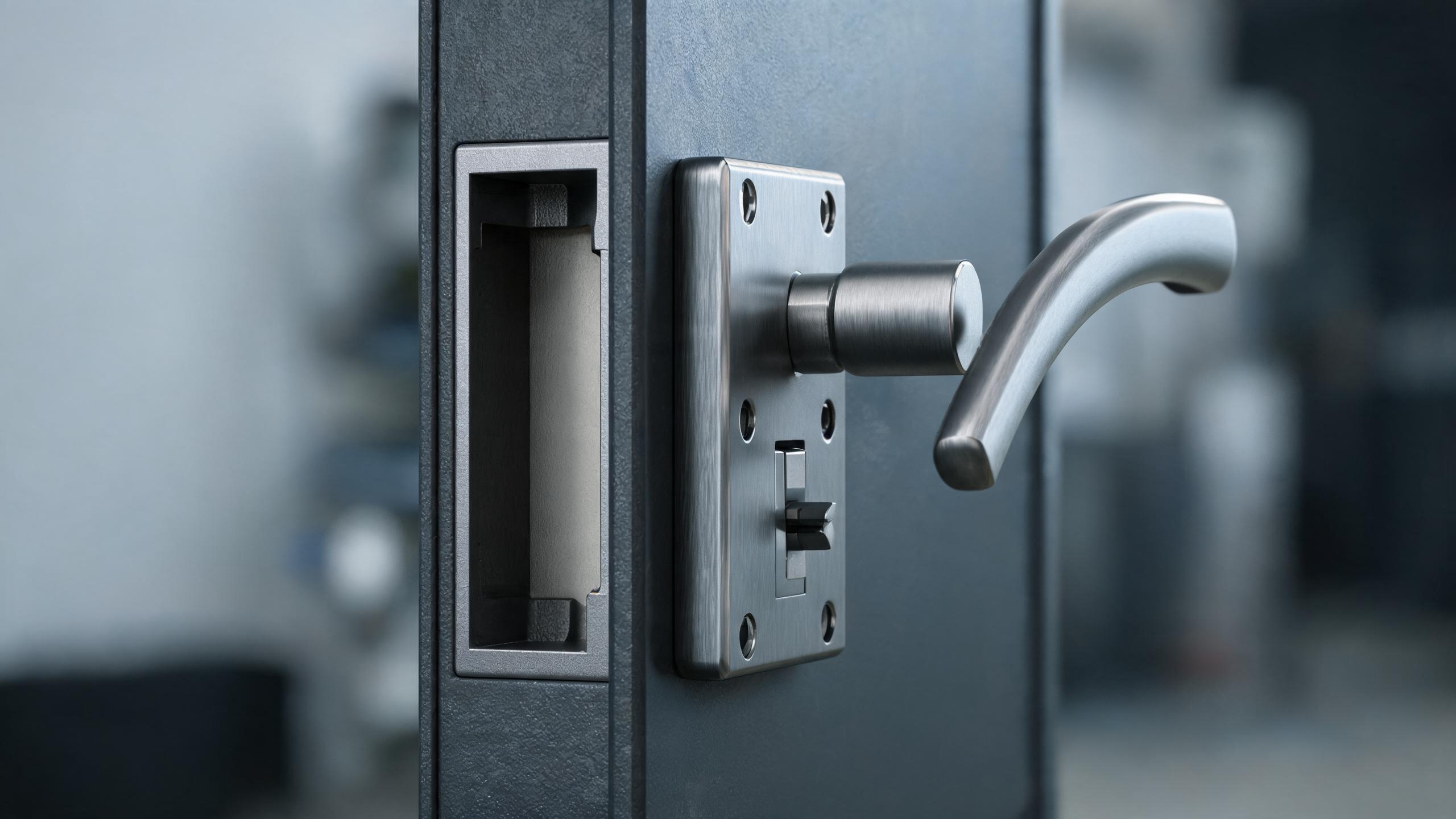 Model reportsA report belongs to a model number and a sample. A different housing is a different scope question.
Fire doors
Fire doors: the lock is one component of a tested assembly
A fire door is not a door with a lock on it. It is an assembly that was tested as a set, and the report names every part of that set. The leaf, the frame, the hinges, the latch or lock, the closer and any coordinating device are tested together, and the rating belongs to the combination rather than to the lock alone. This is the single most common source of failed inspections on a completed project, because the lock was specified correctly and the closer was changed on site.
| Standard | Region | Rating steps commonly tested | What the test treats as one assembly |
|---|---|---|---|
| UL 10C | United States and Canada | 20, 45, 60 and 90 minutes | Leaf, frame, hinges, latch or lock, closer and coordinating devices, mounted and tested as installed |
| NFPA 80 | United States | Assemblies rated from 20 minutes upward, including 3-hour rated doors | The installed configuration and its maintenance rules, including what may be substituted without a new evaluation |
| EN 1634-1 | Europe and the United Kingdom | 15, 30, 45, 60, 90 and 120 minutes | Leaf, frame, hardware, seals and closer, tested in the direction of escape and in both directions where required |
| EN 12209 and EN 14846 | Europe | Cycle and performance grades, not a fire rating | The lock as a mechanical or electromechanical component, outside the fire test itself |
The practical consequence for a buyer is that the door schedule drives the lock specification, not the other way round. Where a schedule carries fire-rated leaves, the lock has to match the hardware set in the tested configuration, and the report has to be checked for the model, the handing, the latch type and the closing sequence. Replacing hardware can void the assembly rating unless the replacement matches the tested configuration, and a project that swaps a closer to meet a delivery date can lose the rating for the whole opening. Interior leaves in normal service usually run between 38 mm and 55 mm in thickness, which is why the survey records each leaf separately instead of trusting a drawing. The manufacturing side of that fit is described at manufacturing, and the tests a buyer can watch before shipment are described at the testing laboratory.
Request
How to request a document pack for a model
- Send the model codes and the destination marketInclude the market, the door type, whether the leaf is fire rated, and the reader option you intend to order. A pack requested for "a hotel lock" comes back generic; a pack requested for a model code and a market comes back specific.
- Receive the document list for that modelA written list of what exists and what does not exist for each code: reports, declarations, listing status where relevant, and the standard editions involved. The list is the point of the exchange, because an absence stated early is cheaper than a tender rejected late.
- Confirm the gaps and decide what to do about themThree outcomes are normal: the gap is acceptable to your market, the gap needs a new test on a new model, or the gap points to a different model that already carries the paper. Each outcome has a different cost and a different schedule, and the choice belongs to you.
- Receive redacted samples before orderingRedacted pages for review, so scope wording can be read without exposing commercial terms. The full set travels with the order, and originals are supplied with the shipment where the market requires a paper copy.
The list is also useful in the reverse direction. A buyer preparing a tender can send the document list the tender panel expects and ask which items can be produced for the chosen model, which turns an open question into a checklist. The units that a report covers matter here too: a report covers a model, not the 500 units in a shipment, so a buyer who needs lot-level evidence should add an inspection to the order rather than expect it from the certificate.
 CE marking and the EU declaration of conformity
 UKCA marking for the Great Britain route
 FCC Part 15 evidence for unintentional radiators
 RoHS and REACH material declarations
Limits
Honest limits on what a document can do
This does not apply to every situation: no certificate transfers to a new private-label model without a scope check, no document covers a market the model was never evaluated for, and no factory document replaces the importer's own registration obligations. The three sentences below are the ones a buyer should copy into their own compliance file.
- No certificate moves to a new model on its own. A private-label change of housing, logo, reader position or firmware build is a new model in scope terms, and the existing report may or may not extend to it. The scope check is a reading of the report, not a courtesy: if the change is outside the tested description, the paper does not follow the product.
- No document covers a market the model was never evaluated for. A report issued against an EU standard says nothing about FCC Part 15, and a G-mark file says nothing about UKCA. A buyer who adds a second market after the order is placed is commissioning work, not requesting a copy.
- No factory document replaces your registration. Where the market requires an importer to register, notify, file or keep a technical file, that obligation sits with the entity placing the product on the market. The factory can supply the inputs, and it cannot sign as the importer.
- No quality system certificate is a product approval. ISO 9001 describes a process at a site. It does not say that a lock meets a lock standard, and a tender panel that treats it as product evidence has misread the document.
- No certificate is permanent. Standard editions change, directives are replaced, and a report references the edition in force when the sample was tested. A document issued before a product change describes the product before that change.
These limits are not reasons to distrust documentation. They are reasons to read the scope paragraph first and the cover page second, which is how a competent reviewer reads any certificate. None of them is unusual to this industry, and a supplier who presents a certificate as a blanket guarantee is telling you that they have not read it either. The shorter version of these limits, in question form, is at the certification FAQ.
Verification
What a buyer can verify on the document itself
Evidence check: five elements on the page decide whether a document is worth the paper it is printed on. They can be checked by a buyer in about 15 minutes, without calling the factory and without a technical background.
| Element | What to check | Why it matters |
|---|---|---|
| Issuing laboratory | The named laboratory, its accreditation number, and whether the accreditation scope covers the standard on the report | A report from a laboratory outside its accredited scope is a commercial document, not a conformity record |
| Report number and register | Whether the number follows the issuing laboratory's own format and can be traced back to that laboratory | A number that cannot be traced to an issuer is the most common feature of a copied or edited report |
| Model code and scope wording | The exact model code, the product description and the options inside scope, for example reader type, finish and battery configuration | A report that names a code you are not ordering does not cover your order, however similar the hardware looks |
| Standard edition and date | The standard number with its edition year, the test date and the report date, compared with the product's last change | A report dated before a product change describes the earlier build, and a superseded edition may no longer be accepted |
| Declaration signatory | The legal entity that signed the declaration, its address, and whether that entity is the manufacturer named in the file | A declaration signed by a trading company rather than the manufacturing entity raises a question the importer has to answer |
Keep the five checks in the same file as the door schedule and the purchase order, and re-run them at each reorder. A model that has been in the catalogue for years can still carry a report tied to a standard edition that has since been replaced, and the reorder is the moment that gap becomes visible. The document centre that holds these files for tenders is at compliance documents; the quality gates behind the sample are at quality control; the capability boundaries of the factory itself are set out at the manufacturer page; and the shipment documents that accompany a certificate are described at logistics and shipping.
FAQ
Certification questions buyers ask
Does the factory hold a certificate for my model?
Ask per model, not per factory. The certificate belongs to the model that was tested and to the laboratory that issued it, and the model document pack states what is held for that model code. If a report exists for the model you intend to order, it is supplied with the pack; if nothing exists for that model in that market, the pack says so plainly and lists what a test would involve.
Which documents does an EU importer need for a smart lock?
Typically the EMC evidence under 2014/30/EU, safety evidence under 2014/35/EU or the radio equipment directive where the reader is treated as radio equipment, RoHS evidence under 2011/65/EU, and an EU declaration of conformity naming the model. The importer keeps the declaration and the technical file available to market surveillance for 10 years. Confirming the exact set with your compliance adviser is still the buyer's step, because applicability depends on the product configuration.
Is an ISO 9001 certificate enough for a tender?
It answers a different question. ISO 9001 describes the quality management system at an audited site and the scope printed on the certificate; it does not approve a lock model, a performance figure or a market. Use it as evidence that a process is controlled, and use the model test report and declaration for the product itself.
Can a certificate be transferred to our private-label model?
Only after a scope check. A logo, a carton or a brand name usually sits outside the tested description and needs no new test; a changed housing, reader position or firmware build is a new model in scope terms. The check reads the report's product description against the change, and where the change falls outside it, new testing is the honest route rather than a borrowed report.
What does a fire-door report cover and what does it leave out?
It covers one tested assembly: leaf, frame, hinges, latch or lock, closer and any coordinating devices, in one configuration under a standard such as UL 10C, NFPA 80 or EN 1634-1. It leaves out any substitution, including an equivalent-looking closer or hinge, and it leaves out the installation, which is governed by the site's inspection regime rather than by the report.
How do we request a document pack?
Send the model codes, the destination market, the door type and whether the leaf is fire rated, then ask for the document list for those codes. The reply states what exists and what does not, and redacted sample pages follow for review before any order. The same route is used for a tender checklist, and the full file set travels with the shipment where the market requires paper.
Send the model code and the market, get the document list
Tell us the model codes you are evaluating, the destination market and whether the door is fire rated. The reply lists the documents that exist for each code and the ones that do not, so the gap is visible before the tender closes rather than after. Price, MOQ policy and lead time are confirmed in writing with the quotation.
Request the document listAsk the export desk