
Last updated: October 31, 2026 · Reviewed by export engineering
Hotel access, resolved by room count
For my room count, what exactly do I install?
One lock per guest room, one encoder per reception desk, and a written rule for every failure you can name - that is the whole system at 50 rooms or at 400.
Hotel lock projects are not decided by feature lists. They are decided by three numbers: how many guest doors, how many reception desks, and how many of those doors carry a fire label. The model, the encoder count, the card type and the spare allowance all follow from those three. This page answers the question a hotel buyer sends after the showroom visit: what arrives on the pallet, what has to be true about the door before it fits, and what the property actually does at 23:40 when a guest card will not read. Every quantity below is planning arithmetic, not a quotation; the confirmed bill of materials follows a surveyed door schedule and is issued in writing.
Quantities first
Room-count tiers: what changes between 50 and 400 rooms
Pick the tier, then the model. The arithmetic rule is identical at every scale; only the encoder count, the software scope and the spare pool move.
Arithmetic rule: 1 lock per guest room, plus 1 spare per 50 doors, plus 1 encoder per reception desk. Spares are quoted as a separate line item and are never folded into the room count by assumption. At 200 guest rooms the rule produces 200 locks, 4 spare locks and 2 encoders at 2 desks; at 50 rooms it produces 50 locks, 1 spare lock and 1 encoder.
| Rooms | Lock models that fit | Encoder quantity | Software scope | What changes at this scale |
|---|---|---|---|---|
| Under 50 rooms | SLK-2020 on guest doors; SLK-230 where the corridor door is too slim for a full escutcheon | 1 at the single reception desk | Single-desk database, staff cards grouped by floor; a PMS link is optional here | One trained person runs check-in and the night audit. The real exposure is that this same person is the only encoder operator, so one spare lock and one written card procedure matter more than software features. |
| 50-150 rooms | SLK-2020 as the standard fleet, SLK-760 on split-style doors, SLK-9936S reserved for suites | 2: arrivals desk plus a back-office or cashier station | Shift-based staff groups, audit export, PMS interface scoped per property | Group arrivals appear and one broken desk PC must not stop check-in. Plan 1-3 spares and keep the second encoder powered independently of the first. |
| 150-400 rooms | SLK-2020 primary, SLK-230 on slim corridor doors, SLK-9936S on club and suite floors | 3: arrivals, groups and cashier | Department zones, lift floor limits, audit retention, tested PMS interface | Installation moves floor by floor, so the door schedule has to be frozen before batch programming. Hold 4-8 spares on site rather than ordering them one failure at a time. |
| 400+ rooms | The same four families, separated by wing and by brand standard, with one recorded generation per wing | 4 or more: one per arrival cluster plus one backup | Multi-wing database, per-wing administrator rights, interface to the property management system | Mixed shipments become the dominant risk. Keep one firmware generation per wing and print the version on the packing list. Spare pool of 9 or more, held in the building. |
Model families are compared on RFID door locks; the encoder and card supply side is documented under hotel door locks. If the property wants its own brand on cards and packaging, that route is described on private label and OEM and ODM.
The room door is a system, not a lock
A hotel room involves a card, a lock, a PMS, a card reader at the front desk and a staff override. The design decision that matters is not the handle shape; it is how the lock reports a guest checkout to the property system.
- Card formats matched to the PMS your property already runs
- A mechanical override for the housekeeper, keyed identically across floors
- Anti-pick and anti-drill features appropriate to the door leaf you specify
Before the order
Door compatibility matrix: what has to be true on the door
A lock is sold against a door, not against a room. These ranges are what we size against during the survey; a door outside them is a different product, not a longer screw.
| Door type | Thickness range | Mortise | Model family | Watch-out |
|---|---|---|---|---|
| Timber guest room door | 38-55 mm | No. 2 hotel mortise | SLK-2020, SLK-760 | A hollow-core leaf needs blocking where the mortise sits; a 15 mm escutcheon will not hide a crushed core. Measure the leaf construction, not just the thickness. |
| Fire-rated corridor door | 44-54 mm | Mortise matched to the door listing, not to the lock catalogue | Only an assembly listed as a set | Fire-door hardware must match the door's certification, not the lock's. UL 10C and NFPA 80 are the references the door supplier works to; the model document pack states what the lock holds. |
| Steel door | 40-50 mm leaf | Steel-door mortise, or a rim solution where the leaf cannot take one | SLK-2020 where the frame member accepts a No. 2 mortise | No self-tapping screws into a honeycomb core. Confirm there is a solid frame member behind every fixing point before the first door is cut. |
| Bathroom and common door | 35-45 mm | Tubular latch where the leaf already has one; privacy function on the inside face | SLK-230 | A card reader on a bathroom door is cost without control. Match the credential to the real risk of the room. |
| Suite double door | 45-55 mm per leaf | Mortise on the active leaf only | SLK-9936S | The inactive leaf needs a flush bolt. Two readers on one suite doubles battery service and adds no control. |
Six hours of the day
Check-in timing: where the seconds actually go
The system is offline, so the timings below are the only ones a guest or a receptionist can feel.
Guest arrivesQueue at the deskThe guest reaches the counter with a name and a passport. Nothing electronic has happened yet, and nothing needs to.
Reception encodesAbout 1 second per cardThe PC-linked encoder writes a MIFARE card in roughly 1 second; a coach group of 40 takes about 1 minute at one desk.
Guest opensUnder 1 secondThe lock reads the card and releases the latch in under 1 second, and stores the event locally. No network call is made.
Checkout expiresRefused at the next readExpiry was written at encode time. The lock enforces it with its own clock, so the same card is refused on the next attempt.
Two parts of this flow are human and three are not. Reception decides the room, the dates and the card count; the encoder stamps the expiry; the lock enforces it. Because the lock runs its own clock, time correction happens at the next card write or audit read rather than continuously. That is why the survey asks for a clock check at every encoder station, and why the acceptance list below tests an expired card instead of assuming the setting works.
Operating under failure
Failure modes and fallbacks the property can run
Every row below has a same-day action and a design choice that makes the row shorter next season.
| Failure | What the property feels | Immediate action | Design prevention |
|---|---|---|---|
| Card left in the room | A guest in the corridor cannot get back in; the card is on the desk inside. | Encode a replacement at the desk in about 1 minute; record the reissue against the room. | Issue two cards for every double-occupancy booking and state the rule at check-in. |
| Lost card | An unknown holder may still open the door until the card is stopped. | Add the card serial to the blacklist, then write it to the lock at the next encoder visit; move the guest if the risk is unacceptable. | Serialised cards, a card deposit, and a written blacklist step in the night audit. The limitation is stated in the boundary block below. |
| Dead lock battery | The door will not release a valid card and the low-battery alert has already been ignored once. | Floor supervisor opens with the mechanical key override, then replaces 4 x AA cells in under 5 minutes. | Log the low-battery alert at the desk and hold one set of 4 x AA per lock as site stock. |
| Encoder unavailable | Check-in stops at that desk even though every lock is working. | Move to the second encoder, or issue pre-encoded batch cards held for exactly this case. | Two encoders above 50 rooms, on separate power, with one operator trained on each. |
| PMS down | Room assignment has to be done on paper; the front desk cannot see arrivals. | Use the paper arrival list and a pre-encoded card block; reconcile the records when the system returns. | Write the manual fallback into the front-office procedure and rehearse it once per quarter. |
| Power outage | Locks keep working because they are battery-powered; issuance stops because the encoder needs mains. | Switch the encoder desk to a UPS or a laptop, and continue with pre-encoded cards if the outage outlasts the battery. | One UPS per encoder station, sized to cover the check-in peak rather than the whole building. |
| Firmware mismatch after a mixed shipment | Cards written for one generation are refused by locks from another batch in the same corridor. | Read the batch label on the lock, then re-encode the affected rooms or swap the lock from the spare pool. | One firmware generation per property or per wing, printed on the packing list and recorded on the door schedule. |
 Front desk: card issuing and guest handover
 Door and corridor access control for hotels
 Energy saving modes for unoccupied rooms
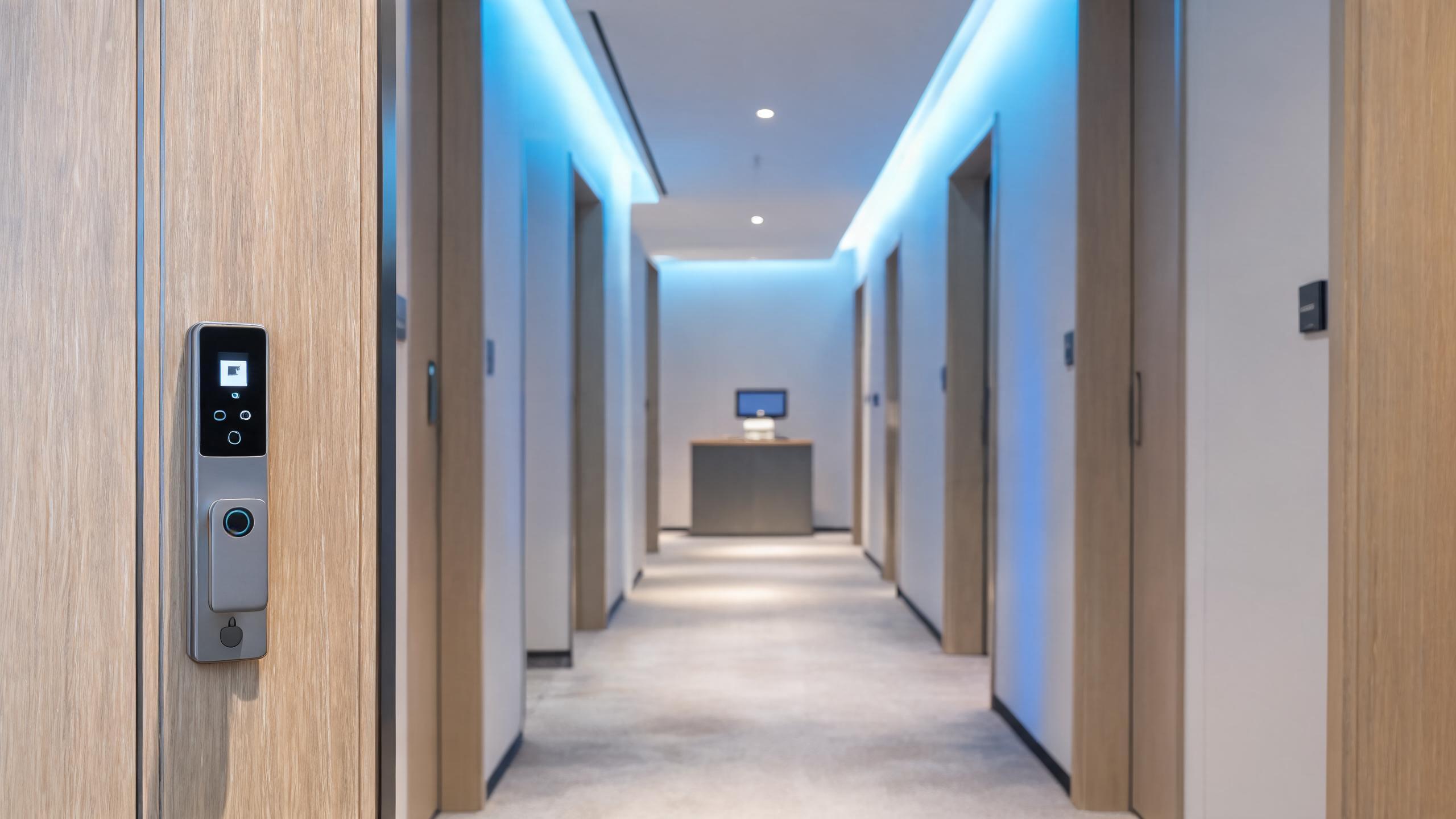 PMS integration: the part that decides the model
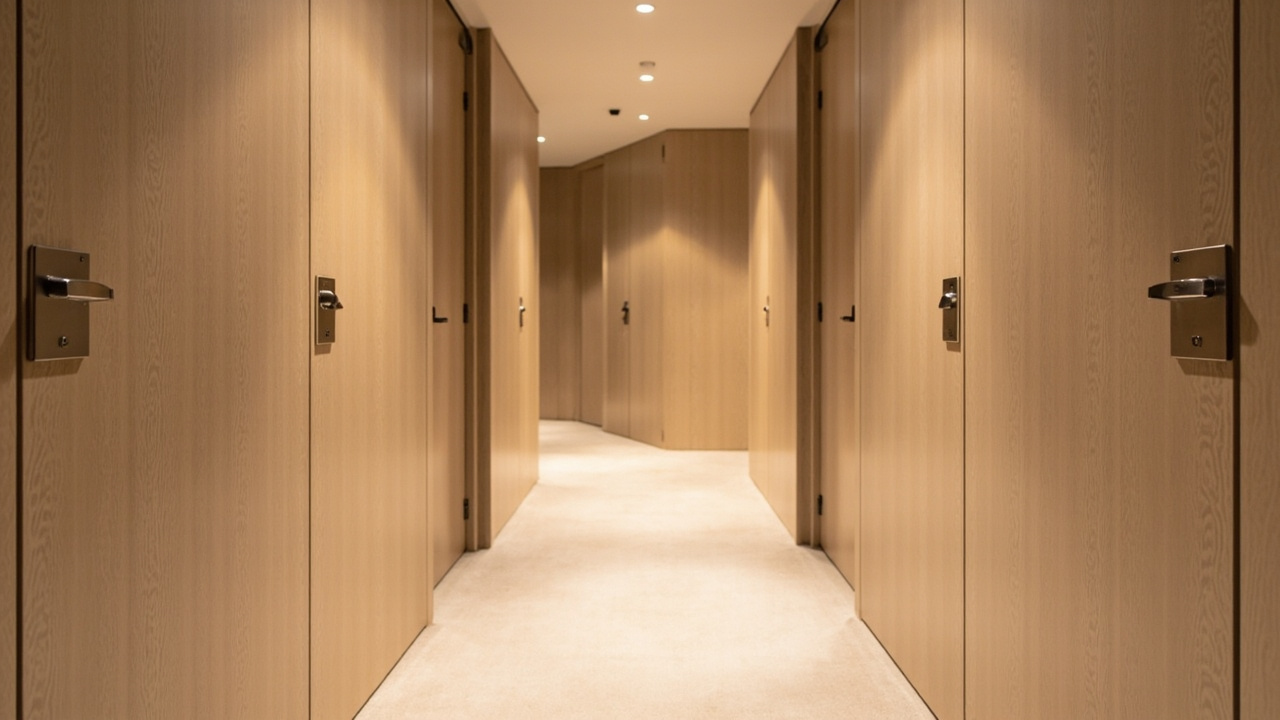 A 200-room project referenced end to end
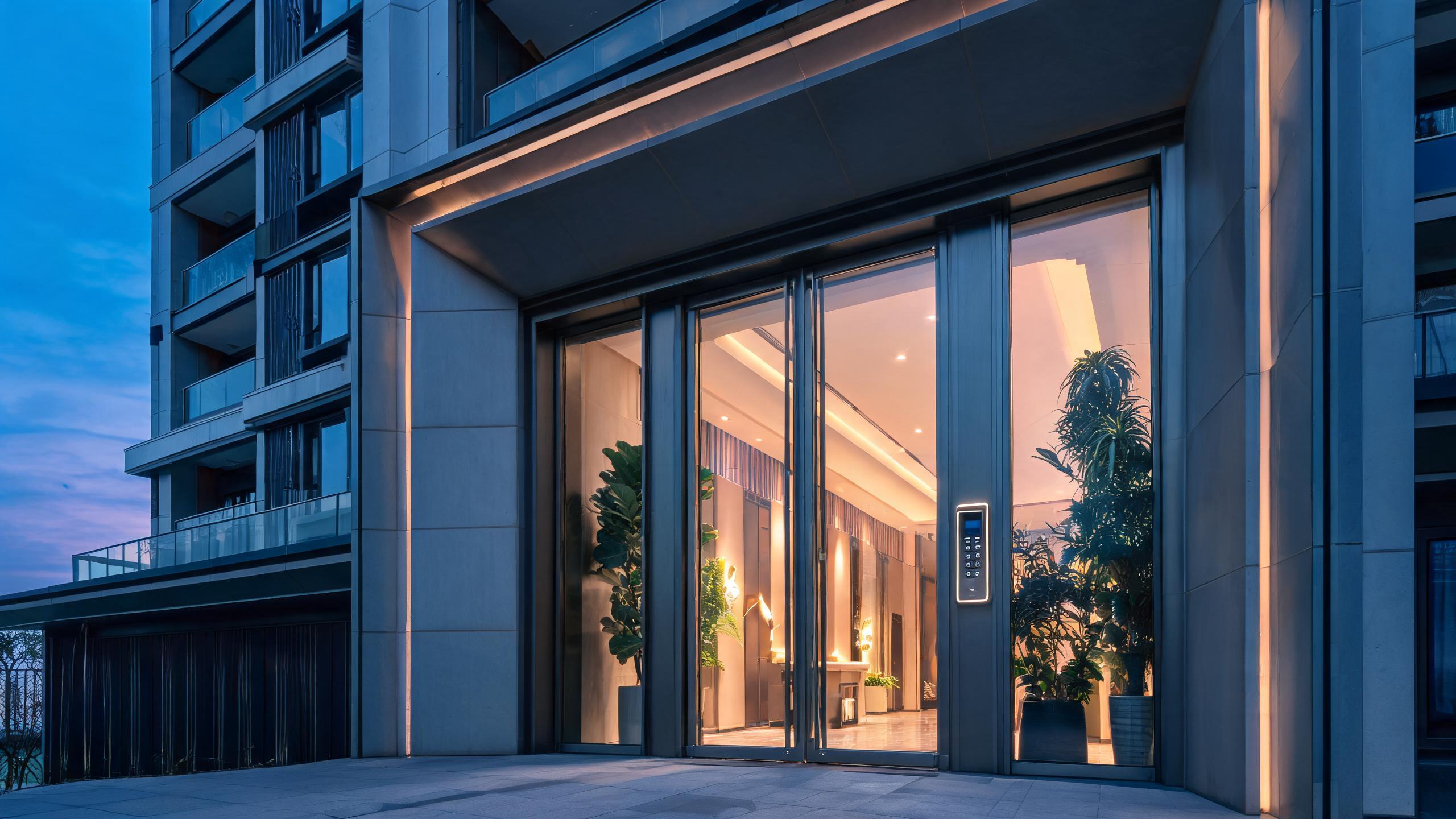 Serviced apartments and long-stay rooms
Sign-off
Acceptance checklist before the first guest checks in
Split into three moments. Each item is something a person can watch happen, not a document that can be signed without looking.
Pre-install
- Measure every guest door. Thickness between 38 mm and 55 mm, leaf construction recorded, frame member confirmed behind each fixing point.
- Confirm handing and strike side per door from the door schedule, not from the corridor walk-through.
- Confirm desk count and power. One encoder per reception desk, and two desks above 50 rooms, each on its own circuit.
- Hold site stock before the first door. One set of 4 x AA per lock and one mechanical key per lock, logged into a sealed key cabinet.
- Separate the fire-door list. Card locks stay off any assembly that is not listed as a complete set with its hardware.
During install
- Hang one door first, then read 10 consecutive cards on that lock before the fleet goes up.
- Verify an expired card is refused. Use a test card set to yesterday and watch the red indication, not the written procedure.
- Verify staff card limits. A housekeeping card should open its assigned floors and fail on a floor it does not own.
- Read the audit trail of 20 events and match each entry to the paper registration sheet for that shift.
- Test the mechanical key override on every installed lock, then seal the key back into the cabinet.
After handover
- Re-run the 10-card read on the five highest-traffic doors at the end of week one.
- Confirm low-battery alerts reach a named person and are written into the maintenance log, not left in a mailbox.
- Verify the spare lock is stored with its key and its batch label, and that the label matches the fleet.
- Sign the warranty schedule and the spare parts list so the property knows what is covered and what is bought separately. Start with warranty questions and spare parts.
- Train housekeeping on two rules: card return at checkout, and the blacklist step for a lost card.
Order shape
System components and how each one is ordered
Six lines on the quotation. Anything outside these six lines is a separate scope with a separate owner.
| Component | Ordering basis | What is not included |
|---|---|---|
| Guest room locks | 1 per guest room, plus 1 spare per 50 doors quoted as its own line | Door modification, core blocking, frame repair and repainting |
| Encoders | 1 per reception desk; minimum 2 above 50 rooms | PC hardware, desk furniture, network cabling and IT support |
| Cards | Per stay: one active card per guest, plus a group pool and a loss pool | Card artwork, personalisation printing and fob conversion requested later |
| Data reader | 1 per property for audit download and clock correction | Staff hours beyond the handover session and travel to site |
| Software | Per property licence; the PMS interface is scoped property by property | The PMS vendor's own interface fee, server hosting and network security |
| Spares | Quoted line item, at 1 per 50 doors minimum, matched by batch label | Site storage, insurance and import duty in the destination country |
Model shortlist
Four models that cover most hotel door schedules
Same card system, different door and different visual weight. Mixing them inside one property is normal.
SLK-2020
SLK-2020 →
201 stainless steel body, 306 x 75 x 15 mm, No. 2 hotel mortise, 4 x AA alkaline batteries, low-battery alert, PC-linked encoder, mechanical key override, offline operation.
SLK-760
SLK-760 →
Split-style body for doors where a single tall escutcheon looks heavy. Same card system, same encoder and same expiry rule as the standard fleet.
SLK-230
SLK-230 →
Slim escutcheon for narrow leaves and common doors. Fits where the wider body of a standard hotel lock would overhang the door edge.
SLK-9936S
SLK-9936S →
Satin finish for suites and premium floors, with the same credential rules as the rest of the property. Finish is a procurement variable, not a different system.
Evidence before purchase
What a buyer can verify before ordering
Four things you can hold, watch or read before a production order is released. None of them requires taking our word for a test result.
| Evidence | What it proves | How to get it |
|---|---|---|
| Golden sample | The exact model, finish, mortise and firmware generation you will receive, tested on your own door leaf. | Order through sample ordering and keep the sample as the reference unit for the shipment. |
| Live line video | The assembly and end-of-line test stations in sequence, dated, with the model visible at the bench. | Request a walkthrough recording or book a factory tour; production detail is documented under manufacturing and quality control. |
| Model document pack | Which declarations and test reports exist for the specific SKU, and in which scope. | Ask for the pack by model and market; the certifications page explains the difference between a factory claim and a model document. |
| PMS scoping email | The interface is written as a scope with named data fields, not assumed from a brochure line. | Send your PMS name and version with the RFQ; the written reply lists what the interface covers and what the PMS vendor charges. |
Boundary
What this system does not do
- No live door status. Standard hotel systems are offline; they do not stream whether a door is open, closed or held open to a dashboard.
- No PMS integration by default. The interface is scoped per property, per PMS version, and is not included in a standard lock quotation.
- No on-site installation abroad. We do not install or configure locks in the destination country. Support is remote, written, and documented on installation support.
- No fire-system replacement. A card system does not replace a fire-alarm release, a listed exit device or the door's own certification.
- No instant revocation. A lost card on an offline lock cannot be stopped remotely; the blacklist reaches the lock at the next encoder write or audit read.
- No door supply. Doors, frames, fire labels and their certificates remain with the door supplier and the project's fire consultant.
Answers
Hotel lock questions buyers ask before the survey
How many locks should a 200-room hotel order?
200 guest-room locks, 4 spare locks and 2 encoders under the published rule: one lock per room, one spare per 50 doors, one encoder per desk. Common doors, back-of-house doors and lift interfaces sit outside that number and are counted from the door schedule. Spares are quoted separately, so the room count never hides them.
Can the front desk still check guests in when the PMS is down?
Yes, because the lock does not depend on the PMS at the moment of entry. The desk writes cards from the encoder database and works from a paper arrival list; access keeps working. What stops is room assignment visibility and automatic record matching, which the night audit reconciles once the system returns.
Does a card lock belong on a fire-rated corridor door?
Only when the complete door assembly, including its hardware, is listed as a set for that rating. The hardware has to match the door's certification rather than the lock's own document. UL 10C and NFPA 80 describe the assembly tests buyers usually reference; the model document pack states what our lock holds, and the door supplier states what the leaf holds.
How is a lost card stopped on an offline lock?
The card serial is added to the blacklist and written to the lock the next time an encoder or data reader visits it. Until that write happens the card can still open the door, so serious loss is handled by moving the guest or changing the room. Online or hub-connected floors shorten that window; a standard offline fleet does not.
Which card technology should the property standardise on?
MIFARE Classic is the common choice for guest cards and is widely supported by encoders and card printers. MIFARE DESFire EV2 is the choice where the operator wants stronger credential protection or already uses it elsewhere. Both sit on ISO/IEC 14443A, and both work with the card locks on this page. Decide once, then order every card to that standard.
Do you install the system in our country?
No. We do not install or configure locks on site abroad. The delivery includes the hardware, the software, the encoder and written commissioning documents; installation is carried out by the buyer's or the project's installer, with remote engineering support and the checklists above. Local labour, travel and site access are outside our scope.
Send the door count and the desk count; get a written BOM
A quotation needs three inputs: the guest-room count, the reception desk count and the list of doors that carry a fire label. Send those with the catalog request and we return a line-by-line bill of materials, spare allowance and the documents each model holds. Two worked examples sit beside this page: the 200-room configuration and the 50-room configuration. Buyers comparing several projects usually start with case studies and the hotel lock FAQ.
Request hotel BOM quotation200-room configuration