
Last updated: October 31, 2026 · Reviewed by export engineering
A rejected carton is cheap. A rejected door in a finished building is not.The difference between the two is decided by which units were tested, how many were inspected, and who signed the report when the answer was no.
A function test proves a unit works on the day it is tested. An inspection proves a batch matches an agreed standard on the day it is sampled. They answer different questions, and neither replaces the other. A batch of 200 locks can pass every end-of-line test and still ship with the wrong manual, and a sample can accept a lot with one dead clutch motor. The question is not whether quality control exists, but which units were tested, how many were inspected, and what happens when a finding is raised.
Gates
Four gates: what is inspected and what is tested
Four gates stand between the parts store and the loading bay, and each one answers a different failure. Gate one stops a bad lot from entering. Gate two stops a bad unit from being completed. Gate three refuses to ship a unit that fails its function test. Gate four checks the packed carton, which is the only level at which the label, the manual and the accessory bag can be judged. Skipping any one of them moves the failure to the next party in the chain, and the next party is normally the buyer.
| Gate | When | Scope | Sampling | Record produced |
|---|---|---|---|---|
| IQC – incoming inspection | On receipt, before a lot is released to the store | Mortise dimensions, plating appearance, board revision, battery date code, module marking | Lot-based; the sample is drawn from the delivery and the result is recorded per lot, not per part | IQC record with lot number, sampled quantity, measured values and the inspector's signature |
| IPQC – in-process inspection | During assembly, at fixed checkpoints along the line | Mortise cycling, clutch and motor fit, gasket seating, handle alignment, badge position | Checkpoint sample taken at defined intervals; a failed checkpoint stops the station, not the batch | IPQC sheet tied to the work order and the shift, with the checkpoint number and the measured value |
| EOL – end-of-line function test | After final assembly, before packing | Every function on every unit: power-on, motor in both directions, credential read and write at 13.56 MHz, keypad or biometric verification, low-battery alert, mechanical override, lock-state feedback, firmware version | 100% of units – no sample, no skip, one record per serial number | Test log per serial number with the result, the tests run and the tester on duty |
| OQA – pre-shipment inspection | After packing, before the cartons are released to the loading bay | Packed cartons: quantity, label text, barcode, manual language, accessory bag, carton condition, finish against the signed reference | Sampling against the lot size, using the plan the buyer names and the report states | Inspection report with the plan used, the sample size, each finding and the accept or reject decision |
The numbers in this table are the parts of the test a buyer can recognise. A hotel card lock carries 4 x AA cells, and the end-of-line check loads those cells, reads them at 1.5 V nominal and confirms the low-battery threshold against the loaded voltage rather than counting cells. The reader is read at 13.56 MHz at three positions on the bench, and a read that only works at 2 cm is a fail rather than a pass with a note. A body measuring 306 mm x 75 mm x 15 mm with a No. 2 hotel mortise is checked against the drawing at IQC and again after assembly, because a faceplate error of 1 mm is a mechanical finding and not a cosmetic one. Interior leaves usually measure between 38 mm and 55 mm, so the fit check refers to the door schedule rather than to the model drawing alone. A durability sample is cycled rather than run once, so the cycle test uses a set drawn from the batch and left on the bench for repeated cycles; the size of that set is agreed per order and is not a percentage promise. None of these checks proves that a lock will survive 10 years on a door; they prove that it left the building in the state the specification describes. The bench and the durability work behind it are described at the testing laboratory.
Quality control is what the paperwork says
A factory that inspects well leaves evidence. The evidence is a report per batch with the checks listed, the units sampled, the failures found and the decision taken. Without it, quality control is an opinion.
- Incoming, in-process and final checks are recorded separately
- Failures are counted, not just detected: the AQL figure appears on the report
- A failed batch is quarantined, not reworked without a record
 VerificationInspection is a written record with a signature, not a photograph.
Unit level
What every unit is tested for
The end-of-line bench is the only gate that touches every unit, so its scope is worth reading line by line. Eight checks run in a fixed order, and a failure at any point stops the unit rather than being noted and passed.
- Power-on and self-check – the unit boots, runs its own diagnostics and reports ready
- Motor drive in both directions – lock and unlock under load, with current draw inside the fixture window
- Credential read and write – a card or tag is enrolled, read and removed at the reader, at 13.56 MHz
- Keypad or biometric verification – a valid code or a reference finger opens the lock, an invalid one does not
- Low-battery alert – the alert is triggered at the threshold and reported to the user and to the audit record
- Mechanical key override – the override opens the lock with the shipped key, independent of the electronics
- Tamper and lock-state feedback – the unit reports locked, unlocked and forced-entry states to the software
- Firmware version stamp – the build identifier is read back and matched to the record for the batch
Two of the eight are the ones buyers ask about most. The low-battery alert is checked because a lock that dies silently on a Sunday is a guest complaint, not a maintenance ticket. The mechanical override is checked because it is the last line of defence when the electronics or the credential fails, and it has to work with the key in the box rather than with a bench key. A unit that passes seven checks and fails the override is a fail, and the record says so. An order of 200 units produces 200 test lines, one per serial, and a visitor can watch 3 units complete the bench from card read to key override. The incoming gate that feeds this bench depends on supplier control, which is set out at supply chain.
Sampling
AQL and sampling: who sets the level
The buyer names the acceptance quality level for the pre-shipment inspection, and the inspection plan follows from that plus the lot size. There is no single AQL number that applies to every order, and quoting one as a factory default would be a number the buyer never agreed to. What the factory can state is the mechanics: the lot size decides the sample size code, the AQL decides the accept and reject thresholds, and the report names both so that a third party can repeat the calculation.
Three practical rules follow. First, the lot for inspection is the shipment, not the production run, so a shipment split across two purchase orders is inspected as two lots. Second, a critical defect is never accepted on a sampling basis, because a unit that fails its function test is a defect at the unit level and not a statistical one; function failures found in the sample are resolved by screening the lot, not by arguing about the acceptance number. Third, cosmetic and label findings may be accepted at the agreed level, and the report states which classification was used for each finding. A buyer who has no AQL preference can ask for the plan used on the previous shipment and start from there, but it should be confirmed in writing with the order rather than assumed.
What this does not mean: an AQL level is not a warranty and it is not a defect allowance the buyer should expect to receive. It describes how many defects a sampling plan will tolerate before the lot is rejected. The target remains the specification, and a lot that meets it should contain no functional failures at all.
Failure handling
When inspection fails
A finding is not a verdict until it is classified, and the classification decides who acts and who pays. The table below is the working rule set; the same six categories are used on the inspection report so that a buyer can read the outcome without a phone call.
| Finding | Classification | Action | Who decides |
|---|---|---|---|
| Cosmetic defect | Major or minor, depending on size, position and visibility at normal viewing distance | Rejected units are sorted out and replaced from a reworked or rebuilt set; the batch is re-offered for inspection | Buyer's AQL level and the signed appearance reference, applied by the inspector |
| Function failure | Critical, regardless of quantity, because a unit that does not open is not a statistical question | Full screening of the lot, root-cause note against the station that created it, and a written correction before re-inspection | Factory quality lead, reported to the buyer before the balance payment |
| Firmware mismatch | Critical when the build differs from the approved specification; major when only the parameter set differs | Units are re-flashed to the approved build or replaced, and the version record is reissued for the batch | Factory engineering, with the buyer confirming which build is approved |
| Missing accessory | Major when the missing item is the override key or the manual; minor when it is a cleaning cloth or a screw pack | Cartons are opened, completed and re-sealed, and the packing list is corrected before release | Packing supervisor, with the buyer informed of the corrected carton count |
| Label error | Critical when the barcode points to another model or the market language is wrong; major when text position is off the proof | Labels are reprinted and re-applied, or cartons are rebuilt if the print run is wrong; a label change after plates exist is a new print | Buyer approves the corrected artwork; the factory owns the reprint schedule |
| Wrong finish batch | Critical when the shade differs from the signed reference at normal light; major when the difference is visible only under inspection light | The lot is held, compared side by side with the golden sample, and either reworked or replaced by a plating run | Buyer's signed reference decides; the factory decides how the lot is corrected |
Two rules keep this table from becoming an argument. The first is that the buyer's written specification outranks any verbal understanding, including a photograph approved on a phone. The second is that a rejection is resolved by rework and re-inspection, not by a discount. A discount leaves the defect in the market and the buyer holding the complaint; a corrected lot leaves the defect at the factory, which is where it can still be fixed. When a lot is rejected, the original inspection report is kept and attached to the corrected one, so the history of the shipment is one document set rather than two competing versions.
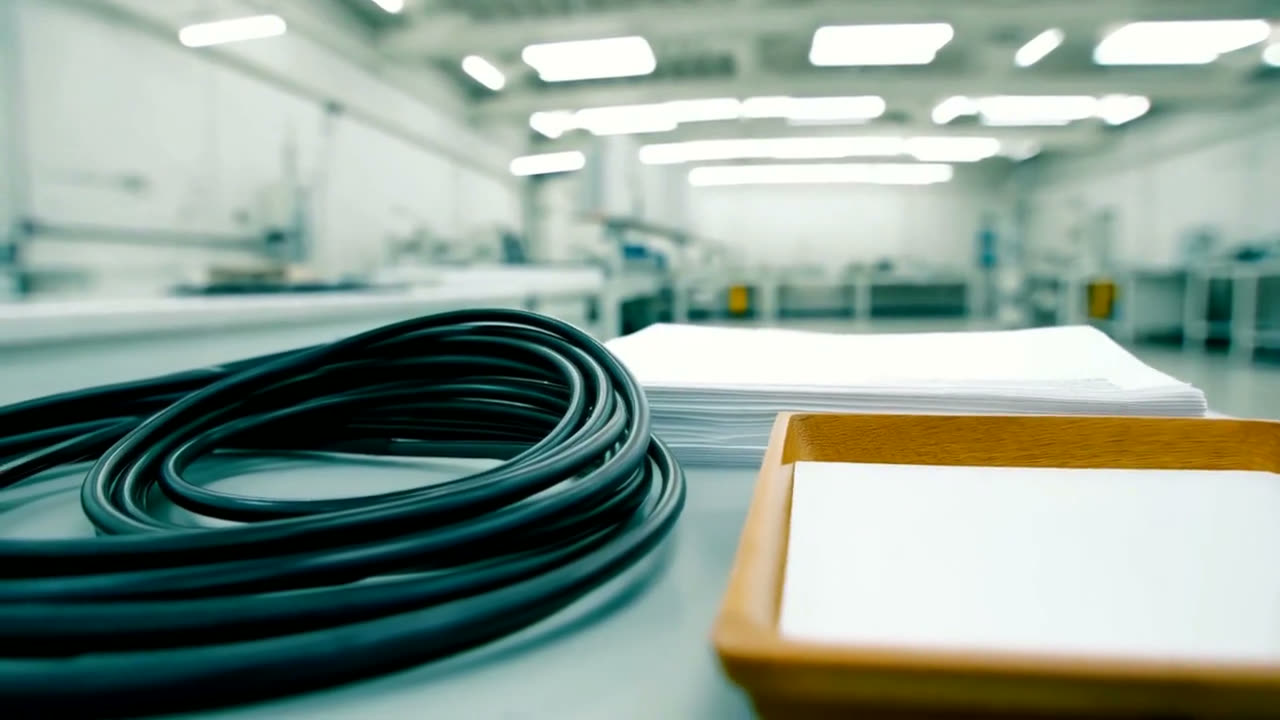
Wiring harnesses and paperwork laid out on the QC bench
Before a unit is measured, its wiring harness is laid out and the paperwork for that batch is stacked on the bench beside it. Each harness is checked against the drawing for the model, and the paperwork stays with the lot until the pre-shipment check is signed off.
Claims
Warranty and claim routing
A warranty claim moves faster when the first message contains four facts: model code, batch or serial number, a photograph of the failure, and a description of what the lock does instead of what it should do. "Not working" is a description of a mood, not a failure mode. "The motor does not drive in the unlock direction, the keypad accepts the code and the bolt stays closed" is a failure mode that can be matched to a station within a day.
With those four facts the route is short. The batch is located in the test log, the firmware version is confirmed against the record, the station that owns the failure mode is identified, and the answer states one of three outcomes: a replacement unit, a spare part, or a return for examination. Freight, customs and the destination party are agreed in the distribution or supply agreement rather than assumed from the warranty wording, because a lock that travels back across a border costs more than most replacements. The spare list that supports this route is described at spare parts.
The honest boundary: misuse and installation damage are not warranty. A lock forced with a lever, mounted on a door that was not prepared to the drawing, wired to a supply outside the specification, or installed with the mortise misaligned is an installation or usage failure, not a manufacturing one. The warranty covers the lock against the written specification; it does not cover the door, the installation labour, or a claim raised without a batch number.
That boundary is not a way of refusing claims. It is the reason a valid claim can be answered quickly: the factory warrants what it built and can trace, and everything outside that line belongs to the party that performed it. Buyers who want the first-line claim handled locally should say so in the distribution agreement, naming who inspects, who pays freight and what the end-user wording says. The warranty questions buyers send most often are collected at the warranty FAQ.
Evidence
Evidence you can request before the balance payment
Verification is a set of artefacts a buyer can hold, not a statement a buyer has to trust. Five of them are produced on every order, and the sixth is optional and paid for by the buyer. All six can be requested before the balance payment, which is the point at which the buyer still has leverage.
| Artefact | What it proves | How to verify it |
|---|---|---|
| Inspection report | The pre-shipment gate was run, on which lot, with which plan | Check the lot size, the sample size and the AQL named in the report against the order |
| Photo set | The packed cartons, the labels and the accessory layout on the day of inspection | Compare the label text and barcode with the approved artwork proof |
| End-of-line test log | Every serial in the shipment carries a pass record | Match the serial range on the release note with the log; count the lines |
| Firmware version record | The build in the boxes is the build in the specification | Read the version at the bench or in the app and compare it with the record |
| Golden sample | The appearance and function standard the batch was judged against | Ask for the signed and dated sample, kept at the line, to be shown next to a production unit |
| Third-party inspection | An independent party applied a checklist the buyer wrote | Nominate the agency, agree the checklist and the sampling plan, and receive the report directly |
Two caveats belong with this evidence. A photograph proves a carton existed; it does not prove the carton contained the right unit, which is why the photo set is read together with the test log. A third-party report proves the sampling plan was executed; it does not prove the model is certified for a market, because certification is a separate document that belongs to the model. Market documents are described at certifications and the questions buyers send about them are collected at the certifications FAQ.
Boundary
What quality control cannot cover
The limits below are real, and a buyer who plans around them avoids the most common post-shipment dispute: a claim raised against quality control for a problem quality control never had the means to test.
- Destination-market certification. Quality control confirms the unit matches the specification; it does not create a certificate. A CE marking, a UL report or an EN test certificate is issued by a laboratory for a model, and the document pack states what is held for that model rather than for the factory.
- Installation quality abroad. A lock that is correct on the bench can still fail on a door that was not prepared to the drawing. The factory can supply the fit drawing, the drill template and remote diagnosis, but it cannot inspect work carried out by a local installer; the support route is at installation support.
- Connectivity on your network. A gateway or a 4G lock behaves differently behind a firewall, a captive portal or a router the factory never sees. Radio coverage is confirmed by a site survey on the buyer's premises, not by a bench test.
- Battery behaviour in extreme cold. The bench checks the battery path at room temperature. Alkaline cells lose capacity well below freezing, and a lock installed on an unheated exterior door needs a battery choice and an alert threshold agreed for that climate, not the default.
- Field conditions after handover. Humidity, salt air, door sag, heavy traffic and cleaning chemicals all change how a lock ages. The factory tests to a specification; it cannot reproduce the building the lock will live in.
None of these limits weakens the four gates. They mark where the gates stop being useful and where a different party, document or field decision has to take over. A buyer who reads the specification, the site and the market together gets more value from the same inspection than one who reads only the inspection report.
The stations that produce these units, and the defect each of them creates, are listed on manufacturing; the capability view of the plant is on smart lock manufacturer. Once a lot is released, the carton handling that follows is covered at logistics and shipping.
FAQ
Quality questions buyers ask after the first shipment
Is every lock tested, or only a sample?
Every unit gets an end-of-line function test, with one record per serial number. The sample appears at the other gates: incoming inspection is lot-based, in-process inspection works at checkpoints, and pre-shipment inspection samples packed cartons against the plan the buyer names. So the answer to both halves is yes, but they apply to different things: the unit is tested, the carton is inspected.
What AQL level should the buyer name?
The level is a commercial decision, not a factory default, and it should match how the goods will be used. A distributor who resells through retail usually wants a tighter level than a project buyer who installs through a contractor. The report states the plan used so it can be recomputed, and a buyer with no preference can start from the plan used on the previous shipment. What the factory will not do is quote an AQL number as if it were part of the product.
What happens if the pre-shipment inspection fails?
The lot is held, the finding is classified, and the correction is agreed in writing before anything is re-inspected. Function failures trigger full screening rather than a statistical argument; cosmetic and label findings are handled at the level the buyer set. The original report stays attached to the corrected one, so the shipment carries one history rather than two versions of it.
Can my own inspector attend the inspection?
Yes. Nominate the agency, send the checklist and the sampling plan, and the inspection is run against your document rather than a generic one. The practical points are the date, because the inspection has to fall after packing and before loading, and the checklist, because an inspector without a written standard will apply a personal one. A factory visit is a different arrangement and is booked through the factory tour.
Is installation damage covered by warranty?
No. A lock forced with a lever, mounted on a door that was not prepared to the drawing, or wired outside the specification is an installation or usage failure. The warranty covers the lock against the written specification, and a claim needs the model code, the batch or serial, a photograph and a described failure mode. The wording buyers ask about most is collected at the warranty FAQ.
Why can't you confirm our network behaviour from the factory?
Because the network is not here. A gateway or a 4G lock behaves differently behind a firewall, a captive portal or a router the factory never sees, and radio coverage depends on the building rather than on the model. The bench confirms the lock's own radio and credential behaviour; the site survey confirms the installation. If a network problem appears after handover, the first useful facts are the router model, the signal level at the door and the gateway log.
Send the specification before the first inspection
Send the model list, the destination market and the standard you intend to inspect against. We reply with the four gates as they apply to your order, the plan the pre-shipment report will state, and the artefacts that travel with the shipment; current MOQ policy and lead time are confirmed in writing with the quotation.
Request a quoteSee the production line