
Last updated: October 31, 2026 · Reviewed by export engineering
A campus does not run on bookings. It runs on a calendar, and most of its access decisions are batch decisions: 400 new students arrive in one week, 400 cards have to read on the first morning, and 120 of those cards have to stop working on graduation day without a technician visiting 120 doors. This page is for the buyer who has to settle three things before term starts: how the site is cut into zones, how cards go out and come back in bulk, and where a card lock must not be fitted at all. Every quantity below is planning arithmetic of the kind we restate in writing with each quotation. It is not a price, a lead time or a test result.
Day one
Term start: what changes on the first day of a semester
Three things change at 08:00. One thing does not, and that is the thing the whole plan turns on.
The people change, the room list changes, and the population of cards in circulation changes. The lock does not. It stays on the same leaf, with the same firmware generation, and keeps its own clock through the summer while the building is empty. That one fact moves the work away from the doors and back to the desk. What has to be finished before the first bell is a frozen room list, a frozen zone list and a counted card stock, not a fleet of locks that has been touched.
The locks in this range are offline. The SLK-2020 body measures 306 x 75 x 15 mm, runs on 4 x AA alkaline cells, and holds its access list and clock on board. The expiry date is written when the card is encoded, and the lock enforces it at the next read without asking a server. A 200-room dormitory with 400 residents needs one encoded card per resident plus a spare pool; at roughly 1 second of machine time per card, the writing is under 7 minutes and the rest of the day is name matching. What goes wrong on the first morning is rarely hardware: it is a card encoded to the wrong room, two residents on one bed, or an expiry copied from last year's record.
- Room list frozen and signed by the accommodation office, one line per bed, before any card is written.
- Zone list frozen, one sheet per building, naming the doors in each group and the doors excluded from all groups.
- Card stock counted by block, so a shortfall is found at the desk and not in a corridor.
- Two people trained at each issuing point, because one trained person is one illness away from a queue at the gate.
- Fire-door exclusion list signed by the person who owns the fire strategy, not by the installer.
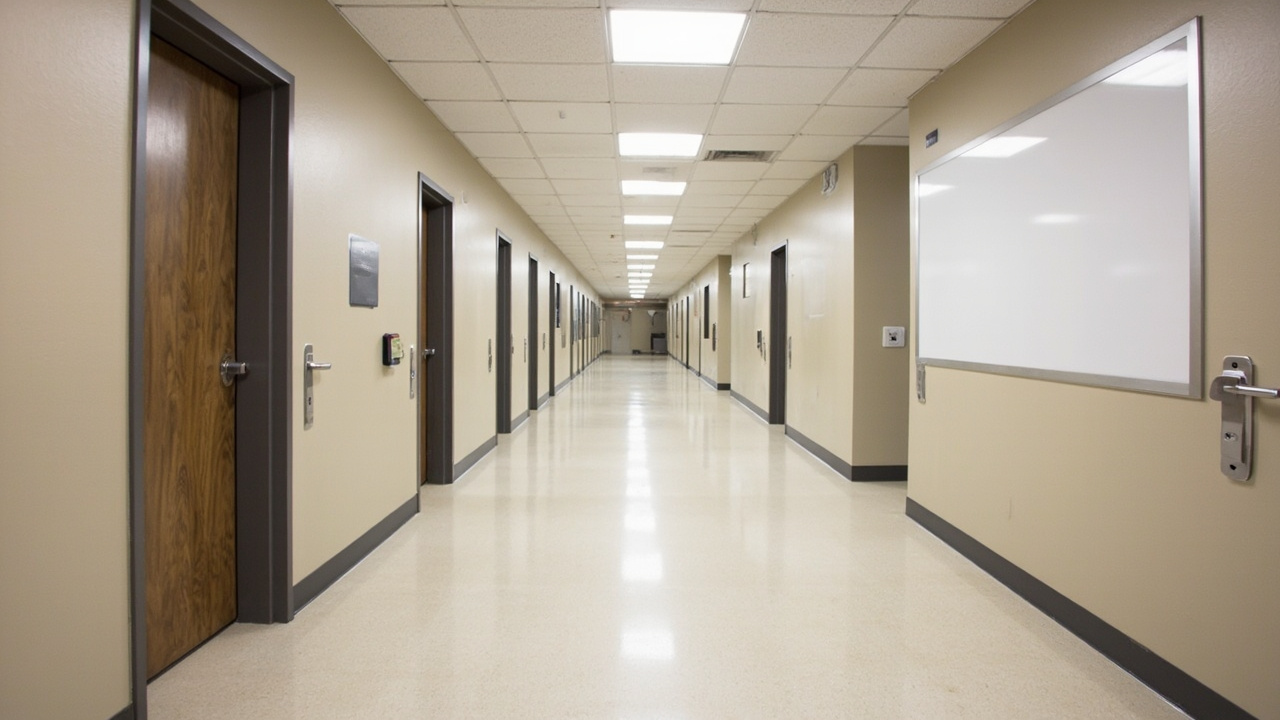
A school lock has to be boring
The best school lock is the one nobody thinks about: it opens with a card, it survives a corridor full of bags, it takes a key from the caretaker and it does nothing clever in a fire evacuation.
- Card or wristband access, with a coded override held by the site
- Durable lever and faceplate for high-traffic classroom doors
- Fire door hardware selected against a tested assembly, not a catalogue entry
Zoning
Five campus zones and the lock each one needs
The reason to split a campus into zones is not tidiness. It is that a lost card in a dormitory, a lost card in a laboratory and a lost card at the gate are three different risks.
All five zones can share one card technology and one encoder. What changes is the door, the credential rule and the cost of a wrong decision.
| Zone | Typical door | Lock family | Credential rule | What decides the choice | Do not fit here |
|---|---|---|---|---|---|
| Dormitory room | Timber leaf, 38–55 mm, No. 2 hotel mortise | SLK-2020 as the standard room lock; SLK-230 on slim leaves | One resident card per bed, expiry at the end of the licence period | The body follows the leaf: thickness and core decide the model, not the software. Offline operation keeps a corridor working during a network fault. | A hollow-core leaf with no blocking at the mortise; a fire-rated leaf unless the assembly is listed as a set. |
| Classroom and lecture hall | Timber or steel, 35–50 mm | SLK-509 keypad and card reader | Staff card with a time window; no student card on the teaching door | Timetables move rooms every 45 minutes, so groups follow timetable blocks rather than individual teachers. | A door that is also a designated escape route; a door with a vision panel that the escutcheon would cover. |
| Laboratory, server room, exam store | Steel, 40–50 mm solid core | Keypad plus card on one reader, with audit download | Named staff only, two-person rule where the institution applies it | The risk is samples, data and unattended chemicals. An audit trail that can be read back matters more than a finish. | Any door where the reader would replace an alarm, a CCTV zone or a locked chemical cabinet. |
| Public areas: canteen, library, gym, corridor | Frameless glass; aluminum framed glass | SLK-G200 for frameless glass; SLK-D11 series on aluminum | Student card on an opening-hours schedule, not on a person | Volume, not security. A canteen door can see 2,000 reads between 11:00 and 14:00, and the reader has to survive that without a battery change in term time. | Any door on a means of escape; any door that staff must hold open for a delivery. |
| Back-of-house, plant room, gatehouse | Steel and aluminum, weather facing | SLK-D12 and SLK-D15 weatherproof aluminum locks | Staff card plus contractor cards with same-day expiry | Weather, dust and a gate that is propped open. The card has to expire without anyone driving to site. | A vehicle barrier or a sliding gate operator; those are separate equipment, not a lock. |
Room-lock models are compared on the SLK-2020 page. Glass doors and aluminum gates are covered under glass door locks and outdoor door locks.
Bulk authorisation
Bulk authorisation: how 400 cards reach 400 doors
Four routes exist. Only one of them is free of walking, and none of them is instant.
A card written at the desk knows nothing until a lock reads it. That is the whole problem of bulk authorisation on an offline campus, and it is why the route matters more than the software. The numbers in the third and fourth columns are planning figures used to schedule a term start, not measured results from a particular campus; each quotation restates them against the actual door count.
| Method | Doors per run, planning | Rollback when a write fails | Elapsed per 100 doors | Where it breaks |
|---|---|---|---|---|
| Programming card walked door to door | About 100 doors in a 1-hour round at 20 seconds per door | The failed lock keeps its previous list. Re-run the tail of the round, not the whole round. | About 33 minutes of walking, plus stair time | Locked rooms at 07:00, a building manager who is not on site, and a card that is left in the reader. |
| Batch card written at the desk, read once at each lock | The same walk; one card covers every lock it touches | A lock that misses the read stays on the old generation, which shows up on the read-back log | About 1 minute of desk time, then the same 33-minute walk | A missed door looks exactly like a written door until somebody checks the read-back list. |
| Hub-connected or networked locks | 100 or more doors per update from one console | Retried per lock. A lock that is offline at the time keeps the old list and reports when it returns. | Minutes rather than hours, while the network is healthy | Cabling, power and the IT owner who has to approve a device on the campus network. |
| 4G cellular lock, one SIM per door | 1 door per SIM, updated from the platform | Each lock retries on its next connection; no walk and no rollback queue | Minutes per door, no walking | A data cost per door every year, and a building where the mobile signal is good at the door and not in the basement. |
The arithmetic for a 400-door campus. Four rounds of 100 doors at 20 seconds each is 1 hour 20 minutes of walking, and with stairs and locked rooms closer to 2 hours 15 minutes. Twice a year, at term start and graduation, the walk costs about 4.5 hours. The desk side is smaller than buyers expect: 400 card writes at 1 second each is under 7 minutes. Add a spare pool of one card per 20 residents and 400 residents need 420 cards.
Two rules keep the batch honest. Write one generation per building and print the generation on the batch label, because two generations in one corridor produce cards that work on one door and fail on the next. Then read the list back before the doors are used: the read-back is the only evidence that a lock received the batch, and the document you show a parent who asks why a card did not work.
Revocation
Lost card, late return and graduation: three revocation paths
Removing access is harder than granting it, because a card that is already in a pocket cannot be reached from a desk.
Every campus has three revocation events, and they are not the same event. A lost card has to be stopped now. An unreturned card has to be stopped at the end of a licence period. A graduating cohort has to be stopped on one date for everybody at once. Only the first requires a person to walk to a door.
| Path | Trigger | Where the block is written | Effective after | What still works | Record kept |
|---|---|---|---|---|---|
| Lost card | Resident reports the loss at the desk or by the resident portal | Blacklist written at the next encoder touch or handheld read of that door group | The next touch. Same day if a round is run; otherwise the next scheduled round. | The mechanical key override, and the door itself, which is not deadlocked remotely | Reissue logged against the resident record and the card serial |
| Late return at end of term | The card is not handed in by the deadline | The expiry already written on the card, enforced by the clock inside the lock | Immediately at the expiry date, with no visit to the door | Nothing after the date. A returned card is wiped and re-issued at the desk. | The issued-card list and the unreturned list, printed for the accommodation office |
| Graduation or withdrawal | The student leaves the institution | One batch write that sets a common end date for the cohort | At the batch date, on every lock that has read the batch | Nothing beyond the date. The card can stay in a drawer as a souvenir. | The cohort list archived with the door schedule for the academic year |
The honest limitation sits in the first row. Between the report and the next touch, a lost card still opens the door it was issued for, and there is no way around that except to shorten the gap. Practical options are a same-day round on the affected building, moving the resident to another room, or treating the mechanical key as the night-time control. Say which one applies before term starts, because at 23:00 nobody is going to invent a policy.
 Staff and administration doors
 K-12 school access control
 A 200-door school project
 Temporary and modular building access
Fire and escape
Fire doors and escape routes: where access control must stop
This is the one part of a campus project where the door has authority over the lock.
A fire door is a certified assembly: leaf, frame, closers, hinges and hardware tested together. Adding a card reader does not add a feature, it changes the assembly. US buyers quote UL 10C and NFPA 80; the European market quotes EN 1634-1 for the door test and EN 14846 for electromechanically operated locks; ANSI/BHMA A156.25 describes electrified locking. The position is narrow and belongs in the tender exactly as written: the model document pack states what a lock holds, the door supplier states what the leaf holds, and neither statement transfers to the other.
The escape side is not a design question at all. A door on a means of escape has to release on the way out with no credential and no staff decision. Where a building needs controlled entry and free exit, that is a controlled-entry door with an exit device, bought as one tested set. A reader on the escape side of a corridor door is how a procurement saving becomes a fire notice.
- Not included in any lock quotation: the fire-alarm interface. Relays, cabling and the connection to the fire panel belong to the fire contractor and are a separate scope with a separate sign-off.
- Not a replacement for an exit device. A card lock does not release a push bar, and it does not make a door compliant on an escape route.
- No reader on the escape side. Free egress at all times; the reader goes on the approach side or not at all.
- No fail-safe assumption. A battery lock is fail-secure by design: a dead battery means the mechanical key, not an open door. Doors that must release on alarm need a different, listed solution.
- No lock on an unlisted assembly. If the leaf is fire-rated and the hardware set is not, the answer is no, whatever the drawing says.
- No door closer removed to make a body fit. A closer that is taken off a fire door turns the whole assembly into an untested one.
Term calendar
The term calendar: what to prepare 30, 7 and 1 days ahead
A campus is delivered against a date that cannot move. The calendar is the project plan.
| When | What has to be done | Owner | Output | If it slips |
|---|---|---|---|---|
| 30 days before | Survey every zone door: thickness, core, handing, frame member behind each fixing point. Freeze the door schedule. | Facilities with the installer | Signed door schedule, one line per door | Models are ordered against a guess, and the wrong body arrives on site. |
| 30 days before | Agree the zone list and the exclusion list, including every fire door and every escape route. | The person who owns the fire strategy | Zone sheet per building, exclusion list signed | A reader ends up on a door that must never carry one. |
| 30 days before | Count students per block and order card stock with the spare pool. | Accommodation office | Card quantity by block, plus a 5 percent spare pool | Cards run out during the first-week queue and get cloned informally. |
| 7 days before | Write the batch for each building, read it back on 10 doors per building, and compare the read-back to the batch list. | Installer plus one campus operator | Batch label, read-back log, generation number | One building runs on last term's list and nobody notices until a card is refused. |
| 7 days before | Test expiry: encode a card to yesterday and watch it being refused at three doors, one per zone. | Campus operator | Test card, signed check sheet | The expiry rule is assumed to work and is discovered in week six. |
| 1 day before | Issue cards by block, print the block lists, and station spare locks and cells at the gatehouse. | Accommodation office | Issued-card register, site stock list | Every query at the gate becomes a search through a spreadsheet at 09:00. |
| 1 day before | Walk three doors with a real card and a real resident, one in each zone, and time each read. | Campus operator | Signed walk sheet | Nobody knows whether the campus is ready or merely installed. |
The calendar assumes a few hundred doors. On a site with several buildings and a facilities team the 30-day rows can be pulled forward; the 7-day and 1-day rows cannot, because they depend on cards that already exist. What must never be compressed is the read-back, the one step where an error is still cheap.
Boundary
What a campus lock system does not do
- It does not show live door status. Offline locks record events on board and report them when a card or a reader visits; they do not stream whether a door is open to a dashboard.
- It does not stop a lost card instantly. The blacklist reaches a lock at the next touch, not at the moment the loss is reported.
- It does not control the fire system. No alarm interface, no relay logic, no release on signal. That is the fire contractor's scope and it is tested by the fire contractor.
- It does not install itself abroad. We do not send technicians to fit or commission locks in the destination country. Support is written and remote, described on installation support.
- It does not replace attendance, CCTV or a door alarm. A lock records who was allowed in; it does not record who was present, and it does not watch a corridor.
- It does not supply doors, frames or fire labels. Those stay with the door supplier and the project's fire consultant.
- It does not apply to a leaf outside the stated range. A 30 mm hollow leaf is a different product question, not a longer screw.
Evidence
What a bursar can verify before the order
Four documents a finance office can hold and check without trusting a brochure.
| Evidence | What it proves | How to get it |
|---|---|---|
| Surveyed door schedule | That every lock quoted matches a real leaf: thickness, core, handing and mortise measured on site | Issued after the survey, countersigned by facilities; the blank form is on buyer resources |
| Golden sample on your door | That the body fits the actual frame, that the read is quick enough for a morning queue, and that the finish survives a term | Order through sample ordering and keep the unit as the reference for the shipment |
| Model document pack | Which declarations and test reports exist for the specific SKU, and in which scope | Request by model and market; the difference between a factory claim and a model document is explained on certifications |
| Batch read-back log | That each lock received the generation that the desk wrote, door by door, before students arrive | Produced during the 7-day step and filed with the door schedule; the bench side is on testing lab |
| Spare and warranty schedule | What is held on site, what is covered and what is bought separately in year three | Quoted as its own line; parts families are listed on spare parts |
A bursar does not need a technical opinion. A bursar needs one document per claim, a date on each document, and a named person who signed it. That is the standard this page is written to, and the same standard applied in the compliance document centre when a public tender asks for the file set.
Answers
School access questions procurement teams ask
How many locks does a 400-bed campus need?
One per controlled door, not one per bed. A 200-room dormitory with 400 residents is 200 room locks, plus common doors, plant rooms and the gatehouse counted from the door schedule. Add one spare lock per 50 doors, quoted as its own line, and one set of 4 x AA cells per 10 locks held on site.
Can a lost student card be stopped the same day?
Only if somebody walks the affected building with a handheld or a batch card that day. The lock is offline, so the block reaches it at the next touch. Until then the card still opens its door. The alternatives are moving the resident, changing the room, or using the mechanical key as the night control.
Do we have to re-key the whole campus every year?
No. Two rules do the work: an expiry date written on every card at issue, and a cohort batch that sets one end date for a whole intake. Neither needs a visit to the doors. Re-keying is only needed if a card generation is compromised, which is a different problem from a card that is simply late.
Can one card open the dormitory and the canteen?
Yes, when the doors are in the same system and use the same credential technology. MIFARE Classic and MIFARE DESFire EV2 both work and both sit on ISO/IEC 14443A; the choice is about credential protection, not about whether one card can carry two permissions.
What happens to access during a power cut?
The doors keep working, because each lock runs on its own 4 x AA cells. What stops is issuing: the encoder needs mains power. Keep a UPS at each issuing desk, hold a block of pre-written cards for the first hour, and the campus keeps functioning while the utility does not.
Can a card lock go on a fire door?
Only where the complete assembly, hardware included, is listed as a set for that rating. UL 10C and NFPA 80 are the references US buyers quote, EN 1634-1 and EN 14846 for the European market. The model document pack states what the lock holds; the door supplier states what the leaf holds.
Do you install locks on campus?
No. We do not fit or commission locks abroad. The shipment includes hardware, encoder, cards and written commissioning documents, and installation is carried out by the buyer's installer with remote engineering support.
Send the zone list and the term dates
Two inputs decide the quotation: how the campus is divided into zones, and the date the first students arrive. Send both with the door schedule and we return a line-by-line bill of materials, the spare allowance and the cards each block needs. Worked projects sit beside this page: a 200-door campus and the university campus index. Smaller sites start on K-12 schools; housing blocks inside the campus follow student housing.
Request campus access quotationRequest the catalog