
Last updated: October 31, 2026 · Reviewed by export engineering
A lock order is a sequence of ten decisions before it is a shipment. Each decision belongs to a named person, and each one can move the date when it is made late or made twice. Most late shipments we see are not production failures. They are approvals that arrived after the material was already cut, or a specification that changed while the line was running. This page sets out the stages we plan against, the records each stage leaves behind, and the line between a change a buyer asks for and a claim a buyer raises.
Three artefacts control the order: one owner on each side, one baseline schedule, one written record. The owner is a person with authority to sign, not a department. The baseline schedule is the version both sides signed at contract stage, and every later date is measured against it. The record is a revision-numbered log, and a stage without a signature in that log has not closed, whatever the chat thread says. The same discipline runs through quality control at the unit level and through compliance documents at the tender level.
Ownership
One owner, one schedule, one written record
The owner signs four things on a standard order: the frozen specification, the sample approval, every change request and the shipment release. On our side the owner is the export engineer named on the quotation, and that name does not change when the order moves into production. On your side the owner is whoever can approve a change without convening a committee. If nobody on your side holds that authority, the order will stall at the first exception, and the stall will be recorded against the schedule whether or not anyone intended it.
The schedule is a table, not a conversation. It lists ten stages, one deliverable per stage and one sign-off per stage, with dates that come from the material plan rather than from a catalogue. The dates are re-baselined only through the change log, never through a phone call. That rule sounds bureaucratic until the first order where a buyer's project manager leaves the company mid-project: the successor reads the log, sees what was approved and by whom, and continues without renegotiating history.
A stage closes by signature, not by shipment. A stage marked complete because the goods left the building is a stage with no evidence. The signature is the evidence, and the milestone pack is what the signature attaches to.
The log carries one revision number per change and nine fields: date, stage, item, requested by, approved by, effect on price, effect on date, effect on documentation, attachment. The naming rule is model code, revision number, date; a folder of 40 files with no revision numbers is not a record.
 A managed project, stage by stage
 Campus and multi-building projects
 Multi-site rollouts and handover
 Project management scope and reporting
 A project referenced end to end
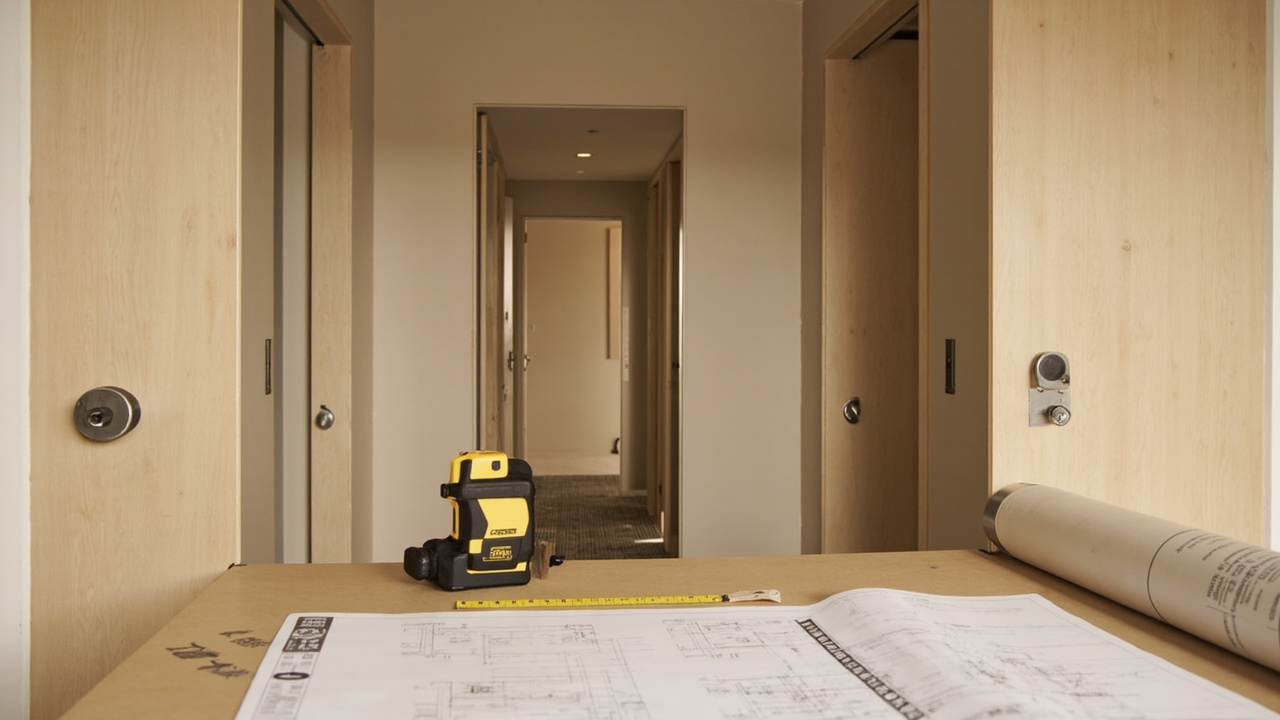 Planning a hotel project before the order
Milestones
Milestones: deliverable, sign-off owner, what happens if it slips
Ten stages cover a standard order from quotation to site support. Each one produces a document that a third party can read without asking either side what it means. The last column is the part buyers tend to skip when they read a project plan, and it is the only part that matters when a date moves. The parameters in the table use a standard hotel card lock as the example: a 306 mm x 75 mm x 15 mm escutcheon with a 13.56 MHz card reader and 4 AA alkaline batteries, models listed at products.
| Stage | Deliverable | Sign-off owner | If it slips |
|---|---|---|---|
| 1. Quotation confirmed | Written quotation with model codes, quantities, MOQ policy, lead-time basis and Incoterm, plus one revision of the model list | Buyer purchasing lead | Quotation validity ends, material is not reserved, and the date is re-quoted against the current plan |
| 2. Specification frozen | One-page specification: leaf thickness 38-55 mm, backset 60 mm or 70 mm, handing, credential type, finish, firmware version, packaging artwork reference | Buyer technical lead and factory export engineer | Anything agreed after this point enters change control and may move both the date and the price |
| 3. Sample approved | One sample per model, three test cards, installation sheet, record of the sample test | Buyer project manager | Mass production does not start; a second sample round is a new stage with its own sign-off |
| 4. Tooling or modification | Tool drawing, first-off parts, material certificate for the changed part | Buyer product manager | The tooling slot is released to the next order and the new date comes from the tool shop, not from the assembly line |
| 5. Bulk material prepared | Material call-off list, component arrival record, incoming inspection plan | Factory planner | Production start moves by the same interval; no partial line is started to protect a date on paper |
| 6. First article approved | One unit from the line, three for a multi-model order, with the full end-of-line record and photographs | Buyer QC and factory QC | The line is held; written approval is required before the run continues, and the hold is logged |
| 7. Mass production | Daily output record with serial ranges, defect list and rework count | Factory project owner | Units that fail end-of-line testing are held for screening, and the shipment quantity drops below the order |
| 8. Final inspection | AQL inspection report on packed cartons, carton count, label and barcode check | Buyer or nominated third-party inspector | The shipment is held; re-inspection is a new event with a new report rather than an edit to the first one |
| 9. Shipment | Booking confirmation, packing list, HS code, document set, container or air waybill | Buyer logistics | Storage and demurrage sit with whoever caused the delay, as the Incoterm allocates them |
| 10. On-site support | Installation checklist, training record, snag list with closure dates | Installer lead and property manager | The snag list stays open and the retention holds; the support scope does not expand by itself |
Two stages are commonly merged and should not be: specification freeze and sample approval. A sample approved against an unfrozen specification approves a build nobody can repeat; a specification frozen without a sample approves a drawing that may not fit the door. Door dimensions that feed stage 2 are collected with the same discipline described at installation support.
Cadence
Communication rhythm during a live order
A live order needs five kinds of update, and each has a fixed form so that a buyer can forward it upward without rewriting it. The cadence is written into the project charter at contract stage; the table below is what that charter contains.
| Cadence | Record delivered | Who receives it | Question it answers |
|---|---|---|---|
| Every working day during production | Line note: units started, units passed, units held, top three defect modes, current blocker | Buyer project manager and factory owner | Is the line running, and where is it stuck |
| Weekly | One-page rolling plan: next 7 days, material status, open risks, decisions needed from the buyer | Both owners, copied to buyer QC | What changes before next week, and what do you need from me |
| At each stage | Milestone pack: deliverable, evidence, deviations, sign-off form | Both owners, copied to QC and logistics | Is this stage closed, and on what evidence |
| On any exception | Exception note: what happened, which cause class it falls into, proposed correction, effect on date | Both owners within 1 business day | Who decides, and by when |
| At handover | Project file index: one folder, one revision number, one contents list | Buyer, installer and service partner | What do we hold now that the order is over |
The daily note is not a meeting. It is one message with numbers, so a buyer does not ask whether anything happened today. The weekly page is the one a buyer forwards to their own manager, which is why it fits on one page and names the decisions needed. Stage packs are longer because they carry attachments; exception notes are short and dated.
What a factory can show during a live order is bounded by what it can see; the stations and records behind the daily note are described at manufacturing, and the inspection that produces the stage 8 report is at quality control.
Change control
Change or claim: the line that decides the price
A change is a request to do something differently. A claim is an assertion that someone must pay for something that went wrong. The same event can become either, and the deciding factor is when it was written down: a finish change before the specification is frozen is a change with a quoted delta, the same change after anodising has started is a claim about processed material. The table maps the common triggers to the cost bearer and to the effect on price and date.
| Trigger | Who carries the cost | Effect on price and date |
|---|---|---|
| Specification change after freeze (finish, reader option, packaging, card type) | Buyer | Price re-quoted for the delta; the date moves by the affected material and tooling, not by a flat allowance |
| Buyer drawing error (wrong backset, wrong handing, wrong hole pattern) | Buyer | Rework and replacement parts quoted; the date moves from the day the corrected drawing is signed |
| Component substitution proposed by the factory | Factory if used without approval; buyer if the substitute is approved | No price change where the substitute is equal or lower in cost; written notice is required before use |
| Cosmetic variance inside the approved sample limit | Factory | No price or date change; sorting or rework is absorbed at the factory |
| Tooling wear inside the stated tool life | Factory | No price or date change; replacement tooling is quoted when the tool reaches the end of its life |
| Buyer-supplied part late or out of specification | Buyer | Line idle time is recorded on the daily note; the date moves from the day the conforming part arrives |
| Transit damage | Carrier and insurance, as the Incoterm allocates risk | Inspection report and photographs decide the remedy; replacement is a new order line, not a free rework |
| Door not prepared on site (no mortise, wrong hole pattern, crushed core) | Installer or buyer | Installation support is re-scoped; this is not a product claim and the lock is not defective |
| Firmware change after first article | Buyer | Re-test and re-approval are required; the date moves by the test and approval cycle |
| Quantity increase after material call-off | Buyer | Additional material is quoted at current cost; the date moves by the supplier interval |
| Regulatory change in the destination market | Buyer | New test or new document is commissioned; the date moves by the test cycle rather than by the factory schedule |
A claim has four parts: a written notice, the evidence, the root cause and the remedy. The notice names the model code, the serial range and the failure mode. The evidence is the inspection report, the photograph or the returned unit. The root cause is assigned to one of the four classes in the next section. The remedy comes from the written warranty terms rather than from the size of the account. A claim without a serial range cannot be adjudicated, because the factory cannot tell which build the unit came from.
We do not invoice expediting as a favour. If a delay is ours, the recovery plan is ours to propose and its cost is agreed before it is incurred. If the delay is the buyer's, the recovery cost is quoted and approved like any other change. Mixing the two produces a disputed invoice and a late building at the same time. The terms that govern this division are summarised at the warranty FAQ.
What the buyer manages and what the factory manages
The split is written down so nobody waits for the other party. The buyer owns the door schedule, the site access and the local compliance filing. The factory owns the build, the test records and the shipment documents.
- Weekly production update against the agreed schedule
- Change requests recorded in writing before they reach the line
- Handover pack: drawings, test records, spare parts list and firmware version
 On siteA project is judged at handover, not at the purchase order.
Attribution
Delay causes and which of them are ours
Every delay belongs to one of four classes, decided by documents rather than recollection. The argument is shorter when the evidence is attached to the exception note on the day it happens.
| Class | Typical example | Evidence that assigns it | What happens next |
|---|---|---|---|
| Ours | Material call-off placed late, line scheduled against an unapproved sample, end-of-line failures | Purchase order date, approval timestamp, test record | We publish the slip, propose a recovery plan and do not present expediting as a favour |
| Yours | Late deposit, late artwork, late sample feedback, late buyer-supplied parts | Bank record, mail thread, approval log | The date is re-baselined from the day the missing input arrived |
| Third party | Component shortage, forwarder roll-over, port congestion, laboratory queue | Supplier confirmation, booking record, laboratory acknowledgement | Both sides see the same evidence and the remedy follows the contract terms |
| Force majeure | Typhoon, power restriction, customs stoppage | Official notice and dated record | Dates are suspended for the documented period only, not for the whole order |
Force majeure is a narrow class and we treat it that way. A component that was ordered late is not force majeure. A laboratory slot that was booked late is not force majeure. A typhoon that closes the port for 4 days is, and the 4 days are documented and suspended rather than used to reset the whole schedule. Buyers should apply the same test in the other direction: a public holiday in the buyer's own approval office is a buyer-side delay, not a factory delay.
Handover
What the project file contains at handover
The project file is one folder with one index and one revision number. It is delivered at handover, and it is the document a buyer's own auditor, installer or service partner will read 10 years later. A file that contains only the invoice and the packing list is not a project file; it is a shipment record. Where the order carries a spare allowance, the planning default of 1 spare lock per 50 doors is written into the file as a line item rather than assumed inside the lock count.
- Frozen specification with its revision number and the date it was signed
- Approved sample record with photographs, serial number and the approval date
- Milestone log with the sign-off name, role and date for each of the ten stages
- Change log with the price and date effect recorded for every revision
- First article record with the end-of-line test results and photographs
- End-of-line test summary, serial range and the count of held units
- Final inspection report with the sampling plan and the finding classification
- Packing list, carton marks, model mix and carton count
- Firmware version, configuration file and the reader option as built
- Key and card schedule, including the master card handling rule
- Installation manual and the door preparation drawing in mm
- Spare parts list matched to model and batch
- Training record with the names of the people trained and the date
- Warranty terms as issued with the order, not as published later
Two items are regularly missing from files assembled by other suppliers: the count of held units and the firmware version as built. Both answer questions that appear months after the shipment. A held-unit count explains why a carton contains fewer locks than the packing list suggests; a firmware version explains why one wing of a building behaves differently from another. The model families are listed at products, and spare-part matching after handover is at spare parts.
Boundary
What project management does not cover
Not included: the parts of a project that sit outside the order. The list below is the scope boundary a buyer should plan against.
- Commercial negotiation with your own client. We can supply the dates and the evidence behind them; the contract with your customer, its penalties and its retention are yours to negotiate.
- Customs clearance, duty and import registration. The export documents and the HS code are supplied. The clearance itself belongs to the importer of record and its broker.
- Installation labour and site supervision. Installation support covers documents, remote help and scheduled visits. It does not put our staff on your scaffold or accept your site safety responsibility.
- Door preparation and hardware we do not supply. A leaf that is not cut to the drawing is an installation issue, and correcting it is not a product remedy.
- Legal or compliance advice for your market. We state what documents exist for a model; we do not tell you what your market requires you to file.
- Adjudication outside the written warranty terms. A goodwill decision is a commercial decision, and it is made in writing rather than implied in a meeting.
- Operation of the access system after handover. Card issuance, staff changes, audit exports and software updates are the property's routine work, supported by training and documentation.
The boundary matters because a supplier who accepts everything ends up accountable for nothing. We also cannot manage a schedule that depends on a permit we never see: where a site programme is gated by a building permit or a fire inspection, the lock order can be ready and still not installable. That is a site dependency and it belongs in the buyer's programme.
Verification
What a buyer can verify mid-project
Six checks can be run by a buyer's project manager in under an hour, without a factory visit. Each check compares two records that should agree; where they disagree, the question to ask is specific.
| Check | What to pull | A correct record looks like |
|---|---|---|
| Stage dates | Milestone log | Each stage has a date, a named signer and an attachment; no stage is marked complete on the day it was requested unless the deliverable was already in hand |
| Production quantity | Daily output record | Serial ranges are continuous, and held units appear on a separate line from passed units |
| Test coverage | End-of-line summary | The count of tested units equals the count of packed units plus the count of held units |
| Change history | Change log | Every revision number on the order matches a revision number on the specification sheet |
| Shipment contents | Packing list | Carton count and model mix match the final inspection report, line for line |
| Firmware as built | Configuration file and packing list | The version string in the file matches the version printed on the packing list |
Evidence check: a milestone pack with a photograph, a dated test record and a named signer is stronger than a status email with an adjective in it. Where a check fails, ask for the report number and the serial range the count refers to. The same verification habit at shipment level is described at logistics and shipping.
FAQ
Project questions asked at contract stage
Who is my single contact once the order is placed?
The export engineer named on the quotation, who signs the specification, the sample approval and the change log on our side. That person stays through shipment and handover, and a backup name sits in the project file. On your side we ask for one named person with authority to approve changes.
What counts as a milestone sign-off?
A written approval that names the stage, the deliverable, the person and the date. A signed page in the milestone log with the attachment listed is a sign-off; an email saying looks good against a photo is a comment.
Can we change the finish after the sample is approved?
Yes, through change control. The change is quoted for the material and tooling effect, the date is re-baselined from its approval, and a new sample may be required where colour matching or corrosion protection is affected.
If a component is late, do we pay for expediting?
It depends on the cause class. A component we ordered late is our delay, and we propose the recovery before the cost is incurred. A component you supplied late is a buyer-side delay, and expediting is quoted like any other change.
What happens if our inspection fails?
The lot is held, the finding is classified, and the correction is agreed in writing before re-inspection. A function failure triggers screening of the affected serial range; a cosmetic or label finding is handled at the level the buyer set.
Do you manage installation on site?
We support it, we do not run it. Documents, remote help and scheduled visits are available through installation support; labour, site safety and the programme belong to your contractor.
How long do you keep the project file?
The file stays with the order record while the model is in production and through the warranty period after the last shipment. Ask for it by model code and order reference, not by project name.
Next step
Send the dates and the sign-off names
A quotation turns into a schedule when five facts are on the table: the delivery window you are planning against, the door schedule with leaf thickness in mm and handing, the names and roles of the people who will sign each stage, whether any door in the schedule is fire rated, and the destination with the Incoterm.
If the order is still at model-selection stage, the faster route is a sample against two candidate models, described at order samples. If the tender needs the document set before the schedule can be fixed, start at compliance documents. Neither route changes the milestone logic above.
Send the door schedule, the dates and the names. The reply is a milestone table with one owner per stage.
Current MOQ policy is confirmed in writing with each quotation, and lead time is quoted per order and depends on model mix, finish and customization. Both sit in the quotation, not in a chat message.
Request a project quotationAsk the export desk