
Last updated: October 31, 2026 · Reviewed by export engineering
Two fears arrive with every distributor enquiry. The first is competition: the factory opens a web shop, answers inbound enquiries from your city, and sells around you. The second is price: your account sees a factory quotation and discovers your margin. Both fears are reasonable, and neither disappears because a supplier says trust me. This page settles them with the rules that govern a territory: what is protected, what is never protected, what the first order contains, and how a contested enquiry is decided.
The answer is not a promise of silence. A factory that stops answering its own website loses the enquiries that pay for the catalogue you sell from, and a distributor who is told nothing about that traffic cannot plan. What follows is the working arrangement: tiers with different commitments, a named-account register that is written rather than implied, a first order whose contents are agreed per market, and a claim window that ends arguments before they reach a lawyer. Read it as a contract outline. Every clause below becomes a document you can hold.
Tiers
Partner tiers and what each one actually commits
A tier is not a discount code. It is a statement of who does what when an end user calls, and how much of the market the factory agrees to leave alone. Three levels cover almost every enquiry we receive, from an installer buying two demo locks to a distributor holding a national project pipeline. Quantity thresholds are deliberately not written as unit counts, because a first order sized to cover a market launch depends on how many doors the market can absorb, not on a number that suits another country.
| Tier | Typical profile | What you get | What we expect | Territory basis |
|---|---|---|---|---|
| Trial account | An importer, installer or systems house testing one or two models before committing to a range; often a first container or a sample-only start | Catalogue and price band, sample orders, a model shortlist for the market, standard documents per model, access to training material | A settled sample order, written feedback on fit, credential behaviour and packaging, and payment on the agreed terms | None. Non-exclusive, and no account registration is issued at this level |
| Authorised partner | An established distributor with a dealer network, a service bench and hotel, developer or installer contacts it already sells to | Partner price band, marketing collateral, a training seat per cycle, warranty routing through the factory, a named market contact at the export desk | An annual volume band agreed in writing, a trained service technician, and no selling into another partner's registered accounts | Non-exclusive inside a named country, with account registration available on request in writing |
| Territory partner | A distributor with delivered project references, its own installation crew and a compliance file for the market it sells into | A named territory, protection for accounts registered in writing, a launch plan, co-branded assets, and a scheduling window agreed with production | A committed annual band, demonstration and service stock held locally, a warranty reserve, and a quarterly review against the plan | Exclusive for accounts listed in a written territory schedule, reviewed and renewed annually |
Two rules keep the ladder honest. First, a tier can be held without buying a slogan: nobody pays for the words authorised partner, only for the work that follows. Second, moving up is earned by behaviour rather than by a single purchase. A trial account that sends measured door data, tests on real doors and pays on time is a better risk than a large first order with no service plan behind it. A shortlisted range is drawn from 70 production-ready models and 6 core families built over 10 years, from a 306 mm x 75 mm x 15 mm hotel card lock to a frameless glass door unit, so the market brief rarely needs a new product. In practice the step from trial to authorised partner is decided by three things: whether the market can absorb a range rather than one model, whether the buyer can service what it sells, and whether the paperwork for the destination market is already understood. The customization range behind those models – from a label change to a full ODM programme – is set out on the OEM and ODM page and the private label page.
What a distributor programme actually gives you
The programme is built around three things a distributor needs and a factory cannot sell one order at a time: a protected range, a stock position in the models that move, and a documented after-sales route.
- A defined range for your territory, with a territory registration record
- Stock guidance by model, based on the history of comparable projects
- Spare parts, firmware and warranty handled through one written process
 Importer guideA distributor protects the margin by controlling the range, not by ordering more units.
Boundary
Territory protection and its exceptions
Boundary: Territory protection covers named accounts that are registered in writing before an enquiry arrives. It does not cover inbound web enquiries, hospitality group tenders that name Smart Lock Factory as the manufacturer, or government tenders that require the manufacturer to participate. Those three situations are handled by notification and a written claim window, not by an exclusive right.
The distinction matters because most distributor disappointment comes from a misunderstanding of what exclusivity means. Exclusivity in a commercial channel is never a wall around a postcode. It is a list of accounts, each with a name, a location, a contact and a registration date, signed off by both sides. A hotel group that runs a tender across three countries and names the factory in its specification is not the same buyer as a single property that asks for a quotation. The first usually requires manufacturer documentation and a factory reference; the second belongs to whoever registered it. Protecting the second while competing for the first is normal practice, and a territory agreement that pretends otherwise will be broken the first time a group tender lands.
| Situation | Protected? | How it is handled | Notification clock |
|---|---|---|---|
| Account registered in writing inside your territory | Yes | The enquiry is forwarded to the registered partner, and the factory quotes only through that partner unless the partner declines in writing | Forwarded within 48 hours |
| Inbound web enquiry from your city, not registered | No | The enquirer is asked whether they already work with a local partner; if they name you, the enquiry is passed to you with the original message attached | Answered within 48 hours |
| Hospitality group tender that names the factory | No | You are notified and asked whether you intend to bid with our model; the factory does not bid against a partner that is already preparing a submission | Notified within 5 days |
| Government or public tender requiring factory participation | No | The factory may bid directly or with a nominated partner; the supply terms for a joint bid are agreed in writing for that tender only | Notified within 10 days |
| Two partners register the same account | First registration | The earlier dated record wins; the second partner receives a written referral and can register a different account | Decided within 48 hours |
Registration is a form, not a conversation. It names the account, the site or sites, the contact person, the project stage and the date. A list of company names on a spreadsheet is not a register, and a verbal claim made on a call has no standing once two partners claim the same buyer. When a claim window is running, both sides stop quoting, the register is checked, and the earlier record wins. The losing partner is told in writing within the same window, which keeps the dispute from reaching the end user. Protection also ends when a partner stops servicing an account, and the usual trigger is a defined period without an order or an active project, agreed in the territory schedule rather than assumed.
First order
First-order structure: five lines, not one unit price
A first order is a launch kit, and a launch kit that contains only locks leaves the distributor unable to demonstrate, service or replace. The five lines below are the normal composition of a market-opening order. Quantities are agreed per market inside the quotation, because a country with a hotel refurbishment pipeline and a country with a retail channel need different mixes of demonstration and service stock.
| Item | Purpose | Notes |
|---|---|---|
| Demonstration stock | Gives the sales team physical units to show, and gives installers a lock to practise on before the first site | One unit per model you intend to present is the planning basis; the exact count follows your showroom, dealer samples and trade-fair plan |
| Spare parts | Keeps installed fleets serviceable without waiting for a shipment from China | Mortise, handle set, reader module, battery cover and card reader parts are listed per model; the spare list follows your installed base and is confirmed in the quotation |
| Marketing collateral | Lets a dealer network sell without inventing claims | Datasheets, brochures and images per model, with the parameters and standards wording taken from the document pack for that model |
| Technical training seat | Creates at least one person on your side who can diagnose a lock rather than replace it | Sales and installer modules are separate; the seat count follows the number of service points you operate |
| Warranty reserve | Covers the first claims without shipping a single unit back to the factory | Planning ratio of one spare lock per 50 doors on the installed base, adjusted for the door population and the local service model; the reserve is held by you, not by us |
The unit price line is the smallest part of this decision. A distributor who orders locks only will spend the first quarter borrowing a demo unit from a hotel and paying express freight for a handle that costs less than the freight. A distributor who orders the five lines above can open a market without a second shipment. Payment terms, MOQ policy and lead time are confirmed in writing with each quotation, and the commonly asked version of those questions is answered at the MOQ and payment FAQ. Spare part numbers are fixed per model, and the ratio behind the reserve is explained at spare parts.
Support
Market support package
Support is split into things that help you sell and things that help you keep what you sold running. The table states both, and when each one becomes available, because support promised after a launch is support that arrives too late to change the launch.
| Support | What it includes | When available |
|---|---|---|
| Model shortlist for your market | A narrowed set from more than 70 production models and 6 core families, matched to your door population, price band and credential preference | After the market brief, before pricing |
| Price positioning guidance | A view of where each shortlisted model sits against the alternatives your dealers already sell, so the range does not compete with itself | With the quotation |
| Local compliance roadmap | Who is responsible for what: which documents come from the factory per model, which declarations the importer signs, and which tests the local authority expects | Before the first order is placed |
| Training for sales and installers | Separate modules with assessment: product and objection handling for sales, door preparation, mortise fitting, encoder workflow and fault diagnosis for installers | Module plan with the first order; delivery per the training calendar |
| Lead lists | Project and channel leads that fit your registered territory, passed with the original enquiry text rather than a name only | Ongoing, from the enquiry flow described above |
| Warranty routing | A written process for claims: what the partner checks first, what evidence is required, when a part is shipped and when a lock is replaced | Before the first shipment |
| Product launch assets | Photography, specification sheets, comparison tables and a launch sequence for the models you commit to | After the model list is signed |
The compliance roadmap is the line most often left out of a distribution agreement and the one that costs the most later. A model certificate belongs to the model, not to the distributor and not to the factory in general, so a shortlist that ignores the destination market produces a range that cannot be legally sold in it. The market-by-market document matrix is described at certifications and compliance documents. Training is where a distributor stops being a reseller: an installer who can fit a mortise on a 38 mm leaf and diagnose a low-battery alert saves a truck roll that would have cost more than the training seat. The module list is on partner training, shipping terms for demo, spares and launch stock are on logistics and shipping, and the calculators and checklists behind a launch plan sit in buyer programs.
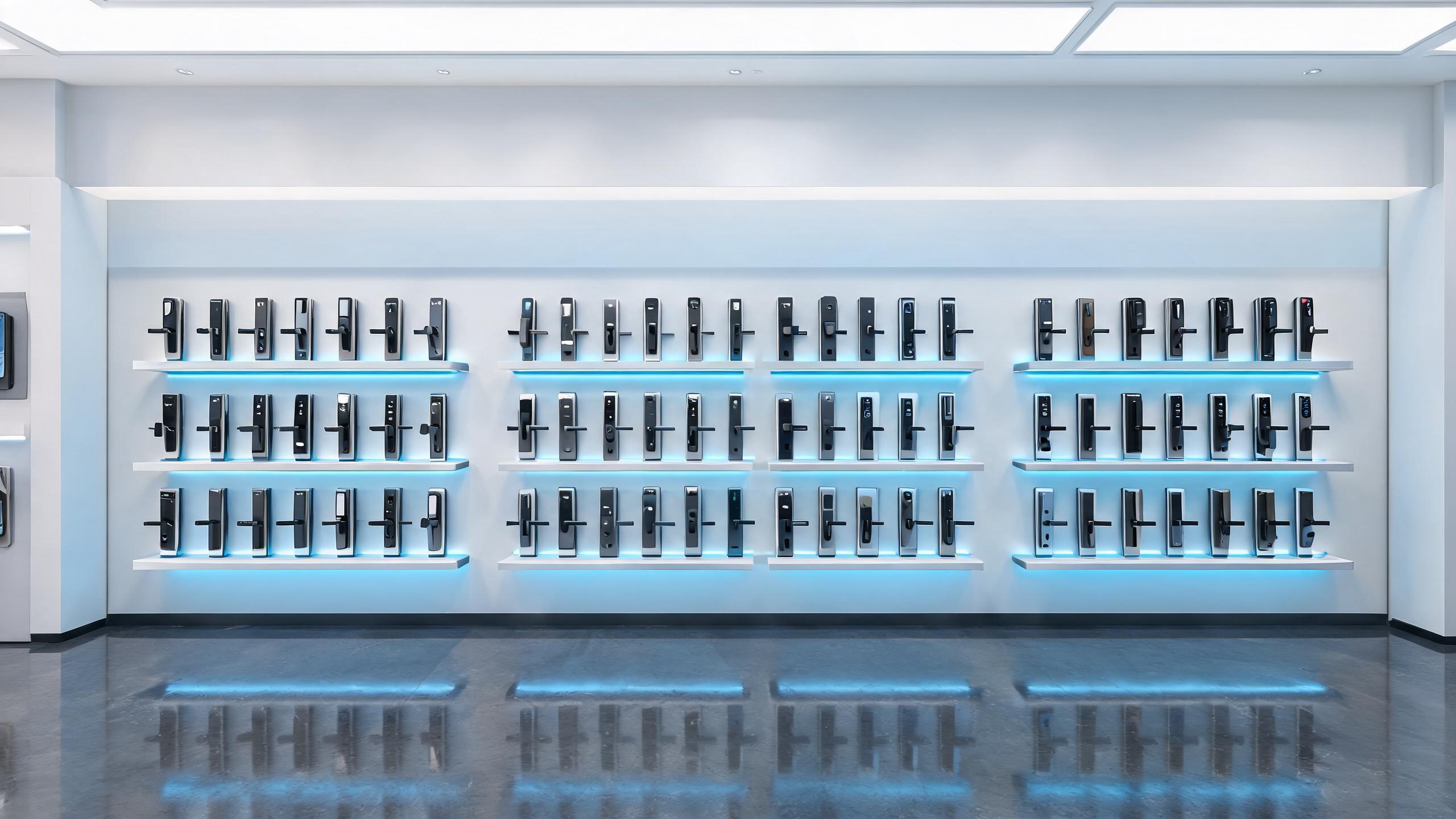 Retail packs and merchandising for channel partners
 First-year ordering pattern for new distributors
 Programme terms, registration and review points
 Market entry notes for the territory you registered
Process
How a partnership starts
Five steps, each with an input from your side and an output you can hold. The sequence is fixed because skipping the second step is the reason territory disputes appear six months into a relationship.
- Market briefInput: country, cities covered, channel mix, door population and the models you already sell. Output: a written model shortlist with the door types each model fits, and an honest note on which requests the catalogue cannot answer.
- Territory and account scheduleInput: the accounts you already serve, the pipeline you are bidding, and any account you want protected. Output: a dated register and a draft tier, signed by both sides before any pricing is discussed.
- Quotation on the five linesInput: quantities for demo stock, spares, collateral, training seats and the warranty reserve. Output: a quotation that names each line, states the MOQ policy in writing, and states the lead time basis rather than a single number.
- Sample and fit validationInput: at least two real doors from your market, with thickness, backset and existing prep measured. Output: a fit and function record naming the firmware version, plus any change the door population forces.
- Launch and quarterly reviewInput: trained staff, collateral in hand and the first order shipped. Output: a launch report, a stock and warranty position, and a review decision: stay, move up a tier, or narrow the range.
The third step is where most conversations succeed or fail. Buyers who send quantities as a range and a market description get a usable quotation in one round; buyers who ask for a unit price first get a number that cannot be compared with anything. The fourth step protects both sides, because a lock that fits a 55 mm leaf may not fit the 38 mm doors in the same corridor, and the only way to know is to measure. The manufacturing controls behind the sample and the mass run are described at manufacturing and quality control.
Rules
Conflict resolution: who wins a contested enquiry
Three rules settle nearly every dispute, and all three are written into the territory schedule before the first order.
Rule one: the registered account wins. A dated, named registration beats a pipeline claim, a verbal relationship and a phone call that started earlier. If the register has no entry, nobody is protected and the enquiry is worked normally by the export desk.
Rule two: a claim window runs for 48 hours. When two partners claim the same account inside one market, both stop quoting, the register is checked, and the earlier record is confirmed in writing. The window exists to stop parallel quotations reaching the same buyer, not to create a race.
Rule three: escalation moves through a fixed path. The account manager at the export desk answers first; if the two sides still disagree, the case goes to the export desk lead with both registration forms and the full enquiry text; the decision is issued in writing and recorded against the account. No decision is taken from a chat message, and no partner is asked to prove a relationship with screenshots alone.
An exception is handled by notification rather than by blocking. When a group tender names the factory, the affected partners are told within 5 days and asked whether they are preparing a bid. If one is, the factory does not submit a competing offer for the same package. If none is, the factory may bid, and any partner that later wins the account still owns the local service relationship. Government tenders that require the manufacturer to participate follow the same notification, with a longer window because the documentation set is larger. The commercial split for a joint bid is agreed in writing for that tender and has no effect on the territory schedule afterwards.
Evidence
What a prospective partner can verify before signing
An arrangement that cannot be checked is a promise. These four items are shown to a serious prospect before a territory discussion becomes a contract, and each one can be confirmed independently of the sales conversation.
| Item | What it shows | How to verify it |
|---|---|---|
| Registration records of existing accounts | That a named-account register exists and is maintained, not invented for the meeting | Ask for a redacted extract showing account type, region and registration date, with names and contacts removed |
| Warranty claim history process | How a claim is received, what evidence is requested and what the partner is expected to check first | Request one anonymised claim file for a comparable model and compare it with the written process |
| Training material samples | The level the sales and installer modules actually reach | Review a module outline and one assessment paper before booking a seat |
| Reference markets | Where the catalogue is already sold, and what the channel looks like there | Ask for market profiles by region and for the warranty terms that apply in each one |
The evidence has limits, and they are worth stating. Existing account records are confidential, so a prospect receives a redacted extract rather than the full register. Warranty history is shared as process and anonymised files, because a claim file names a hotel and sometimes a guest. Reference markets are described by region and channel type, not by customer name, unless that customer has authorised a reference in writing. What a prospect can always check is the factory itself: the production stations, the test bench and the packed goods, described at manufacturing and through the factory tour. The wider company structure and the business we decline are set out at about us.
FAQ
Distributor questions we answer before a territory is signed
Will the factory sell directly in my market?
Only in the cases stated on this page: inbound web enquiries that no registered partner owns, group tenders that name the factory, and public tenders that require manufacturer participation. Every other enquiry inside your territory is forwarded to you or quoted through you. The rule that protects you is the written account register, not a general promise of silence.
What exactly does territory protection cover?
It covers named accounts registered in writing, with a date, a site and a contact. It does not cover a postcode, a city or a website visit. An account that is not in the register can be quoted by another partner or by the export desk, and a registered account can lose protection if it is left unserviced for the period stated in the territory schedule.
How is the first order sized?
By the market, not by a published number. The five lines are demonstration stock, spare parts, marketing collateral, a training seat and a warranty reserve, and the quantities for each are agreed per market in the quotation. MOQ policy is confirmed in writing with that quotation, and the warranty reserve is planned at one spare lock per 50 doors on the installed base.
What happens when two partners claim the same account?
Both stop quoting, the register is checked, and the earlier dated registration wins. A claim window of 48 hours applies from the moment the conflict is reported, so a parallel quotation cannot reach the buyer first. The losing partner receives a written referral and can register a different account.
Can we hold stock and handle warranty locally?
Yes, and a territory partner is expected to. The warranty reserve is held by the distributor, the claim process is written before the first shipment, and the factory ships replacement parts or units against that process. Warranty terms for a partner are confirmed in writing per agreement, and the buyer-facing version is at the warranty FAQ.
How long does it take to move from a trial account to a territory?
Usually one full cycle: a sample and fit validation, a first order that includes demonstration and service stock, and a quarter of reported sell-through. The decision looks at service capability and market coverage rather than at order size alone. The tier conversation is documented at the quarterly review, and the territory schedule is renewed annually.
Ask for a territory, and get the rules in writing
Send your country, the accounts you already serve and the door population you expect to cover. We reply with a model shortlist, a draft tier, the first-order structure for your market and a territory schedule you can sign. MOQ policy, payment terms and lead time are confirmed in writing with the quotation, and the required documents per model are confirmed at the same time.
Request a distributor quotationWhatsApp the export desk