
Standards
IP ratings for smart locks: reading the two digits that define dust and water ingress
IEC 60529 IP codes appear on every outdoor lock spec sheet. The digits are precise laboratory outcomes — and silent on corrosion, steam cleaning and installation quality.
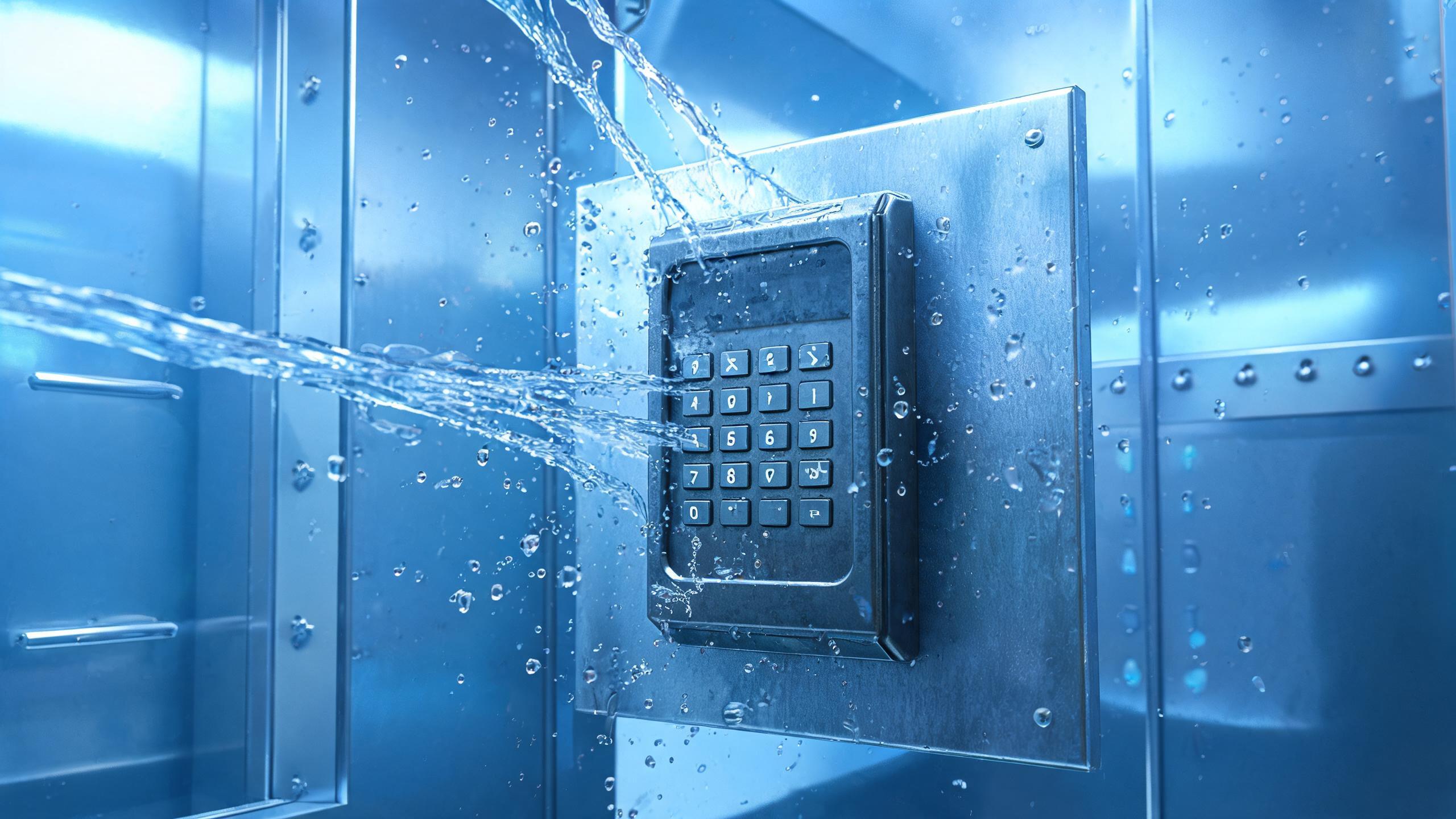
An IP (Ingress Protection) code, defined by IEC 60529, describes how well an enclosure keeps solid objects and water out. It carries two digits: the first rates solids from 0 (no protection) to 6 (dust-tight), and the second rates water from 0 to 9K (IPX4 splash, IPX5 water jets, IPX6 powerful jets, IPX7 temporary immersion to 1 meter for 30 minutes, IPX8 continuous immersion under manufacturer conditions, and IPX9K high-temperature high-pressure spray). For smart locks, common claims sit between IP54 (dust-protected, splash-resistant) for sheltered entrances and IP66 (dust-tight, powerful-jet resistant) for exposed outdoor keypads. Two cautions matter in procurement: the code certifies the tested enclosure in laboratory conditions, not corrosion resistance (covered by salt-spray classes) or survival of pressure washing; and cable glands, door gaps and retrofit fit can erase a rating on site. This guide explains how to specify IP codes and what evidence our factory provides for named SKUs per quotation.
IP rating at a glance
| Standard | IEC 60529 defines the IP code internationally; identical European and national versions include EN 60529. |
| First digit | Solids: 5 means dust-protected (ingress permitted but not harmful), 6 means dust-tight under continuous vacuum test conditions. |
| Second digit | Water: 4 splashing, 5 jets, 6 powerful jets, 7 immersion 1 m/30 min, 8 deeper or longer immersion, 9K high-pressure hot spray. |
| Typical lock claims | IP54 for sheltered entries, IP55 or IP65 for exposed keypads, IP66 for jet-wash-exposed sites; the rating is for the tested enclosure only. |
| X placeholder | An X (IPX4) means that characteristic was not assessed, not that it failed or passed — check the exact marked code. |
| What it excludes | Corrosion, ice, UV aging, steam cleaning beyond 9K conditions, vandalism and mechanical force; salt-spray and IK ratings cover separate risks. |
| Evidence | An IEC 60529 test report naming the SKU, the tested configuration (glands, caps, mounting) and the laboratory; marketing numbers without reports are unverified. |
Answer unit
Which IP code should each project location specify?
Specify from the actual exposure: rain direction and pressure, canopy geometry, cleaning regime and dust environment all drive the second digit. Over-specifying costs money; under-specifying creates warranty disputes.
| Location | Common code | Reason |
|---|---|---|
| Indoor corridor, office | No code required or IP20-style basic | No water exposure; vandal and finish specs dominate. |
| Sheltered residential entrance | IP54 | Dust plus wind-driven splash under a canopy. |
| Exposed apartment front door | IP55 or IP65 | Direct rain and occasional cleaning jets. |
| Gate and perimeter readers | IP66 | Powerful directional spray and open weather. |
| Pool, spa and marine areas | IP66 plus corrosion evidence | Humidity and chlorides matter more than the IP digit. |
| Food or pharma washdown zones | IP66 or IPX9K as specified | High-pressure hot cleaning is a distinct test. |
Markets, products and evidence
The rated enclosure only works when installed as tested. The table below lists the site factors that most often cause an IP-rated lock to fail in the field despite a valid certificate.
| Opening | Typical door | Lock approach |
|---|---|---|
| Cable entries | Specified glands and drip loops | The most common path water finds into an enclosure. |
| Mounting surface | Flat backing and supplied gasket | Warped or rough doors break the seal face. |
| Battery covers | Cover seated and screw torqued per manual | A loose cover voids every digit on the label. |
| Door gaps and drainage | Water managed at the door, not the lock alone | Trapped standing water exceeds any splash test. |
| Canopy and exposure | Site geometry mapped to jet versus splash | A claimed IPX4 under full rain exposure will fail. |
| Cleaning regime | Pressure washers kept away unless 9K-tested | IP65 is not a steam-cleaning warranty. |
Documentation pack for an IP-rated smart lock
For named outdoor SKUs our factory supplies the pack below per quotation, so specifiers can distinguish genuinely tested enclosures from catalog numbers copied from a component datasheet.
| Component | Typical logic | Notes |
|---|---|---|
| IEC 60529 test report | Laboratory report stating the exact code and test conditions. | Core evidence for the IP claim. |
| Configuration photos | How glands, caps and gaskets were arranged during the test. | Shows the configuration installers must reproduce. |
| Installation drawing | Mounting, gasket, drainage and cable-entry requirements. | Protects the rating in the field. |
| Maintenance guidance | Gasket inspection and cover replacement intervals. | Seals age; the rating assumes maintained seals. |
| Scope letter | Which SKU and which face (outside escutcheon) carries the code. | Interior halves of split locks are often unrated. |
IP specification workflow
- Assess exposureRecord rain geometry, canopy, dust, cleaning method and chemical atmosphere.
- Choose the codeWe propose SKUs with a tested IP code matching the site conditions.
- Verify the reportThe IEC 60529 report and configuration photos accompany the quotation.
- Install to the drawingGlands, gaskets and drainage are inspected during commissioning.
- Maintain the sealsScheduled gasket and cover checks preserve the rating over service life.
Related standards
Related standards and door types
Buyer questions about IP ratings
What exactly do IP54, IP65 and IP66 mean on a smart lock?
IP54 means the enclosure is dust-protected (some dust may enter but harmlessly) and resists water splashed from all directions. IP65 means it is dust-tight and withstands water projected by a 6.3 mm nozzle from any direction. IP66 keeps dust-tightness and raises water resistance to powerful jets from a 12.5 mm nozzle. Tests are performed on the finished enclosure with specified water volumes, pressures and durations under IEC 60529. An outdoor residential entrance commonly accepts IP54 under a canopy or IP55/IP65 when exposed; gate readers and perimeter sites trend to IP66. The marked code must match the tested configuration, including glands and covers, not just the plastic shell.
Does a higher IP rating mean the lock is better built?
Only at resisting ingress; it says nothing about overall quality. IP testing measures enclosure sealing against dust and water under laboratory conditions, not hinge strength, electronics reliability, encryption, corrosion resistance or handle abuse. An IP66 lock with poor internal coatings can still corrode in a salty poolside environment, and an IP54 lock built with premium components may outlast it in a sheltered lobby. Specifiers should treat the IP code as one attribute alongside salt-spray class, the EN or ANSI mechanical grade, IK impact rating and the warranty terms. Selecting IP66 everywhere also adds cost and can complicate battery access, so matching the code to exposure is the professional approach.
What is the difference between IPX7, IPX8 and IPX9K?
The X shows solids were not assessed. IPX7 means the enclosure survived immersion in 1 meter of water for 30 minutes; IPX8 means deeper or longer continuous immersion under conditions the manufacturer defines; IPX9K is a separate high-pressure, high-temperature spray test (80 °C water at high pressure and flow from defined angles), originally developed for vehicles and washdown equipment. Critically, the tests are not cumulative unless marked so: an IPX7 device has not automatically passed jet testing, so a lock might be rated IP67 (jets are not implied) rather than IP66. For doors, washdown environments like food or pharma sites need a code that explicitly includes the jet or 9K condition they use.
Does the IP rating survive installation and years of weather?
It survives only if the enclosure keeps the tested configuration and its seals remain intact. Cable glands substituted on site, missing drip loops, warped mounting plates, missing gaskets, cross-threaded battery covers and retrofits onto uneven doors are the common reasons a rated lock leaks. Outdoor seals also age under UV, ozone and temperature cycling, so the rating assumes the maintenance regime in the manual — periodic gasket inspection and cover replacement. Reputable manufacturers supply installation drawings that reproduce the tested arrangement and make the outside/inside split explicit, because the escutcheon facing rain may be rated while the interior half is not.
How do I verify an IP claim instead of trusting a catalog?
Ask for the IEC 60529 test report and check four fields: the applicant and model must match the quoted SKU; the rated code must match the marketing claim; the tested configuration must show the same cable glands, gaskets and battery cover as the shipped product; and the laboratory must be a credible independent facility. Some suppliers cite the IP rating of an internal component (a keypad module) as if the whole lock carried it, which a careful report reveals. For projects with exposure, request configuration photographs and the installation drawing, and have the first installed units inspected against them. Our factory provides the full report for every outdoor SKU we claim a code for.
Need the IEC 60529 report for an outdoor lock?
Describe the entrance exposure and cleaning regime. We quote SKUs with the matching tested IP code and provide the full ingress report, configuration photos and installation drawing.
Request Spec Sheet + QuoteCertifications overviewLast updated: October 31, 2026 · Reviewed by the Smart Lock Factory editorial team