
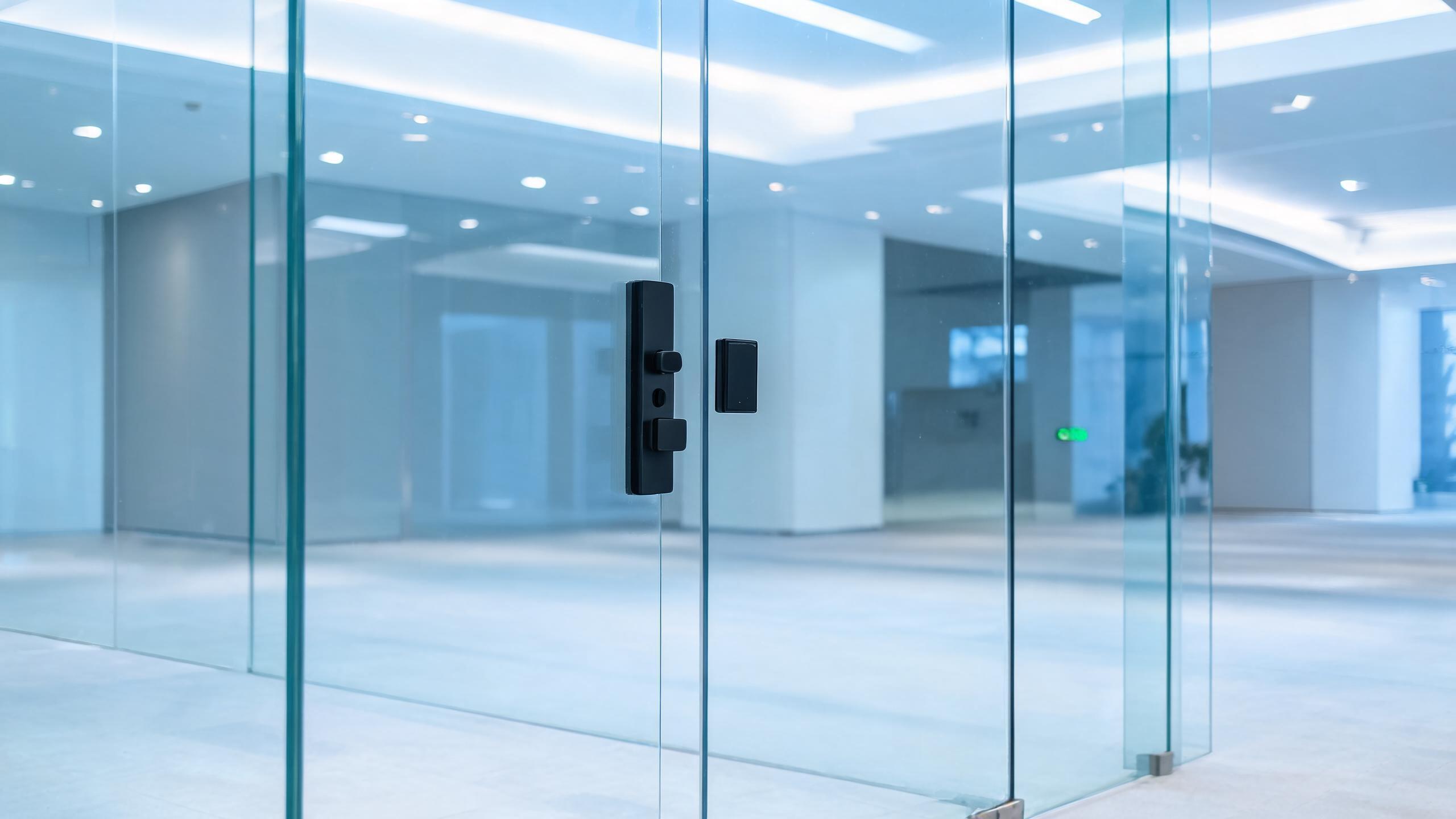
Door types
Smart locks for frameless glass: clamp hardware protects the pane
Frameless tempered glass cannot be drilled on site. Smart locks clamp between patch fittings, and the access strategy is designed with the floor spring and the gap.
Frameless glass doors derive their strength from tempered panes and patch fittings at the corners; the glass itself cannot be field-drilled without catastrophic failure risk. Smart access on frameless doors therefore uses clamp-on patch locks, electrified patch strikes, or access control on an adjacent framed leaf or gate. Glass thickness is typically 10–12 mm for interior leaves and up to 15 mm for toughened exterior doors, and every electronic component must accommodate the floor-spring swing and maintain finger clearance. This guide covers patch standards, double-leaf coordination, fail-safe behavior and the information we need for a written fit confirmation.
Frameless glass fit at a glance
| Glass rule | Only fully tempered safety glass is used for frameless doors; all holes and cut-outs are made before toughening at the factory. |
| Thickness band | Interior leaves commonly run 10–12 mm; exterior toughened doors may reach 15 mm; clamps are thickness-specific. |
| Patch fittings | Locks and pivots clamp at corners; patch series must match across the project for interchangeability. |
| Floor spring | Closing force and hold-open are set at the floor spring; the electronic lock only secures the closed position. |
| Double leaves | One leaf often carries the strike or overlapping stile; the active leaf gets the reader and lock. |
| Fail-safe | Glass entrances in escape routes release on alarm; electrified patches follow the fire strategy, not convenience. |
| Weather | Exterior patches need drainage and rated seals; interior patch locks are not weatherproof by default. |
Answer unit
Where is access control installed on a frameless entrance?
Electrified patch locks secure the leaf directly; where fire strategy or traffic demands, access moves to an adjacent framed door, gate or speedlane in the lobby.
| Position | Typical setup | Considerations |
|---|---|---|
| Electrified patch lock | Clamp lock at top/bottom corner of active leaf | Glass thickness and patch series matched at order |
| Electric strike patch | Strike patch on passive leaf | Fail-secure/safe set per fire design; alignment critical |
| Reader on glass | Adhesive or clamp reader near the handle line | Cabling routed through floor or transom, not the pane |
| Adjacent framed door | Glass leaf free-exit, framed door controlled | Common where DDA/width or fire strategy favors it |
| Lobby speedlanes | Glass outer doors on hours, lanes control entry | Typical corporate reception arrangement |
| Motor operator + access | Sensor operator unlocked by credential | Best for high-traffic accessible entrances |
Door types and lock-body match
Patch locks are ordered to the exact glass thickness and overlap dimension; a clamp sized to 12 mm will not properly secure a 10 mm leaf.
| Opening | Typical door | Lock approach |
|---|---|---|
| Office interior leaf | 10–12 mm tempered single leaf | Battery patch smart lock or electrified patch |
| Double retail entrance | Two tempered leaves with floor springs | Active/passive roles defined; strike on passive leaf |
| Exterior storefront | 12–15 mm toughened glass | Weather-sealed patch hardware and drainage |
| Meeting room | Single frameless leaf in partition | Simple privacy/electronic latch, light duty |
| Hotel lobby screen | Interior glass portal behind framed main doors | Access controlled at outer doors, patches free running |
| Server room viewport | Framed is preferred; if frameless, verified patches | High-security openings generally use framed doors |
Example BOM shape for a frameless glass entrance
This example illustrates a typical configuration, not a specific customer project. Thickness, patch series and floor springs drive the list.
| Component | Typical logic | Notes |
|---|---|---|
| Electrified patch locks | One per active leaf, thickness-specific | Finish coordinated with pulls and spines |
| Strike patches | On passive leaves or frames | Fail state set per fire strategy |
| Readers and operators | Clamp readers and optional motor operators | Cabling paths through floor or transom |
| Floor spring service | Closing force adjusted during commissioning | Lock engagement verified at closed position |
| Spare patches | Small stock of matched series for service | Mixing patch brands is avoided |
How frameless glass access is delivered
- Survey the glassRecord thickness per leaf, tempering marks, existing patch brand and floor spring model.
- Set leaf rolesDefine active and passive leaves, swing direction and overlap, plus escape-route obligations.
- Choose control pointPatch lock, electric strike, adjacent door or lobby lanes per security and fire design.
- Fit before finishingAll patches and cabling are installed with the glazier before final floor trim.
- Commission the closureTune the floor spring so the lock engages cleanly and release is tested on alarm.
Related door types
Related glass door guides
Frameless glass doors: common questions
Can you drill a frameless glass door to fit a smart lock?
Not after tempering. Frameless doors are toughened safety glass, and any hole or notch must be cut in the annealed pane before heat treatment; drilling tempered glass on site risks immediate shattering. All smart hardware therefore clamps onto the pane or replaces patch fittings at the corners, which are already engineered load points. When a project needs cabling, it is routed through the floor, transom or an adjacent stile rather than through the glass. The patch series and exact thickness are confirmed before order because clamp plates are thickness-specific and cannot be shimmed safely.
What thickness should frameless smart-lock doors be?
Interior office leaves commonly use 10 or 12 mm tempered glass, while exterior entrance doors in toughened frameless systems typically run 12–15 mm depending on span, wind load and local code. Thickness is decided by the glazier and facade engineer rather than by the lock brand; the lock is then selected from clamps rated for that exact pane thickness. Span, floor spring capacity and any laminated makeup also affect the schedule. Under-specified thin glass flexes, causing patch misalignment and intermittent latching, which is why fit confirmation always references the glazing schedule drawing.
How do smart patch locks behave in an emergency?
Electrified patches on escape-route glass doors follow the fire and life-safety design: monitored fail-safe release on alarm is common, with immediate free egress from the inside regardless of credential state. Battery patch locks on non-egress interior rooms may simply unlock electronically while allowing mechanical release. The floor spring keeps the leaf controlled after release rather than swinging free. Because glass entrances often sit in lobbies, many projects keep the outer glass doors openable and enforce real access control at speedlanes or an adjacent framed door, simplifying compliance and accessible operation.
Do frameless glass locks work outdoors in rain?
Only exterior-rated patch hardware belongs on exposed leaves. Interior patch locks use electronics and finishes that tolerate office conditions, not driving rain and washdown. Exterior sets add sealed clamp bodies, drainage at the threshold, corrosion-resistant finishes and compatible weatherstripping at the overlap. The cable exit at a reader is the most common water path and is always sealed and looped downward. Projects should name the exposure — canopy-covered, fully exposed or coastal — in the RFQ so the correct patch family is quoted rather than upgrading an interior part in the field.
Can access control be added to an existing frameless entrance?
Yes, with two practical paths. The direct path replaces passive or active corner patches with electrified equivalents matching the existing series and pane thickness, and adds a clamp reader; this needs a glazier and floor-spring check. The indirect path keeps the glass untouched and adds a framed control door, gate or speedlane inside the lobby — often cheaper and simpler for high-traffic corporate entrances. A short survey of patch branding, glass thickness, swing and cable routes determines which path is viable, and a single-leaf pilot confirms latching before the remaining entrances are converted.
Specify smart access for frameless glass entrances
Send the glazing schedule with thickness, patch brand and swing direction — receive a patch-lock map and pilot plan in writing.
Discuss your project (RFQ)Project configurationsLast updated: October 31, 2026 · Reviewed by the Smart Lock Factory editorial team