
Door types
Smart locks for security doors: hardware matched to a door built to resist
A security door is a system of steel, multi-point bolts, frame and lock. Smart credentials add control without weakening the mechanical core that defines the rating.
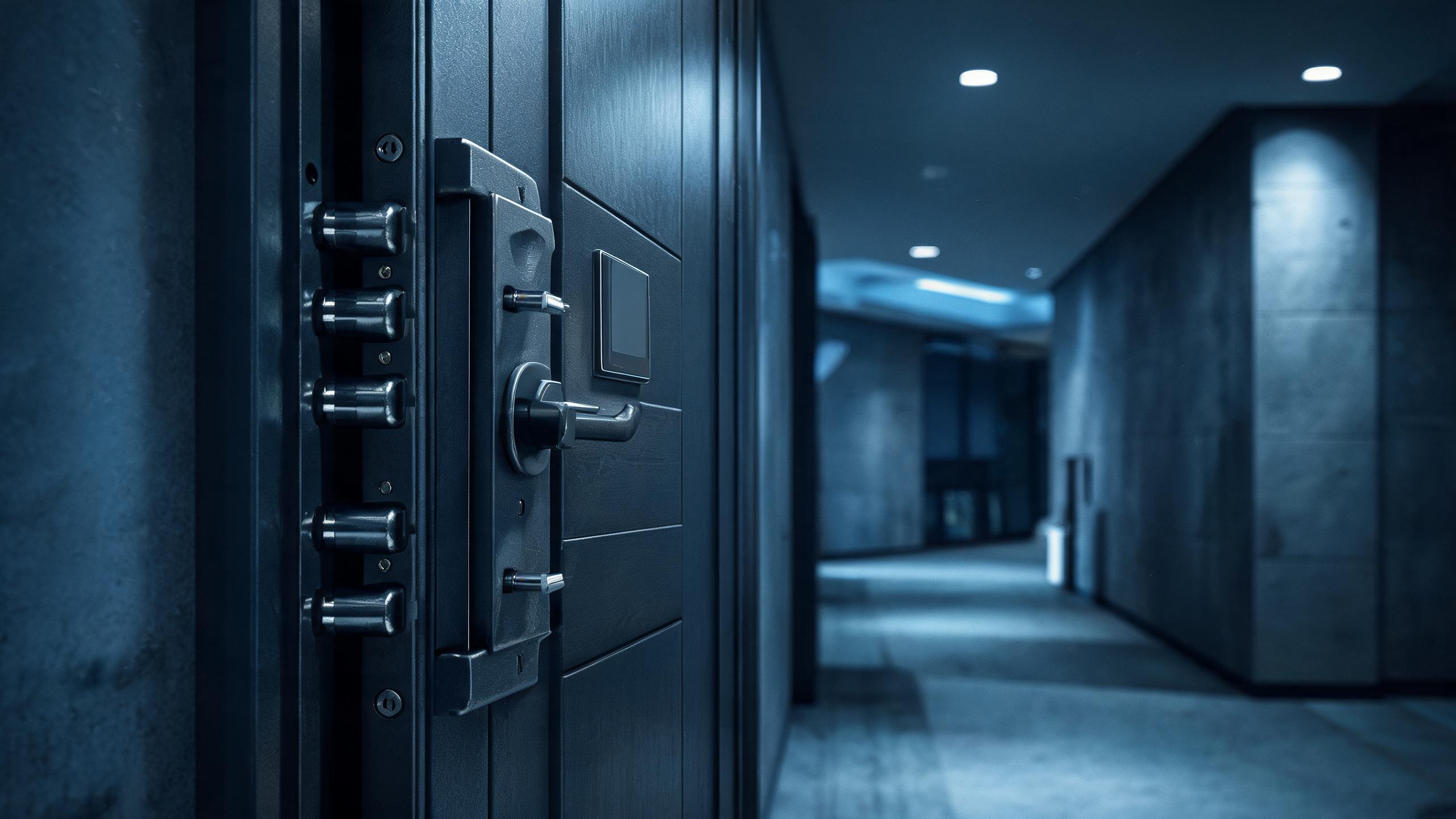
Security doors — steel-clad entrances, multi-point security doors and institutional high-resistance leaves — are specified to resist forced entry over time, so the lock is one component in a coordinated system: a high-strength mortise body or Grade 1 deadbolt, a reinforced or electric strike, security cylinders with anti-snap/anti-drill features, and often multi-point rods driven from the lock. Smart access is layered onto that core through credential readers and audit rather than replacing the protective mechanics. This guide maps the security door families, the lock standards that matter, and the documentation buyers request for high-risk openings.
Security door lock at a glance
| System thinking | Door leaf, frame, hinges, lock and strike are tested as one assembly; a smart lock does not raise the door’s own rating. |
| Lock body | BHMA Grade 1 mortise or heavy deadbolt bodies are typical; light residential smart locks are not used. |
| Multi-point rods | Some security doors throw top and bottom rods from the lock gear; the smart actuator must drive full travel. |
| Cylinders | Anti-snap, anti-drill, anti-pick cylinders with restricted key sections protect the credential override path. |
| Strikes | Reinforced steel strikes, sometimes electrified and monitored, anchor into structural frames. |
| Standards | Buyers reference BHMA grades, EN 12209/14846 classes, UL listings and local burglary standards by market. |
| Evidence | Test reports and certificates are provided for named SKUs and written into the quotation scope. |
Answer unit
Where does smart access plug into a security door system?
Credentials control an electrified high-grade lock body or a monitored strike; the mechanical resistance core and its certification remain unchanged.
| Layer | Mechanical core | Smart/access layer |
|---|---|---|
| Lock body | Grade 1 mortise or security deadbolt | Solenoid or motor release inside the same body |
| Cylinder | Anti-attack key cylinder | Electronic knob or reader as alternative credential |
| Strike | Reinforced steel keep | Electric strike with position monitoring |
| Multi-point | Rods driven from gearbox | Motor gear with full-travel confirmation |
| Hinges | Anti-lift pin hinges | Door-open time monitoring via contact |
| Override | Restricted mechanical keys | Held by named security officers only |
Door types and lock-body match
The strongest lock is irrelevant if hinges can be lifted or the frame is unanchored; the full schedule is reviewed, not just the credential device.
| Opening | Typical door | Lock approach |
|---|---|---|
| Steel security entrance | Steel-clad leaf in anchored frame | Grade 1 electrified mortise + security cylinder |
| Multi-point residential | Reinforced door with rod locks | Smart motor gear driving all points |
| Institutional portal | High-resistance labeled assembly | Listed body, monitored strike, dual control |
| Safe-room / strong room | Maximum resistance schedule | Mechanical core dominant; access tightly logged |
| Retail cash office | Security door inside a normal shop | Grade 1 deadbolt, audit, time delay optional |
| Residential security screen | Steel grille security screen door | Security screen lock, separate from main door |
Example BOM shape for a security door project
This example illustrates a typical configuration, not a specific customer project. Door rating and frame drive the list.
| Component | Typical logic | Notes |
|---|---|---|
| Grade 1 lock bodies | Electrified mortise or heavy deadbolts | Certified as named SKUs |
| Security cylinders | Anti-attack restricted key sections | Key holders defined in writing |
| Electric / monitored strikes | Reinforced keeps with latch status | Fail state per security and fire design |
| Multi-point actuation | Motor gearboxes with rod-travel monitoring | Commissioned end-to-end |
| Evidence pack | Test reports and certificates per model | Supplied per quotation scope |
How security door smart access is specified
- Read the door scheduleIdentify leaf rating, frame anchoring, hinges and existing lock standard.
- Define threat modelState attack resistance, audit and dual-control requirements per opening.
- Select certified hardwareChoose Grade 1 or classed bodies with matching cylinders and strikes.
- Integrate credentialsAdd reader and controller without altering the certified mechanics.
- Test as a systemVerify attack-relevant fixings, egress, monitoring and fail states in commissioning.
Related door types
Related security and standards guides
Security doors: common questions
Does adding a smart lock make a door a security door?
No. A security door earns its resistance from the tested combination of leaf construction, frame anchoring, hinges, locking points and strike; a credential reader or smart escutcheon changes how users prove identity, not how long the assembly resists attack. Bolting an electronic lock to an ordinary timber door does not transfer the smart lock’s marketing claims to the door, and it can even weaken a certified door if non-listed parts are introduced. The correct sequence is the reverse: take a security door schedule already meeting the required standard, then select an electrified version of its listed lock body or a listed electric strike. Evidence is requested for the named model, not the brand generally.
Which BHMA grade should a security door lock have?
High-risk security doors are normally specified at BHMA Grade 1, the heaviest certified duty, with attention to the specific tests behind the grade rather than the number alone — cycle, torque, strength and security evaluations matter differently by opening. European and international projects instead reference EN 12209 mechanical and EN 14846 electromechanical lock classes, plus market-specific burglary standards where applicable. Grade/class selection follows the threat model: a cash office, embassy wing and utility meter room do not share identical requirements. We provide the certificate for the exact SKU with its listed scope, and buyers in regulated sectors submit that evidence to their specifier or approving authority.
How are multi-point security doors motorized for smart access?
Multi-point doors throw a central lock plus top and bottom rods into the frame; the electrified version uses a motor gearbox designed for that specific gear, with current or position sensing to confirm all points have fully traveled rather than assuming closure from the handle position. Installation and commissioning check rod alignment in their keepers, because a bent rod causes partial locking that looks correct at the handle. Mechanical override and free egress remain available inside. Where the door is fire-rated, the motorized gear must be part of the listed assembly. This is fundamentally different from adding a keypad to a single-point door and is specified at fabrication for new security doors rather than field-added.
What cylinder security features matter on security doors?
The override cylinder is a critical path because it survives even when electronics are destroyed: anti-snap geometry controls the common snapping attack, hardened inserts resist drilling, anti-bump and pick-resistant pinning defeat manipulation, and restricted key sections prevent unauthorized key copying. High-security cylinders are delivered with a security card or registration system that controls duplicate keys. These features are specified explicitly because a Grade 1 body can still be paired with a weak cylinder by mistake. Key custody policy — who holds registered keys, where blanks are stored — completes the physical layer and is documented alongside the electronic credential rules.
Can smart security locks be opened by manipulating the electronics?
Credential systems are designed around layered protections: encrypted credential exchange, tamper alarms, lockout after repeated attempts, and audit trails, while high-security openings separate the reader from the controller inside the secured space so damaging an exterior reader cannot release the door. No electronic system is absolute, which is precisely why mechanical cores remain strong and why security doors also rely on monitoring and response rather than a single device. Buyers should request the security whitepaper for the platform, define credential issuance and revocation policy, and test loss scenarios (stolen card, departed employee) during commissioning. We document both electronic and mechanical measures per model rather than claiming the electronics alone make the opening impenetrable.
Specify smart access within a certified security door
Send the door rating, frame and threat requirements — receive a listed hardware map with certificates for named models and written terms.
Discuss your project (RFQ)Project configurationsLast updated: October 31, 2026 · Reviewed by the Smart Lock Factory editorial team