
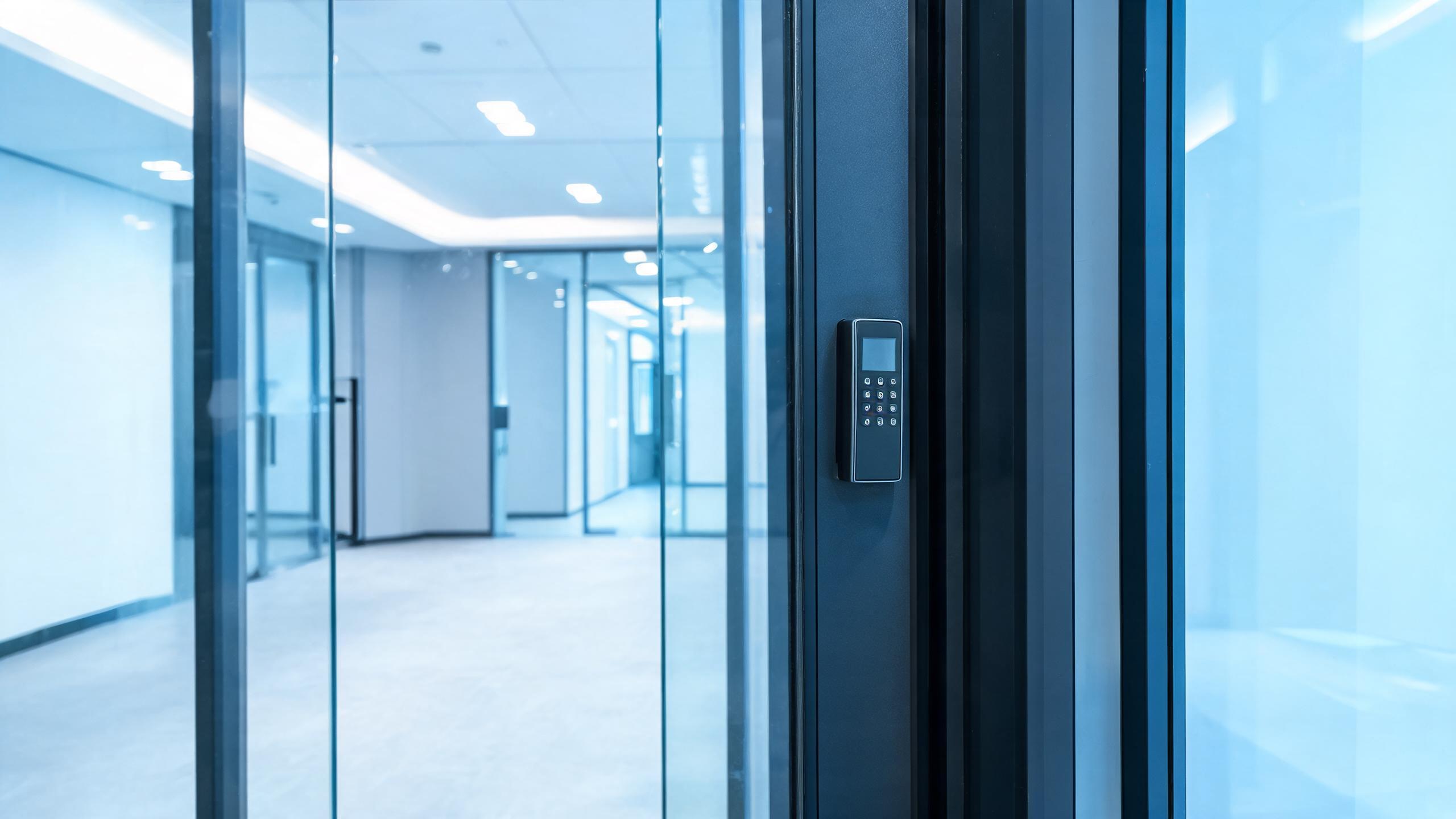
Door types
Smart locks for framed glass: the stile carries the hardware
A framed glass door gives you something to bolt to. Fitment follows the stile width, lock channel, handle center distance and whether the frame is aluminum or steel.
Framed glass doors — aluminum or steel stiles around a tempered or laminated pane — accept a much wider range of smart locks than frameless doors because the stile provides a real mounting structure. Even so, fitment is driven by the profile: stile face width determines escutcheon size, the internal chamber decides whether a Euro cylinder, mortise body or electric strike fits, and the handle center distance must line up with the glass cut-out. This guide separates aluminum framed glass from hollow metal framed glass, explains the electrification options, and lists the measurements and drawings we require for written fit confirmation.
Framed glass fit at a glance
| Frame material | Aluminum profiles use chambers and Euro cylinders; hollow metal framed doors use ANSI preps and strikes. |
| Stile width | Face width from about 40 mm upward limits escutcheon width; wide stiles accept mortise bodies. |
| Glass cut-out | Lock and handle positions are cut into the glass before toughening; hardware centers must match. |
| Cylinder path | Electronic Euro cylinders suit aluminum; ANSI cylinders or smart bodies suit hollow metal. |
| Electric strike | A strike in the frame is often cleaner than a lock in a narrow stile and preserves the handle set. |
| Reader mounting | Mullion, clamp or stile-surface readers follow available flat area and cable route. |
| Documentation | Frame shop drawings and an elevation showing centers are requested for project fit checks. |
Answer unit
Aluminum stile or hollow metal frame?
Aluminum framed glass follows Euro/chamber logic; hollow metal framed glass follows ANSI prep and strike logic, just like solid steel doors.
| Frame | Typical hardware channel | Smart access path |
|---|---|---|
| Narrow aluminum stile | Euro chamber, limited face width | Electronic Euro cylinder or slim escutcheon |
| Wide aluminum stile | Larger chamber with routing room | Smart mortise-style body or motor lock |
| Hollow metal frame | ANSI cylindrical or mortise prep | ANSI smart lock or electric strike |
| Steel storefront frame | Welded steel with strike plate | Heavy-duty smart body or strike with reader |
| PVC-framed glass | Welded uPVC chamber with gearbox | Electronic Euro cylinder (see uPVC guide) |
| Stainless-framed door | Box section stainless stile | Plate-mounted escutcheon, corrosion-rated |
Door types and lock-body match
Hardware center positions are set when the glass is cut; moving the lock after fabrication means replacing the pane, not drilling it.
| Opening | Typical door | Lock approach |
|---|---|---|
| Office partition door | Aluminum stile, tempered glass | Euro smart cylinder or slim escutcheon |
| Exterior storefront leaf | Thermally broken aluminum frame | Profile-matched smart lock, sealed fixings |
| Steel-framed lobby door | Hollow metal stiles with glass | ANSI smart body or electric strike |
| Meeting room door | Slim framed single leaf | Electronic cylinder, light traffic |
| Hospital / lab door | Metal frame with wired glazing | Strike/exit hardware to clinical fire schedule |
| Retail double leaf | Two framed leaves, central meeting stiles | Active leaf lock, passive leaf flush bolts |
Example BOM shape for framed glass rollout
This example illustrates a typical configuration, not a specific customer project. Frame material and centers drive the split.
| Component | Typical logic | Notes |
|---|---|---|
| Stile smart locks | Euro or ANSI bodies per frame family | Escutcheon finish matched per project |
| Electric strikes | For narrow stiles and fire doors | Fail state set per opening schedule |
| Readers | Mullion or stile-mounted credential readers | Cable routes planned in shop drawings |
| Matching cylinders | Electronic cylinders per measured chamber | Cam and length cut to door |
| Pilot lot | One opening per frame type validated | Centers and closing verified pre-rollout |
How a framed glass smart lock is confirmed
- Classify the frameDetermine aluminum, hollow metal, stainless or PVC frame and record series.
- Read the drawingCheck stile width, chamber, glass cut-out centers and handle height.
- Select body or strikeChoose lock in stile versus electric strike in frame per space and fire role.
- Pilot one of eachFit a sample per frame series, testing swing, latch and reader cable.
- Fix the scheduleRelease fabrication with hardware positions and readers coordinated.
Related door types
Related framed and glass guides
Framed glass doors: common questions
What is the difference between smart locks for framed and frameless glass?
Framed glass doors have aluminum or steel stiles that carry conventional lock bodies, cylinders and strikes, so the retrofit behaves like a normal door once the chamber and center distances match. Frameless doors have no stile; hardware clamps to engineered patch fittings on the tempered pane and cannot be drilled. Framed projects therefore have more choices — Euro cylinders, slim escutcheons, ANSI bodies or electric strikes — while frameless projects are limited to patch-family hardware. Cost and install time are usually lower on framed doors, and more heavy-duty security options exist.
Can a smart lock be fitted to a narrow aluminum framed glass door?
Yes, but the path follows the chamber rather than the visible stile alone. A narrow 40–70 mm face rarely accepts a wide residential smart escutcheon, yet most such stiles house a standard Euro-profile chamber, so an electronic Euro cylinder upgrades the door with zero new glass or routing. When credentials must present on the face, a profile-specific slim escutcheon with clamp fixing is used. An electric strike in the frame is another clean route that leaves handle centers untouched. The profile section drawing confirms which route is available before anything is ordered.
Do handle center distances matter when ordering?
They are decisive on framed glass. The lock hub, cylinder hole and handle are cut into the glass before toughening, and the frame holes are punched at fabrication, so an escutcheon with a different center distance cannot be adjusted on site. Standard regional distances vary, and mixed developments can contain more than one. The elevation drawing is checked for the handle center, cylinder center and any thumb-turn position before lock models are committed. Where multiple center distances exist in one building, the model list is split by series instead of forcing one SKU across the project.
Are electric strikes better than lock bodies on framed glass?
They solve different situations. A smart lock body in the stile delivers credentials and mechanics in one unit and suits medium-security offices and meeting rooms. An electric strike keeps the existing mechanical handle set — often an aesthetic or warranty requirement — and adds control at the frame, which is also the normal choice on fire doors where listed strikes preserve the schedule. Downsides include cabling through the frame and defining fail-secure/fail-safe behavior. New fabrication can route cables cleanly; retrofits may rely on battery smart cylinders instead. Each opening is classified during the survey rather than standardized blindly.
What information is needed for a framed glass project quote?
The fastest package includes the frame series or a cross-section drawing, stile face width, material (aluminum, hollow metal, stainless or uPVC), the elevation showing handle and cylinder centers, door thickness including glass, and the swing and handing. Photos help for retrofits, while new projects should supply the door fabricator’s shop drawings. Fire labels, exterior exposure and any existing access control wiring complete the picture. With that package we return a model-by-model fit map with named SKUs; without it, quotation stays generic and sample fitting is advised.
Map smart locks to your framed glass shop drawings
Send frame series, stile width and elevation centers — receive a per-opening hardware map with sample and documentation terms.
Discuss your project (RFQ)Project configurationsLast updated: October 31, 2026 · Reviewed by the Smart Lock Factory editorial team