
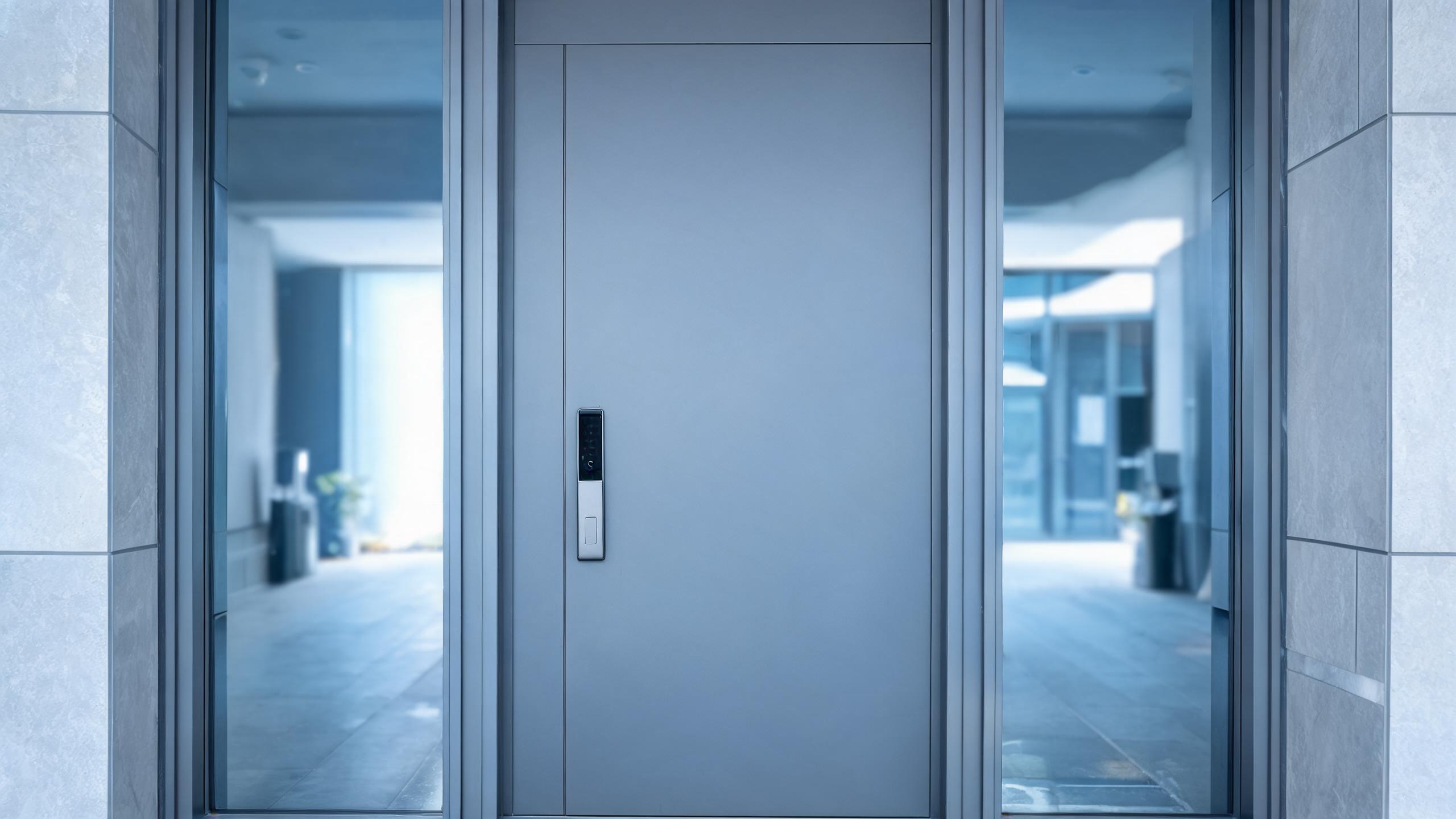
Door types
Smart locks for aluminum and broken-bridge entrances: slim profiles demand slim hardware
Thermally broken aluminum storefronts and narrow-stile doors have little metal to spare. The fitment follows the profile chamber, cylinder type and handle spacing.
Aluminum doors are profile-based systems: extruded stiles, thermal breaks, glass infill and hardware channels defined by the system house. Conventional thick wooden-door smart locks usually cannot mount on narrow aluminum stiles without visible adapters or compromised fixing. Successful projects use one of three paths — an electronic Euro-profile cylinder in the existing chamber, a slim escutcheon or clamp-on plate designed for narrow profiles, or electrified hardware (electric strike, motorized latch) inside the frame. This guide maps profile measurements, thermal-break protection and the photographs needed for a written fit confirmation on aluminum and broken-bridge doors.
Aluminum door fit at a glance
| Profile width | Narrow stiles (often 40–70 mm visible face) limit escutcheon width; clamp or slim-format hardware is used. |
| Thermal break | Fixings must not bridge the polyamide thermal barrier incorrectly; hardware selection preserves the door’s thermal and warranty performance. |
| Cylinder chamber | Most aluminum systems use a Euro-profile chamber; electronic Euro cylinders are the fastest retrofit path. |
| Handle height | European and Asian handle heights differ; spindle offset and cylinder center distance are measured before ordering. |
| Glass and patch | Frameless adjacent panels use patch fittings, a separate hardware class from the framed leaf. |
| Frame electrification | Motorized frame latches and electric strikes need routed cabling through the profile, planned during fabrication where possible. |
| Fit confirmation | Profile cross-section datasheet or calipered stile photos are required for a written fit map. |
Answer unit
Which retrofit path fits an aluminum entrance?
Electronic Euro cylinders cover most existing chambers; slim escutcheons cover upgrade projects; frame-integrated motor locks are specified at fabrication for premium entrances.
| Path | Door situation | What is required |
|---|---|---|
| Electronic Euro cylinder | Existing mechanical Euro cylinder in the stile | Swap cylinder only, keep handles, no routing; cam length measured |
| Slim escutcheon | Customer wants keypad/card on a narrow stile | Profile-rated plate with clamp or blind fixings; handle offset checked |
| Frame motor lock | Premium storefront being fabricated | Motorized latch in frame header, reader on stile, coordinated wiring |
| Electric strike | Frame has a strike chamber | Strike matched to profile series; power and monitoring cabling routed |
| Patch glass adjacent | Frameless glass leaf beside the aluminum frame | Patch lock hardware specified separately, not a stile-mounted body |
| Reader-only upgrade | Motorized hardware already in frame | Add credential reader and controller; lock body unchanged |
Door types and lock-body match
The profile series matters more than the door brand: chamber, strike and routing positions differ between system houses even at identical visible widths.
| Opening | Typical door | Lock approach |
|---|---|---|
| Storefront entrance | Single or double narrow-stile aluminum leaf | Euro smart cylinder or slim escutcheon; electric strike if automated |
| Broken-bridge thermal door | Insulated residential/commercial aluminum | Non-bridging fixings; gasketed escutcheon to protect the seal |
| Office glass partition | Slim framed interior aluminum door | Light electronic escutcheon or Euro cylinder, low traffic load |
| Hotel / apartment entrance | Anodized aluminum system door | Profile-matched smart lock with online/offline credential choice |
| Sliding aluminum | Lift-slide or parallel-slide leaf | Hook-bolt smart lock family — see the sliding glass guide |
| Industrial aluminum gate | Wide-profile extruded gate | Weather-rated rim or Euro hardware, drainage and long fixings |
Example BOM shape for an aluminum entrance program
This example illustrates a typical configuration, not a specific customer project. Profile series and chamber drive the choice.
| Component | Typical logic | Notes |
|---|---|---|
| Smart Euro cylinders | One per leaf with measured cam and length | Finish matched to existing hardware |
| Slim escutcheons | For doors requiring keypad or card presentation | Clamp kits profiled to stile width |
| Frame motor locks | For new fabrication with header space | Coordinated with the system house routing |
| Readers and control | Mullion or surface readers at entrance stiles | Wired online or offline battery options |
| Sample validation | One cylinder/lock per profile series first | Fit confirmed before volume release |
How an aluminum smart lock project is validated
- Identify the profileRecord the system series and section drawing, or photograph calipered stile width and chamber.
- Measure the cylinderNote Euro length both sides, cam type, handle offset and center distance.
- Select the pathChoose electronic cylinder, slim escutcheon or frame motor lock per aesthetics and wiring access.
- Sample-fit on siteValidate one opening per series including closing force and weather seal.
- Release to fabricationLock positions and routing are fixed in the shop drawings before doors are produced.
Related door types
Related aluminum and glass guides
Aluminum and broken-bridge doors: common questions
Can you mount a standard smart lock on a narrow aluminum stile?
Usually not without compromise. Stiles on storefront and broken-bridge doors can be 40–70 mm wide, while many residential smart lock roses are wider and rely on through-bolts that find only thin aluminum and a thermal barrier. The robust paths are an electronic Euro-profile cylinder that replaces only the cylinder in the existing chamber, a slim escutcheon made for narrow profiles with clamp-style fixing, or a frame-integrated motor lock on new fabrication. Adapters that visibly bend around the stile or pierce the thermal break are avoided. The correct path is confirmed from the profile section drawing.
Will adding a lock damage the thermal break in broken-bridge doors?
Thermally broken aluminum separates inner and outer metal with polyamide strips, and hardware must be chosen so mounting screws or clamp plates do not create an uncontrolled metal bridge or crush the strips. Electronic Euro cylinders sit inside the existing chamber and are the least invasive option. Escutcheons use profile-specific clamp kits and sealing gaskets rather than long through-bolts. Where frame motor locks are installed, routing is coordinated with the system house during fabrication. The written fit confirmation covers fixing method; if the system supplier conditions warranty on its own hardware list, that list takes precedence.
Which measurements are needed for an electronic Euro cylinder?
Three measurements settle most orders: the cylinder length from the center screw to each outer face (inner and outer halves), the cam type for the specific lock body, and the handle/center distance where an escutcheon is also fitted. Door thickness is captured at the lock line, and any protruding weatherstrip is included. For aluminum doors the outer face often sits flush with the hardware channel, so an oversized cylinder protrudes and catches weather. A measured edge photograph with a ruler, or the system datasheet, allows us to cut or specify the exact cylinder length.
Are aluminum frame motor locks reliable for a busy commercial entrance?
Motorized frame locks are common on premium storefronts because the strong latch sits in the frame header rather than hanging off a thin stile. Reliability comes from correct specification: duty-rated motor, monitored latch position, battery backup or fail-safe strategy per the fire design, and integration with the operator and sensors. Installation is the critical factor — the motor, strike and closer must align or the door binds. For retrofits, access is usually simpler with an electronic cylinder or electric strike; frame motors are best planned at fabrication with shop drawings.
Can the same credential system work across aluminum and other door types?
Yes — credential strategy is independent of door material. A project can run electronic Euro cylinders on aluminum entrances, smart mortise locks on timber office doors, and electric strikes on steel stair doors under one card, code or mobile credential system, whether online or offline-capable. The hardware list is mixed, but identities, revocation and audit follow the same platform. During scheduling we map each opening to its fitting hardware family while keeping the reader and credential form consistent, so tenants meet one user experience across the building.
Confirm fitment for your aluminum profiles
Send the profile section drawing or calipered stile photos — receive a cylinder and escutcheon fit map for each entrance series.
Discuss your project (RFQ)Project configurationsLast updated: October 31, 2026 · Reviewed by the Smart Lock Factory editorial team