
Comparisons
Keypad codes versus RFID cards: which credential fits the door?
Codes cost nothing to issue and travel by message; cards are faster to tap and survive phone-free environments. Hotels and gyms run cards, rentals run codes, and mixed-use buildings increasingly issue both from one lock.
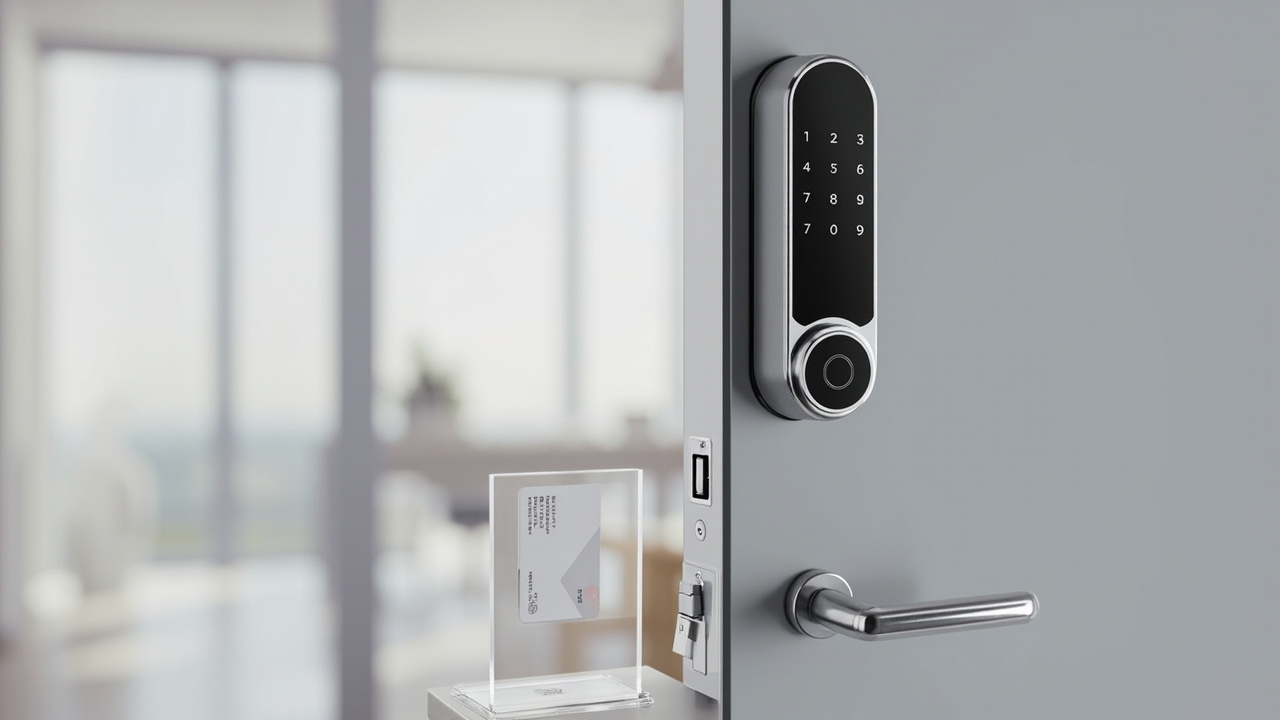
Keypads and RFID readers are the two workhorses of non-biometric electronic locking. A keypad verifies a remembered numeric secret: no credential medium exists, issuance is free and instant, and guests receive codes through booking messages without hardware handover; the costs are observation risk, forgotten codes, worn buttons and slower entry for frequent users. RFID verifies a presented card, wristband or fob: taps are fast and work in gloves and darkness, credentials are cheap to replace in bulk and amenity systems (turnstiles, lockers, elevators) share them; the costs are card logistics, front-desk encoders and cards being lent or cloned in CSN-only systems. Many commercial locks carry both readers so operators choose the issuance model per person. This guide compares the methods across hotels, rentals, offices and leisure; supported card types and code modes per model are confirmed per quotation.
Keypad vs RFID at a glance
| Credential medium | Keypads use a remembered code with no physical medium; RFID uses a card, fob or wristband that must be carried and presented. |
| Issuance cost | Codes are created and messaged at zero unit cost; RFID requires cards or wristbands and, in hotels, an encoder station. |
| Entry speed | Card taps are sub-second with no recall step; codes take longer and generate more queue time at busy entrances. |
| Turnover model | Codes are changed remotely between users; cards must be collected, deactivated or replaced when holders leave. |
| Shared amenities | RFID wristbands naturally extend to turnstiles, lockers and elevators; codes do not integrate beyond doors. |
| Security notes | Codes risk observation; CSN-only cards risk cloning, while keyed smartcards mitigate the latter. |
| Our policy | We document code modes, card IC support and reader behavior per SKU and commonly offer dual-reader hardware. |
Answer unit
Where does each credential win?
Rentals and unmanned sites favor codes for zero-logistics check-in; hotels, gyms and offices favor cards for speed and amenity sharing; mixed deployments buy dual-reader locks and choose per holder.
| Environment | Better credential | Practical reason |
|---|---|---|
| Short-term rental | Keypad codes | Self check-in with no key handover or card loss. |
| Full-service hotel | RFID keycards | Fast taps, amenity sharing and proven encoder workflow. |
| Gym or water park | RFID wristbands | Sealed credentials survive sweat, pools and lockers. |
| Small office | Either; dual-reader locks | Codes for visitors, cards for daily staff. |
| Construction site | Dated codes | Trades rotate weekly; no card stock to manage. |
| Student housing | RFID cards plus codes | One card for doors and meals; code for lockouts. |
Side by side across real projects
The credential decision follows the building logistics: who issues credentials, how fast people must flow through the entrance, and what else besides doors the credential should operate.
| Decision factor | First option | Second option |
|---|---|---|
| Issuance logistics | Instant and free via message or app. | Requires card stock, encoding and handover process. |
| Throughput | Slower typing creates queues at peaks. | Sub-second taps keep lobbies and turnstiles moving. |
| Lost credential | Change the code; nothing physical to replace. | Deactivate and reissue the card; small unit cost. |
| Amenity sharing | Limited to doors that accept codes. | One credential spans doors, lockers, lifts and payment. |
| Weather and gloves | Tactile buttons can work through thin gloves. | Hands-free tapping works with gloves and in darkness. |
| Cloning or sharing | Codes are shared deliberately and observed accidentally. | CSN cards can be cloned; authenticated cards resist this. |
Credential selection checklist
The choice propagates into front-desk design and guest instructions. The items below are confirmed for the shortlisted lock models before a credential standard is chosen site-wide.
| Checkpoint | What to confirm | Why it matters |
|---|---|---|
| Code capabilities | Code types, length, scheduling and capacity of the lock. | Self check-in depends on dated and one-time code support. |
| Card compatibility | Supported bands, card IC families and CSN versus keyed mode. | Defines clone exposure and encoder investment. |
| Encoder or app setup | Front-desk encoder model or app-based issuance workflow. | Hotel front desks need a documented backup procedure. |
| Amenity integration | Turnstile, locker and elevator readers sharing the credential. | Mixed-amenity sites should standardize one card scheme. |
| Visitor instructions | How codes or temporary cards reach visitors and expire. | Poor instructions generate the majority of support calls. |
Selecting the credential in five steps
- Map the populationSeparate residents, staff, guests and amenity users.
- Measure throughputCount peak-minute entries at each controlled entrance.
- Audit amenitiesList lockers, lifts, turnstiles and payment on one page.
- Price the logisticsCost card stock, encoders and labor versus code support calls.
- Pilot both methodsRun dual-reader locks at one site before standardizing.
Related comparisons and guides
Related credential comparisons and guides
Questions about keypad and RFID locks
Which is cheaper overall, keypad codes or RFID cards?
At the lock itself keypad hardware is usually cheaper and there is no per-credential cost: codes are generated in software and sent by message, making them the cheapest issuance model for unmanned rentals and construction sites. RFID adds card or wristband unit cost and often an encoder station, but it cuts labor at manned entrances because taps are much faster than typing and cards double as amenity credentials for lockers, elevators and payment. The real total-cost comparison therefore depends on throughput, staff wages and card loss rates rather than lock price alone. Hotels and gyms frequently find RFID cheaper to operate despite higher credential cost. We provide hardware and credential pricing separately per RFQ so buyers can model their own five-year logistics honestly.
Can RFID cards be copied like a cheap access badge?
It depends on the card mode. Basic 125 kHz proximity and CSN-only 13.56 MHz cards present a serial number that commodity writers can copy onto writable cards, which is why low-security amenity doors accept them but perimeter doors should not. Authenticated smartcard schemes — keyed MIFARE sectors or AES-based DESFire applications — require cryptographic keys the clone does not hold, so the transaction fails. Procurement should ask the supplier to state explicitly whether the reader operates in CSN or authenticated mode, because the card logo alone says nothing. Locks that also carry a keypad allow a migration posture with stronger credentials on high-risk doors and simple cards on amenities. Supported card ICs and operating modes for each model are documented per quotation.
Do hotels ever use keypad codes instead of keycards?
Some serviced apartments, guesthouses and digital-first hotels do use codes to eliminate front desks and card logistics, but mainstream hotels continue to favor RFID keycards because they integrate the full guest ecosystem: room door, elevator floor, energy-saving switch, parking, breakfast lounge and sometimes payments all read the same credential issued in one second at check-in. Cards also avoid asking guests to remember codes after travel and provide a physical fallback independent of phone batteries. Hybrid models exist where guests choose mobile keys or cards while staff carry codes. The deciding factors are front-desk model, amenity count and brand standard rather than technology alone. We supply both lock architectures and detail which PMS and amenity integrations each supports in writing per project.
What happens when a guest loses an RFID card versus forgetting a code?
A lost card is deactivated in the system or replaced at the lock level depending on the platform, and a new card is issued at reception; exposure is limited because the card itself carries no identity and, in keyed systems, cannot be cloned. Lost cards still carry a small unit and staff cost, which hotels price into operations. A forgotten code costs nothing to reset remotely but generates a support call or message exchange, which is painful for unmanned sites at 2 a.m.; rental operators mitigate with clear pre-arrival messages and offline code recovery. In student housing and offices, the standard pattern is both: cards for daily use and code or app paths for lockout moments. Replacement workflows and code-reset permissions for each platform are documented per quotation.
Can one lock support both keypad codes and RFID cards?
Yes, dual-reader locks are a standard product configuration: the same escutcheon carries a keypad and a 13.56 MHz or multi-frequency reader, and operators choose the credential per holder — cards for full-time staff and hotel guests, dated codes for deliveries, cleaners and one-off visitors. The combination reduces lockouts and lets a site evolve its credential policy without changing hardware. Buyers should confirm that the specific firmware exposes both readers simultaneously, which card families and code types coexist, and how audits distinguish the two credential types. Most mixed-use buildings we supply take this path. Reader combinations, simultaneous operation and credential capacities for each SKU are stated in writing per quotation and validated with samples.
Choosing between code and card credentials?
Share your entrance throughput, front-desk model and amenity list with your RFQ. We confirm code modes, card IC support, encoders and dual-reader configurations per model, with sample locks and credentials for end-to-end trials.
Request Spec Sheet + QuoteComparison overviewLast updated: October 31, 2026 · Reviewed by the Smart Lock Factory editorial team