
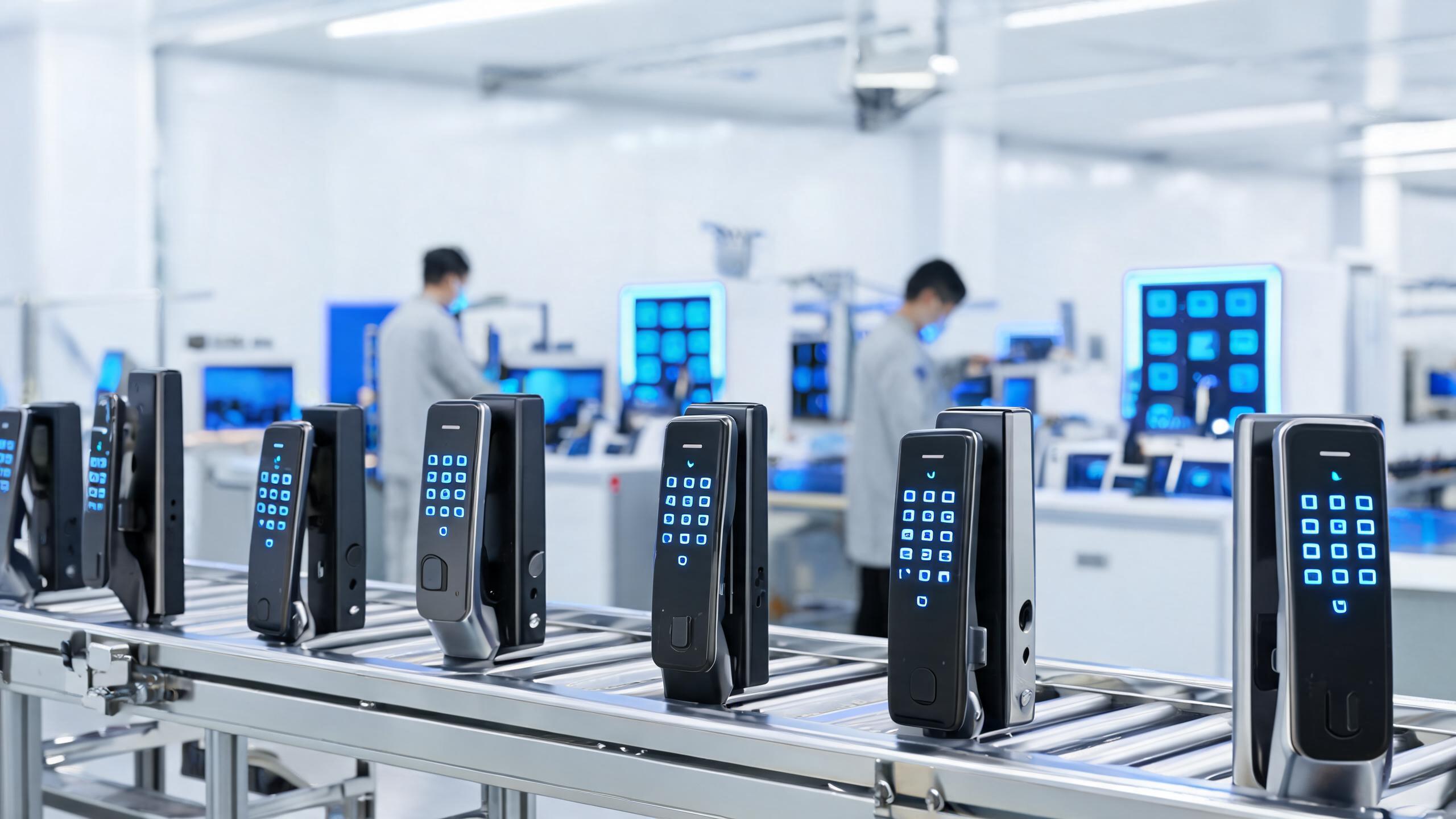
Manufacturer · keypad
Keypad door locks built for codes, turnover and retrofit doors
A China manufacturer producing keypad smart locks across deadbolt, mortise and lever platforms — touch and button keypads, multi-code logic, offline and connected remote-code SKUs, with OEM/ODM and model-specific certification files.
We manufacture keypad door locks for buyers whose users authenticate with a code they can change, not a credential they can lose. That single property makes keypad locks the default choice for rental turnover, staff doors, utility rooms and family homes. The keypad range spans capacitive touch and physical-button keypads on deadbolt-replacement, mortise and lever platforms, with passcode combined with mechanical key, RFID card, fingerprint and app access on different SKUs. The distinction that matters most is architectural: offline models are programmed at the door, while connected SKUs generate and revoke time-limited codes remotely through a gateway or ecosystem platform such as Tuya or TTLOCK. Code capacity, anti-peep logic, backlight behavior, battery life and weather sealing are properties of each SKU and are confirmed on its specification sheet and in your quotation, not as blanket claims.
Keypad lock manufacturing at a glance
| Keypad type | Capacitive touch panels and physical-button keypads across current models; layout, backlight and wake method vary by SKU |
| Form factors | Deadbolt replacement, mortise, lever/handle and push-pull platforms across the keypad range |
| Access mix | Passcode plus combinations of mechanical key, RFID card, fingerprint and app access; exact mix is model-dependent |
| Code logic | Multiple user codes and, on covered SKUs, anti-peep (embedded-digit) entry; maximum code count per model on its spec sheet |
| Remote codes | Time-limited codes remotely issued only on connected SKUs with gateway/ecosystem; offline SKUs are programmed at the door |
| Power behavior | Low-battery alerts and mechanical-key or emergency-power override per SKU; stated battery life assumes the model's test profile |
| Outdoor use | Only SKUs with a stated weather-sealing rating are intended for exposed gates — see the outdoor range |
| Files & testing | Model-specific compliance files for covered SKUs and keypad-specific end-of-line checks — certifications, QC |
Answer unit
Which keypad lock architecture fits the use case?
The use case decides whether the lock must speak to a network or never needs one. Choosing a connected SKU for a door that only needs household codes adds gateway cost and support load; choosing an offline SKU for a rental with remote guests makes every turnover a site visit. Match the architecture first, then the lock body.
| Use case | Architecture | Access pattern | Confirm before ordering |
|---|---|---|---|
| Vacation rental turnover | Connected + gateway | Time-limited codes generated per booking | Wi-Fi coverage, ecosystem account model |
| Family home | Offline, multi-code | Household codes plus service code | Retrofit deadbolt fit, override key |
| Office & staff doors | Keypad + RFID mix | Codes for regulars, cards for visitors | Common-door traffic, audit needs |
| Retail back-of-house | Offline or connected | Shift codes changed on rotation | Whether remote revocation is required |
| Exposed outdoor gate | Weather-rated SKU only | Code access at the perimeter | IP rating, temperature range, cover |
| Budget retrofit | Deadbolt keypad replacement | Codes and key on existing prep | Door thickness, existing deadbolt standard |
How a keypad smart lock is built and checked
Keypad failures concentrate in three places — the panel surface, the code logic, and low-voltage behavior — so the station sequence gives each of them a dedicated check in addition to the standard mechanical and wireless tests. Buyers can review stations on a factory tour and request applicable records for their run.
- Incoming materialsKeypad panels, PCBs, motor/clutch parts, lock bodies and gasket seals checked against specification before entering the line.
- Electronics & assemblyBoard preparation, panel bonding, motor and clutch fitment, and full assembly with the seal integrity required by the SKU.
- Firmware provisioningModel firmware loaded; code-capacity defaults and connected-model provisioning (Tuya/TTLOCK where specified) applied.
- Keypad function testsTouch response and backlight verified; code add/delete, anti-peep entry, wrong-code lockout and low-battery alerts tested per unit at end of line.
- Wireless & aging checksGateway pairing and remote-code flow checked on connected SKUs; sample aging runs per the batch plan.
- Final QC & packingCosmetic inspection, accessory count, keypad film and carton labeling before warehousing and shipment.
Why this manufacturer
What keypad-lock buyers depend on
Panel discipline
Touch and button panels specified per SKU, with bonding and sealing matched to indoor or outdoor duty.
Code logic tested
Multi-code, anti-peep and lockout behavior verified per unit, not just demonstrated on a sample.
Rental integration
Connected SKUs on Tuya and TTLOCK-based platforms for booking-driven remote codes and turnover automation.
Low-voltage design
Alerts and override paths engineered so a battery warning never becomes a lockout call at 11 p.m.
OEM depth
Logo, packaging, firmware defaults, app branding, finish and lock-body variants, up to ODM for qualified programs.
Market documents
Model-specific compliance files for covered SKUs, matched to destination market rather than blanket claims.
Customization layers for keypad locks
Each layer changes threshold, lead time and approval requirements; current terms for every layer are confirmed in writing rather than published as a fixed figure.
| Layer | What changes | Approval needed | Program level |
|---|---|---|---|
| Laser logo | Engraved brand mark on the housing | Logo artwork proof | Branded stock |
| Packaging & manual | Color box, printed manual, quick-start card | Dieline and print proofs | Branded / private label |
| Firmware defaults | Code length, lockout timing, language defaults | Configuration sheet | OEM |
| App branding | Branded app on supported ecosystems or white-label discussion | Brand assets, account structure | OEM / turnkey |
| Finish & body variant | Panel color, handle shape, regional lock body | Signed sample, compatibility check | OEM |
| New tooling / ODM | New housing or engineered platform | Design freeze, tooling schedule, milestones | ODM |
Keypad locks by application
Airbnb & vacation rentals
Short-term rentals
Remote time-limited codes remove key handover and rekeying between guests.
Apartments
Rental housing
Tenant and maintenance codes that change at every turnover without new hardware.
Typical configuration example (L5)
150-door multifamily retrofit — typical bill of materials
This example illustrates a typical configuration, not a specific customer project. Quantities and SKUs always follow a real door survey.
| Line | Item | Typical detail |
|---|---|---|
| 1 | Keypad deadbolt/mortise locks | ~150 units, platform matched to existing prep and door thickness |
| 2 | Gateways | For remote-code SKUs only; count follows building Wi-Fi layout and coverage |
| 3 | Override keys | Per lock plus registered spares; mechanical backup retained throughout tenancy |
| 4 | Turnover documentation | Code-reset quick guides for property managers and installer setup sheets |
| 5 | Spare components | Key components planned as a portion of the order for maintenance swaps |
Plan a real project on the project configurations hub or see the case studies hub.
Related manufacturers
Compare nearby lock categories
Keypad door lock manufacturing: common questions
Are the keypads touchscreen or physical buttons?
Both exist in the current range: capacitive touch panels on some SKUs and physical-button keypads on others, each with different backlight, wake and sealing characteristics. The keypad type is named on the specification sheet, so choose per application rather than assuming the whole range shares one panel.
How many passcodes can one lock hold?
Maximum code count differs by model firmware and is stated per SKU on the specification sheet. Household models cover family plus service codes; higher-traffic commercial SKUs carry larger code tables. If your operation needs named-user audit trails, state that requirement so connected models are shortlisted.
Can codes be issued remotely for guests and contractors?
Only on connected SKUs: time-limited codes are generated through the gateway and ecosystem platform (selected models on Tuya or TTLOCK). Offline keypad locks require codes to be programmed physically at the door — fine for stable households, unsuitable for remote turnover. Confirm building network coverage before choosing connected models.
What happens when the batteries run low or die?
Models provide low-battery alerts through the lock and/or app, and retain mechanical override keys; some SKUs also expose emergency power terminals. Battery-life claims follow each model's test profile and are confirmed on its spec sheet — carry the override key during battery changes.
Can a keypad lock be installed on an exposed outdoor gate?
Only SKUs with a stated weather-sealing rating and operating temperature range are built for exposed mounting, ideally under a weather cover. Indoor keypad locks installed on open gates are a common source of warranty disputes. State the exposure — rain, direct sun, salt air — and use the outdoor-rated range.
Request keypad lock factory pricing
Send your use case, door type, quantities and whether remote codes are required — receive SKU-level specs, MOQ, lead time and applicable cert files.
Request a quoteOrder samples firstLast updated: October 31, 2026 · Reviewed by the Smart Lock Factory editorial team