
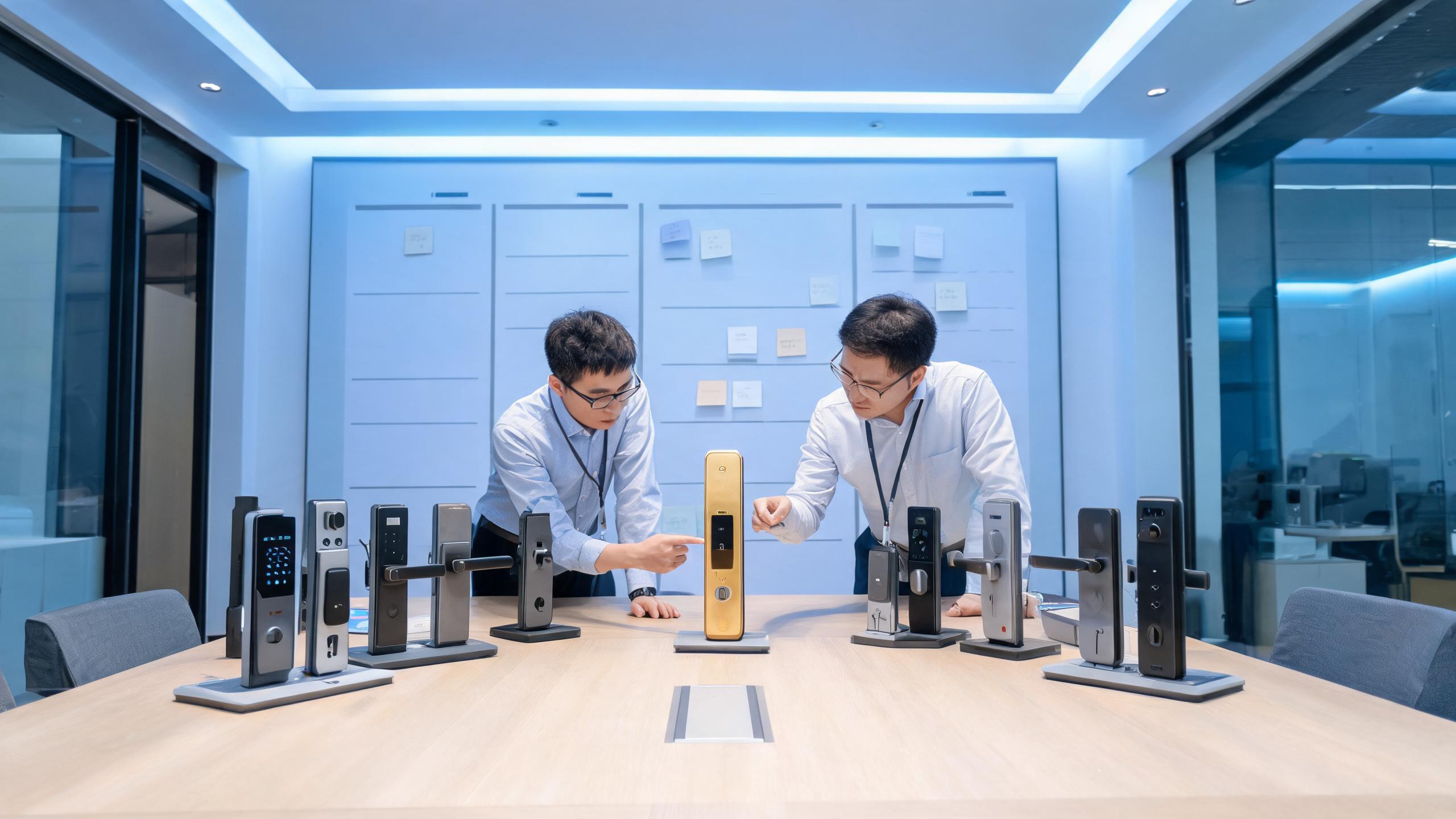
Turnkey program
Turnkey smart lock OEM: one accountable factory, full scope
From product selection and design through samples, certification support, branded app, packaging and mass production — scoped, quoted and delivered through one engineering and project team.
A turnkey OEM program makes the factory the single accountable point for the complete launch: selecting or developing the platform, adapting design and lock bodies, producing engineering samples, supporting market certification, provisioning the branded app and packaging, running QC, and scheduling the first mass-production shipment. It is designed for brand owners and project buyers who do not want to coordinate separate design houses, app vendors, packaging printers and assembly lines. The scope is fixed in a written deliverables list with dated milestones, approval gates and payment stages — “turnkey” never means vague; it means every workstream is listed, owned and quoted.
Turnkey scope at a glance
| Program scope | Platform selection/development, design adaptation, samples, certification support, app provisioning, packaging, QC, pilot and mass production |
| Single accountability | One project and engineering team owns the schedule across workstreams, with one quotation and one approval chain |
| Milestones | Brief → proposal → samples → approvals → certification → pilot → mass production; each gate signed before the next begins |
| What you provide | Brand assets, target market and channel, certification expectations, volume forecast, and timely decisions at approval gates |
| Deliverables list | The written scope names every item: SKUs, lock bodies, app route, packaging, card quantities, documents, spares and training materials |
| Commercial structure | Development or tooling items, if any, quoted separately from production unit pricing; MOQ applies to the resulting SKUs |
| Honest boundary | Market certification bodies, customs and your sales channels remain external obligations; the factory supports but cannot legally perform your importer duties |
Answer unit
What is inside a turnkey smart lock OEM package?
Below is the full workstream map. Items are removed when an existing platform already covers them — for example, a program built on an in-production model with ecosystem app branding has no tooling or custom-app workstream. The deliverables list in your contract states exactly which lines are in scope.
| Workstream | Deliverables | Approval gate |
|---|---|---|
| 1. Product definition | Specification sheet, SKU list, lock-body and finish selection | Signed specification |
| 2. Design & tooling | Adapted or new housing design; molds only if required | Design freeze / T1 sample |
| 3. Samples | Engineering and golden samples, door-fit verification | Signed golden sample |
| 4. Electronics & firmware | Configuration, default settings, version lock | Configuration sheet |
| 5. App & cloud | Branded ecosystem app; custom app only where scoped | App acceptance checklist |
| 6. Certification | Test support and model-specific files for covered SKUs | Document pack review |
| 7. Identity & packaging | Laser logo, color box, manual, branded cards/fobs | Print proofs |
| 8. Production | Pilot batch, end-of-line QC, mass production, spares pack | Pilot approval & inspection |
How a turnkey launch proceeds
- Brief & proposalMarket, specification, volumes, certification expectations and channel become a scoped proposal with milestone dates.
- Platform & designProven platform selected or design adapted; tooling started only after the design freeze and commercial agreement.
- Engineering samplesSamples prove fit on your doors, recognition and app behavior; refinement rounds run before the golden sample.
- Certification & assetsMarket testing support proceeds in parallel with artwork, packaging production and app provisioning.
- Pilot batchA production-intent run validates fixtures, yield and QC records; third-party inspection welcomed.
- Mass productionFirst scheduled run with spares and documentation, followed by a post-launch review and reorder plan.
Turnkey vs standard OEM vs ODM
| Dimension | Turnkey OEM | Standard OEM | Standalone ODM |
|---|---|---|---|
| Workstreams owned | All, under one plan | Product configuration only | Product development only |
| You coordinate | Decisions and assets | App/packaging vendors possibly | Everything downstream |
| Best for | Full launches without internal teams | Brands with some supply chain | Companies needing product only |
| Contract shape | Deliverables list + milestones | OEM configuration order | Development agreement |
| Start page | This page | OEM/ODM | ODM manufacturer |
Related programs
Adjacent ways to launch
Turnkey smart lock OEM: common questions
What does “turnkey” actually include?
Whatever the signed deliverables list says: typically product selection or adaptation, samples, certification support, app provisioning, branded packaging, pilot and mass production. Each workstream is listed with an owner and approval gate, so nothing is implied or left to assumption — request the scope template through the RFQ form.
Is turnkey OEM more expensive than buying catalog models?
Unit pricing on proven platforms is close to standard OEM terms, while genuine new tooling or custom development carries separate project costs. The quotation separates development, tooling and production pricing, so you see exactly what carries a one-time charge.
Can the package include a fully branded app?
Yes. The standard route provisions your brand on supported smart-lock ecosystems (Tuya/TTLOCK-type platforms); a standalone custom app with its own feature set and backend is a scoped workstream with its own acceptance checklist.
Who handles certification and customs for our market?
The factory supports testing and provides model-specific files for covered SKUs, and packages export documentation. Importer-of-record duties, market registration where applicable and customs clearance remain your responsibility as the buyer; the markets hub and logistics page explain both sides.
How is a turnkey project paid and scheduled?
Against dated milestones and approval gates, with any tooling or development handled separately from production payments. The full schedule — samples, approvals, certification, pilot and first mass run — is attached to the proposal before anything starts.
Plan a complete launch with one team
Send market, channel, specification and volumes — receive a deliverables list, milestone dates and separated cost structure.
Scope a turnkey projectStart from the catalogLast updated: October 31, 2026 · Reviewed by the Smart Lock Factory editorial team