
Customization
Custom smart locks built around your specification
Choose what is customized — logo and packaging, finish and lock body, firmware and app, or a fully developed new model. Every option is scoped on a proven in-production platform with thresholds and lead times confirmed in writing.
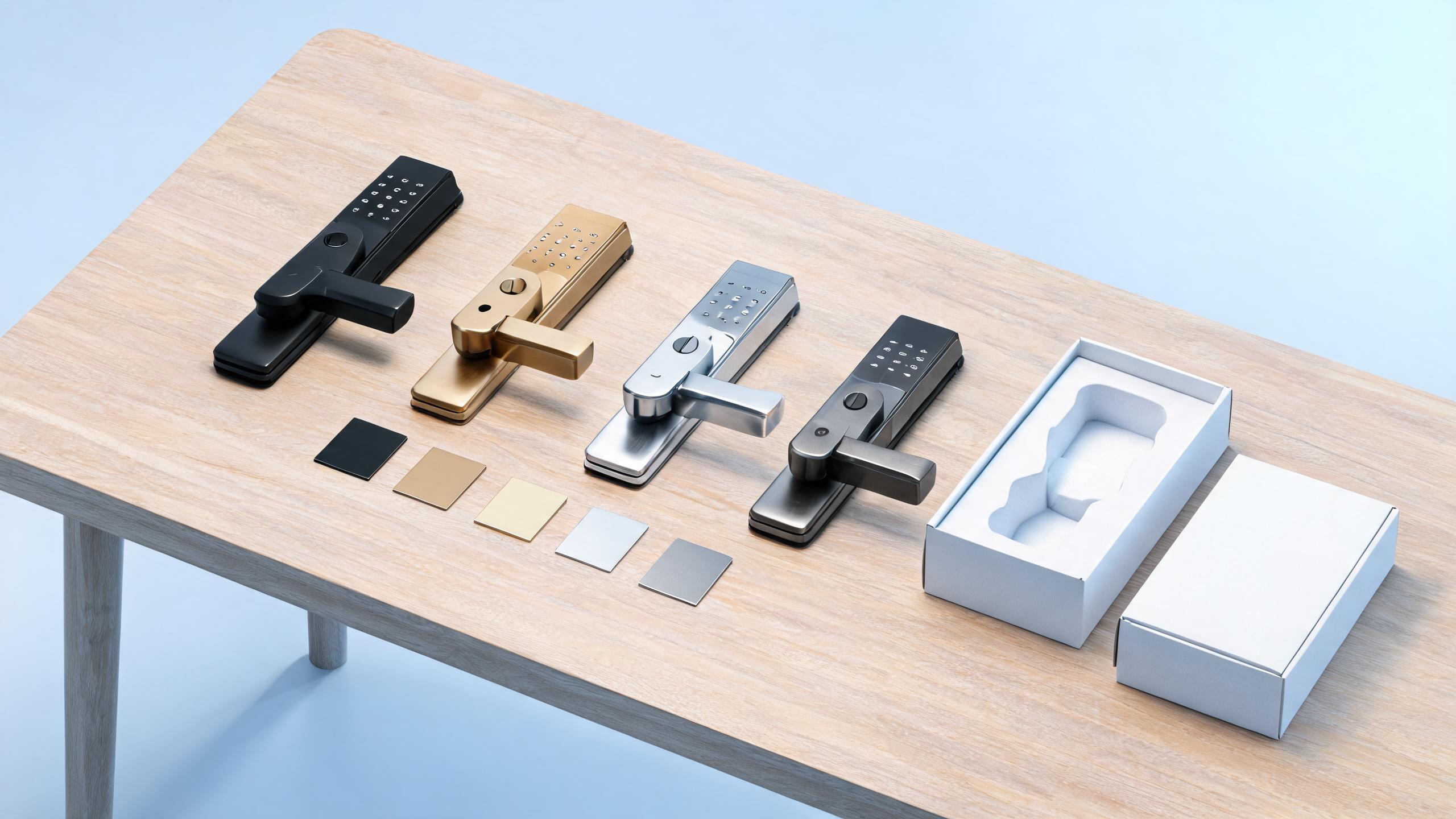
“Custom smart lock” means six different things to six different buyers — the practical question is which layers you need. Customization here runs from surface-level branding on a catalog model (laser logo, custom box, printed manual) through configuration choices (finish, lock body, firmware defaults, app branding) to genuine product development via ODM. The smart order is to customize only what your market rewards: every extra layer adds threshold, cost and approval time. Your specification is reviewed against in-production platforms first, so most “custom” requests are delivered without new tooling.
Customization at a glance
| Customizable layers | Logo/laser marking, packaging and manuals, finish and color, lock body/region variant, firmware defaults, app branding, credentials; new tooling via ODM |
| Platform rule | Customization is applied to proven in-production platforms — electronics and mechanical architecture stay validated, which protects reliability |
| MOQ logic | Each layer carries its own threshold: branding below full configuration, new tooling highest; current MOQ per layer is quoted in writing |
| Artwork & approvals | Vector logo, dieline proofs, color references and a signed golden sample or proof are approved before production |
| App customization | Branded apps on supported ecosystems (Tuya/TTLOCK-type); custom feature development scoped as an ODM workstream |
| Compliance | Cosmetic changes keep an SKU's covered-model status; changes to electronics or radio modules can require updated certification files — see standards |
| Lead time | Branded stock schedules fastest; printed packaging and firmware configuration add stages; ODM runs on a milestone schedule |
Answer unit
What can actually be customized on a smart lock?
Most buyer requests fall into one of eight layers. Layers 1–3 make a catalog model yours without touching its engineering; layers 4–6 change configuration around a validated platform; layer 7 enters ODM; layer 8 is often forgotten and is what delays customs or retail onboarding. Tick what you need and send it with the RFQ.
| # | Layer | Examples | You provide |
|---|---|---|---|
| 1 | Identity | Laser logo, silk-screen brand mark | Vector artwork |
| 2 | Packaging | Color box, sleeve, printed manual, insert card | Dieline, copy, print proofs |
| 3 | Credentials | Branded RFID cards/fobs, key tags | Artwork, card technology (125 kHz/13.56 MHz) |
| 4 | Finish | Color, surface treatment, handle variant | Color reference, signed sample |
| 5 | Lock body | Regional mortise or cylindrical body, spindle/latch variant | Door prep and thickness data |
| 6 | Firmware & app | Default language/settings, branded app on supported ecosystems | Brand assets, account structure |
| 7 | New development | New housing, new mechanism or feature set | Product brief — ODM route |
| 8 | Market compliance | Model-specific files for your market, labeling | Destination country, channel requirements |
Three custom programs, three commitments
| Dimension | Branded stock | Configured OEM | Full ODM |
|---|---|---|---|
| What changes | Logo, box, cards | Layers 4–6 on a platform | New product engineering |
| New tooling | No | Usually no | Yes |
| Approval cycle | Artwork proofs | Proofs + signed sample + config sheet | Milestone gates |
| Threshold level | Lowest of the custom paths | Medium | Project-based, highest |
| Lead-time driver | Printing schedule | Config and sample approval | Tooling and certification |
| Typical buyer | Retailers, resellers | Brand owners | Established brands |
| Start at | Private label | OEM/ODM | Turnkey OEM |
Information to send with a custom RFQ
Complete briefs get accurate quotes; missing fields are where surprises enter. This is the same checklist the sales engineering team works through on the first call.
- Model or platform — catalog SKU if you have one, otherwise the feature set you need.
- Custom layers — which of the eight above apply, with artwork and dielines where ready.
- Door and lock body — door material, thickness range, existing prep and regional body standard.
- Access and connectivity — fingerprint/keypad/RFID mix; offline, Bluetooth, Wi-Fi or gateway; ecosystem requirements.
- Market and channel — destination country, required compliance files, retail vs project channel.
- Volumes and timing — first order quantity, forecast, target on-shelf or installation date.
Related options
Not sure how much customization you need?
Custom smart locks: common questions
Can I get custom smart locks with my own logo and packaging?
Yes, on in-production models: laser marking, custom color boxes, printed manuals and branded cards are the standard branding layers, each with its own threshold. Provide vector artwork and the dieline so proofs can be prepared before production — see the private label page for the path.
Can you change the lock body or finish for our market?
Regional lock-body variants, spindle/latch options and selected finishes can be configured on proven platforms. Send door prep and thickness details with the RFQ; engineering confirms compatibility and whether the variant affects the model's certification files.
Will custom locks have our own branded app?
App branding on supported smart-lock ecosystems is available for connected SKUs; requirements for custom features or a standalone app are scoped as a development workstream. State platform, account ownership and feature expectations in your brief.
What is the MOQ for a custom order?
It scales with the layers: logo and packaging carry lower thresholds than firmware configuration, and new tooling is project-priced. Rather than publish numbers that drift with the schedule, the exact MOQ per layer is confirmed on the written quotation — low-MOQ options are available for first market tests.
Do cosmetic changes affect CE or FCC certification?
Logo and packaging changes generally do not alter the certified product, but changes to electronics, radio modules or certain mechanical structures can affect compliance. The sales team confirms whether the exact SKU remains a covered model or needs updated documentation before quoting the change.
Send your custom lock specification
List the layers you need with market and quantities — receive feasibility, MOQ, lead time and sample plan in writing.
Request custom pricingValidate a base model firstLast updated: October 31, 2026 · Reviewed by the Smart Lock Factory editorial team