
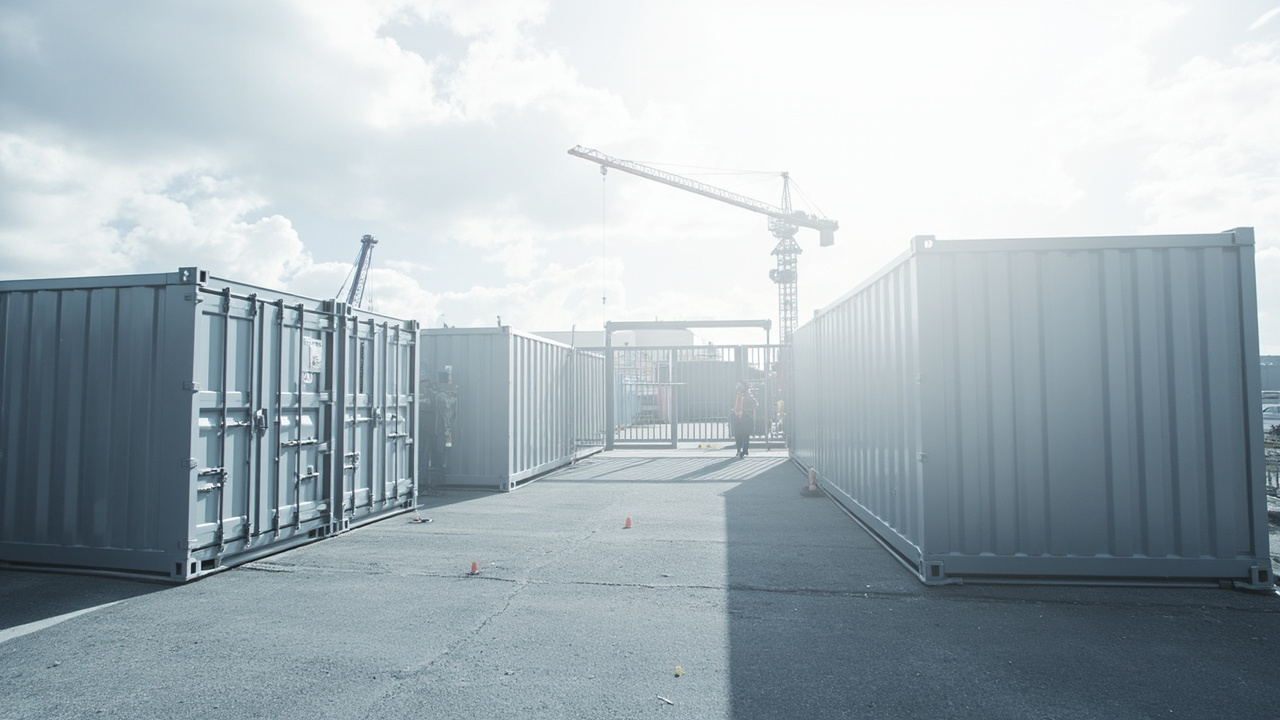
Project configurations
A representative 30-container site access plan across subcontractor crews
On a construction site the workforce changes faster than the project does, so access has to be issued, expired and audited by the day.
This page is a representative typical configuration for a construction compound using about 30 site containers plus a controlled gate, not a delivered project for a named contractor. It shows how site managers usually combine a perimeter gate with container-level locking for site offices, tool stores, canteens and welfare units. Crews are credentialed by subcontractor and phase, so a crew that finishes its scope loses access automatically instead of keeping a key for the rest of the project. Tool and material containers log per-person openings because shared padlocks cannot say who took what, and crane or lift zones follow permit status rather than crew affiliation. Sites rarely have stable power, so battery hardware, offline codes and weather-rated keypads are normal rather than exceptional, and containers must remain secure through weekends and demobilisation. Quantities, gateway ratios and specifications are planning estimates only; exact quantities and specifications are confirmed per project quotation.
30-container construction site at a glance
| Site profile | A representative construction compound with roughly 30 site containers and a manned or controlled perimeter gate. |
| Openings in scope | Planning estimate of about 30 container doors plus the site gate, turnstile path, tool stores, canteen and welfare units. |
| Credential architecture | Crew credentials by subcontractor and phase, short-window visitor codes, staff roles and automatic expiry at handover. |
| Software/integration | Central platform with crew groups, phase logic, audit retrieval and optional attendance or site-system linkage per project. |
| Network/power | Battery locks with offline code support, outdoor-rated keypads and gateways zoned across stacked containers. |
| Compliance evidence | Environmental and electrical evidence for named SKUs are provided per RFQ; evacuation and egress follow site safety rules. |
| Commercial terms | Current MOQ policy, sample terms and lead time are confirmed in writing per quotation; certificates and test reports for named SKUs are provided per RFQ. |
Answer unit
How does access follow subcontractor phases on a site?
Tie credentials to the phase, not to the person alone. When a subcontractor starts, its crew receives access to the zones its work needs; when the scope closes, that group expires and nobody has to collect keys. Tool stores then log per-person openings, and crane or lift zones follow permit status, so site security reflects the programme instead of a growing key ring.
| Opening group | Typical choice | Scale reasoning at 30 containers |
|---|---|---|
| Site perimeter gate | Outdoor-rated keypad with time windows | The single checkpoint where every crew and visitor enters. |
| Container offices | Keypad lock with role codes | Site managers and engineers need access separate from general crews. |
| Tool and material containers | Keypad or reader lock with audit | High-value tools need per-person records, not a shared padlock key. |
| Canteen and welfare units | Time-boxed codes by crew | Crews get wide windows while visitors and deliveries stay narrow. |
| Crane and lift zones | Interlocked access tied to permit status | Access follows the permit, not the crew that happens to be nearby. |
| Emergency and muster points | Mechanical release with egress compliance | Evacuation routes open regardless of credential state. |
What evidence backs this configuration page
| Evidence level | What this page states |
|---|---|
| L1 authorized named case | A named contractor or project case with identifiable sites requires written authorization. None is published without NDA, so no such case is claimed here. |
| L2 public-reference case | Public references to comparable construction compounds may be cited where independently published, without confirming we supplied them. |
| L3 NDA photo or record case | Photos and delivery records for similar site compounds can be shared with qualified buyers under mutual NDA per RFQ. |
| L4 genericized record | Anonymized records keep container counts, crew grouping and phase logic while removing contractor and project identity. |
| L5 representative typical configuration | What is published here is an L5 typical configuration: an illustrative 30-container site plan for budgeting and RFQ discussion, not a statement of a delivered project. Higher levels are provided to qualified buyers under NDA per RFQ. |
Indicative bill of materials for this scale
This is a planning bill of materials for budgeting, not a quotation. Container counts follow the compound layout, while gate, gateway and weather-kit quantities are confirmed against the site plan per project quotation.
| Component | Quantity logic | Notes |
|---|---|---|
| Component | Typical quantity logic | Notes |
| Container locks | Around one per controlled container door | Fitted to steel doors with reinforcement plates where needed. |
| Gate keypad and controller | One per controlled site entrance | Power and standby supply agreed with the site team. |
| Turnstile or barrier interface | One per pedestrian or vehicle lane | Integration scope confirmed with the site-security supplier. |
| Gateways | One per coverage zone across stacked containers | Steel stacks create dead spots; coverage is measured. |
| Weather kits and fixings | One per exposed lock or keypad | Dust, mud and rain shorten unprotected hardware life. |
| Spare locks and batteries | A pool sized to crew turnover and site distance | Weekend and holiday coverage drives the spare level. |
What changes when a site compound reaches about 30 containers?
Re-check the items below when your project is smaller or larger than the representative scale on this page.
| Scale factor | How the configuration changes | What to verify |
|---|---|---|
| Scale factor | Impact on configuration | Planning note |
| Workforce churn | Crews arrive and leave with each phase | Expire credentials by phase instead of collecting keys. |
| Subcontractor mix | Different trades need different zones | Group by subcontractor and zone from day one. |
| Theft risk | Tools and materials disappear fastest on shared keys | Log per-person openings on tool containers. |
| Temporary power | Mains supply is unreliable or absent | Plan battery service and offline codes up front. |
| Weather and ground | Dust, mud and standing water reach every keypad | Specify rated housings and raise mounting heights. |
| Demobilisation | The compound is dismantled at project end | Keep a documented recovery list for every fitted lock. |
From compound layout to phase-based access in five steps
- Survey the compoundMap containers, gate lanes and crane zones with power and exposure notes.
- Group by phaseDefine subcontractor groups and expiry dates before ordering hardware.
- Harden the hardwareFit reinforcement plates and weather kits to steel doors and keypads.
- Link site systemsConfirm attendance or security-system linkage and audit export per project.
- Commission by areaInstall by area, test muster release and brief site supervisors.
Related pages
Related construction and temporary-site access pages
Planning a similar 30-container construction site configuration?
Send your compound layout, subcontractor phases and crane zoning. We confirm container lock selection, gate hardware, gateway placement and phase-based expiry logic; current MOQ policy, sample terms and lead time are confirmed in writing per quotation, and certificates and test reports for named SKUs are provided per RFQ.
Request Similar ConfigurationProject configurationsLast updated: November 1, 2026 · Reviewed by the Smart Lock Factory editorial team