
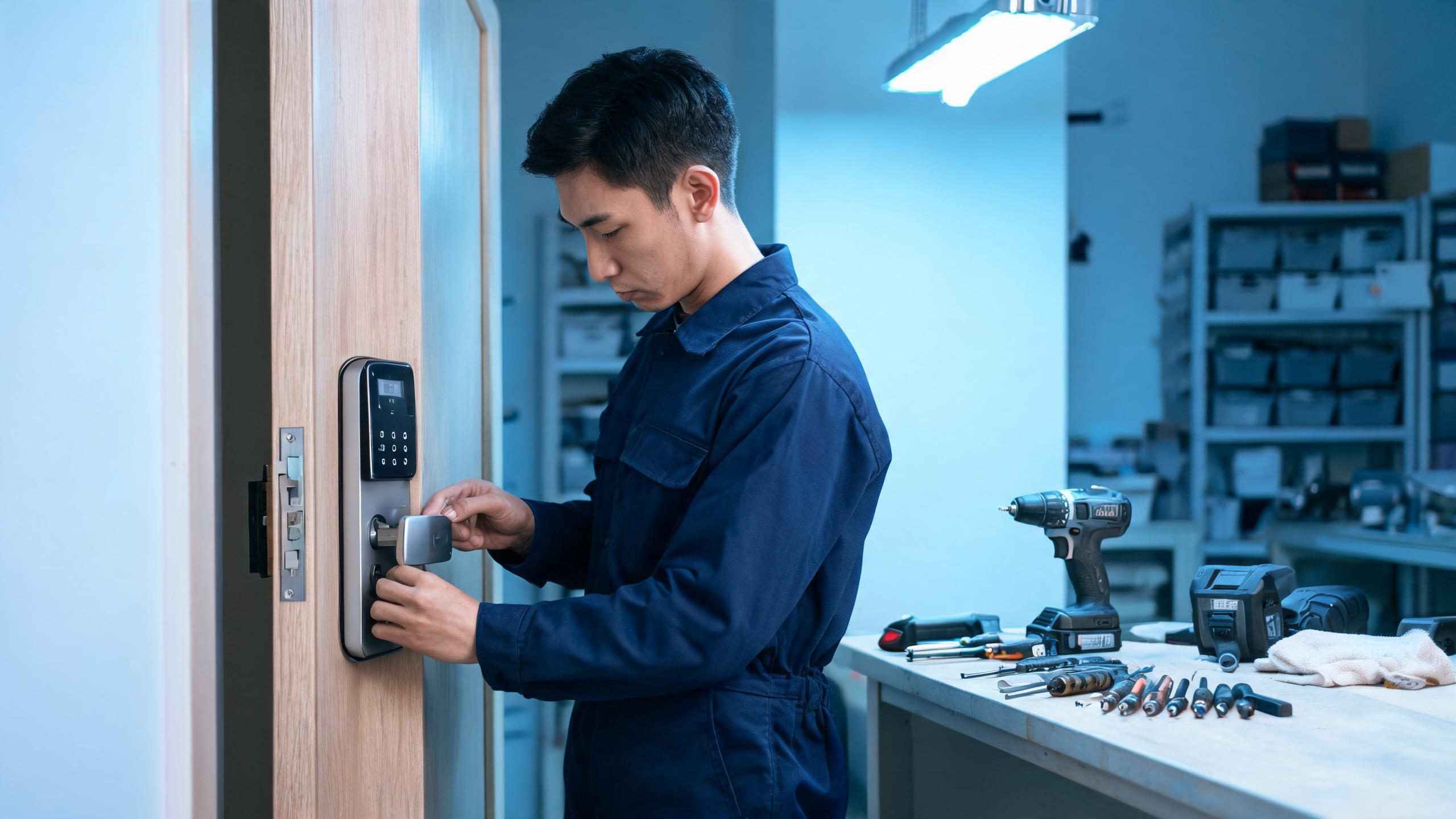
For locksmiths
Smart locks for locksmiths: install, service and sell
Retrofit-friendly models with mechanical override, fitment-first selection, trade supply terms and technical support — the program for professionals who answer when a door will not open.
For a locksmith, a smart lock is first a mechanical product on a real door: the prep has to match, the override cylinder has to be trusted, and the unit must be serviceable on a callout without exotic tools. The locksmith program selects models with that mindset — retrofit-friendly form factors, proper key override, documented reset and battery-failure procedures — and backs them with trade-style supply: small stock orders, spare cylinders and components, fitment guidance, and a technical escalation path when a job needs the factory. Training material covers installation and the troubleshooting questions that generate return visits, while commercial terms are confirmed in writing for trade accounts.
Trade program at a glance
| Fitment-first range | Models chosen to cover common residential and light-commercial door preps and thickness ranges, with fitment notes per SKU |
| Mechanical override | Physical key override retained on the supplied range so lockout scenarios always have an analog fallback |
| Serviceability | Documented battery replacement, reset and emergency-power procedures; modular components where the platform allows |
| Trade supply | Small recurring stock orders and spare cylinders/lock bodies rather than full-container commitments; terms per account |
| Technical support | Escalation through a sales engineer for installation and commissioning questions beyond the trade counter |
| Training assets | Install steps, compatibility checklist and troubleshooting material for the exact models stocked |
| Warranty path | Clear claim flow so the trade professional can give customers a confident answer — support |
Answer unit
What should a locksmith check before fitting any smart lock?
Nearly every failed smart lock job is a fitment failure disguised as an electronics failure. Door thickness, existing prep, handing, latch alignment and the gap around the door decide whether the motorized lock body can operate freely for years — a smart lock cannot fix a badly prepped door. The checklist below mirrors the pre-install survey used by the factory's own technical team.
| Check | Why it matters | Where to confirm |
|---|---|---|
| Door thickness | Outside the SKU range, spindles and cables do not fit | Specification sheet |
| Existing prep | Deadbolt, cylindrical or mortise prep selects the platform | Door types hub |
| Handing & swing | Motor direction and handle orientation depend on it | Install sheet |
| Latch alignment | Binding causes the most motor and battery complaints | On-site adjustment |
| Door gap & weather | Exposed doors need the correct IP-rated SKU | Outdoor range |
| Override access | Customer must always hold a working mechanical key | Handover procedure |
Trade value
Why locksmiths stock these models
Override retained
Key cylinders on the range mean lockouts and dead-battery calls end with the mechanical key, not a forced door.
Fitment confidence
Per-SKU thickness and prep data plus survey checklists reduce failed callouts and returns.
Technical escalation
Questions beyond the counter route to an engineer with the job details and model in hand.
Parts, not whole units
Cylinders, bodies and key components available so repairs stay economical.
Training material
Install and troubleshooting documentation aligned to each stocked SKU, not generic marketing.
Upsell path
From the keypad entry model to fingerprint and connected options as customers upgrade.
The range by service-call type
| Typical job | Model direction | Note |
|---|---|---|
| Residential upgrade | Fingerprint deadbolt/handle | Check prep and thickness first |
| Budget keyless | Keypad lock | Simple fit, strong override key |
| Rental turnover | Bluetooth/code models | Confirm ecosystem with the owner |
| Office doors | RFID / card | Card issuing process required |
| Shopfront glass | Clamp-on glass lock | No glass cutting; measure thickness |
| Exposed gate | Outdoor-rated | Verify IP rating against exposure |
Related pages
Trade and technical resources
Smart locks for locksmiths: common questions
Do these smart locks keep a mechanical key override?
Yes, the trade range is selected with physical override keys as standard, because lockout and dead-battery scenarios are routine service calls. Confirm the override key count and profile on the specific SKU's specification sheet and always hand the keys to the customer during installation.
Can trade professionals buy small quantities with spares?
Yes. The trade program supports recurring small stock orders rather than container commitments, with cylinders, lock bodies and key components available separately so common repairs do not require replacing the whole unit. Current terms are confirmed in writing per account.
What is the most common installation problem you see?
Binding from misaligned latches and mismatched door prep. A motorized lock cannot operate correctly against a poorly aligned strike, and these cases arrive back as “electronic faults.” Running the pre-install checklist on the door types hub prevents the majority.
Do you provide technical support on difficult installs?
Yes. Questions that go beyond the install documentation route through the sales engineer to the factory technical team, with the model number, door details and a description or short video of the behavior. Complex commissioning questions follow the same escalation used for installer accounts.
How are warranty claims handled for trade customers?
Through a documented flow with a named engineer: the issue is diagnosed with model and batch information, replacement parts are dispatched where applicable, and response expectations are set up front so the locksmith can relay them honestly to the end customer — see support and warranty.
Stock locks you can fit and service
Tell us the door types in your service area and trade volume — receive fitment notes, component availability and trade terms in writing.
Request trade termsView the trade catalogLast updated: October 31, 2026 · Reviewed by the Smart Lock Factory editorial team