
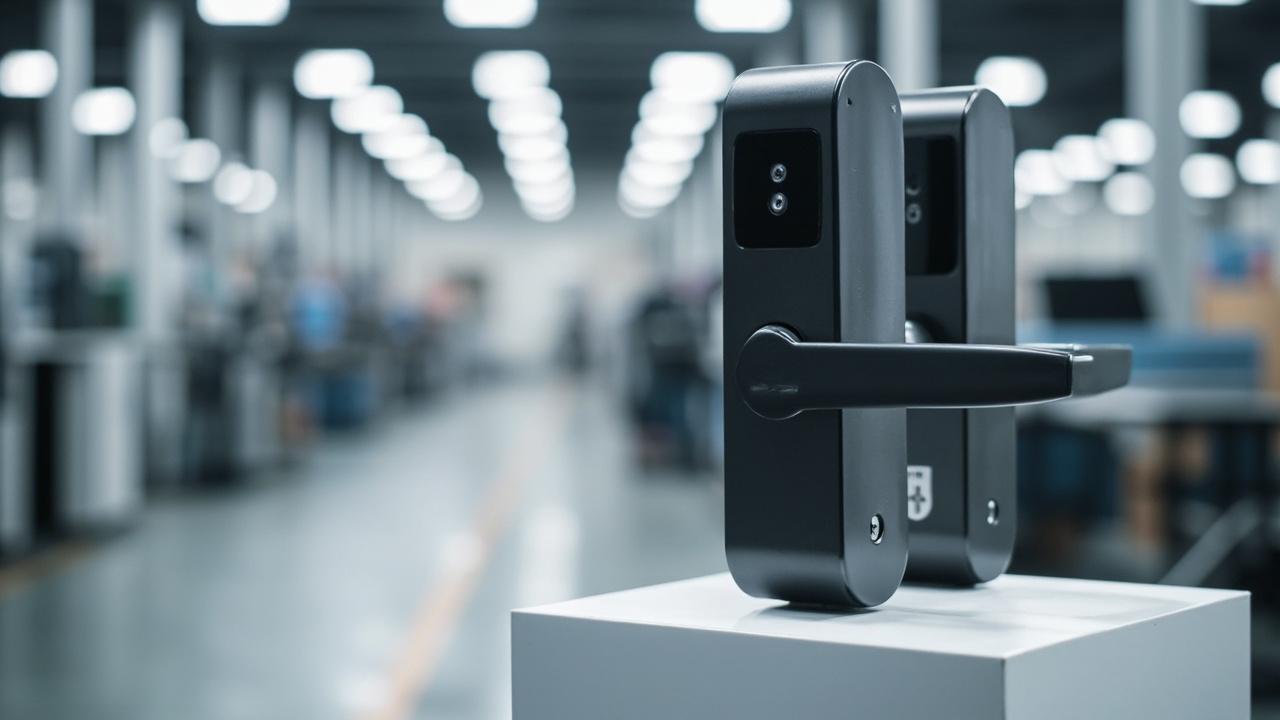
Smart Locks for Universities
A university estate is not one building. It is a network of buildings — academic blocks, administrative wings, a library system, halls of residence, plant rooms and plant yards — each with its own door population, its own occupancy rules, and its own governance. A "smart lock for the university" question is therefore five questions stacked together, and almost every procurement failure begins with one RFQ sent to one supplier with no internal map of which doors belong to which governance. The purpose of this article is to draw that map honestly so the right locks land on the right doors, the right scope is sent to the right contract lot, and the door-lock product is not asked to do work that belongs to a central campus identity system.
The useful answer up front: a smart lock product is a per-door device. It owns the door, the credential reader at the door, the local decision to release the latch, and a local audit of that release. For a multi-building university estate the honest scope split is (a) per-door locks on academic doors, library sub-rooms, hall common doors and standalone plant-room doors — these are within the per-door-lock catalogue's natural fit; (b) the central student-and-staff credential, the one-card system, residence-student room assignment, campus-wide lockdown, library gate-count and the BMS / ACS controller — these are not in this product's scope, and any quotation that has quietly absorbed them has over-promised. The five pillars below organise the door-by-door decision; the identity question is named on its own pillar so the boundary is impossible to miss.
This article is for university procurement managers, estates directors, FM contractors and system integrators acting on a multi-building university estate. It is deliberately distinct from Smart Locks for Schools (the K–12 lens — under-18s, safeguarding, classroom-led door population, principal-and-caretaker governance, single-building norm), from Smart Locks for College Dormitories: A Stage-Gate Timeline Aligned to the Academic-Year Door Rhythm (the residence-student room lens — student-managed rooms, semester turnover, residential-life governance), from Smart Locks for Campuses: A Master-Plan Buyer's Hub for Site Entries, Perimeter Doors, and the Honest Boundary With Central Identity Systems (the perimeter-and-master-plan lens — site entries, vehicle gates, central systems), and from Smart Locks for Classrooms (the single-door classroom lens — academic-week cadence, teacher-side governance). Where the lenses overlap — and they do, on lecture doors, library doors, plant doors — the overlap is named and routed.
Pillar 1 — The five-building campus map
Almost every subsequent decision on a university estates programme is easier if the door population is first drawn on a single page with five named building classes and a per-door governance label. Without that map, a single RFQ invites a single supplier to quietly absorb scope the per-door product does not own, and the procurement conversation drifts from "which lock on which door" to "please replace our identity system," which is a different vendor's job.
| Building class | Typical door population | Governance owner | Smart-lock catalogue fit |
|---|---|---|---|
| Academic buildings | Lecture halls, classrooms, seminar rooms, teaching labs, faculty offices, research-lab side rooms | Faculty registrar / faculty operations manager; per-department sub-governance | Strong — per-door product is the natural fit on the lecture-room, seminar-room and faculty-office doors |
| Administrative buildings | HR office, finance office, records room, faculty-burials office, registrar's front counter, council chamber | University secretary / chief operating officer | Strong — per-door product fits each named-room door; central HR system is out of scope |
| Library system | Main entrance (public), special-collections door, stacks doors, group-study-room doors, after-hours side door, IT carrels, librarian workroom | University librarian / head of collections | Mixed — per-door product fits stacks, special-collections, study rooms, workrooms; the main entrance is a public-egress conversation |
| Halls of residence (common doors only — student rooms belong to the dormitory lens) | Main hall entrance, common-room door, kitchen, laundry, plant cupboards, staff-only corridor doors | Head of residential services / warden | Strong on common doors; the student-room layer is a separate lens, not this article's promise |
| Plant rooms and back-of-house | Boiler-house, chiller plant, lift-motor room, electrical substation, BMS panel room, generator enclosure, telecom room | Estates director / chief engineer | Mixed — standalone plant-room doors fit the catalogue; networked plant control, monitored alarms, generator interlocks and BMS controllers are out |
The single most important move in this map is the bracketed rule at the bottom of the table: the catalogue fit is per-door, not per-building, and the per-door fit stops where the door becomes part of a campus-wide system that owns the credential, the lockdown posture, or the fire-egress behaviour. Where the catalogue says "Strong," the conversation belongs to this article and to the per-door lock catalogue. Where it says "Mixed," the conversation must be split between the per-door supplier and a different contract lot. The next pillars go door by door inside the five classes.
How to use this map
Three rules. Walk the campus and mark every door that takes a credential — not every door in the building, but every door whose opening is policy-controlled rather than free. On the worksheet, write the building class from the table above. Write the governance owner. Note any door whose lock is downstream of a campus-wide system (a one-card reader, a fire-panel release, a BMS unlock, an elevator destination dispatch), and tag those doors with the phrase "Not the lock supplier's scope." The doors that survive this filter are the ones the per-door-lock RFQ will name. Doors with the tag go to a different contract lot — typically a system-integrator RFQ for the central identity system, a BMS integrator for plant control, or a fire-egress hardware professional for monitored release.
This is the moment where a wholesale buyer or estates director typically pushes back with "but we want one supplier for everything." The honest answer is that the door-lock supplier is good at the door lock, the system integrator is good at the central system, and the two contracts are written separately so neither quietly absorbs the other. A single supplier covering all of it is usually a single supplier that has over-promised in writing.
The door walk is worth picturing as one afternoon of somebody's day, because the lot split falls out of the walk rather than out of the catalogue:
journey
    title One door walk across the five-building map
    section Walking the estate
      Marking every policy-controlled door: 4: Estates officer
      Naming the governance owner per door: 3: Estates officer
      Tagging the out-of-lot doors · one-card · BMS: 4: Estates officer
    section After the walk
      Sending surviving doors to the per-door lock lot: 5: Procurement manager
      Routing one-card and BMS doors elsewhere: 5: Procurement manager
Pillar 2 — Central identity system versus per-door lock product
The second pillar is not optional, and it sits ahead of every other pillar because every product selection downstream depends on the answer. Universities almost universally run, or are planning to run, a central identity system — a campus card, a one-card credential, a Shibboleth / SAML / OAuth identity provider, a housing-management system, a card office that issues staff and student credentials. The question is where that system ends and where the per-door lock begins, and the answer is rarely understood the same way by the card office, the estates director, the IT director, the procurement manager, and the facilities contractor.
The honest scope split:
- Central identity system — owns the roster of named credentials, the credential issuance lifecycle, the campus-wide suspension when a student or staff member leaves the institution, the card-office workflow, the integration with the student-information system (SIS) and HR system, the SSO platform for IT systems, and the door population that reads those same credentials at the door (one-card readers, multi-technology readers).
- Per-door lock product — owns the door, the lock case, the latch, the local credential reader surface (PIN, RFID, fingerprint, app/Bluetooth on supported models — see the catalog spec base), the local decision logic to release the latch, the local audit trail of releases, the per-credential expiry window, the mechanical override, and the local power source (battery or mains where wired).
The catalogue does not supply one-card readers. It does not supply the credential-issuance platform, the LMS, the SIS, the housing-management system, or the campus-wide lockdown controller. It supplies the per-door device that reads a credential and makes a local decision about whether to release the latch on that door. On some doors it is appropriate for that decision to be made by the central system (a card reader upstream of a relay, releasing a maglock on a controlled-access door), and on some doors it is appropriate for the decision to be made locally at the lock (the lock owns the roster, the expiry, the audit). The first case is a system integrator's RFQ with the lock as a component; the second case is a per-door-lock RFQ with no central system involvement. Conflating the two is the most common cause of an over-promised quotation.
What the per-door-lock product will not do for the university
Five things, named honestly:
- It will not provision a campus-card credential. A lock may read an RFID card that happens to be the campus card, but only if the lock's reader technology matches the card's chip — usually RFID Mifare 1 @ 13.56 MHz on supported models and on the SLK-9936S class, but check the model’s published specification for the specific model under evaluation. The lock does not issue or revoke the card; the card office does.
- It will not sync with the student-information system. A lock's roster, where it exists, is held at the lock or in the lock's management software (PC software on supported hotel-class models, app-based on Bluetooth models). It does not interface with the SIS to know that a student's enrolment lapsed on 31 August.
- It will not perform a campus-wide lockdown on a single command. Each lock decides independently based on its own roster and its own policy. If a campus needs coordinated simultaneous lockdown across N doors, that is a system-integrator's RFQ — networked ACS controllers, head-end software, multi-door coordination — not a per-door-lock RFQ.
- It will not satisfy AHJ fire-egress, fire-rating or panic-hardware requirements. Those compliance items belong to the door assembly, the panic hardware, the fire-alarm system and the AHJ's interpretation. A lock that releases on power loss is a credential-coordination conversation; it is not a fire-rating conversation. Any line in an RFQ that conflates "lock releases on power loss" with "door is fire-rated" is a line that needs to be split.
- It will not own a monitored intruder or panic alarm. A monitored alarm is a separate contract lot — alarm panel, communication path, ARC (alarm-receiving centre) routing. Where a lock and an alarm share a door, they are coordinated, not unified.
These five "will nots" do not diminish the per-door-lock product. They define it. The remainder of the article is built on the assumption that the procurement officer has internalised this list and is no longer asking the lock supplier to provide a campus identity system.
Where the locks and the central system do meet
They meet at the door, in a coordination handshake that has two honest shapes:
- Shared credential, separate system. The campus card carries an RFID chip that the lock's reader also reads. The credential is issued by the card office; the lock only sees a credential token. The lock's roster may be managed locally — for example, on a library sub-room door where the librarian admin issues a short list of staff RFID tokens directly — or it may be populated from a local file. The lock does not need to know the central system exists.
- Wired upstream reader, electric strike or magnetic lock. A reader upstream of the lock talks to the central system; the central system decides; the central system instructs the electric strike or magnetic lock to release. The lock, in this configuration, is a strike or a maglock, not a smart lock in the sense of this article. This configuration is the system integrator's RFQ.
A useful rule of thumb: if the door's "open" command comes from somewhere other than a credential presented at the lock, the lock supplier is the wrong contract lot. If the door's "open" command comes from a credential presented at the lock and a local decision, the lock supplier is the right contract lot.
Pillar 3 — Academic buildings: lecture halls, classrooms, teaching labs
Academic buildings carry the highest footfall and the most predictable weekly cadence. Monday-to-Friday, 08:00–18:00 with evening extension, weekend conference use, exam-period expansion. The door population is heterogeneous: a lecture hall and a faculty office and a wet-lab cold-room are three different lock problems with three different credential classes and three different audit postures.
Door classes within an academic building
| Door | Population | Cadence | Audit posture | Catalogue fit |
|---|---|---|---|---|
| Lecture hall (200+ seats) | Lecturer, technical operator, late entrants during a session | Term-time hour-blocks; sporadic evening booking | Per-session entry log; cleaning after lecture | Keypad or RFID; mechanical override held by faculty operations |
| Classroom (20–60 seats) | Lecturer, students with timetabled booking, AV technician | Per-period lock/unlock; open between periods if no class | Per-day or per-period entry; warden-style escorts after hours | Keypad for shared code; RFID for staff-card issuance |
| Teaching lab (wet lab, electronics lab) | Faculty, demonstrators, lab technicians, students with booked sessions | Term-time; after-hours access for post-grad researchers | Per-user entry log; hazmat / chemical-storeroom coordination | RFID where staff issue cards; keypad for shared codes on prep rooms |
| Faculty office | Named occupants (1–6), departmental admin | Office hours + department's evening work pattern | Per-user log; mechanical override in escrow | Fingerprint for single-occupant offices; keypad for shared offices |
| Research-lab side room (postgrad-only) | Research-lead, named postgrads, visiting researchers | Variable — often evenings and weekends | Per-user log; long-tail roster turnover | RFID or fingerprint; per-credential expiry for visiting researchers |
The honest observation: a single model across all five door classes is usually the wrong model on most of them. The lecture hall sees high-footfall mechanical pressure that a fingerprint reader is not built for; the faculty office wants a small-roster biometric or PIN-only model with a clean admin path. The teaching-lab door sees card-cleaning / glove cycles that a glossy fingerprint reader will not survive; the research side-room wants a per-credential expiry that visiting researchers get on a 90-day window and lose on departure.
What the academic lock spec must contain
Five non-negotiable inclusions before any model is chosen:
- Per-credential expiry window. Academic staff turn over (visiting lecturers, sabbaticals, postdocs leaving). Students turn over harder (year-on-year). A model whose credentials expire only on manual deletion forces the faculty operations manager into a manual-delection queue; a model with per-credential windows runs that queue itself. Check the model’s published specification that the SKU supports per-credential expiry.
- Mechanical override design. Every academic door has a mechanical key in the cylinder. The custody chain matters: who holds the key during term, who holds it out of term, who holds the master, where the master is sealed, what the rotation period is for the seal. Mechanical-override design and keyway custody are both model-specific and must be confirmed on the product page.
- Battery type, count and service interval. A lecture hall that opens six times a day for forty weeks a year is doing about 1,200 cycles a year on its lock body. A faculty office is doing forty. The battery rotation period is therefore door-specific, not building-specific. Battery type (commonly 4 × AA on hotel-class locks and equivalent spec on others; check the model’s published specification) and dead-battery behaviour (does the lock fail-secure or fail-safe, and what is the mechanical-key path) belong on the product spec block before order.
- App/Bluetooth lane where present. On Bluetooth-class locks the management path is the app — TTLock, Tuya or Doodle where those platforms are supported; check the model’s published specification. The app is the admin's path; it is not the door's primary credential surface unless the policy has chosen it deliberately.
- Audit depth and retrieval path. Per-door audit depth is the number of events the lock holds locally before overwrite. The SLK-9936S hotel-class lock is documented at up to 1,000 events on the product page; that figure is hotel-class and does not transfer to any other model in the catalogue — it is published here once as a documentation-format yardstick to show what granularity of disclosure a sophisticated lock spec block should contain, not as a figure any university-door model inherits. Every per-model audit depth that is actually used on a university door must come from that model's product page.
What the academic lock spec must defer
Two deliberate deferrals:
- Networked ACS coordination. If the lecture hall must release on a fire-panel signal — for staged evacuation or for fail-safe egress — the lock is a component of that system, but the system is not the lock supplier's deliverable. The lock supplier's deliverable is the lock and its local behaviour under that signal; the system integrator's deliverable is the signal.
- Student biometric consent. A lecture-hall or classroom door does not normally read a student fingerprint. Even where a faculty-office door does, the consent and data-protection regime for student biometrics at an under-18 student (e.g., a foundation-year or international student on the cusp of majority) belongs to the institution's data-protection officer and to the relevant national framework. This is named, not solved, here.
Pillar 4 — Library system: public entrance, stacks, special collections, study rooms
The library is the second-most-visible university building and the one whose door-population map looks most like a museum — public entrance, controlled stacks, high-security special collections, group study rooms, single-occupancy carrels, and back-of-house staff rooms. Each is a different lock problem, and the right model for one is usually the wrong model for another.
Door map for a typical university library
| Door | Population | Governance | Risk shape | Per-door lock decision |
|---|---|---|---|---|
| Public main entrance | Anyone during opening hours; staff on key outside hours | University librarian + library steering committee | Member-of-public; failure here is a public safety and accessibility event | Not the per-door-lock product's scope in any meaningful sense — see Pillar 2; egress discipline, ADA / equivalent, panic hardware and AHJ conversation |
| Stacks door | Enrolled students, staff, walk-in visitors registered at the desk | Head of access services | Stack theft; mis-shelving; after-hours access by contractors | Keypad or RFID where the library wants a record; mechanical override held by head of access services |
| Special-collections door | Researchers, visiting scholars, named staff | Head of special collections | High-value materials; chain-of-custody on rare items | Fingerprint or RFID with per-credential expiry and a named admin who issues each researcher credential for a fixed window |
| Group study room (4–8 seats) | Student groups who have booked the room via the library booking system | Circulation / front-desk supervisors | Misuse; noise; food / drink; left-behind property | Keypad with per-booking code; check the model’s published specification whether the SKU supports per-credential time windows |
| Single-occupancy carrel | Named student or staff for the assigned semester | Head of access services | Personal-belongings protection | PIN-only or fingerprint for named user; per-semester credential expiry |
| Librarian workroom | Named staff, occasional technicians | Head librarian | Document custody, payroll, petty cash | Fingerprint for known occupants; RFID for technicians on day-pass credentials |
| IT-carrel array door | Named students or staff at the array; cleaning crew after hours | Library IT manager | Equipment theft; misuse | RFID for staff; keypad for cleaning crew; mechanical override held by library IT |
Special collections is the security bottleneck
Special-collections doors are the smallest population on a university estate and the highest consequence. A reader for special collections typically sees five to twenty named researchers a year, each on a fixed-window credential (week-long, term-long, year-long depending on the fellowship), with a record of every visit. Three operational questions shape the lock spec:
- What is the credential population at peak? Twenty researchers is a roster easily held at the lock with per-credential windows; five hundred is a population that wants a credential-issuance office behind it. Check the model’s published specification that the SKU under evaluation supports the expected roster size with headroom.
- What is the audit retention requirement? Some institutions hold researchers to a research-conduct rule that requires a chain-of-custody record on every special-collections door event for seven years. Audit retention beyond the lock's local buffer must be retrieved from a management-software export or from a system-level integrator. Check the model’s published specification what the lock's local buffer is and how management software exports it.
- What is the mechanical-override custody? Special-collections mechanical keys are usually held in a sealed envelope with the head of special collections and a deputy, never on the named researcher's keyring. Check the model’s published specification the cylinder design, keyway family and key-rotation protocol supported.
These questions are deliberately framed the same way the corresponding questions are framed for hotel-class locks on the SLK-9936S — same documentation pattern, similar language, similar granularity of disclosure — because the most honest publication of a university library lock spec borrows the same rigor, with the reminder that the SLK-9936S's specific specs do not transfer to non-hotel locks.
The public main entrance is not this article's promise
The library's main entrance is named, but it is intentionally not solved here. A public entrance in a public building during opening hours is governed by egress discipline, by accessibility law (and equivalents outside the US), by the AHJ, and by the library's own opening-hours policy. The lock on that door — if there is one — is part of an egress conversation, not a per-door-lock catalogue decision. Where the library needs an after-hours staff-only entrance, that is a staff-door problem and falls back to the academic-building pillar above.
Pillar 5 — Halls of residence: common doors only
Pillar 5 must be read alongside Smart Locks for College Dormitories: A Stage-Gate Timeline Aligned to the Academic-Year Door Rhythm. That article owns the student-room lens — the door a student manages for themselves across a semester, with semester turnover, residential-life governance and the named-room decision. This pillar owns the common-door lens — the doors a hall shares among its residents, its staff and its visitors. Conflating the two is the second most common mistake on university RFQs, after conflating the central identity system with the per-door lock.
Door classes inside a hall of residence
| Door | Population | Cadence | Catalogue fit |
|---|---|---|---|
| Main hall entrance | Residents, staff, named visitors, contractors, postal / courier | 24-hour residents; staff by shift; visitors on sign-in | Keypad with per-credential windows for visitor codes; mechanical override in custody of the warden |
| Common room | Residents, named guests (resident-signed-in), staff at events | Variable — evenings and weekends heavy | RFID for residents; keypad for staff at events; check the model’s published specification whether the SKU supports a "common room closed" lock-down mode |
| Shared kitchen | Residents, cleaning staff, occasional maintenance | 24 hours residents; 07:00–09:00 cleaning | Keypad for cleaning crew; resident credential via RFID where the system supports it |
| Laundry room | Residents, contractor for machine servicing | 24 hours residents; monthly contractor | Keypad with per-credential expiry for the contractor's day-pass; resident PIN or RFID |
| Plant cupboards under stairs, riser-cupboard doors, gas-meter cupboards | Maintenance staff only; estates contractors | Out-of-hours and weekend | Fingerprint for named maintenance; mechanical override in custody of the chief engineer |
| Staff-only corridor (warden's office corridor, night-porters' desk route) | Named wardening staff, night porters | Variable shifts | Fingerprint for named staff; RFID where the university already issues staff cards |
| Guest room (named, bookable by visitors of the university) | Named guest, named host (faculty or staff), cleaning | Booking-window only | RFID or fingerprint with per-credential booking window — guest-room is operationally a hotel-class problem; the SLK-9936S spec block is a documentation-format yardstick for this row, not a model recommended for it; the actual model chosen must be confirmed on the product page |
Why the common doors and the student rooms are separate RFQ lots
A student-room lock is sold to the student (or to the institution on the student's behalf) and is administered by the residential-life team. A common-door lock is sold to the institution and is administered by the warden or chief engineer. The two populations are administered by two different governance owners, often in two different cost centres, on two different procurement cycles, and on two different management-software platforms. Bundling them into one RFQ invites the supplier to choose whichever platform it knows better and to leave the other platform half-built. The clean RFQ names the two lots separately: common-door lot, student-room lot.
A second honest scope point: the named guest room
A hall of residence sometimes contains named guest rooms — often for visiting lecturers, conference delegates, or university guests. The guest room is operationally a hotel room: named guest, booking window, cleaning between stays, audit log of entry, mechanical override in custody of the named duty manager. The per-door-lock catalogue has relevant models here, and the [SLK-9936S hotel-class lock spec block — door thickness 36–100 mm, RFID Mifare 1 @ 13.56 MHz, read distance 0–5 cm, read time under 0.25 s, 4 × AA power, battery operating cycles above 15,000, audit/event records up to 1,000, 5-pin cylinder, 3-point latch, stainless steel + alloy body, multiple finish options, mechanical emergency access, multilingual management software, standalone or centralized database modes — is the most rigorous documentation example in the catalogue. That documentation standard is what every guest-room model should be specified to, even though the SLK-9936S itself is positioned for hotels and the specific door-thickness / audit / read-distance figures do not transfer to non-hotel locks. The model actually ordered for a guest room must be confirmed on the product page.
Pillar 6 — Plant rooms and back-of-house
Plant rooms are the smallest population on a university estate by door count and the highest by consequence-per-door. A boiler house, a chiller plant, a lift-motor room, an electrical substation, a BMS panel room and a generator enclosure are six different lock problems, three different fire-and-safety regimes, and two differentiators: is the door wired into a plant control system and is the door on a fire-rated assembly. Both questions are out of the per-door-lock catalogue's scope.
Door map for a typical university plant estate
| Door | Population | Risk shape | Per-door-lock fit | Out-of-scope items |
|---|---|---|---|---|
| Boiler house | Chief engineer, estates technicians, gas-safe contractors | Health-and-safety; gas-safe regulation; COSHH-adjacent | Standalone keypad or fingerprint | Gas-safe contractor certification; alarm panel; BMS |
| Chiller plant | Chief engineer, HVAC contractor | Mechanical, electrical | Standalone fingerprint or RFID | BMS integration; monitored alarm; chillers' own controllers |
| Lift-motor room | Chief engineer, lift contractor, fire-test inspector | Working-at-height; falling-object | Standalone fingerprint or keypad with mechanical override held by estates | Lift-installation certification; fire-test records; the lift itself |
| Electrical substation (LV / HV) | Chief engineer, electrical contractor, DNO staff | Arc-flash; electrocution | High-security fingerprint or RFID with mechanical override in custody of the chief engineer | HV authorisation; arc-flash PPE; DNO access procedures |
| BMS panel room | Chief engineer, BMS specialist contractor, controls vendor | Loss of building control if breached | Standalone RFID with per-credential expiry on contractors | BMS itself; alarm monitoring; controls vendor's software |
| Telecom / data room | IT director, network engineers, third-party vendor | IT outage; data-protection | RFID or fingerprint with audit log; mechanical override in custody of IT director | UPS, fire suppression, the network itself |
| Generator enclosure (outdoor) | Chief engineer, generator vendor | Standby power loss; weather exposure | Outdoor-class lock only; check the model’s published specification what the IP / weather envelope is | Generator controls; fuel systems; the generator itself |
The five per-door-lock disciplines that survive on plant doors
Five disciplines survive on plant doors even though the plant systems themselves are out of scope:
- Named-credential population. A plant-room roster is small (3–15 named people), stable, and administered in person. A model that supports a small roster with per-credential expiry is the right shape. Check the model’s published specification.
- Mechanical override in custody of the chief engineer. Plant rooms have sealed mechanical keys held in a separate fire-resistant cabinet with a named custodian. The cylinder design and keyway family belong to the model spec; the custody and rotation belong to the chief engineer's policy.
- Audit log. Every plant-door event should be retrievable. The lock's local buffer is short-term; long-term retention belongs to a management-software export cadence agreed at the order. Check the model’s published specification what the local buffer is.
- Per-credential expiry for contractors. A gas-safe contractor receives a 30-day credential that expires automatically. A lift inspector receives a 24-hour credential. Check the model’s published specification that per-credential windows are supported on the chosen model.
- Weather envelope where outdoors. Generator enclosures and some external plant cupboards face weather. The catalogue has an outdoor class — outdoor / aluminum-door series D11, D12, D15, ODS, DQ — and the door thickness, finish and weather envelope vary across that class. Check the model’s published specification for the specific outdoor model under evaluation; do not assume an indoor model on an outdoor door.
The five plant-door disciplines the catalogue will not deliver
Conversely, five plant-door disciplines the catalogue will not deliver, named so the RFQ does not quietly ask for them:
- Real-time plant control. The chiller's setpoint is not a lock concern.
- Arc-flash or HV authorisation. A fingerprint does not authorise anyone to work on a live panel; an HV authorisation document does.
- Gas-safe certification. A lock does not make a gas engineer competent; a certification body does.
- Monitored intruder alarm. A lock and an alarm are coordinated; they are not unified.
- UPS, fire suppression and the network itself. A telecom door is a credential-controlled door; the UPS behind it is a power-engineering decision, the fire-suppression system is a fire-engineering decision, and the network is an IT decision.
These are pre-emptive clarifications, not criticisms. They sharpen the lot split so the chief engineer, the IT director and the procurement manager each get the RFQ that belongs to them.
Illustrative scenario — a 14,000-student multi-building campus
Consider a 14,000-student multi-building campus with eight academic blocks, a central administrative building, a four-floor main library, six halls of residence totalling 2,400 student rooms, and a plant estate comprising two boiler houses, three chiller plants, a lift-motor room, an HV substation and a BMS panel room. The estates director has been asked by the procurement office to "send a smart-lock RFQ to the existing lock supplier." The estates director pauses.
Walking the campus with the five-building map, the director marks roughly 1,800 lockable doors and tags about 1,420 of them as in the per-door-lock catalogue's natural fit — academic lecture halls and classrooms (650), teaching labs (110), faculty offices (310), library sub-rooms and study rooms (140), administrative offices (95), common doors in the six halls (110), and standalone plant-room doors (45). The director tags the remaining 380 doors as not in scope for a single per-door-lock supplier: 240 student-room doors (sent to the residential-life lot, see dormitories), 60 main entrances and public-facing egress doors (sent to the egress-discipline conversation with a qualified door hardware professional and the AHJ), 40 networked-reader doors reading the campus card (sent to the central identity system integrator), 30 networked plant doors under BMS control (sent to the BMS integrator), and 10 monitor-alarm-controlled doors (sent to the alarm contractor).
The 1,420 doors are split into six lots — one per door class — and the RFQ is sent for each lot separately, with a per-door spec worksheet and a request to verify against the model’s published specification each per-model capability: door thickness envelope, credential capacity, per-credential expiry, audit depth, mechanical-override design, battery spec, app/Bluetooth lane where relevant, weather envelope on outdoor plant doors, and any specific integration requirement. The SLK-9936S product-page-documented spec block is attached to the briefing pack as documentation-format yardstick for the hotel-class guest-room lot within the halls of residence — not as a recommended model for any non-hotel door.
This is what a clean RFQ looks like at a multi-building university. It does not deliver the central identity system, the campus-wide lockdown, the fire-egress sign-off or the plant control. It delivers 1,420 per-door decisions, each one named on its own line, each one confirmed on the product page, each one with mechanical override and audit posture decided in writing. The other 380 doors go to the appropriate contract lots.
Decision matrix — per-door-lock fit, by door class
The matrix below summarises the per-door catalogue fit for every door class named in the six pillars, with the honest out-of-scope tags inline. Three rules apply: (a) the matrix reads per-door, not per-building; (b) per-model capabilities must be confirmed on the product page for the SKU under evaluation; (c) the SLK-9936S product-page-documented spec block — door thickness 36–100 mm, RFID Mifare 1 @ 13.56 MHz, read distance 0–5 cm, read time under 0.25 s, 4 × AA power, battery operating cycles above 15,000, audit/event records up to 1,000, 5-pin cylinder, 3-point latch, stainless steel + alloy body, multiple finish options, mechanical emergency access, multilingual management software, standalone or centralized database modes, positioned for 1–5 star hotels — is published here as a documentation-format yardstick only; the figures are hotel-class and do not transfer to other models.
| Door class | Governance owner | Best-fit credential lane | Mechanical-override holder | Out-of-scope (named) |
|---|---|---|---|---|
| Lecture hall (200+) | Faculty operations | Keypad or RFID | Faculty operations manager | Fire-egress release; coordinated lockdown |
| Classroom | Faculty operations | Keypad or RFID | Faculty operations manager | None within per-door scope |
| Teaching lab | Lab manager | RFID (glove / card friendly) | Lab manager | Hazmat / COSHH compliance |
| Faculty office | Department | Fingerprint or keypad | Department admin | None |
| Research side-room | Research lead | RFID or fingerprint, per-credential expiry | Research lead | Visitor screening (institutional, not per-door) |
| Library stacks | Head of access services | Keypad or RFID | Head of access services | None |
| Library special collections | Head of special collections | Fingerprint or RFID, per-credential expiry | Head of special collections | None within per-door scope (research-conduct rules are institutional) |
| Library study rooms | Circulation / front-desk | Keypad with per-booking code | Front-desk supervisor | Booking system integration is institutional |
| Administrative office | Chief operating officer | Fingerprint, keypad or RFID | Chief operating officer | Records-management compliance is institutional |
| Hall main entrance | Warden | Keypad with per-credential visitor windows | Warden | Visitor sign-in policy is institutional |
| Hall common room | Warden | RFID or keypad | Warden | None |
| Hall plant cupboards | Chief engineer | Fingerprint | Chief engineer | None within per-door scope |
| Hall guest room | Front-of-residential-services manager | RFID or fingerprint with booking window | Manager + named deputy | None |
| Plant room — boiler | Chief engineer | Fingerprint or keypad | Chief engineer | Gas-safe certification; alarm; BMS |
| Plant room — chiller | Chief engineer | Fingerprint or RFID | Chief engineer | BMS; alarm |
| Plant room — electrical substation | Chief engineer | Fingerprint or RFID | Chief engineer | HV authorisation; arc-flash PPE |
| Plant room — BMS panel | Chief engineer | RFID with contractor expiry | Chief engineer | BMS itself; alarm |
| Plant room — generator | Chief engineer | Outdoor-class lock (D11/D12/D15/ODS/DQ catalogue) | Chief engineer | Weather envelope — check the model’s published specification |
Catalog-coverage snapshot for the university estate
The catalogue has 79 published models across Smart Door Locks, Fingerprint, Hotel, Keypad, Outdoor, RFID, Face Recognition, Cabinet, Glass and Video Camera categories; per category, 77 Smart Door Locks, 37 Fingerprint, 24 Hotel, 18 Keypad, 10 Outdoor, 9 RFID, 6 Face Recognition, 6 Cabinet, 3 Video Camera, 3 Glass. Unlocking methods across the catalogue span fingerprint, passcode, RFID/IC card, mechanical key, app/Bluetooth across TTLock, Tuya and Doodle lanes, remote control, 3D face on a small number of face-recognition models, hotel PC software, camera/cat-eye and 4G. Palm-vein, Matter, Zigbee and Apple Home Key are not in the catalogue and are not attributable to any model — do not request them. Check the model’s published specification for the SKU under evaluation which unlocking methods and which app lane are supported.
This snapshot is provided so the procurement officer can sanity-check the choice against the university door map. It is not a substitute for the per-model product page. The snapshot is a coverage map; the product page is the per-door contract.
Where to take the spec next
Three honest next steps, in order:
- Walk the campus and draw the door map. Five building classes, every lockable door marked, governance owner named, out-of-scope tag where relevant. This is a worksheet a single estates officer can do in a long afternoon with a printout of the master plan.
- Write the per-door spec worksheet. Door class, governance owner, expected credential population, expected cadence, mechanical-override custody, audit retention requirement, weather exposure, fire-egress behaviour (if any). One row per door. This becomes the appendix to the RFQ.
- Send the per-door RFQ for each lot, with the spec worksheet attached and the documentation yardstick in the briefing pack. Ask the supplier to verify in writing, in writing for the SKU under evaluation: door thickness envelope, credential capacity, per-credential expiry, audit depth, mechanical-override cylinder design and keyway family, battery spec and dead-battery behaviour, app/Bluetooth binding lane where relevant, weather envelope for outdoor plant doors. Ask for a separated price line for any item that touches fire-egress hardware, monitored alarm, AHJ sign-off, BMS / ACS controllers, elevator dispatch, parking gates or central-identity system behaviour — and have those items removed from the lock lot if the supplier cannot separate them.
For a side-by-side reading of the K–12 lens, see Smart Locks for Schools. For the student-room residence lens, see Smart Locks for College Dormitories: A Stage-Gate Timeline Aligned to the Academic-Year Door Rhythm. For the broader campus perimeter and master-plan lens, see Smart Locks for Campuses: A Master-Plan Buyer's Hub for Site Entries, Perimeter Doors, and the Honest Boundary With Central Identity Systems. For the single-door classroom cadence, see Smart Locks for Classrooms.
For per-door orders and sample requests, Order samples lists available evaluation units from the relevant catalogue classes. For a structured quotation with the door map, the out-of-scope items separated, and the per-door worksheet attached, send the worksheet to Request a quote and the team will route it through the appropriate door-class lots. The hotel-class category page is the natural starting point for any guest-room lot in the halls of residence; the keypad category for shared-code academic and library doors; the RFID category where the institution already issues RFID staff cards; and the fingerprint category for named-occupant offices and senior staff lanes. None of these per-model decisions are settled here — every one of them is confirmed on the product page, in writing, before order.