
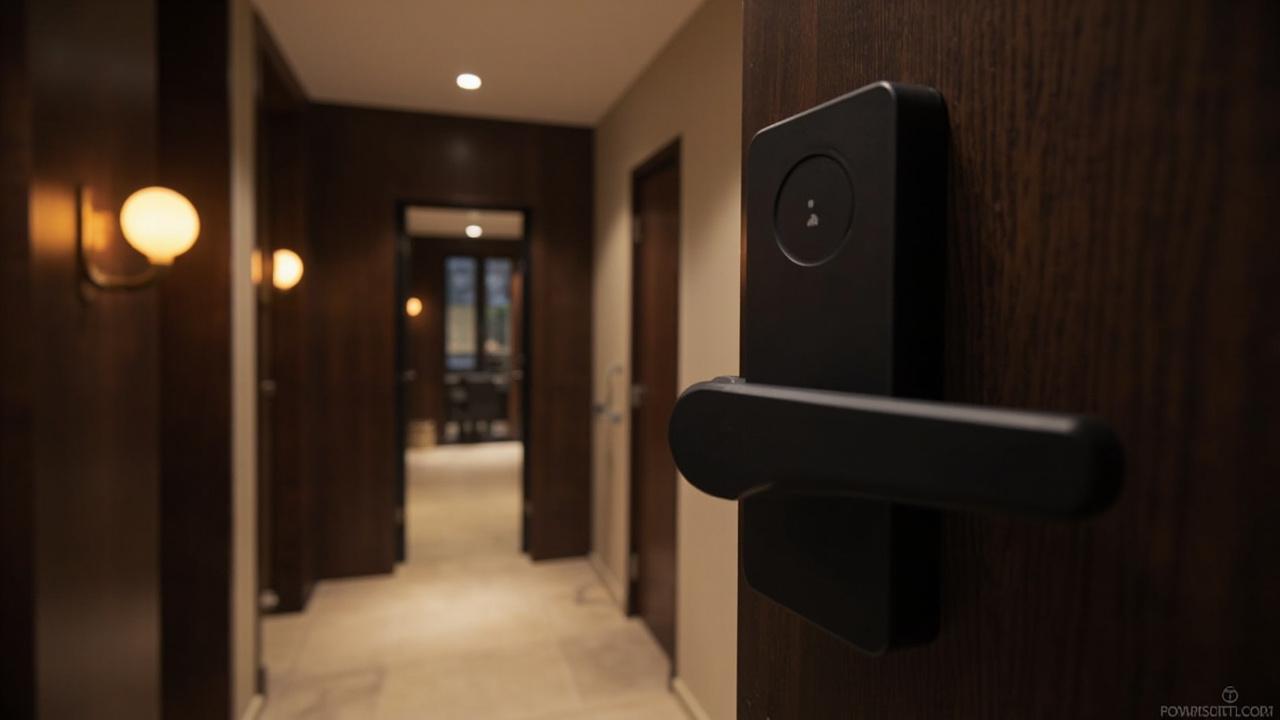
SLK-9936S vs Traditional Hotel Door Locks
One lock carries a published datasheet. The other carries history. That is the entire difference in how this comparison must be run: every claim for the SLK-9936S can be checked against a printed line; every claim for a traditional hotel door lock can only be checked against how your own fleet has behaved on your own doors. This article scores them head-to-head across nine operational rounds — the front desk, the lost credential, the door itself, the night audit, the power story, the staff change, the arriving guest, the portfolio, and the emergency. No pricing figures appear anywhere, because neither side publishes numbers you could compare honestly; cost appears only as factor structure, resolved at quote.
Direct answer: For a hotel evaluating SLK-9936S against traditional hotel door locks — mechanical keyed locks and first-generation magnetic stripe card locks — the SLK-9936S wins six of nine operational rounds, the traditional side wins one (zero electrical dependency), and two end in draws. The decisive margins are documented credential issuance (RFID Mifare 1 @ 13.56 MHz, read time <0.25 s), revocation without re-keying, and an on-lock event buffer of up to 1,000 records that mechanical and stripe locks cannot match in kind. Traditional locks stay relevant only where doors fall outside the 36–100 mm published envelope or where an operator refuses to run any battery program at all.
The Tale of the Tape: Pinning Down Both Fighters
"Traditional hotel door lock" is not one product. It is two generations sharing a reputation. Generation one is the mechanical pin-tumbler hotel lock: brass or steel body, keyed cylinder, keys cut at the desk or by a locksmith, custody managed by a rack and a log. Generation two is the magnetic stripe hotel card lock, the device that largely replaced keys in the 1970s and 1980s: a card swiped through a reader head that reads tracks encoded at the front desk. Neither generation publishes anything a buyer can audit the way the SLK-9936S can.
The SLK-9936S enters with a spec block on its product page (verified listing) — the anchor first-party data used throughout this arena:
| Published line | SLK-9936S (PDP-cited) | Mechanical keyed lock | Magnetic stripe lock |
|---|---|---|---|
| Credential interface | RFID Mifare 1 @ 13.56 MHz, tap, 0–5 cm | Physical key bitting | Card swipe, contact reader head |
| Read/actuation time | <0.25 s read time | Turn of a key | Depends on head condition and card condition |
| Door thickness fit | 36–100 mm | Whatever the original prep accepts | Whatever the original prep accepts |
| On-lock memory | Audit/event records up to 1,000 | None | Generation-dependent; typically far less (CONFIRM-PER-MODEL) |
| Cylinder | 5-pin cylinder, mechanical emergency access | The key IS the only access path | Usually an optional mechanical override |
| Latching | 3-point latch | Body-dependent | Body-dependent |
| Power | 4 × AA, battery operating cycles >15,000 | None required | Batteries; stripe readers add wear items |
| Body/finish | Stainless steel + alloy, multiple finish options | Brass/steel, finish options | Steel/plastic, older aesthetics |
| Management | Multilingual software; standalone or centralized database modes | Key-bitting registries and racks | Encoder station, proprietary software |
| Positioning | 1–5 star hotels | Any | Legacy inventory |
Two ground rules for the scoring. First, a round is won on evidence a buyer can demand in writing, not on anecdote. Second, draws are allowed and expected — an arena that scores 9–0 is advertising, not analysis. Each round: winner takes 1 point, a draw splits 0.5/0.5.
Round 1 · Morning Rush at the Front Desk
Three properties arrive at the desk on the same shift: a guest who needs a key cut, a guest whose stripe card will not encode cleanly, and a guest holding a fresh card for a 9936S-fitted door.
The mechanical path is manual twice over. Someone locates the door on a key rack or a keying chart, someone cuts or issues the key, someone logs custody because a key has no expiry. Every step is a person and a minute, and the minutes multiply when the property runs a mixed keying system — an almost universal condition in older hotels, which is why the full custody argument gets its own article (RFID Hotel Lock vs Traditional Key).
The stripe path moved credentials off metal but put wear back into the loop: contact through a reader head means the head and the card degrade together, and encoding quality drifts as the encoder wears. The head-to-head on that mechanism specifically is dissected in RFID Hotel Lock vs Magnetic Stripe Lock; here it only scores as desk friction.
The 9936S path is a tap-based handshake. The published interface — Mifare 1 at 13.56 MHz, coupling within 0–5 cm, read in under 0.25 s — means issuance at the desk is an encode-and-verify action with no contact parts to wear, and expiry is written into the credential rather than chased by a log. The read time matters as an operational floor: it is the number that keeps a 0–5 cm tap from becoming a queue at the door.
Winner: SLK-9936S. Desk throughput with no cutting, no racks, no consumable wear loop. Score: 9936S 1 — Traditional 0.
Round 2 · The Lost Credential
The most expensive moment in hotel locking is not installation. It is someone reporting something lost.
Lose a mechanical key and the question is "what can it open?" If the answer is more than one room, the prudent response is cutting work and re-pinning — paying labor to make old metal worthless, door by door. Lose a stripe card and you re-encode future credentials, but the exposure window for the lost card depends entirely on that generation's design, and most legacy fleets have no written answer.
Lose a Mifare 1 card at a 9936S door and the response is credential-side, not door-side: issue a replacement and make the old credential fail to re-authorize. The exact invalidation mechanism differs between the lock's two published management modes — standalone versus centralized database — so demand the mechanism in writing for your configuration (CONFIRM-PER-MODEL: whether a re-issued guest credential is superseded at next read, at next download, or only at re-encoding sweep). What matters for scoring is the category: the 9936S loses nothing physically at the door, while a lost key can force hardware work on doors that are still perfectly good.
Winner: SLK-9936S. Revocation is a data action, not a cut-and-cylinder action. Score: 9936S 2 — Traditional 0.
Rendered as a state machine, the 9936S loss response never touches a door:
stateDiagram-v2
    [*] --> Issued_at_desk
    Issued_at_desk --> Working_at_door : tap within 0-5 cm
    Working_at_door --> Expired : expiry written into the credential
    Working_at_door --> Reported_lost : guest reports the card missing
    Reported_lost --> Replacement_issued : re-issue at the desk \nno re-keying, no cutting
    Replacement_issued --> Old_credential_superseded : at next read or download \nmechanism per mode = CONFIRM-PER-MODEL
    Expired --> Retired
    Old_credential_superseded --> Retired
    Retired --> [*]
Round 3 · What the Door Can Tell You Later
A dispute at 02:14. Management asks a flat question: who entered this room, and when?
A mechanical lock is mute. It has no memory and takes no notes; the only witness is the key rack log and human recollection. A stripe-generation lock is semi-mute — some models of that era stored events, but capacity and exportability are generation-specific and rarely documented in ways a buyer can verify today (CONFIRM-PER-MODEL, and expect thin answers).
The 9936S publishes audit/event records up to 1,000 per lock. Read the line honestly: a rolling buffer, not an archive. On a busy room the window it covers shrinks fast — the buffer arithmetic is worked through in the audit-trail datasheet dissection — so the operational rule is pull discipline, not assumption of infinite recall. But the asymmetry decides the round: one contender commits to a number a buyer can demand evidence against, and the other two contenders cannot be asked the question at all.
Winner: SLK-9936S. Evidence exists in one corner and is categorically absent in the other. Score: 9936S 3 — Traditional 0.
Round 4 · The Door Envelope and the Retrofit Burden
Now the traditional side gets its moments, because this round is about wood, not data.
The 9936S publishes 36–100 mm door thickness, a 5-pin cylinder, and a 3-point latch. Those lines are generous — they cover the mainstream hotel door population and the thick timber assemblies resorts favor — but a published envelope is also a gate. Every door outside 36–100 mm needs a different answer, which is why replacement projects run a caliper census before they run an order; the method is laid out in the SLK-9936S replacement guide and the door-thickness compatibility survey side by side with fitting-class splits. A mechanical lock already hanging on a quirky door asks nothing of you except continued custody discipline. It fits because it was fitted.
The honest reading: the 9936S converts retrofit uncertainty into a bounded, measurable survey — one number per door, checked against one published band. Traditional locks convert retrofit into zero, but they also offer no path forward when you want Rounds 1–3. The round belongs to neither side outright.
Draw. The datasheet gives you a filter; the key gives you a free pass with no future. Score: 9936S 3.5 — Traditional 0.5.
Round 5 · Power, Consumables, and What Can Fail on You
Electronics eat. The 9936S runs on 4 × AA cells and publishes battery operating cycles >15,000 — an endurance class for the mechanism, not a promise about calendar pack life; the two clocks are separated in the battery and power guide treatment. Whatever the cycle headroom, the property inherits a program: cells bought, swapped in sets, tracked, and a low-voltage behavior at the door to learn (CONFIRM-PER-MODEL: how the lock indicates a dying pack and what happens to the latch on the last day).
The mechanical contender swallows nothing. No program, no rounds, no disposal, no door-side electronics failure mode at 2 a.m. That is the whole round, and the traditional lock takes it cleanly. Stripe-generation locks, to be fair, sit in the 9936S's column here — they run on batteries too and add reader-head wear to the consumables list — but the arena's traditional fighter is its best representative, and the best representative on power is the one with no power.
Winner: Traditional (mechanical). Zero electrical dependency is a real operational virtue. Score: 9936S 3.5 — Traditional 1.5.
Round 6 · Staff Turnover and Multilingual Sites
Housekeeping and desk staff rotate constantly in resort and transit markets, and the locking system has to survive the churn.
For keys, training is trivial — everyone has used a key — but the discipline that actually protects the property (custody logs, rack counts, keying charts) is exactly the part that erodes with turnover, and the failure is invisible until an incident. For the 9936S, the published multilingual management software plus the choice between standalone and centralized database modes means the desk procedures can be written in the staff's languages and run either lock-by-lock or from one database. The encoder station at the desk is a new skill, yes, but it is a bounded one: issue, verify, recover, reconcile.
The traditional side's simplicity and the 9936S's governability offset each other. Neither has a documented advantage that survives scrutiny on a property with good key discipline — and almost no property can prove it has good key discipline without an audit it never ran.
Draw. Skill burden moved; it did not clearly shrink. Score: 9936S 4 — Traditional 2.
Round 7 · Ten Seconds at the Door with Luggage
The guest never sees Rounds 1–6. The guest sees this one.
A key is a small object that must be found, oriented, and turned while pulling a carry-on. A stripe card is a small object that must be swiped at the right speed past a contact head whose condition no guest can see — and the generation's reputation for "the card stopped working" was earned honestly. A 9936S credential is presented within 0–5 cm and read in under 0.25 s: a tap, not a procedure. The finishes published for stainless steel + alloy bodies cover the aesthetic expectations from 3-star refreshes up, consistent with the model's stated positioning for 1–5 star hotels.
There is one genuine guest-side risk to score honestly: a dead pack at the door is a guest-facing event, whereas the key lock never dies electrically. But the 9936S publishes mechanical emergency access as the fallback path at the door itself, so the event is handled, not unhandled.
Winner: SLK-9936S. The tap beats the twist and the swipe on every arrival with full hands. Score: 9936S 5 — Traditional 2.
Answer box: Where the SLK-9936S beats traditional hotel door locks most visibly to guests: contactless RFID presentation within 0–5 cm read in under 0.25 seconds, versus fumbling a key or swiping a wear-prone magnetic stripe; plus multi-finish stainless steel and alloy bodies positioned for 1–5 star properties.
Round 8 · Running Twenty of These Doors, or Two Hundred
Single-door comparisons flatter everyone. Portfolio comparisons punish everyone.
Mechanical fleets scale badly in three known ways — custody load, re-keying exposure after departures and losses, and the absence of any operational data leaving the doors. The published 9936S portfolio story is the mirror image: the same event-record buffer that resolves disputes becomes, in aggregate, housekeeping and maintenance telemetry; the two database modes let an owner run one lock or a fleet policy from software; and the credential standard (Mifare 1 @ 13.56 MHz) is a single blank-card specification to buy against, instead of key blanks per bitting. Standardization reaches past one model: the hotel category spans 24 models within a 79-model catalog, sold into 80+ countries by a manufacturer with 10+ years in smart locks — meaning a configuration string can be standardized across a portfolio and re-ordered years later, an argument developed at owner level in Hotel Smart Lock vs Traditional Hotel Lock.
The traditional contender's counter — "nothing to upgrade, nothing to learn, nothing to integrate" — is a cost-avoidance argument, not a capability argument, and cost avoidance is exactly what a re-keying weekend erases.
Winner: SLK-9936S. Fleets need a data plane and a credential standard; keys supply neither. Score: 9936S 6 — Traditional 2.
Round 9 · When the System Is Down or Someone Must Enter Now
The emergency round is where sloppy comparisons cheat the traditional lock and rigorous ones split the point.
Keys are the classic emergency answer: no failure mode at the door, only custody questions — who holds the master, where is it, can it be reached tonight. The 9936S does not forfeit this round on electronics, because its published block includes mechanical emergency access through the 5-pin cylinder: the emergency path exists on the smart lock itself, at the door. What the 9936S cannot honestly claim is redundancy of power — if packs are neglected long enough, the electronic path degrades even while the mechanical path stands ready, and the operational answer is a battery program plus key-set custody, both governed topics (see the SLK-9936S buyer guide for the full fit assessment).
One side carries a custody burden with zero door-side technology risk; the other carries a small technology risk hedged by its own mechanical override. Neither dominates.
Draw. The emergency answer is "governed either way." Score: 9936S 6.5 — Traditional 2.5.
The Final Tally, Read Carefully
| Round | Question decided | Winner | 9936S — Traditional |
|---|---|---|---|
| 1 | Front-desk issuance | SLK-9936S | 1 — 0 |
| 2 | Lost credential | SLK-9936S | 2 — 0 |
| 3 | Post-event evidence | SLK-9936S | 3 — 0 |
| 4 | Door envelope / retrofit | Draw | 3.5 — 0.5 |
| 5 | Power and consumables | Traditional | 3.5 — 1.5 |
| 6 | Staff churn, multilingual | Draw | 4 — 2 |
| 7 | Guest at the door | SLK-9936S | 5 — 2 |
| 8 | Portfolio operations | SLK-9936S | 6 — 2 |
| 9 | Emergency access | Draw | 6.5 — 2.5 |
6 — 1 — 2 draws. The shape of the scoreboard matters more than the numbers. Every round the SLK-9936S won, it won on a published line: 0–5 cm / <0.25 s, 1,000 records, Mifare 1 13.56 MHz, multilingual software with two database modes, mechanical emergency access. The single round the traditional side won, it won on the absence of a datasheet requirement — no power means no power program. Draws fell exactly where good governance, not hardware, decides the outcome. That is the arena's real verdict: the 9936S trades on verifiable commitments; traditional locks trade on practices your property either runs or quietly skips.
Answer box: Scored verdict — SLK-9936S wins six of nine operational rounds against traditional hotel door locks (issuance, revocation, evidence, guest experience, portfolio operations, retrofit coverage), traditional locks win one (no electrical dependency), with door-fit, staff-churn, and emergency rounds drawn. The outcome flips only for doors outside the published 36–100 mm envelope or operators unwilling to run a battery program.
Verdict by Buyer Profile
| If you are… | Your rounds that decide it | Default reading |
|---|---|---|
| 20–40 room B&B, one keeper of keys | 5, 9 | Mechanical honestly suffices; 9936S enters only if guest-experience or evidence starts mattering |
| 80–150 room independent, mixed keying today | 1, 2, 4 | Strongest 9936S case: kill the key-rack tail after a caliper census |
| 4-star city hotel refreshing wings on a schedule | 2, 3, 8 | 9936S as standard configuration; centralized mode for portfolio policy |
| Resort with thick timber doors | 4, 7 | The 36–100 mm band usually covers you; survey first, tap experience sells itself |
| Owner of a legacy stripe fleet at end of life | 1, 5, 7 | Both fighters run batteries; 9936S wins on wear-free interface and records |
| Distributor assembling a hotel program | 8 | 9936S anchor SKU inside the 24-model hotel category; traditional is not a repeatable line |
Illustrative Scenario: Consider a 120-Room Property with Two Lock Generations
A 120-room, three-floor hotel: 74 rooms still on a mixed keying system from two previous owners, 46 on original-generation stripe locks kept alive by encoder maintenance. Front desk averages eight new keys and four "card not working" escalations per week — the counts come from their own complaint log, not from any published statistic, and your property's number is yours to measure. Two losses in one quarter trigger a re-key sweep of one corridor: labor concentrated, doors taken out of inventory one at a time.
Run the arena against that calendar. Round 1 loads eight desk actions a week. Round 2 loads the sweep. Round 3 loads every escalated dispute with nothing to show for it. Rounds 5 and 9 load the 9936S side: a cell-swap program across 120 doors and custody of emergency key sets. The migration question is never "is the 9936S magic"; it is whether Rounds 1–3 recur more often than Rounds 5 and 9 bite. On that property's own log, they did — and the door census (36–100 mm check, fitting-class grouping) became the first work order, executed wave by wave per the replacement guide sequence.
Replay the Arena on Your Own Property
The scoreboard above is portable only if you score it with your evidence. Use this worksheet — every blank cell is a number or document you pull before your next quote conversation.
| Criterion to score yourself | Your data source | Mechanical fleet — EXAMPLE | 9936S — EXAMPLE | Your score (0/1/2) |
|---|---|---|---|---|
| Desk minutes per issuance | Shift observation | 4 min incl. rack + cut | ~1 min encode + verify | ___ |
| Cost events per lost credential | Last 4 incidents | Re-key sweep / none | Re-issue / none | ___ |
| Can a door answer "who entered?" | Try one tonight | No | 1,000-record buffer, pull cadence | ___ |
| Doors outside fit envelope | Caliper census | n/a (already fit) | Count outside 36–100 mm | ___ |
| Consumables you must stock | Purchases log | Blanks, cutting service | AA sets, Mifare blanks | ___ |
| Staff training to replace a key holder | Write the SOP | Short but custody-heavy | Encoder SOP + mode rules | ___ |
| Emergency path documentation | Ask supplier/locksmith | Key cabinet exists today | Mechanical override + custody policy | ___ |
Score 12+: the 9936S case replicates on your property. Score 8–11: hybrid — move new construction and problem wings first. Below 8: your traditional fleet is being run well; revisit at end of stripe support.
What to Demand in Writing Before You Sign Off Any Verdict
| Ask | Why it decides a round | Acceptable answer shape |
|---|---|---|
| Published door-thickness band per finish variant | R4 | Numeric band, matching 36–100 mm for the base 9936S block |
| Credential invalidation method in standalone vs centralized mode | R2 | Named mechanism + timing, not "card is blocked" |
| Event record fields and export format | R3 | Field list + export sample within the 1,000-record buffer |
| Low-voltage indication and last-days behavior | R5, R9 | Documented signal path, per model |
| Emergency keyway and blank supply route | R9 | Custody-capable answer: how blanks are obtained later |
| Encoder software languages and DB mode options | R6, R8 | Multilingual confirmed; standalone/centralized stated |
| Credential tier for the deployment (Mifare 1 class handling) | R2 | Written card-specification match to 13.56 MHz blanks |
Anything that cannot be written in these shapes is a marketing asset, not an operational one.
Take the Scoreboard to the Quote
The arena is decided on published commitments, so close it the same way: request the SLK-9936S configuration for your door census and mode choice at request-a-quote, and put the nine-round worksheet and the demand table into the same envelope so the supplier answers the operations, not the brochure. Compare the hidden-reader alternative, the SLK-9905A, on the identical rounds if door aesthetics drive your shortlist — and browse the wider hotel lock category to see how many of the 24 hotel models fit the roles your wings actually need.