
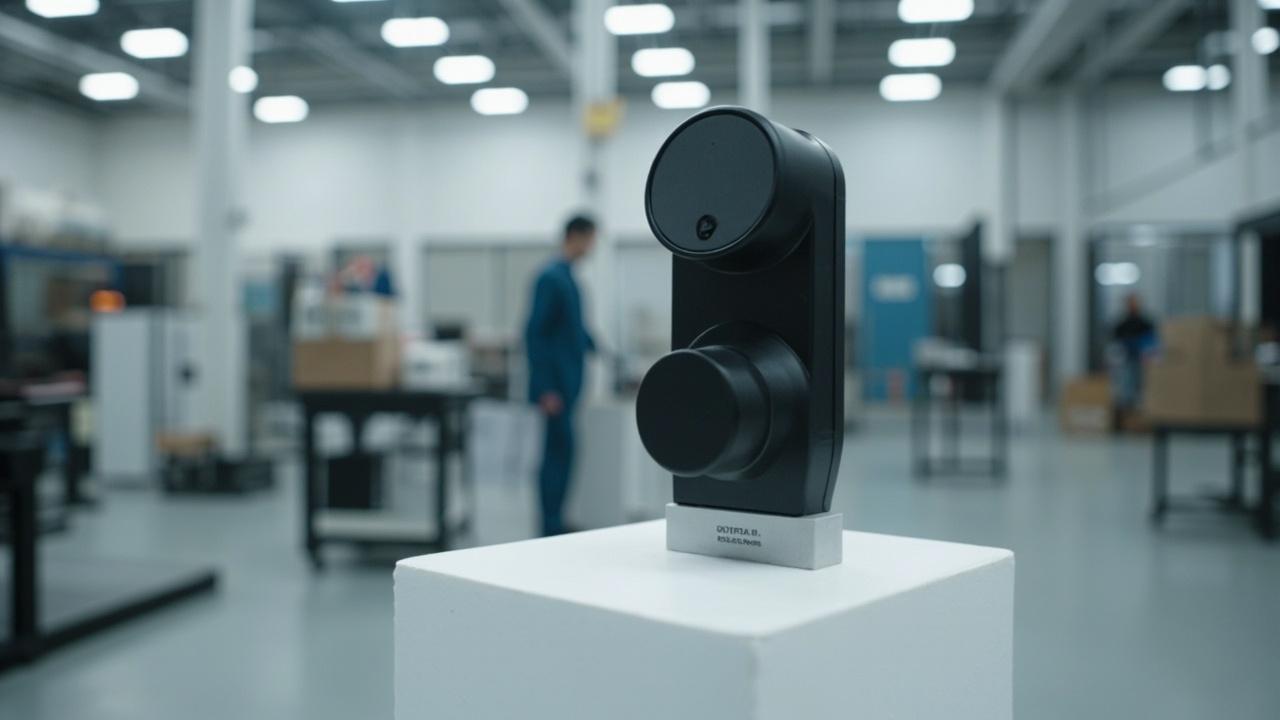
Smart Lock Mold Cost
A smart lock mold is the steel tool — sometimes aluminum for short-run plastic prototypes — that shapes the lock's metal housing, plastic cover, handle escutcheon, fingerprint sensor window, battery compartment, RFID reader face, or any other repeatable component whose geometry cannot be machined more cheaply than it can be cast or injected. Mold cost is a subset of the broader tooling cost envelope (see the smart lock tooling cost reading) and a subset of the wider OEM cost stack (see the smart lock OEM cost breakdown). It is one of the few lines on the offer letter that a buyer can spend a six-figure sum on without receiving a single shippable unit, which is precisely why the line deserves literacy before it deserves negotiation. The rest of this article walks that literacy — what a smart lock mold is, what drives its cost, how the figure amortises into per-unit pricing, where break-even sits, what clauses govern ownership and transfer, what a trial-shot cadence looks like, what lifecycle considerations follow the first production run, and where the buyer goes from here. No specific dollar amount is filled in anywhere in this article; every per-mold figure is routed to the supplier's dated written offer letter and to the catalog's per-SKU confirmation discipline.
What the factory floor calls a "mold" when the conversation turns to a smart lock
The word "mold" travels across three distinct process families inside a smart lock factory, and the offer letter almost never distinguishes them clearly enough. A buyer who only sees one line called "mold" can end up comparing two fundamentally different tools as if they were the same line.
The first family is die-casting tooling for zinc-alloy lock bodies, latch bolts, handle bases, and the heavier internal frames that give a lock its mechanical rigidity. These tools are large, multi-slide steel dies with cooling channels, ejector pins, and surface-finish grades calibrated to the plating or painting that follows. They are expensive, slow to build, and built to last across hundreds of thousands of shots.
The second family is plastic injection tooling for ABS, PC, or PC-ABS covers, escutcheons, fingerprint sensor windows, battery doors, reader faceplates, and the cosmetic shells that ride on top of the mechanical structure. These tools vary enormously in cost depending on cavity count, surface finish, and slide count, and the same mold can run anywhere from a short pilot lot to a multi-year production run depending on the program.
The third family is the smaller family of compression molds, SMC/BMC molds, rubber gasket molds, and silicone overmolds that show up around keypads, gaskets, sensor windows, and waterproof sealing rings. They tend to be cheaper than the first two but still non-trivial, and they are often forgotten until the buyer asks why their waterproof claim requires yet another mold line.
A smart lock program of any meaningful scale uses at least one mold from each family, often several from each. The combined mold investment can rival — or exceed — the cost of the first production run itself, which is why the discipline of treating mold cost as literacy rather than as a number matters.
What drives the figure on a smart lock mold
A mold quote is a stack of design drivers, not a single number. The offer letter should itemize each driver or the buyer has no way to evaluate whether the figure is fair. The drivers that swing the figure most are listed below in roughly descending order of cost impact.
Component geometry and wall section. A thin-walled lock cover with a uniform rib pattern is a different mold than a thick-walled zinc-alloy body with internal cavities, bosses, and undercuts. Geometry drives steel block volume, machining time, cooling layout, and slide count. The same nominal lock family can carry a two-figure-percentage difference in mold cost depending on whether the inside geometry is machinable from one direction or requires lateral slides.
Cavity count. A single-cavity mold produces one part per shot; a multi-cavity mold produces several. Cavity count raises mold cost sharply because each cavity needs its own steel, cooling, ejector, and finishing. It also lowers per-part cycle time once the mold is running. The right cavity count depends on the program's annual volume and on the factory's press capacity — neither of which the buyer can assume.
Steel grade and tool life expectation. Different grades of steel tolerate different shot counts before they fatigue, polish out, or need refurbishment. A short-run pilot mold in a softer steel costs less and runs fewer shots before maintenance. A long-run production mold in a harder steel costs more and runs further between refurbishments. The tool-life number written into the offer letter should match the volume the buyer is committing to.
Surface finish grade. A lock body that goes straight to painting tolerates a coarser mold finish than a lock body that goes to mirror plating or to a fingerprint-sensor-grade cosmetic surface. Surface-finish grade drives polishing, EDM, and hand-fitting labor, all of which sit on the mold-cost line.
Slide and lift count. Undercuts that cannot be drafted out of the part geometry require mechanical slides or angle lifters in the mold. Each slide adds steel, machining, and assembly labor. A handle base that needs two or three slides is materially more expensive to mold than a flat cover with no undercuts.
Runner and gating system. A cold-runner mold wastes material in the runner between shots. A hot-runner mold keeps the runner molten and reduces waste, at a higher mold cost. For high-volume programs the hot-runner premium is recovered through material savings; for low-volume programs the buyer should not be paying for it.
Tolerance and cosmetic class. A structural internal frame tolerates wider dimensional tolerance than a fingerprint-sensor cosmetic cover that the end-customer touches every day. Tighter tolerance means more cautious mold design, more precise machining, and more trial-shot iteration. Cosmetic-class parts almost always carry a higher mold line than structural-class parts of the same weight.
Trial-shot and sampling cadence. A typical mold goes through T1 (first shot), T2 (sample after adjustment), and T3 (pre-production sample) rounds before production starts. The number of rounds the offer letter budgets, the scrap allowance per round, and the sample-lot size per round all sit on or near the mold line.
None of these drivers can be priced in this article. Every one of them resolves to a per-program figure the buyer must obtain from the supplier against a dated written offer letter. The supplier's response — or refusal to itemize — is itself a signal about how seriously the supplier takes mold cost as a discipline.
Amortisation: how mold cost folds into per-unit pricing
A mold is paid for once. The production units it makes are sold many times. Amortisation is the bridge between those two facts. There are three common ways the smart lock industry writes the bridge, and the buyer should know which one is sitting in the offer letter before signing it.
Capitalised mold, buyer-owned. The buyer pays the full mold cost up front, the mold is registered in the buyer's name on the factory's mold register, and the per-unit price the buyer pays contains no mold-recovery component. The buyer carries the risk that volume falls short of the forecast; the factory carries no recovery risk. This structure suits programs with a confident multi-year volume commitment and a buyer who wants the mold off the factory's balance sheet.
Amortised mold, factory-owned, recovered per unit. The factory pays for the mold and recovers the cost as a per-unit surcharge across a stated volume band. Once the band is crossed, the surcharge drops. This structure suits programs where the buyer wants a lower entry barrier and the factory is comfortable underwriting the volume forecast. The risk is asymmetric: the buyer carries less cash-flow risk; the factory carries the volume-shortfall risk.
Hybrid. The buyer pays a portion of the mold cost up front to anchor commitment, the factory funds the rest, and the per-unit price carries a reduced surcharge that steps down at agreed volume thresholds. This is the most common structure for mid-volume OEM programs, and it is the structure that requires the most disciplined offer-letter wording.
The shape of the amortisation matters as much as the size of the mold line. A buyer who agrees to a per-unit surcharge without specifying the volume band, the step-down thresholds, the surcharge sunset condition, and the mold ownership transfer clause on band completion can find themselves paying for the same mold twice — once through the surcharge, once through a renewal the factory imposes at the band's end.
The amortisation horizon also matters. A mold designed for 100,000 shots amortises very differently from a mold designed for 500,000 shots. The buyer's forecast has to align with the steel grade and tool-life expectation the factory is quoting, or one of the two parties is going to carry a hidden liability.
Break-even: when a custom mold pays for itself against a catalog alternative
Break-even is the moment when the cumulative per-unit savings from using a custom mold have repaid the mold cost, after which every additional unit is pure margin relative to the alternative. The alternative, in a smart lock program, is one of three things: a catalog SKU with the buyer's logo and finish; an existing factory mold the buyer hires time on; or a competitor's product the buyer has decided not to use.
The break-even math has four inputs the buyer controls, and one the buyer cannot control.
The four controllable inputs are: the per-unit price difference between the catalog alternative and the custom-mold product; the mold cost itself; the annual volume the buyer can commit to; and the mold life expressed in shots or years. None of these four figures can be filled in this article, because each varies program by program, SKU by SKU, supplier by supplier.
The one uncontrollable input is the catalog alternative's price floor. The catalog alternative is a price the supplier already quotes, and the supplier holds the leverage on whether the catalog line moves down over the program life. A buyer who builds a break-even case on a catalog price that drifts down over three years will find the case broken before the mold finishes its first production run.
A reasonable buyer-side break-even framework treats the mold cost as the numerator and the per-unit savings as the annual denominator. A buyer who can describe the calculation aloud — without revealing the specific figure — is in a better negotiating position than a buyer who has only the headline number from the offer letter.
The break-even also shifts when the program scope shifts. Adding a second SKU that shares the same mold compresses the break-even because the mold cost is spread across more units. Adding a cosmetic variant that needs a second mold pushes the break-even back out. A buyer who treats the mold investment as a portfolio decision rather than a per-SKU decision usually negotiates a better envelope than a buyer who treats each SKU as its own island.
Mold ownership, transfer, and storage clauses the offer letter must contain
The clause that protects the buyer is not the mold cost clause — it is the mold ownership clause. A buyer who has paid for a mold but does not have a written ownership transfer, a registered mold record, and a storage-and-maintenance commitment is a buyer who has underwritten the factory's balance sheet rather than bought a tool.
The five clauses the offer letter should contain are these.
Ownership clause. Names the legal owner of the mold steel. The clause should specify whether the buyer holds title from day one, whether title transfers on final payment, or whether the factory retains title until a stated volume threshold is reached. The clause should be unambiguous about what happens on program termination.
Mold register clause. Lists the mold by part name, part number, cavity count, steel grade, weight, and serial number. The clause should specify where the physical register sits — typically with the factory's tooling department — and how the buyer can audit it.
Storage and maintenance clause. Specifies where the mold is stored, who is responsible for routine maintenance, what the maintenance interval is (typically tied to a shot count), and how the buyer is notified when a maintenance cycle is approaching. The clause should also specify who pays for refurbishment once the mold crosses its stated tool life.
Transfer clause. Specifies what happens to the mold if the program ends, the buyer switches suppliers, or the factory ceases operation. The clause should describe the physical handover procedure, the documentation that travels with the mold, the time window for transfer, and any cost the buyer pays for the transfer service.
Confidentiality and exclusivity clause. Specifies whether the mold can be used to produce parts for a third party. A buyer who has invested in a private-label mold generally expects exclusivity. A factory that wants to keep the mold available for other buyers will resist. The clause resolves the conflict in writing rather than in litigation.
None of these clauses can be filled with sample wording in this article. Each clause is a negotiation, and each clause depends on the relationship between the buyer and the supplier. The buyer's leverage on these clauses is highest before the first wire transfer leaves the buyer's account, and lowest after the mold has been built and is sitting on the factory floor.
Trial-shot cadence: T1, T2, T3 and what each round tells the buyer
A smart lock mold does not go from steel to production in one step. The trial-shot cadence is the documented protocol that catches mold problems before they reach the production line, and it is one of the cheaper insurance policies a buyer can negotiate into the program.
T1 — first shot. The mold is mounted on the press for the first time. The buyer typically sees a small sample lot — sometimes a handful of parts, sometimes a few dozen. T1 parts almost always show mold defects: short shots, flash, weld lines, sink marks, warpage, color drift, surface blemishes. T1 is a learning round, not a production round, and the offer letter should budget for T1's scrap rather than treating T1 parts as shippable units.
T2 — second sample after adjustment. The factory adjusts the mold based on T1 findings — trimming gates, polishing surfaces, adjusting cooling, balancing runner flow. T2 parts are closer to production quality, but they usually still carry some flaws the buyer should document. T2 is the round where the buyer and the factory align on what "acceptable" looks like.
T3 — pre-production sample. The factory runs the mold under near-production conditions and produces a sample lot sized to the program's pre-production volume. T3 is the round where the buyer signs off on cosmetic class, dimensional tolerance, and functional fit. T3 parts are usually shippable; T1 and T2 parts usually are not.
The trial-shot cadence costs the factory labor and machine time and costs the buyer time-to-market. Both costs are visible in the offer letter, and both should be budgeted openly rather than absorbed silently. A supplier who refuses to itemize trial-shot cost is a supplier who is likely to compress the cadence under schedule pressure, which almost always surfaces as cosmetic defects in the production run.
The buyer who treats T1, T2, and T3 as inspection rounds rather than as production rounds keeps the discipline intact. The buyer who accepts T1 parts as shippable inventory is a buyer who will spend the next six months managing field complaints.
Lifecycle considerations: what happens after the first 100,000 shots
A mold does not stay new forever. Steel fatigues, surfaces polish out, cooling channels scale, ejector pins wear, and slides lose tolerance. The lifecycle considerations begin the moment production starts, not when the mold reaches end-of-life.
Maintenance interval. Most production molds carry a maintenance interval measured in shots or in production days. A typical interval for a zinc-alloy die-casting mold is between 50,000 and 150,000 shots; a typical interval for a plastic injection mold is between 100,000 and 300,000 shots. The interval depends on the steel grade, the material being molded, the cosmetic class, and the operating conditions. The offer letter should specify the interval and the scope of routine maintenance.
Refurbishment threshold. Eventually the mold reaches a point where routine maintenance is no longer enough. The threshold — typically between 300,000 and 500,000 shots for a hardened steel mold — is when refurbishment begins. Refurbishment can mean re-polishing surfaces, replacing ejector pins, re-machining cavities, or re-texturing finishes. The cost of refurbishment usually sits in a separate line from the original mold cost, and the offer letter should specify who pays.
Mold migration. A mold built for one product generation often survives into the next. A hotel-class lock body mold built for a 36–55 mm door thickness program can serve a 38–70 mm door thickness successor with a re-machined cavity. A plastic cover mold built for one fingerprint sensor footprint can serve a successor with a smaller footprint if the slide geometry was designed for adjustability. Mold migration is a real source of amortisation benefit, and it is a discipline the buyer can write into the program from day one.
End-of-life decision. When the mold reaches the end of its useful life, the buyer faces a choice: refurbish, replace, or retire. The decision depends on the program's volume outlook, the next-generation product's geometry, and the cost of a fresh mold relative to the cost of refurbishment. The end-of-life decision is rarely made well under time pressure, which is why the offer letter should anticipate it.
A buyer who treats the mold as a long-lived asset rather than a one-off purchase negotiates a different envelope than a buyer who treats the mold as a sunk cost. The factory's tooling department can usually tell the buyer, in writing, how long the mold is expected to last under stated operating conditions. The buyer who asks is the buyer who gets the figure on the record.
Where smart lock mold cost sits in the wider OEM and tooling envelopes
Mold cost is one slice of a larger pie, and the buyer who evaluates the slice in isolation often misreads the pie. Two siblings on this site — the smart lock OEM cost breakdown and the smart lock tooling cost — frame the slice in context.
The OEM cost breakdown treats the per-unit cost stack as the primary lens: materials, electronics, finish, assembly, packaging, software, certification, and the order economics that move per-unit pricing up and down the wholesale tier ladder. Mold cost sits on the buyer-side capex side of that ledger rather than the per-unit side, and the relationship between capex and per-unit is precisely the amortisation discipline described above.
The tooling cost frame treats molds as one category within a wider tooling envelope that also includes jigs, fixtures, gauges, test rigs, custom packaging tooling, and the sample-evaluation tooling that supports pre-production. A buyer who reads both articles alongside this one sees that mold cost is the largest single line inside tooling, but tooling itself is one slice of the wider OEM program cost, and the wider OEM program cost is one slice of the buyer's market-entry economics.
The disciplined reading order is OEM cost breakdown first, tooling cost second, mold cost third. The disciplined reading produces a buyer who knows how mold cost fits into capex, how it folds into per-unit pricing, and how it shapes the break-even against the catalog alternative. A buyer who reads the articles in any other order is a buyer who has the detail without the frame.
Illustrative scenario: a private-label hotel program weighing mold investment
Consider a 120-room mid-scale hotel group planning a private-label lock program across three of its properties. The group has shortlisted two suppliers: Supplier A offers a catalog hotel-class line with the group's logo and finish applied at the catalog level; Supplier B offers a custom die-cast lock body mold in the group's brand geometry, paired with a plastic injection cover mold for a signature fingerprint sensor window.
The group's OEM cost breakdown shows the per-unit difference between the two offers. The group's tooling cost comparison shows that Supplier B's envelope includes a die-cast mold and an injection mold, while Supplier A's envelope includes only a logo artwork line. The mold cost line on Supplier B's offer is non-trivial, but it is itemized across die-cast mold cost, injection mold cost, trial-shot rounds, and mold maintenance.
The group's break-even math takes the mold cost as the numerator and the per-unit savings — driven by Supplier B's lower per-unit price once the catalog supplier's premium is removed — as the annual denominator. The group's three-property, multi-year volume forecast puts the break-even well inside the mold's stated tool life, which makes the program financeable.
The group's offer letter from Supplier B carries the five clauses described above: ownership, mold register, storage and maintenance, transfer, and confidentiality. The group has negotiated a step-down in the per-unit surcharge after a stated volume band, and the group has documented the trial-shot cadence with T1, T2, and T3 sample lot sizes.
This is an illustrative scenario, not a customer story. Every name is fictitious, every figure is illustrative, and every per-SKU detail resolves to the supplier's dated written offer letter and to the catalog's per-SKU confirmation discipline. A real program would carry per-mold figures, per-cavity figures, per-slide figures, per-trial-shot figures, and per-refurbishment figures that this article deliberately does not fill in.
What this article deliberately does not assert
This article does not fill in any per-mold figure, any per-cavity surcharge, any per-trial-shot cost, any per-amortization-unit surcharge, any per-refurbishment fee, or any per-storage fee. Every one of those figures is supplier-specific, program-specific, and SKU-specific, and asserting any of them in a public article would mislead the buyer who treats this site as a reference.
The article also does not assert any held certification claim of any kind for any mold supplier, any mold steel grade, any mold surface finish, or any mold maintenance procedure. ISO, DIN, ASTM, JIS, and any other standards-body designation must be confirmed in writing on the supplier's offer letter, not borrowed from a public article.
The article also does not assert any specific lead-time, any specific MOQ, any specific warranty period, any specific payment-term ladder, or any specific per-mold maintenance interval. Each of these is a negotiation, and each resolves to the buyer's specific program with the specific supplier.
The article also does not extend the SLK-9936S first-party specification block — door thickness 36–100 mm, RFID Mifare 1 at 13.56 MHz, read distance 0–5 cm, read time under 0.25 s, 4 × AA, battery operating cycles above 15,000, audit/event records up to 1,000, 5-pin cylinder, 3-point latch, stainless steel and alloy body, multiple finish options, mechanical emergency access, multilingual management software, standalone or centralized database modes, positioned for 1–5 star hotels — to any sibling SKU. The block is invoked here only as a documentation-granularity yardstick for what a thorough smart lock specification block looks like, scoped strictly to that SKU and never extended to SLK-9936G, SLK-9905A, SLK-9951TH, SLK-9962S, SLK-G200, SLK-8831 5-in-1, SLK-1104 class, SLK-3108, the cylindrical Tuya round-code model, the 3D-face remote-intercom model, the outdoor D11 / D12 / D15 / ODS / DQ series, the face 9L5-R / Q7 / Future 1 line, the 516 cat-eye, the Q7 intercom, the 4G model, the cabinet six-model family, the fingerprint 37-model family, the keypad 18-model family, the RFID 9-model family, or the glass 3-model family. Every per-SKU mold figure outside the SLK-9936S firewall resolves to the dated product page and to the supplier's offer letter.
Where the buyer goes from here
A buyer who has read this article to the end has the literacy to evaluate a mold line on a supplier's offer letter, but not yet the per-program figure. Three next steps close that gap.
The first step is to request a per-SKU mold quote on a dated written offer letter that itemizes each of the eight drivers described above, the amortisation structure, the step-down thresholds, the surcharge sunset condition, the trial-shot cadence, the maintenance interval, and the five ownership-related clauses. The request routes through request a quote with the supplier's RFQ intake team.
The second step is to order samples of the catalog SKUs the buyer is considering as the alternative to the custom mold. Samples reveal cosmetic class, finish quality, and mechanical fit in a way that a price list never can. The sample program is the buyer's chance to compare the catalog alternative to the projected custom-mold output before either commitment is locked.
The third step is to request the catalog and review the per-SKU documentation depth against the SLK-9936S yardstick described above. SKUs whose product pages carry the same documentation granularity as SLK-9936S are the SKUs whose mold-and-tooling conversations will be the easiest to have; SKUs whose product pages are thin are the SKUs whose mold conversations will require more discipline.
The broader site context — smart lock manufacturer, OEM/ODM program, private label, become a distributor, and the manufacturing capability overview — frames where mold investment sits inside the supplier's wider program. Cross-link siblings smart lock OEM cost breakdown, smart lock tooling cost, and smart lock product development cost round out the cluster.
The buyer who treats mold cost as literacy rather than as a number is the buyer who negotiates the mold line, the amortisation envelope, and the ownership clauses from a position of knowledge rather than a position of need. That position is the position this article is designed to build.