
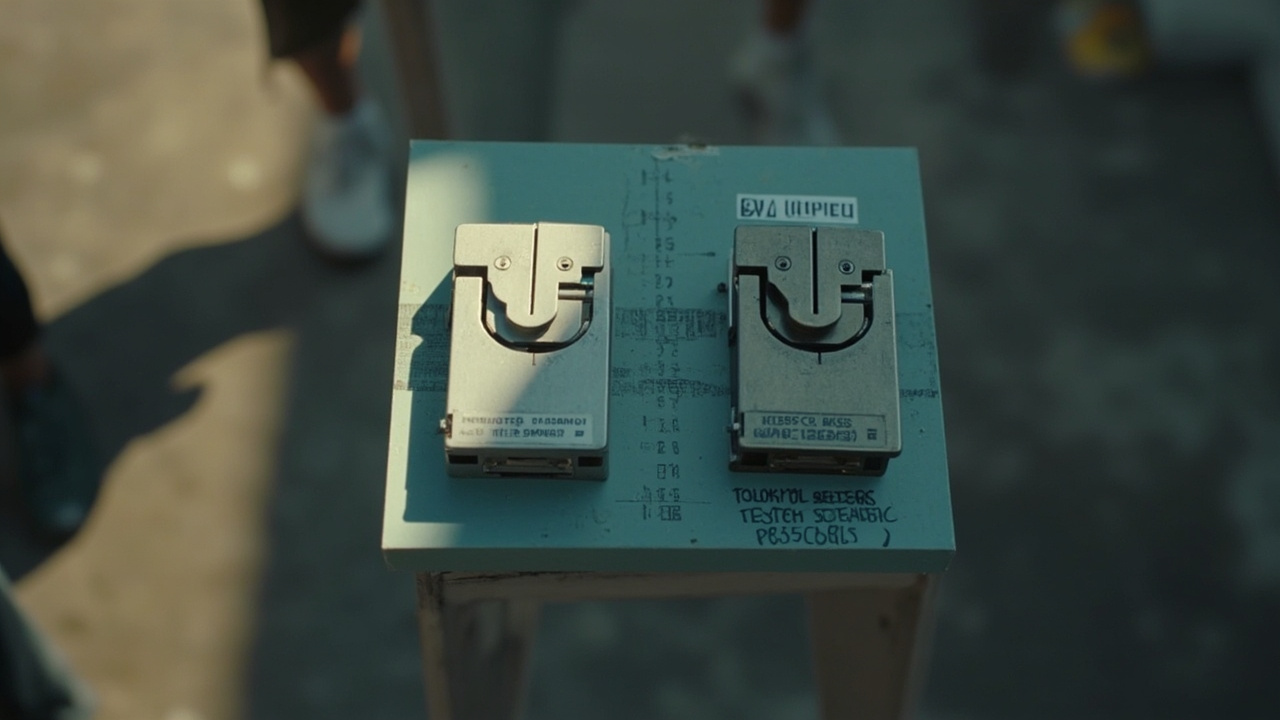
Fingerprint Versus External Power: Decision Matrix for Data Centres and Server Rooms Operators
Procurement conversations about data centre access hardware tend to collapse into a single question: is the door fingerprint-driven or fed from the site supply? That framing hides the decision that actually matters, which is where the credential is granted relative to the lock. The fingerprint versus external power data centres matrix in this article separates the two architectures at component level, then scores the parts against what a data centre operator's own auditors tend to ask for — the credential, the trail, or the door record.
Direct answer. Short version — fingerprint versus external power data centres matrix is treated here as fingerprint versus external power data centres matrix first. external-power comes second. The evidence for fingerprint versus external power data centres matrix is named in the sections below. A fingerprint versus external power data centres matrix is a comparison written to be reused. Criteria are stated. fingerprint versus external power data centres matrix is where the fingerprint versus external power data centres matrix shortlist narrows.
- Set the yardstick — name the criteria for fingerprint versus external power data centres matrix before comparing anything
- Score on one yardstick — score every option against external-power the same way
- Give up something — say what each option in two architectures behind one costs you
- This is the sequence fingerprint versus external power data centres matrix has to follow, anchored on external power.
For a procurement manager working on electronic access control procurement, the short version is this: a fingerprint-first lock is a self-contained battery device carrying its own reader, its own credential store and its own log, while an externally powered door lock is a device that keeps the door ready and waits to be told what to do. Neither is better in the abstract. They fail differently, and they leave different evidence behind.
flowchart TD
    A[Define audit evidence requirement] --> B[Teardown both component chains]
    B --> C[Check door fit and egress]
    C --> D[Compare architecture criteria]
    D --> E[Score audit fit]
    E --> F[Allocate architecture by door family]
    F --> G[Define failure clauses and RFQ]
    G --> H[Freeze the quoted specification]
Two architectures behind one door schedule
A fingerprint-first lock is a standalone unit. The finger is presented to a sensor on the escutcheon, the matching template is held on the lock's own control board, a motor and gearbox turn the latch or bolt, and the event is written to a log store inside the lock. Energy comes from cells in the battery compartment. If an external supply appears anywhere in the chain, it appears as an override for the moment the cells run flat, not as the normal operating source.
An externally powered door lock inverts that arrangement. The lock's job is to hold the door and to listen. The credential arrives from elsewhere — a reader on the wall, a controller in the rack room, a system the operator already runs and already audits. Power is continuous, so the device is never the reason a door stays shut. The trail may live in that upstream system rather than inside the lock at all.
Both architectures answer the vertical question a data centre operator has to settle before any model is shortlisted: what does the audit actually ask for — the credential, the trail, or the door record? Answer that first and the power architecture largely chooses itself. Answer it last, and the tender will oscillate between two products that are each capable, and each wrong for a different reason.
Teardown, path one: the fingerprint chain from sensor to bolt
Pull a fingerprint smart lock apart and the chain is short enough to reason about. A fingerprint sensor on the escutcheon captures the print. A template store on the control PCB holds the enrolled prints for that leaf. The control PCB performs the match, drives the motor and gearbox, and writes the event. The gearbox turns the spindle, the latch or bolt retracts into the mortise case, and the strike keeper releases the door leaf.
Around that core sit the parts a data centre buyer will actually interrogate: the battery compartment and its cells, the low-battery alert, the mechanical override key, the audit and event log store, and — where the catalogue records it — an emergency power override port.
The catalogue gives usable anchors for this chain. The SLK-026 semi-automatic anti-theft fingerprint door lock is recorded with a manganese-steel front panel and aluminium-alloy handle, a mortise compatible with large multi-bolt security-door mortises, a panel of 335 × 72 × 24 mm, 4 × AA alkaline power, a capacity of 100 fingerprints, and both TTLock (Bluetooth) and Tuya (Wi-Fi / Bluetooth) platforms carrying remote unlock, temporary and periodic passcodes, user management and access records. The SLK-005 anti-theft fingerprint entrance lock is recorded with a 328 × 68 × 20 mm aluminium-alloy panel, 4 × AA alkaline supply, and 100 fingerprints. The smaller SLK-1102 round fingerprint keypad smart lock is recorded with a deadbolt latch adjustable at 60–70 mm, 4 × AAA cells and 20 fingerprints.
Confirm on the dated product page for the specific SKU before any of those figures enter a tender document. Note also what the capacities imply: a lock whose template store holds a hundred prints is a different proposition from one holding twenty, and neither number is a statement about how many people can pass through the door. It is a statement about how many identities the lock can recognise without a network call. Where the entrance serves a contractor population larger than the store, enrolment becomes a queueing problem, not a hardware problem.
| Component in the fingerprint chain | Role | What to confirm before ordering |
|---|---|---|
| Fingerprint sensor | Captures the print at the escutcheon | Sensor position on the chosen panel and how the surface is sealed |
| Template store on the control PCB | Holds enrolled prints for that leaf | Capacity on the specific SKU and how a print is deleted or transferred |
| Control PCB | Matches, drives the motor, writes the event | Whether records export in a format your system can read |
| Motor and gearbox | Turns the spindle against a loaded door | Behaviour on a misaligned or heavy leaf |
| Latch and bolt drive | Engages the strike plate | Mortise type: single bolt, deadbolt or multi-bolt |
| Battery compartment | Primary energy source | Cell type and the interval you are willing to maintain |
| Low-battery alert | Flags a flat battery before lock-out | How the alert reaches the operator on shift |
| Mechanical override key | Manual entry | Custody, register and return procedure |
| Audit and event log store | Holds the per-door record | Retention, export format and who administers it |
| Emergency power override | Contact for a temporary external supply | Whether a given SKU carries the port at all |
Teardown, path two: the externally powered chain from terminal
An externally powered door lock contains a different set of obligations. The chain runs from an external power terminal on the escutcheon or lock body, through a conditioning stage that regulates and protects the feed, into the control PCB, and out to the motor and gearbox that drive the latch or bolt. A backup element — a cell pack or an energy buffer — usually sits underneath so that the door does not freeze in an undefined state when the supply drops. Above the lock, a network gateway or RF module carries the credential and the events.
The catalogue entry that matters here is specific and worth reading precisely. The SLK-1103 keypad card-sensing smart door lock is recorded with 4 × AA batteries and, in the same power row, emergency power: external power override via USB terminal. Its access record lists RFID/IC card, passcode, mobile app and mechanical override as standard, on a Tuya (Bluetooth) platform, in a high-purity zinc alloy die-cast electronic keypad deadbolt lock.
That phrase is the crux of the whole comparison. An override terminal is a rescue path for a flat battery, not a mains architecture. The catalogue does not currently list a stock SKU as a continuously externally powered lock, and a buyer who reads "external power override via USB terminal" as "this lock runs on site power" will be disappointed by the tender pack. If the programme genuinely requires a continuously fed lock, that is a specification request handled through the OEM/ODM route the catalogue records for the range — custom logo, finish, packaging, manuals and product configuration for distributor and project orders — with dimension drawings, an installation guide and a full datasheet available on request.
The other side of this path is upstream of the door. If the credential is granted elsewhere, then the site already has a system that issues credentials, holds zone rights and stores the trail. The lock becomes an actuator. That is a legitimate and often cheaper arrangement for a perimeter with an existing reader, and it means the access system itself becomes part of the audited estate either way — the difference is whether the audited estate includes one more device per leaf or one more device per room.
Where both architectures meet: the mortise case and the rebate
Both paths terminate in the same hardware: the mortise case, the latch or deadbolt, the strike plate and strike keeper, the spindle, and the door frame rebate the case sits inside. This is where the choice becomes expensive, because changing a mortise case in an existing frame is a different job from mounting an escutcheon over one that stays.
The catalogue records show how varied the door-fit picture is. The SLK-026 is recorded as compatible with large multi-bolt security-door mortises. The SLK-086 single-latch fingerprint lock carries a 60 / 70 mm single-tongue mortise. The SLK-1102 carries a deadbolt latch adjustable from 60 to 70 mm. The SLK-1101 keypad smart door lock with grip handle is recorded with an adjustable 60 / 70 mm single latch, a door thickness of 35–60 mm and wood and metal door types. The SLK-006 indoor wooden-door fingerprint lock is recorded for 30–50 mm door thickness.
Where a door-fit field is blank in the catalogue, that is an absence of a recorded value, not a statement that the leaf is unsuitable. Measure the leaf. A measurement pass covering leaf thickness, backset, rebate width and depth, swing direction and opening angle is worth more than any specification argument, and the survey process for it is set out in Office Smart Lock Site Survey.
One further object belongs in this teardown even though it belongs to the door rather than the lock: the escape device. Whether a server room security door is a fail-safe or fail-secure leaf, with a lever exit or panic hardware, changes what the lock is allowed to do when power is lost or a credential is refused. Put that question to the door and the egress designer before the lock is chosen, because retrofitting it afterwards means touching the frame.
The matrix: fingerprint versus external power data centres matrix
The table below is the fingerprint-versus-external-power matrix in its working form: each row is a decision a procurement manager has to defend to a facility, a security lead and an auditor, and each row asks for evidence rather than opinion. Scores are deliberately absent — the weights belong to the site, and a matrix that arrives with pre-set scores is an opinion dressed as a tool.
| Criterion | Fingerprint-first architecture | Externally powered architecture | Evidence to demand |
|---|---|---|---|
| Source of the audit record | The lock's own event log and access records | The upstream access system that issues the credential | A sample export file, its field set and the retention period |
| Behaviour during a supply or network event | Cells keep the lock working; a cell change is a scheduled task | Loss of supply forces a fail-safe or fail-secure decision | The written behaviour on loss of supply, plus who is notified |
| Credential administration | Enrolment on the device or through its app, bounded by template capacity | Badge issuance and zone rights handled by the existing system | The enrolment and de-enrolment procedure with turnaround times |
| Retrofit effort on the leaf | Escutcheon swap, mortise case often retained | Cable route to the leaf, and possibly a frame change | A door schedule with thickness, backset, rebate and swing |
| Exposure in plant rooms and loading bays | Cell choice drives the change interval | Cabling, connectors and sealing become the maintenance item | The maintenance interval the manufacturer will stand behind |
| Emergency entry | Mechanical override key and its custody | Override plus the site supply and a fallback | The override procedure and a signed key register |
| What moves the price | Panel material, mortise complexity, electronics count, configuration | The same, plus power conditioning and any site wiring | A quote that itemises hardware, accessories and site works separately |
| Fit with the rest of the estate | Adds a device per leaf to audit | Adds a device per leaf to the existing system | A statement of who owns the record and who signs it off |
The weighting logic behind the matrix is worth making explicit for anyone who has to defend it. If the answer to the vertical question is the credential, weight the credential-administration row heavily and ask who enrols a finger or a badge and how quickly a leaver is removed. If the answer is the trail, weight the source-of-record row and insist on a sample export rather than a promise in a brochure. If the answer is the door record — who opened which leaf, when, and what the door did afterwards — then both rows matter, and the deciding factor becomes the failover behaviour row, because a record that stops when the cells die is not a record.
Scoring the matrix against what the audit actually asks
A worksheet only works if the site sets the weights. The table below offers one starting frame: five points for the architecture that answers the question cleanly, zero for the one that leaves it open. Replace the descriptions with your own auditor's wording before you use the numbers, because the value of the exercise comes from the arguments it forces internally, not from the total.
| Criterion | A score of 5 looks like | A score of 0 looks like |
|---|---|---|
| Record ownership | The lock and the trail have one named owner | Ownership is disputed between the lock supplier and the access system |
| Failover on power loss | Behaviour is specified, tested and written into the contract | Behaviour is discovered during an incident |
| Credential lifecycle | Enrolment and removal are documented with times attached | Removal depends on someone remembering |
| Door fit confidence | Every leaf has a measured schedule | Leaves are described as "standard" |
| Maintenance load | Intervals are calculated from the environment | Intervals are guessed from a residential experience |
| Audit acceptance | Evidence format confirmed in writing by the auditor | Evidence format discovered at the next review |
Two disciplines make this worksheet usable. First, score the architectures separately rather than averaging them across the site: a perimeter door and a plant room door can legitimately earn opposite answers. Second, record the reason next to every score, because the reason is what a reviewer will read six months later.
Allocating architectures across the four door types on site
Data centre and server room sites tend to have the same four door families, and each one pulls the matrix in a different direction. The useful output of the matrix is not a single winner but an allocation.
| Door position | Dominant access pattern | Likely bias | Question that must be answered first |
|---|---|---|---|
| Secure perimeter | Badge with zone rights, a reader at the line, a recorded trail | Externally powered, networked | Does the perimeter reader or the lock own the record? |
| White-space entrance | Frequent staff and contractor turnover | Fingerprint-first on a shared entry | How many prints are enrolled, and who de-enrols them? |
| Plant room | Restricted, low traffic, wide temperature swing | Fingerprint with a mechanical override | What is the cell-change interval at that temperature? |
| Loading bay | Episodic traffic, wide leaf, often alarmed | Externally powered with an override | Is the leaf alarmable, and who resets it? |
The allocation also depends on physical facts that only a survey produces — leaf thickness, frame type, swing direction and the space behind the escutcheon. For perimeter and plant room work on existing frames, the retrofit-specific method in Smart Lock Retrofit Site Survey is the more relevant reference, because the retrofit cases are the ones where the mortise case is the constraint rather than the credential.
One practical point on the perimeter: an externally powered door lock with a badge upstream means the audit trail already exists in a system the operator knows, and the lock's own log becomes a secondary record. Confirm with the security team whether a secondary record is welcome, ignored, or a liability, before you specify two competing logs.
Temperature, gloves and cabling: the environment argument
Data centre white space is a controlled environment. Plant rooms, loading bays and external entrances are not, and the environmental spread is where the two architectures earn or lose their maintenance case.
Battery-powered access control inherits the environment directly. Cells discharge faster in low temperatures, and a flat cell in a secure zone is an outage on a door the operator cannot easily enter. The fingerprint-first case is therefore a battery-change interval question before it is a credential question. Ask for the interval the manufacturer will stand behind, ask how the low-battery alert is routed to whoever is on shift, and ask what happens at the door when the alert is ignored.
Finger recognition has its own environmental constraint: plant rooms and loading areas often involve gloves, and a sensor is a surface with a coating and a seal. Several catalogue records carry an operating range — the SLK-1101 is recorded at -25°C to 60°C — and each SKU states its own range or none at all.
The externally powered case removes the cell-change interval and replaces it with cabling. A feed to the leaf means a route, a connection, a protection method and a junction somewhere the design team has to approve. In a loading bay with a wide steel leaf, that route may be a door-frame change. In a plant room, it may be a surface run across a floor that gets washed down. Neither is expensive in isolation; both become expensive when the survey happens after the hardware order.
Failure modes that should end up in the contract
The matrix is only useful if it produces contract language. The table below turns the architecture difference into failure exposure and into the clause you would want to see before signing.
| Failure mode | What it looks like in service | Where the exposure sits | What to write into the contract |
|---|---|---|---|
| Cells flatten in a secure zone | The lock refuses to release until the override is used | Fingerprint-first | Battery-change interval, alert routing and override custody |
| Site supply lost | The door state follows whatever the lock does when unpowered | Externally powered | Fail-safe or fail-secure instruction and notification duty |
| Fingerprint rejected for a valid user | The person cannot enter and escalates to a human with a key | Fingerprint-first | Enrolment procedure, an alternative credential path and sensor maintenance |
| Motor or gearbox failure | The door will not retract even with a valid credential | Both | Spare policy, response time and who carries the callout |
| Override key custody failure | A physical key remains with someone who left | Both | Key register, return-to-issue steps and audit of use |
| Log export does not match the reader | The record cannot be reconciled during a review | Both | Sample export file, field set and retention commitment |
Two of these deserve emphasis in a data centre context. The override key is not a backup, it is a permanent part of the security model, and it belongs in a register that someone actually maintains. The log export is the artefact your auditor will ask for, and a promise that records are kept is not the same as a file you can open. Ask for a sample export from the specific configuration you intend to buy, not from a demonstration unit.
CONFIRM-WITH-LOCAL-AUTHORITY: Confirm which authority signs off on the access record for a secure area in your jurisdiction, and confirm the scope of that requirement per product rather than per market.
What to send in the RFQ, and what to get back
Electronic access control procurement fails at the tender stage when the door schedule is missing and the audit requirement is vague. Send the following, and ask for the responses in the same order:
- A door schedule per leaf: thickness, backset, rebate width and depth, frame material, swing direction, opening angle, and whether the leaf carries existing hardware.
- A power map: for each leaf, whether a supply is available, where the nearest connection point sits, and whether a conduit run is acceptable in that space.
- The credential model in use today at that site — badge, code, fingerprint or mixed — and what the operator expects the door to accept.
- The audit requirement in the auditor's own words, plus what the site already stores and who owns it.
- Maintenance constraints: the change window, the response expectation, and whether cells or site wiring are more disruptive to the operation.
- Documentation required with the quotation: dimension drawings, an installation guide and the full datasheet for the exact configuration.
- OEM/ODM requirements if the programme carries a brand: logo, finish, packaging, manuals and product configuration.
What to get back is equally specific: a quote that itemises hardware, accessories and any site works as separate lines; a per-model answer to each of the matrix rows that applies to that leaf; and a written answer to the failover question for every door. A quotation that returns only a unit price, a lead time and a model number has skipped the evaluation entirely.
For the architectural argument in shorter form, the comparison memo in Fingerprint Versus External Power: Which Fits a Data Centres and Server Rooms Door Programme works through the same allocation at programme level rather than door level.
The records the trail has to produce
The vocabulary on the access side is already familiar to a procurement manager: unlock records, access records, temporary and periodic passcodes, user management, and remote unlock appear across the catalogue's platform functions. One record in particular is instructive. The SLK-019 stainless steel keypad RFID smart lock is recorded with hotel lock management software available on card-model versions, carrying guest card issuance, floor and room permissions, check-in validity windows and unlock records, with a capacity of 100 fingerprints, a 304 stainless steel body and a 345 × 73 × 22 mm panel on 4 × AA alkaline supply. That combination of validity windows and permission scopes is exactly the shape a contractor and visitor programme needs, whatever the physical door looks like.
The questions to ask about the trail are therefore plain. Does the record identify the credential or the person behind it? How long is a record retained, and who deletes it? Can the log be exported in a format your reporting tools read, or does it stay inside the lock or its app? When a reader and a lock both keep records, which one is the record of truth, and how are the two reconciled at review time?
CONFIRM-WITH-LOCAL-FACILITIES: Verify the electrical supply, standby arrangements and conduit routes your local site rules permit before an externally powered door lock reaches a purchase order.
Where the catalogue stops and a project build begins
The 79-model catalogue spans 77 smart door locks, 37 fingerprint models, 24 hotel models, 18 keypad models, 9 RFID models, and smaller runs in outdoor, cabinet, glass, video-camera and face-recognition families. Across that range, RFID or card access is recorded on 72 models, a mechanical override key on 63, a passcode on 55, a mobile app on 41 and fingerprint on 38, with connectivity recorded as Bluetooth on 23 models, Wi-Fi with Bluetooth on 15 and 4G LTE on one.
Those counts tell you where the catalogue is strong and where a programme becomes a build. A continuously externally powered lock with site-side conditioning, a stainless escutcheon for a plant room and a specific audit export format is a project build: custom configuration, documentation on request, and a quotation issued against that scope rather than a catalogue line.
That distinction should be stated plainly in the tender so that bidders quote the same thing. One bidder may be pricing a stock fingerprint model with an override port; another may be pricing a modified build with a power-conditioning stage and a different export. Without a written statement of which is required, the responses are not comparable, and the lowest number on the sheet wins for the wrong reason.
How to move this to a quote
The decision matrix only pays out if it reaches a measured door schedule, a stated audit requirement and a written failover instruction per leaf. Where you already have those three, the next step is straightforward: send the door schedule with the RFQ, ask for the fingerprint-first and externally powered configurations side by side, and require the quote to answer the matrix rows one by one rather than by model name.
The practical counterpart to this point is smart lock supplier evaluation checklist. That is the same question fingerprint versus external power data centres matrix has to answer here.We publish dimension drawings, an installation guide and a full datasheet on request for the exact configuration under discussion, and we size each quotation against the door schedule you send rather than against a standard package. Sample units can be handled through the sample request route, the full range through the catalogue request route, and a project quotation with the allocation table attached through the quote request page. Where the programme needs a continuously fed lock with a specific panel material and a named audit export, say so in the enquiry — that is the detail that decides whether you are ordering a model or commissioning a build.
CONFIRM-WITH-LOCAL-INSURANCE: Ask the client's insurer and auditors which evidence they expect in the door record before the specification is frozen and the hardware is ordered.
Close the loop with requesting a quote.