
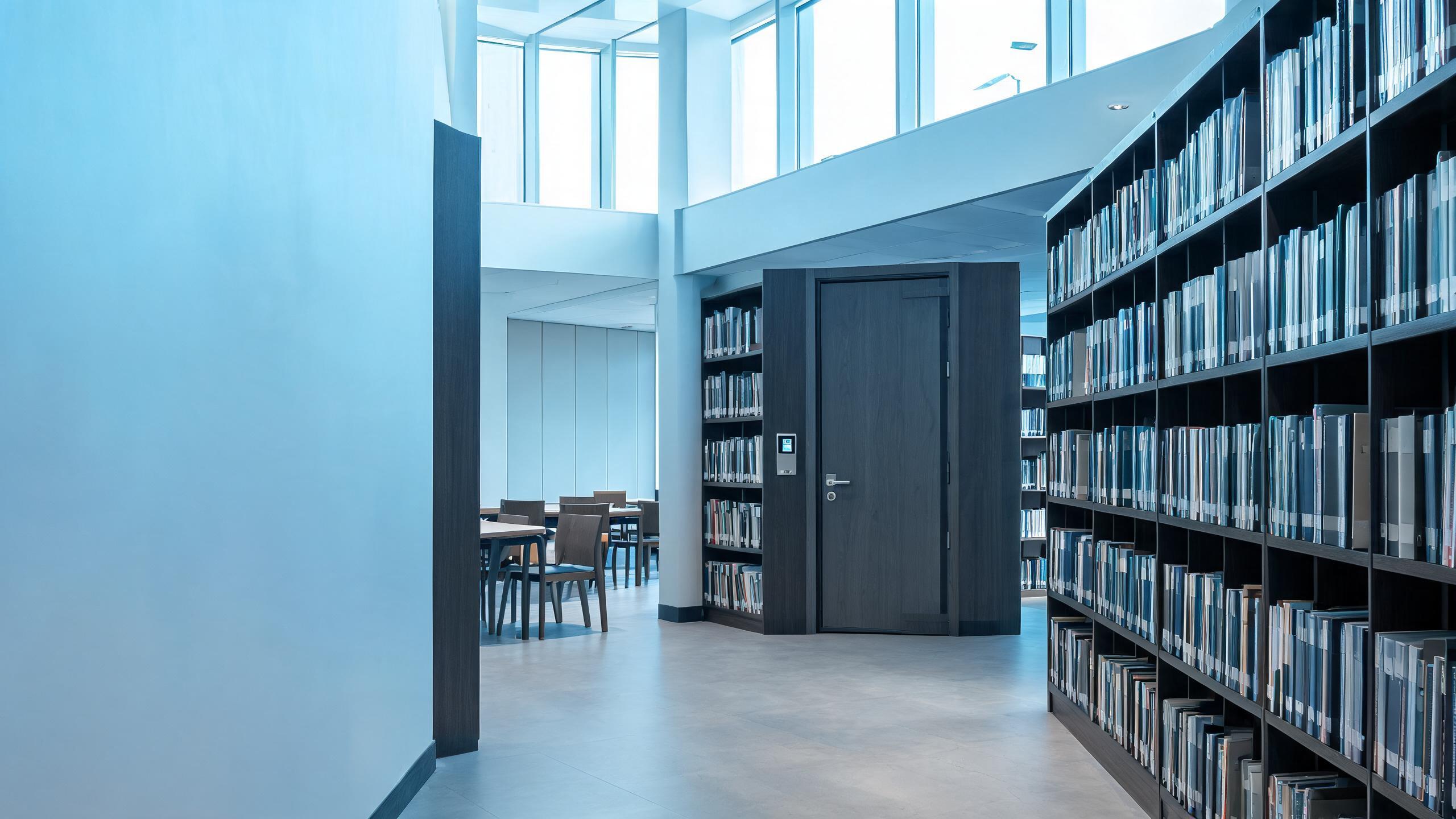
Applications
Smart locks for libraries and archives: open shelves for all, special collections for the named few
Public-reading, staff and special-collections zones, dated researcher and volunteer credentials, after-hours return workflows and hardware that protects irreplaceable records.
Libraries balance openness — the principle that anyone may walk in and read — with genuine protection needs behind the public floor: staff workrooms, IT closets, cash-handling desks, local-history rooms and special-collections archives holding unique, irreplaceable records. Smart access keeps the public promise intact while zoning the rest: a researcher gets a dated credential for one special-collections session, a volunteer opens only the room and shift they were trained for, and after-hours book-return handling follows a scheduled route. Archives benefit from entry records that document who accessed a collection and when, which matters for preservation and donor agreements as much as security. Hardware on archive doors is coordinated with environmental conditions and fire egress, and branches on one specification simplify rollout across a library system. The museums page covers cultural-site evidence, the laboratories page covers controlled research environments, and the school guide covers campus media centers.
Library and archive access at a glance
| Public mission | Reading rooms, self-service and common areas stay open to everyone without credentials during hours |
| Special collections | Rare books, archives and local-history material require named, dated researcher access with records |
| Volunteer program | Volunteers and friends-group members receive room-and-shift credentials tied to training status |
| After-hours returns | Book-return rooms and external chutes operate on a scheduled staff route separate from public hours |
| Branch rollout | One approved specification repeats across branches so system facilities teams deploy consistently |
| Preservation | Archive door hardware is compatible with environmental controls and the fire schedule |
| BOM shape | Public-zone controls, staff and archive doors, researcher workflow, branch kits and held spares |
Answer unit
Staff keys for back rooms, or scheduled credentials with researcher and volunteer windows?
Most systems keep public floors open and move staff, volunteer and researcher movement onto dated credentials, especially where archives sit in the same building.
| Dimension | Staff keys for service doors | Scheduled credentials with dated access |
|---|---|---|
| Researchers | Escorted only, staff time heavy | Dated session credentials with entry records for registered readers |
| Volunteers | Key held by coordinator | Room-and-shift credentials following training status |
| Lost keys | Cylinder rekey across doors | Central revocation with no mechanical change |
| After-hours | Shared alarm and door codes | Scheduled return-route credentials distinct from daytime groups |
| Branches | Per-branch key culture | One specification and lifecycle repeated system-wide |
| Typical fit | Small single-room libraries | Library systems, archives, special-collections repositories |
Door types and lock-body match
The public floor rarely locks; service doors, special collections and the return room carry the real specification.
| Opening | Typical door | Lock approach |
|---|---|---|
| Public entrance | Glazed entrance with open reading room beyond | Open by day; scheduled staff credentials for opening and closing routines |
| Reading / study rooms | Interior glass or timber doors | Open or room-booking access during hours, locked schedule after |
| Special-collections room | Reinforced archive door | Named researcher sessions, entry records and donor-agreement alignment |
| Archives stack | Climate-controlled stack door | Narrow staff credentials, environmental-compatible fitment and records |
| Staff workroom / IT | Service door behind public desk | Staff-only credentials with cash-room and IT logic separated |
| Book-return room | Interior room served by external chute | Scheduled handling route, distinct from public and volunteer groups |
Example BOM shape for a central library and archive branch
This example illustrates a typical configuration, not a specific customer project. Special-collections use, branch count and volunteer scale drive the list.
| Component | Typical logic | Notes |
|---|---|---|
| Service-zone controls | Staff, IT, cash and return-room doors | One repeatable specification for deployment across branches |
| Special-collections workflow | Reader registration to dated credential and records | Aligned with donor-agreement and reading-room rules |
| Volunteer lifecycle | Training-based room-and-shift credentials | Issued and withdrawn through the volunteer coordinator |
| Branch rollout kit | Standardized hardware, signage and opening routine | Supports system-wide deployment by facilities teams |
| Held spares | Locks and readers for staff and archive doors | Swap handling restricted to named facilities staff |
How a library system rolls out smart access
- Service reviewDoor schedules, special-collections rules, volunteer programs and branch opening routines are documented first.
- Pilot branchOne library and its archive run researcher, volunteer and after-hours return workflows against acceptance tests.
- System rolloutBranches commission on the same specification during normal closures with no change to public hours.
- Volunteer adoptionCoordinators rehearse training-based issuing and withdrawal on the real volunteer schedule.
- Assurance handoverOpening and closing procedures, record practice, spare locations and researcher etiquette are documented.
Related applications
Related cultural and research pages
Smart locks for libraries: common questions
How do researchers access special collections and archives?
Registered readers are scheduled against a session rather than handed a key: the credential names the researcher, the collection room, and the appointment window, and the door records the session for the reading-room register and donor-agreement files. This replaces escort-only access that consumes curator time while still preserving the reading-room rules — identification, supervised handling and no bags — which remain policy. The workflow is configured with the archivist, including who approves repeat visitors and how Saturday or extended sessions are authorized, and credentials expire automatically at the session end instead of depending on a returned pass.
Can volunteers be given access without compromising archives?
Yes, through room-and-shift credentials tied to training status rather than volunteer trust: a friend-of-the-library volunteer opens the sorting room on their scheduled shift, a trained volunteer may additionally open the local-history desk area, and no volunteer group inherits archive-stack access. When a volunteer pauses or leaves, the credential is withdrawn centrally without rekeying. The coordinator owns issuing and periodic reconfirmation, and the access model is written into the volunteer handbook so expectations are clear from induction, which is simpler and safer than tracking physical keys across a rotating volunteer population.
Does smart access change how after-hours book returns work?
The external chute stays available to borrowers while the internal return-room door follows a scheduled staff route, so returned material waits in the chute bay until the handling credential window rather than exposing the workroom. Opening and closing routines, alarm coordination and the first-morning sort are mapped to named staff groups, replacing shared opening codes. Weekends and holiday openings use the same scheduling model. Every after-hours service door opening is recorded, which helps branch managers review routine handling and quickly narrow any discrepancy in the cash-handling or returns process.
Can one system cover many branches with different layouts?
Yes: library systems standardize on one hardware and policy specification even when branch door schedules differ, which is how volume and consistent staff training accumulate across the system. Each branch maps its own public floor, staff rooms and any local-history collection onto the common model, and credentials follow staff who cover multiple branches without issuing them separate keys. Rollout phases branch by branch on normal closure days, with identical documentation and spare sets per site, so a facilities team moving between buildings works with one procedure instead of relearning each branch’s key cabinet.
How is a library BOM and MOQ scoped?
The BOM counts controls across public service doors, staff and archive rooms and return routes, separates the researcher and volunteer workflow, and lists branch rollout kits and held spares, with MOQ and lead time confirmed in writing per quotation. Systems typically pilot one central branch and archive before phased rollout, which lets the central library validate special-collections evidence before volume commitment. Send the branch list with door counts, collection-room details, volunteer scale and opening routines, and the quote is structured per branch and per zone so procurement and facilities review the same line items.
Keep the doors open, and the stacks accountable
Send the branch list, special-collections details and volunteer scale — receive a per-branch BOM with workflow scope and written MOQ and lead-time terms.
Discuss your project (RFQ)Project configurationsLast updated: October 31, 2026 · Reviewed by the Smart Lock Factory editorial team