
Smart Lock vs Traditional Hotel Lock — A Five-Pillar Decision Programme for Hotel Modernization
A traditional hotel lock is a single object on a single door. A smart hotel lock is one component of a four-component property operating system that issues credentials at the front desk, audits every door event to a property computer, and voids lost cards in software rather than at a locksmith's bench. The smart-lock-vs-traditional-hotel-lock question is not, therefore, "which lock costs more or less per door." It is a five-pillar programme decision — operating-system boundary, credential issuance and revocation, audit and accountability, loss-event and override posture, migration and procurement sign-off — in which the property evaluates the four-component operating system against the single-door object, and pays for what each one is actually worth to the operating model the property is going to run for the next ten years.
This is a decision-pillar explainer. The subheads are pillar names, not questions. There is no FAQ section by design: every buyer question that belongs in a FAQ lives inside the pillar where the answer actually applies — a credential-issuance question is answered in the credential pillar, an audit-trail question in the audit pillar, a migration question in the migration pillar. Tables are the working surface of each pillar. The voice is the supplier who has watched too many hotels buy a four-component operating system against a single-door price comparison, and then spend the first eighteen months explaining to ownership why the comparison did not predict what the property was actually paying for.
For the architectural frame this five-pillar programme sits inside — the four-component operating system, the optional centralized database above it, and the way each component maps to a SKU on the product page — read alongside Hotel Smart Lock System Architecture. For the two credential-family-specific comparisons this article deliberately does not re-litigate, read alongside Smart Lock vs Mechanical Hotel Key and Smart Lock vs Magnetic Stripe Hotel Lock.
What "traditional hotel lock" and "smart hotel lock" actually name
The two phrases sit across one of the larger divides in hospitality hardware, and the divide is not primarily about what the guest sees at the door. The guest sees a credential and a handle in both cases. The divide is about what the property runs behind the door, what the front desk operates, what the night auditor pulls, what the locksmith is called for, and what the general manager is accountable for when a card goes missing or a lock fails.
A traditional hotel lock is a mechanical-key cylinder on each guest door, a master-key hierarchy the property carries on a steel cabinet, a key-cutting bench or a locksmith on retainer, and a paper registry of who has which key. In some properties — and this matters for the comparison — the "traditional" lock is a magnetic-stripe lock instead of a mechanical one, where the door reads a stripe card instead of a key, but the property still runs on a master-key cabinet for back-of-house, a paper register for issuance, and a locksmith for cylinder changes. In both sub-classes the lock is a single object on a single door, the issuance medium is a physical key or a single-use stripe card the guest keeps in a wallet, and the audit posture is whatever the front desk writes in the registration book.
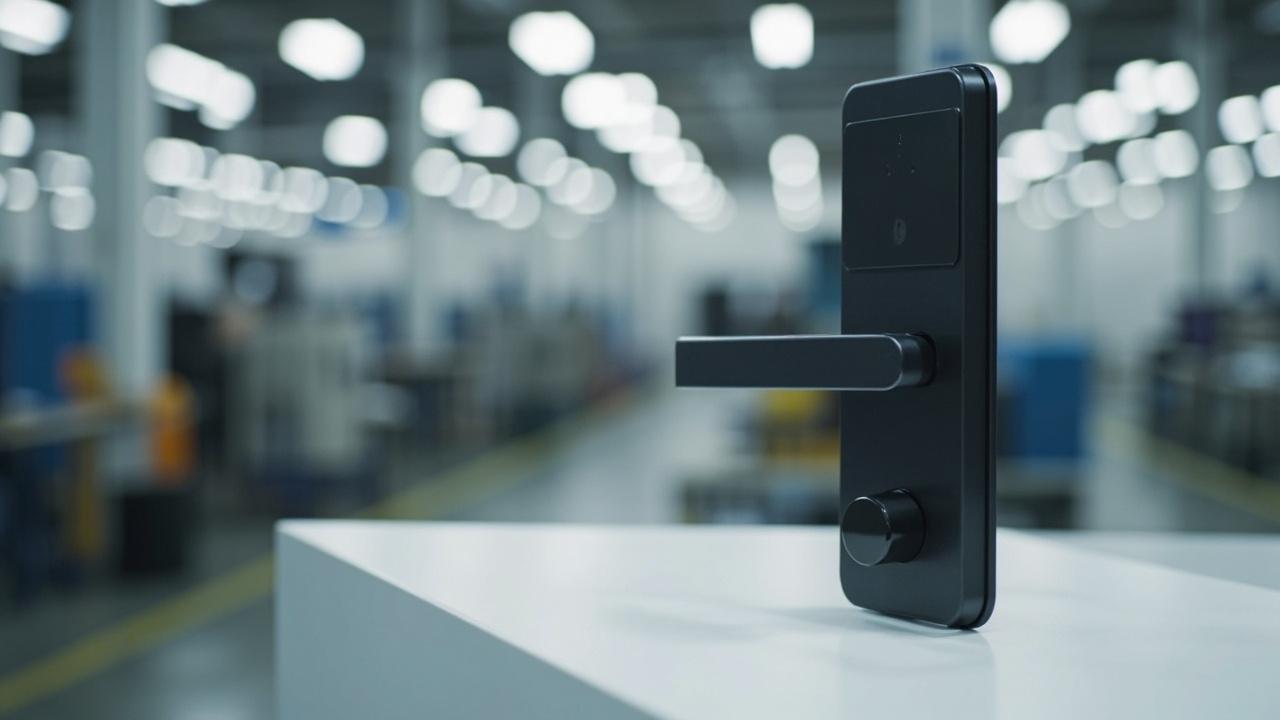
A smart hotel lock — in the form the hotel-locks line on this catalogue supports — is a four-component operating system: the electronic lock on the door, the contactless credential issued at the front desk, the encoder station at reception that writes the credential from a property computer, and the hotel PC software that holds the room inventory, the guest data, the staff hierarchy, and the audit pull. The smart hotel lock can run standalone at a small property (one property computer, one encoder, locks set by handheld programmer) or as part of a centralized database across a multi-property group (locks write back to a central database for revenue, security, and brand-standard reporting). The mechanical-key override and a mechanical emergency-access path are kept on the door as the cross-cutting fallback for power loss, electronics failure, fire-marshal inspection, and the rare card-read failure that needs a physical entry path.
The smart-lock-vs-traditional question is therefore a question about two different operating models the property is going to run for the next decade. The five pillars below are the working language a hotel group, an owner, a property manager, or a system integrator uses to evaluate one operating model against the other before any SKU is shortlisted and before any quote is signed.
Pillar 1 — Operating-system boundary: what the lock is a component of
The first pillar asks what the lock is part of when the property buys it. The answer is not the same on both sides of the divide, and the difference is what drives the rest of the comparison.
A traditional hotel lock is a single-door object. The property buys a cylinder, a key, and — when the lock fails or the key is lost — a locksmith's visit. The hotel-locks line on this catalogue, by contrast, sits inside a four-component operating system: lock hardware on the door, card or mobile credential issued at the front desk, encoder station at reception, and hotel PC software on a property computer that holds the room inventory and pulls the audit. Above the property computer sits an optional centralized database for multi-property groups. The five-pillar comparison only makes sense once both sides are framed at the same level — single-door object vs four-component operating system — and the property decides whether it is buying a lock or it is adopting an operating system.
The frame cascades down through the next four pillars. If the property is buying a single-door object, the audit pillar, the credential pillar, and the loss-event pillar are mostly bookkeeping questions. If the property is adopting an operating system, those same pillars become questions about training, software-version control, encoder spare-parts budget, audit retention, and PMS handshake — questions a single-door object never raises.
| Pillar-1 dimension | Traditional hotel lock (mechanical / magnetic stripe) | Smart hotel lock (electronic hotel-locks line) |
|---|---|---|
| What the property buys | Cylinder + key per door (or stripe reader + stripe card per door) | Four-component operating system — lock + credential + encoder + hotel PC software, with optional centralized database |
| Who installs it | Locksmith per property | Per-door installation + front-desk encoder setup + property computer + hotel PC software commissioning |
| What the front desk operates | Key cabinet + paper register | Encoder station + hotel PC software |
| What the night auditor pulls | Paper register (or nothing) | Audit-event pull from each lock to the property computer |
| What scales to multi-property | Not natively — each property runs its own cylinder hierarchy | Centralized database mode writes the same shape across properties |
| Where the failure lives when something breaks | At the door | Potentially at the encoder, the property computer, the network, the hotel PC software, or the door — five failure surfaces |
| Default posture when ownership asks "what did we buy?" | A lock per door | An operating system |
The supplier-side warning from Pillar 1 is straightforward. A property that evaluates a smart hotel lock against a mechanical cylinder on a per-door unit price is comparing two different things at two different scopes. The four-component operating system costs more per door than a single cylinder, and it does more per door than a single cylinder, and the property's first decision is whether the four-component scope is what the operating model needs at all. Sibling Smart Lock vs Mechanical Hotel Key carries the per-credential-family comparison at the door level; this article is the umbrella that comparison sits inside.
Pillar 2 — Credential issuance and revocation: how a guest gets in and how a lost credential stops working
The second pillar asks what happens at the front desk when a guest arrives, what happens when the same guest checks out, what happens when a card is lost in the lobby, and what happens when a staff member leaves. The four answers are different on the two sides of the divide, and the property's staffing posture depends on which side the answers come from.
Issuance. A traditional mechanical lock requires a key to be physically produced for every guest — either cut in advance from a master, cut on demand by a locksmith or the front desk, or pulled from a numbered cabinet slot. A magnetic-stripe lock requires a stripe-card writer (the older generation of hotel encoder) and a fresh stripe card for every guest, with the writer binding the card to a single room and a single stay window. A smart hotel lock requires a contactless credential — a card in the Mifare family at 13.56 MHz, a mobile key in the app lane, or both as dual-credential — written from the front-desk encoder to the hotel PC software's reservation record. Per-credential specifics (carrier frequency, read distance, read time, dual-credential posture, mobile-app binding, encoder-to-lock handshake) are routed to "check the model’s published specification" for every shortlisted SKU; the property does not inherit them from this comparison.
Check-out and revocation. A traditional mechanical cylinder does not know a guest has left; the key is either returned to reception and re-shelved or it is lost, and a lost key triggers a cylinder change. A magnetic-stripe lock writes the stay window onto the card at issuance and the card expires by clock, with a check-out void written to the encoder. A smart hotel lock voids the credential in the hotel PC software the moment the front desk checks the guest out, and the credential stops working at the door whether or not the guest remembers to hand it back. The audit pillar (Pillar 3) records the void; the loss-event pillar (Pillar 4) handles the lost-not-returned case.
Staff turnover. A traditional property handles staff turnover at the master-key cabinet — keys are returned, master-key control logs are updated, and any key that is not returned triggers a cylinder re-pin. A smart property handles staff turnover in the hotel PC software — the staff credential is voided in software, the door stops recognizing the card within the same shift, and the audit pull records the moment of void. The mechanical-versus-software distinction is what makes the smart-hotel-lock labour cost at turnover go down even when the unit cost of the credential goes up; the property pays for software, but the software replaces a locksmith visit and a cylinder re-pin on every staff exit.
| Pillar-2 sub-process | Traditional (mechanical / magnetic stripe) | Smart (electronic hotel-locks line) |
|---|---|---|
| Guest arrival | Key cut or stripe card written at the front desk | Contactless credential written from the hotel PC software to the encoder to the card |
| Guest check-in time | Key pull / write / hand over (varies by property) | Encoder write at reception (per-credential write-time specifics on the product page) |
| Guest check-out | Key returned to cabinet or thrown away | Credential voided in the hotel PC software |
| Lost credential | Cylinder re-pin (mechanical) or card blacklist on writer (stripe) | Credential voided in software within the same shift; audit pull records the moment |
| Staff turnover | Master-key cabinet + cylinder re-pin if not returned | Hotel PC software void; same-shift de-authorization |
| Re-issuance after a stay | New key cut (mechanical) or new stripe card written | New credential written from the encoder |
| Operating cost per stay | Locksmith visits, cylinder changes, key blanks | Hotel PC software seat, encoder maintenance, blank-card stock |
The supplier-side warning from Pillar 2 is the one the brochure never prints. A smart hotel lock makes staff turnover cheaper and lost-guest cards cheaper, but only if the property commits to running the hotel PC software on every shift. A property that adopts a smart hotel lock but still treats the encoder as a backup tool the desk uses "when the system is down" is paying the four-component operating-system cost while running a single-door-object operating model — the worst of both sides. The hotel-locks line on this catalogue supports standalone and centralized modes (check the model’s published specification for the specific SKU); whichever mode the property picks, the property commits to the operating model that mode implies.
For the credential-medium-specific comparison — the per-credential-family case for the mechanical-key lane and the magnetic-stripe lane specifically — read Smart Lock vs Mechanical Hotel Key and Smart Lock vs Magnetic Stripe Hotel Lock. This pillar here is the umbrella those two per-credential-family comparisons sit inside.
Pillar 3 — Audit and accountability: what the lock records and to whom the record is readable
The third pillar asks what the lock records, how the record is read, who is allowed to read it, and what survives a dispute. The four answers are different on the two sides of the divide, and the property's incident-response posture and its litigation posture both depend on the answers.
A traditional mechanical hotel lock records nothing at the door. The audit posture of a mechanical property is the paper registration book at the front desk, the master-key control log, and whatever the night auditor writes in the night report. A magnetic-stripe lock writes a small event buffer at the door — typically a few hundred most-recent events — that the front desk reads by handheld device or that erases when battery power is lost. A smart hotel lock writes a per-event audit trail that the hotel PC software pulls on a cadence the property sets, with the audit-event buffer sized for hotel-class use and the central database holding the consolidated record across properties.
The audit-event buffer depth the property should demand in writing is the discipline Pillar 3 enforces. For the hotel-locks line, a hotel-class lock such as the SLK-9936S-class product on this catalogue publishes an audit-event buffer depth of up to 1,000 most-recent events at the door before pull, with battery operating cycles above 15,000 on 4 × AA cells and a read time under 0.25 s on a Mifare 1 @ 13.56 MHz contactless credential at 0–5 cm read distance, per the product-page-documented spec block for that SKU. These are documentation-granularity numbers — the property should demand this level of per-SKU figure for every model on the shortlist. They are not transferable from the SLK-9936S to its siblings (SLK-9936G, SLK-9905A, SLK-9951TH, SLK-9962S, and the wider hotel-line catalogue), and per-model specifics for every other SKU are routed to the product page of that SKU. The SLK-9936S spec block is invoked here as the yardstick the buyer should demand for every other SKU; it is not a portable spec across the catalogue.
| Pillar-3 audit dimension | Traditional (mechanical / magnetic stripe) | Smart (electronic hotel-locks line) |
|---|---|---|
| Per-door event recording | None (mechanical) / small event buffer (stripe) | Per-event audit buffer at the door (per-SKU depth on the product page; SLK-9936S-class published at up to 1,000 events) |
| Audit pull cadence | Front-desk paper register (mechanical) / handheld read (stripe) | Hotel PC software pull on a cadence the property sets |
| Multi-property consolidation | Not native — each property has its own paper log | Centralized database mode consolidates per-property pulls to one record per event |
| Evidentiary posture in a dispute | Weak — paper register, no per-event timestamp | Strong — per-event record with credential ID, door ID, timestamp |
| Read access discipline | Front desk and ownership | Role-based access in hotel PC software; per-property admin role structure on the product page |
| Retention window | Whatever the property decides to keep the paper | Hotel PC software retention policy (per-deployment configuration) |
| GDPR / data-protection posture | No biometric or per-stay identifier at the door | Credential ID at the door (not biometric on a hotel-class lock); staff-side biometric posture is a separate per-SKU conversation routed to the product page |
The supplier-side warning from Pillar 3 is the audit-trail-survives-dispute discipline. A property that adopts a smart hotel lock but sets the audit pull cadence to "whenever the auditor asks" is paying the four-component operating-system cost without the audit-side return. A property that adopts a smart hotel lock and sets the audit pull to a fixed daily or shift cadence — and writes the cadence into the hotel operations manual — gets the litigation posture, the incident-response posture, and the brand-standard reporting posture that a mechanical property cannot reach. The five pillars work as a chain because Pillar 3's audit cadence is what makes Pillar 4's loss-event response defensible in writing.
Pillar 4 — Loss event and override posture: what happens when the credential goes missing and when the lock has to fail open
The fourth pillar asks two questions in one: what does the property do when a credential is missing, and what does the property do when the lock has to fail open because of fire, power loss, electronics failure, or a fire-marshal inspection. The two questions are linked because the same door has to support both, and the property's incident-response posture is the sum of the two answers.
Lost credential. A traditional mechanical property handles a lost guest key by re-pinning the cylinder (the locksmith visits, the cylinder is re-pinned to a new key, every other guest key is invalidated by the re-pin) or by cutting a fresh key from a master and accepting the risk. A traditional magnetic-stripe property handles a lost card by blacklisting the card on the encoder and re-writing a fresh card for the guest. A smart hotel property handles a lost card by voiding the credential in the hotel PC software within the same shift and writing a fresh credential for the guest if the stay continues — the door stops recognizing the lost card without a locksmith visit and without a cylinder change.
Lock has to fail open. Every guest door in every hotel class has to fail open under fire conditions, regardless of credential medium. The smart-hotel-lock line preserves mechanical emergency access on the door as the cross-cutting fallback for power loss, electronics failure, and fire-marshal inspection — the property can open the door with a mechanical key when the electronics are not available, and the cylinder profile (5-pin on the SLK-9936S-class product, per the product-page-documented spec block for that SKU; per-SKU cylinder pin count for every other model on the product page) is the documentation-granularity yardstick the property should demand for every SKU on the shortlist. The mechanical override is not a backup for lost electronics; it is a parallel path the door carries for the lifetime of the property.
Back-of-house. A traditional property handles a back-of-house lost master key by re-pinning the cylinder and re-cutting every master on the hierarchy. A smart hotel property handles a lost back-of-house credential by voiding it in the hotel PC software and the door stops recognizing it. The mechanical master-key hierarchy still exists on a smart hotel property for emergency access, fire-marshal inspection, and the rare electronics-failure case; what changes is that the day-to-day back-of-house credential is software-managed and software-voidable, and the mechanical master is reserved for the cases only the mechanical path can cover.
| Pillar-4 sub-event | Traditional (mechanical / magnetic stripe) | Smart (electronic hotel-locks line) |
|---|---|---|
| Lost guest card / key | Re-pin cylinder (mechanical) or blacklist (stripe) | Void in hotel PC software; new credential written; audit pull records both events |
| Lost staff credential | Re-pin cylinder hierarchy | Void in hotel PC software; same-shift de-authorization |
| Power loss at the door | Mechanical key override (always) | Mechanical emergency access path (per-SKU cylinder profile on the product page) |
| Electronics failure at the door | n/a — there are no electronics | Mechanical emergency access path; per-SKU failure surface on the product page |
| Fire / fire-marshal inspection | Mechanical fail-open per office standards | Mechanical fail-open + mechanical override path; per-SKU fail-open posture on the product page |
| Audit record of the loss event | Paper register entry | Per-event audit pull with credential ID, door ID, timestamp |
| Operating cost of the response | Locksmith visit + cylinder re-pin | Hotel PC software void + encoder re-write of the credential |
The supplier-side warning from Pillar 4 is the override posture discipline. A property that adopts a smart hotel lock and then lets the mechanical override key sit in an unsecured drawer is paying the four-component operating-system cost without the override posture return. The mechanical override on a smart hotel property is part of the operations manual, not a backup the desk keeps "in case." The cylinder profile, the key-control log, and the override-path documentation are part of the same procurement sign-off block the property signs at handover.
Pillar 5 — Migration and procurement sign-off: how the property actually gets from one side to the other
The fifth pillar asks how the property moves from the operating model it has today to the operating model it is buying, and what the procurement sign-off block looks like at the moment the property commits to the new operating system. The two questions are linked because the migration shape is what determines whether the property actually runs the four-component operating system it paid for, or whether it runs a hybrid that pays four-component cost for single-door value.
Three migration shapes the property will encounter.
New-build. The property is fitting a smart hotel lock into a hotel that does not have one yet. The sign-off block is clean — the property has not yet built any operating model, and the four-component operating system is what the property commits to from handover. The procurement sign-off block in this shape covers the encoder station, the hotel PC software seat, the per-door lock spec, the per-door credential type, the per-staff-role credential hierarchy, the audit-pull cadence, the override-path documentation, and the training plan for the front desk, the housekeeping lead, the night auditor, and the engineering team.
Brownfield retrofit to a property already running mechanical or magnetic-stripe. The property has an existing cylinder hierarchy, an existing key cabinet, an existing paper register, and an existing locksmith relationship. The migration shape here is two-stage — the new operating system runs in parallel with the old one for a transition window (typically a few weeks, depending on the property), and the property has to write the transition sign-off block separately from the steady-state sign-off block. The property should expect at least one cut-over event per door population (guest-room cut-over, back-of-house cut-over, common-area cut-over), and the audit posture during the transition is the union of the old paper register and the new hotel PC software pull.
Multi-property group rolling out across a portfolio. The property is one of several in a group, and the centralized database mode is what the group is buying. The migration shape here is per-property cut-over plus a group-wide centralized database commissioning event, and the procurement sign-off block covers the per-property sign-off plus a group-wide signature on the central database posture (who has read access, what the data-retention window is, how a per-property GM escalates a centralized lock event). The supplier-side warning here is the group-wide-versus-per-property decision rights question — the group owns the database, but the per-property GM is the one accountable for the audit pull cadence on the property side.
| Pillar-5 dimension | New-build smart hotel lock | Brownfield retrofit (mechanical or stripe) | Multi-property group rollout |
|---|---|---|---|
| What the property is buying | Four-component operating system from handover | Four-component operating system replacing an existing single-door-object operating model | Per-property four-component operating system + group-wide centralized database |
| Operating model at cut-over | Four-component from day one of operations | Two-stage — old model and new model run in parallel during the transition | Per-property cut-over plus group-wide central-database commissioning event |
| Procurement sign-off scope | Single sign-off block at handover | Sign-off block + transition sign-off block + steady-state sign-off block | Per-property sign-off block + group-wide central-database sign-off block |
| Training scope | Front desk + housekeeping lead + night auditor + engineering | Same as new-build + the parallel-running period | Same as new-build + group-wide admin training for the central database |
| Risk posture | Single-mode risk — the new operating model | Hybrid risk — both models during the transition | Per-property risk + group-wide reporting risk |
| Where the supplier has to commit | Per-door spec + per-credential spec + encoder spec + hotel PC software spec + audit-pull cadence | All of new-build + transition cut-over plan + parallel-running policy | All of new-build + central-database commissioning + per-property admin role structure |
| What the supplier does not commit to | Destination-market fire code, ADA, accessibility statute, fire-marshal inspection posture — the property's local counsel and AHJ own these | Same as new-build + the legacy cylinder hierarchy disposition | Same as new-build + group-wide IT posture (network, firewall, audit retention) |
The supplier-side warning from Pillar 5 is the procurement sign-off block at the moment of commitment. A property that adopts a smart hotel lock without a written sign-off block on the four-component operating model will, within the first year, fall back to a hybrid that pays four-component cost for single-door value. The sign-off block is what stops the fallback. It names the encoder station, the hotel PC software seat, the audit-pull cadence, the override-path documentation, the staff-role credential hierarchy, the training plan, and the per-door procurement commitment — in writing, dated, signed by both the property GM and the supplier. Sibling Hotel Smart Lock System Architecture is the architectural frame the sign-off block sits inside; this Pillar 5 is the closing artefact that architectural frame is signed against.
The five pillars as a decision stack
Read together, the five pillars form a stack. Pillar 1 decides whether the property is buying a single-door object or adopting a four-component operating system. Pillar 2 decides how credentials are issued and voided across guest and staff populations. Pillar 3 decides what the lock records, how the record is read, and what survives a dispute. Pillar 4 decides how the property responds to a lost credential and how the door fails open under fire, power loss, or electronics failure. Pillar 5 decides how the property gets from the operating model it has today to the operating model it is buying, and what the procurement sign-off block looks like at the moment of commitment.
The stack reads downward — Pillar 1 is the scope, Pillar 2 is the issuance-and-revocation discipline, Pillar 3 is the audit discipline, Pillar 4 is the loss-and-override discipline, Pillar 5 is the migration-and-sign-off discipline — and each pillar produces a written artefact the next pillar consumes. A property that runs the stack in order ends with a procurement sign-off block that names the operating model in writing, and the supplier who countersigned the block is committed to delivering the operating model not just the lock.
| Pillar | The question the pillar answers | The written artefact the pillar produces | The pillar the artefact feeds |
|---|---|---|---|
| Pillar 1 — Operating-system boundary | What is the property buying? | Scope statement: single-door object vs four-component operating system | Pillar 2, Pillar 3, Pillar 4, Pillar 5 |
| Pillar 2 — Credential issuance and revocation | How does a guest get in and how does a lost credential stop working? | Credential policy: per-population credential + per-population void cadence | Pillar 3, Pillar 4 |
| Pillar 3 — Audit and accountability | What does the lock record and to whom is the record readable? | Audit policy: per-door buffer depth + pull cadence + retention + read-access discipline | Pillar 4, Pillar 5 |
| Pillar 4 — Loss event and override posture | What happens when the credential is lost and when the lock has to fail open? | Incident-response playbook: lost-credential void cadence + override-path documentation + cylinder profile | Pillar 5 |
| Pillar 5 — Migration and procurement sign-off | How does the property move from one operating model to the other and what does the sign-off block say? | Procurement sign-off block: per-door spec + per-credential spec + encoder spec + hotel PC software spec + audit cadence + training plan | Closing CTA |
A note on what the stack deliberately does not name. The five pillars do not name a per-door unit price, a per-door labour hour, a per-credential cost, a per-property MOQ, a per-property lead time, or a per-property warranty year. The hotel-locks line on this catalogue is quote-based commerce, and the per-deal commercial terms — price, MOQ, lead time, warranty year, artwork fee, setup fee, finishing fee, packaging fee, sample cost, freight, duty, customs, held certification, destination-market regulator dossier — belong in the request-a-quote conversation, not in the five pillars comparison. The pillars name the operating-model discipline; the quote names the commercial terms.
A realistic project scenario — a 140-room independent hotel mid-renovation
Consider a 140-room independent hotel in a regional capital, mid-renovation between two ownership groups. The property has run a master-key cabinet and a paper register for twenty-two years. The new ownership group wants to retire the master-key cabinet, adopt a contactless credential, run a hotel PC software pull every shift, and consolidate the property to a brand-standard reporting posture for the next ownership cycle. The general manager has six months to commission the new operating model before the high season.
Pillar 1 lands first. The property is not buying a lock; the property is adopting the four-component operating system the hotel-locks line on this catalogue supports. The encoder station, the hotel PC software seat, the per-door lock spec, and the per-credential policy are scoped together. Per-door credentials, each of the four components is named in the procurement sign-off block on day one — see Hotel Smart Lock System Architecture for the architectural vocabulary this scope statement sits inside.
Pillar 2 lands next. The property commits to a contactless credential written from the front-desk encoder to the hotel PC software's reservation record, with a dual-credential posture (contactless card plus card) on the guest-room population and a single-credential posture on the back-of-house population. Per-credential specifics — carrier frequency, read distance, read time, encoder-to-lock handshake — are routed to the product page for the shortlisted SKU; the property does not inherit any of these from this comparison. Lost-guest-card void cadence is set to the same-shift policy; lost-staff-credential void cadence is set to the same-shift policy with a master-key cabinet retained for the deferred emergency-access cases only.
Pillar 3 lands third. The audit-pull cadence is fixed at once per shift, written into the hotel operations manual, and signed by the general manager and the night auditor. The audit-event buffer depth the property should demand in writing for every shortlisted SKU is the hotel-class depth — for the SLK-9936S-class product on this catalogue, the published depth is up to 1,000 most-recent events at the door before pull, per the product-page-documented spec block for that SKU; for every other shortlisted SKU, the property pulls the depth figure from the product page of that SKU. The retention window is set to a year, the read-access discipline is set to the general manager and the assistant general manager, and the per-property admin role structure is documented in the hotel PC software on handover.
Pillar 4 lands fourth. The lost-credential response is a hotel PC software void within the same shift, plus an audit pull that records the void, plus a fresh credential written from the encoder if the stay is ongoing. The mechanical override path is documented per door, the cylinder profile is documented per SKU (5-pin on the SLK-9936S-class product per the product-page-documented spec block for that SKU; per-SKU profile for every other model on the product page), and the key-control log is owned by the engineering team with a daily check at shift handover. The fail-open posture under fire conditions is documented per the property's local fire code and the fire-marshal inspection posture — the destination-market fire code is the property's local counsel's responsibility, not the supplier's, and the property's local authority having jurisdiction owns the inspection.
Pillar 5 lands fifth. The procurement sign-off block covers the per-door lock spec, the per-credential policy, the encoder station spec, the hotel PC software seat, the audit-pull cadence, the override-path documentation, the staff-role credential hierarchy, and the training plan for the front desk, the housekeeping lead, the night auditor, and the engineering team. The transition sign-off block covers the two-stage cut-over from the master-key cabinet operating model to the four-component operating model — the old cylinder hierarchy is sealed and archived, the new operating model runs in parallel for two weeks, and the cut-over is signed by the general manager and the supplier at the end of the parallel-running period. The commercial terms — per-door price, MOQ, lead time, warranty year, sample cost, freight, duty — are routed to request-a-quote and do not appear in the sign-off block.
The 140-room property has, by the end of the five pillars, an operating model it can run for the next ownership cycle, and a sign-off block that names what the property committed to in writing. The supplier has, by countersigning the sign-off block, committed to delivering the four-component operating system not just the lock. The two commercial-terms conversations the property has to have — the per-deal quote and the per-deal sample — live at request-a-quote and order-samples, and the property runs them after the sign-off block is signed, not before.
What the five-pillar framework deliberately does not cover
The five pillars are the operating-model decision; they are not the per-SKU specification, the per-deal commercial terms, the destination-market regulator dossier, the property's local accessibility statute, the property's fire-marshal inspection posture, the property's insurance posture, the property's brand-standard reporting framework, or the property's existing IT posture. Each of those is a separate conversation the property has to have, and the five pillars do not replace any of them.
Per-SKU specification (door-thickness envelope, credential carrier frequency, read distance, read time, battery format, audit-event buffer depth, mechanical override cylinder profile, finish options, app-platform binding, hotel PC software language pack, central-database mode availability, encoder compatibility, firmware version, audit retention window) is routed to the product page of every shortlisted SKU. Per-deal commercial terms (price, MOQ, lead time, warranty year, artwork fee, setup fee, finishing fee, packaging fee, sample cost, freight, duty, customs, held certification, destination-market regulator dossier) are routed to request-a-quote and order-samples. Destination-market fire code, ADA, accessibility statute, and fire-marshal inspection posture are the property's local counsel and the authority having jurisdiction's responsibility, not the supplier's.
The five pillars also do not name a specific per-SKU credential carrier frequency, read distance, read time, battery format, audit-event buffer depth, cylinder pin count, finish option, or environmental envelope for any SKU other than the SLK-9936S, and the SLK-9936S figures are invoked here only as the documentation-granularity yardstick the buyer should demand for every other SKU. Every other model's per-SKU figure is documentation.
Closing — the procurement sign-off block
The smart-lock-vs-traditional-hotel-lock question reduces, in writing, to one question: which operating model is the property going to run for the next ownership cycle, and what does the procurement sign-off block say at the moment the property commits to that model. The traditional hotel lock is a single-door object on a master-key cabinet; the smart hotel lock is one component of a four-component operating system that issues credentials at the front desk, audits every door event to a property computer, voids lost credentials in software, and consolidates the record across properties when the property is part of a group. The five pillars — operating-system boundary, credential issuance and revocation, audit and accountability, loss event and override posture, migration and procurement sign-off — are the working language the property uses to evaluate one operating model against the other before any SKU is shortlisted.
The supplier-side commitment the five pillars produce is the procurement sign-off block the property signs at handover. The sign-off block names the encoder station, the hotel PC software seat, the per-door lock spec, the per-credential policy, the audit-pull cadence, the override-path documentation, the staff-role credential hierarchy, and the training plan — in writing, dated, signed by the property general manager and countersigned by the supplier. The per-deal commercial terms live in request-a-quote; the per-deal sample lives in order-samples; the per-SKU documentation lives on the product page of every shortlisted SKU.
For the architectural frame this sign-off block sits inside — the four-component operating system, the optional centralized database, and the way each component maps to a SKU — read Hotel Smart Lock System Architecture. For the two per-credential-family comparisons this article deliberately does not re-litigate, read Smart Lock vs Mechanical Hotel Key and Smart Lock vs Magnetic Stripe Hotel Lock. For the standalone-versus-centralized database mode question the sign-off block names, read Hotel Smart Lock Standalone Management and Hotel Smart Lock Central Management. For the PMS handshake the hotel PC software holds, read Hotel Smart Lock PMS Integration Guide. For the supplier-side programme frame — how the hotel group locates a factory, verifies a factory, evaluates samples, and runs the sample-pilot — read Smart Lock Manufacturer and OEM/ODM.
For the next step — the quote, the sample, the catalogue — the working pages are request-a-quote (primary), order-samples (secondary), and request-catalog (tertiary).