
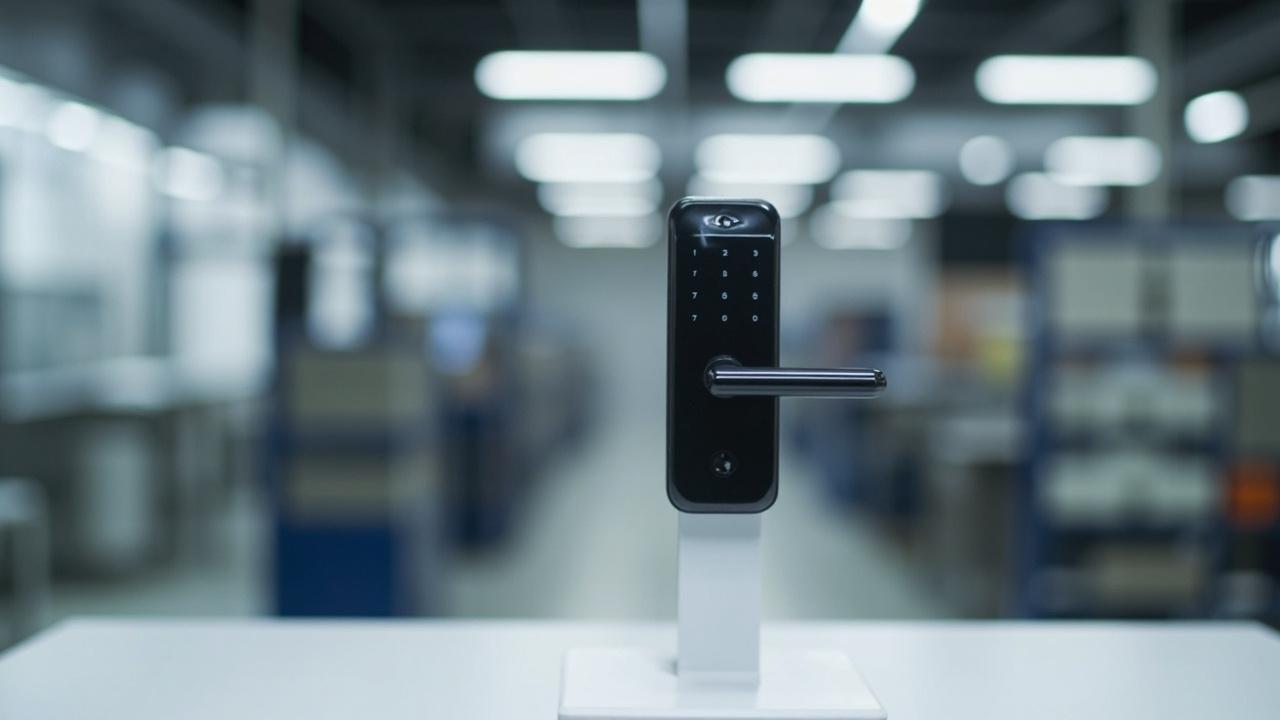
Smart Locks for Hospitals
A smart lock for a hospital is an electronic door lock — keypad, RFID card, fingerprint, app-Bluetooth, or a layered combination of those credentials — installed on a door inside a hospital campus where the door owner is, in the day-to-day operating sense, the facility rather than a clinician, a patient or a regulatory regime. The product on the door looks the same as the product on a hotel corridor or an apartment unit. The conversation should not, because the accountability chain above a hospital door is the most layered of any building type the lock catalog meets.
Hospitals operate inside at least four separate accountability chains at once. Clinical doors sit inside the infection-prevention regime, the controlled-substance regime where applicable, the patient-safety regime and the local authority having jurisdiction for fire and means of egress. Administrative and consultant offices sit inside an HR-and-facilities regime that looks much closer to a corporate office than to an operating theater. Plant, IT, BMS and server rooms sit inside a building-systems regime that looks much closer to a data center than to a clinic. Back-of-house staff doors sit inside a facilities-management regime that looks much closer to a hotel housekeeping closet than to anything clinical. The honest engineering question — and the entire editorial purpose of this article — is to name which of those regimes the lock catalog can serve honestly, and which ones it emphatically cannot. We have quoted and built electronic locks for 10+ years, into 80+ countries, including the non-clinical doors of hospitals, clinics, laboratories and medical schools. What follows is the manufacturer-side editorial on the door-layer framework as we write it for hospital clients.
The through-line is one sentence that needs to be in every integrator's head before a single model is shortlisted: the door-lock catalog serves the non-clinical doors of the hospital and does not serve the clinical doors. Saying that cleanly, and saying it before the marketing material lands, is what separates a defensible hospital procurement from the kind that ends up in a serious incident review.
What the catalog actually is, inside a hospital
Strip the brochures away and the smart lock is three ordinary things. It is a credential reader. It is an actuator that throws or retracts a latch or deadbolt in response to a credential decision. It is a small log of events — who came in, who tried, when, on which door. Every other feature in a lock manufacturer's catalog either improves one of those three functions or layers operational policy on top of them: schedules, multi-credential fallbacks, audit trails, temporary or one-time codes, app-based admin, role hierarchies. None of those features, by themselves, constitute a clinical safety system, an infection-prevention system, a controlled-substance compliance system or a fire-egress system. They constitute the access-management substrate that those higher systems might be assembled around.
Inside a hospital that substrate is genuinely useful, but only on the doors the substrate can responsibly serve. A director of operations gets a credential that lasts until HR revokes it, the head of biomedical engineering gets a credential that opens the plant-room doors, the night-shift cleaning supervisor gets a credential with a schedule that fires only during the night-shift window, and the hospital's records custodian gets a log file that shows who entered the medical-records storage room and when. These are real operational improvements, and honest ones, and they are the reason a hospital facility program proceeds with a smart lock upgrade in the first place.
What the substrate cannot do is clinical. It cannot claim to be medical-device-grade. It cannot claim biocompatibility. It cannot claim an infection-prevention rating — the lock product is not sterilized between procedures, it is not a patient-contact surface, and no manufacturer of door-lock products that publishes honest documentation should be writing that the lock satisfies a clinical-cleaning, clinical-handling or clinical-zone requirement. That conversation belongs to the hospital's infection-prevention team and to the medical-device vendors that supply equipment that genuinely needs to meet those regimes. Smart-lock companies that blur this line are signaling the wrong thing about how they treat evidence, and a serious hospital procurement officer should refuse the product-page copy that blurs it.
Four door populations in the hospital building
A hospital building owns doors in four populations that we can serve from the catalog honestly, plus a fifth population that lives permanently outside the catalog. Most hospital-facing marketing collapses them into one. That collapse is why hospital projects end up with locks mounted on doors they were never designed for. The framework below names the four populations we can serve and the one population we cannot.
Administrative and director offices. Reception, accounts, payroll, HR, director of nursing's office, medical director's office, marketing, fundraising, legal, the executive suite. These doors behave like corporate office doors. Credential variety is wider than a hotel — full-time staff, locum tenens, contractors, vendors, board members — but the operational model is the same: issue a credential, revoke it on exit, capture an event log the HR or records custodian can read later. The lock catalog is comfortable here. A keypad-only door, a fingerprint door, an RFID card door, or a multi-method 5-in-1 door fits the room; the RFID door lock and keypad door lock lines are the first place most hospital integrators look, and the integrator should confirm credential capacity, audit depth, admin role structure and app-platform binding on the product page for the specific SKU before binding it to a tender.
Consultant suites and clinical-administration meeting rooms. The rooms where attendings meet, where multidisciplinary team meetings happen, where tumor boards convene, where family meetings occur. Some of these doors carry a clinical label because the people going through them are clinicians, but the door itself is not a clinical door — no patient is treated on the door, the door does not open onto an isolation room, and the door does not carry a controlled-substance threshold. The conversation is about meeting confidentiality, audit visibility, and after-hours access for the named clinicians. Again the catalog is comfortable here. Check the model’s published specification that the lock supports the role structure the hospital needs (board observer, named consultant, joint-credential pair, time-windowed meeting credential) before binding.
Plant rooms, IT closets, BMS rooms and server rooms. Mechanical rooms, electrical rooms, medical-gas manifold rooms, water-heating plant, chiller plant, BMS head-end rooms, IT closets, server rooms, telecom rooms, fire-alarm panel rooms, security head-end rooms. These doors behave like the building-systems doors they are. The credential population is narrower than the administrative floors — facilities, contracted mechanical-and-electrical vendors, medical-gas inspectors, BMS engineers, IT and security. The audit trail matters because the rooms are critical and the regulatory environment is unforgiving (medical-gas alarms, BMS history, server-room access). The catalog serves these doors but with a sharper eye on door-prep and on environmental ratings; the integrator should confirm door thickness, ingress protection language, mechanical key override behavior, and the audit-event depth on the product page for the specific SKU before binding any one of these doors. Where a plant-room door sits on a fire-rated wall, the door-prep conversation moves to a qualified door-hardware professional and the fire authority having jurisdiction, not the lock manufacturer; we return to that division below.
Non-clinical staff-only back-of-house doors. Housekeeping closets, non-clinical staff break rooms, linen rooms, foodservice support doors that do not pass through the clinical zone, the back-of-house route the maintenance team walks from the loading dock to the plant room, the security office, the chapel, the staff gymnasium, the conference center. These doors behave like hotel housekeeping or back-of-house doors, and the catalog is comfortable here. The credential population is mostly facility staff, with named exceptions for contracted vendors. Confirm the door-prep, the credential capacity, the per-credential windows where vendor passes are issued, and the mechanical key override on the product page for the specific SKU before binding.
The fifth population — clinical and patient-zone doors — does not sit inside the catalog. Operating-room doors, ICU doors, isolation-room doors, NICU doors, birthing-room doors, emergency-department treatment doors, procedure-room doors, in-patient room doors, medication-room doors where controlled substances are stored, clean-supply and soiled-utility rooms that route into the clinical zone, and pharmacy doors across the controlled-substance boundary are emphatically out of the lock-catalog conversation. Those doors are governed by infection-prevention practice, by controlled-substance compliance, by patient-safety policies, by means-of-egress codes, and by the medical-device regulatory regime where applicable. The smart lock product is not a medical device. The smart lock manufacturer does not certify biocompatibility, sterilization tolerance, or clinical-cleaning compatibility. A hospital integrator who tries to procure a catalog smart lock for a clinical door is procuring under a category error, and the procurement is best caught at the door-survey stage, before the SKU is shortlisted.
How does a single door on the survey form actually get routed? The test runs in one fixed order, and the order is the point:
flowchart TD
    A["Door recorded on the hospital door survey"] --> B{"Patient care · isolation · operating room · medication or controlled-substance threshold?"}
    B -- "Yes" --> C["Out of catalog · route to infection-prevention · controlled-substance compliance · clinical engineering"]
    C --> G["Named out of scope in the survey document before any SKU is shortlisted"]
    B -- "No" --> D{"Sits on a fire-rated wall or a means-of-egress path?"}
    D -- "Yes" --> E["Door assembly owned by the qualified door-hardware professional · fire authority having jurisdiction · lock specified to the rated door · not in place of it"]
    D -- "No" --> F["Catalog-eligible population · administrative · consultant · plant and IT · non-clinical back-of-house"]
    F --> H["Confirm per SKU on the product page · credential capacity · audit depth · mechanical override · app-platform lane"]
    E --> H
    H --> I["Sub-spec written per population · shortlist and RFQ"]
The door the lock is mounted on is the conversation we do not own
A second honest point that is often quietly negotiated out of hospital specs: the door, the frame, the wall, the hinges, the smoke and fire assembly, the means of egress, the panic hardware where applicable and any signage or rating plaque on the door are a separate procurement and engineering conversation that the lock product does not and cannot own. The lock catalog is mounted onto that conversation. A hospital procurement that asks the lock manufacturer to warrant the door assembly as a whole is asking the wrong vendor. A lock manufacturer that issues such a warranty in writing is signaling the wrong thing about how it treats evidence.
The same division applies to clinical-cleaning tolerance. Hospital-grade disinfectants and the contact-time regimes the infection-prevention team publishes are real, demanding and enforced. The lock product is not a medical device and is not warranted by us, by any reputable lock manufacturer, or by any reputable test laboratory as compatible with clinical-grade contact-time disinfectants. The lock product is rated for the cleaning regime a commercial door receives, which is to say wiping with a standard non-abrasive cleaner. Anything stricter — and a hospital procurement that asks for stricter will, in our experience reading RFPs, frequently ask for stricter — is a different conversation, with a different vendor, on a different procurement line. Surface-finish compatibility for the lock product should be confirmed on the product page; anything beyond that should be confirmed in writing from the actual cleaner manufacturer and the hospital's infection-prevention lead.
The same division applies, emphatically, to controlled-substance access. Where a hospital pharmacy door or a medication-room door sits inside the controlled-substance regime, the access regime is governed by a controlled-substance compliance officer, a regulatory framework and a chain-of-custody record that the lock product cannot satisfy by itself. The lock can capture an event, but the lock cannot certify chain-of-custody for a controlled substance, cannot be the regulatory record for one, and cannot be the witness that the regulator asks about. The pharmacy door is a separate procurement, governed by separate evidence, routed to the controlled-substance compliance officer and not to the lock manufacturer.
The credential model a hospital actually runs
Hospitals design their credential model around populations that overlap in ways the lock product has to support honestly. Three of those populations are inside the catalog. A fourth is not.
Year-round staff want the same kind of access a workplace would give: a credential that lasts until HR revokes it, the ability to add a door to their profile without re-issuance, and audit visibility into their own access history. This is the population every catalog page describes well.
Locum tenens, contractors, vendor representatives, board members and visiting consultants are the population most catalogs under-describe. The hospital needs a credential the director of operations can issue the morning the locum arrives and revoke the evening the locum leaves, without anyone handling a physical key. The credential has to be cheap to issue, hard to pass along, and short-lived in the software even if the physical card survives. The audit trail on this credential matters: which locum entered which consultant suite at which hour on which day is the question a hospital counsel is eventually asked, and the answer has to come from the lock system's event log, not from a locum agency's handwritten roster.
Visitors are a narrower category. In a well-run hospital, a visitor is not a credential-holder; a visitor is a reception-supervised guest with a printed badge and a host who escorts. Lock-level visitor features have a place in this design for after-hours entrances and high-volume non-clinical entries, but they are an augmentation of the reception workflow, not a substitute for it. Hospitals that try to replace the reception workflow with a self-service visitor link tend, in our experience reading their RFPs, to end up rebuilding the reception workflow a year later.
A fourth category — patients — is mostly out of scope for the door-lock conversation. Patients and patient-affiliated credentials on the catalog's standard SKU lanes are not what a hospital needs at the in-patient room door, at the ICU door, or at the operating-room door; the patient-affiliated workflow belongs to the patient-flow system, the clinical staff's badge workflow, and the access controls that live alongside the medical-device regime. Naming this honestly at the start of the procurement is what keeps the lock catalog from being blamed for failing at a job it was never sold to do.
Sorting the four populations by how long their credential should live, by the question the event log must answer, and by where the catalog honestly stops makes the boundary visible at a glance:
| Credential population | Intended credential lifetime | The question its audit log must answer | Catalog fit |
|---|---|---|---|
| Year-round staff | Until HR revokes it | Own access history over time; doors added to a profile without re-issuance | Inside the catalog |
| Locum tenens · contractors · vendor reps · board members | Issued the morning of arrival, revoked the evening of departure; short-lived in software even if the card survives | Which named person entered which door at which hour on which day | Inside the catalog · needs per-credential windows · check the model’s published specification |
| Visitors | No standing credential; reception-supervised badge and escort | After-hours and high-volume non-clinical entry events only | Inside the catalog as an augmentation of the reception workflow · not a substitute for it |
| Patients and patient-affiliated workflows | Not a door-lock credential at all | Owned by the patient-flow system, not the lock log | Outside the catalog · route to the clinical-side regime |
What a defensible hospital spec looks like
The honest vendor's spec list looks less like a brochure and more like a list of disambiguations, because most hospital RFP ambiguities are not technical ambiguities about the lock; they are categorical ambiguities about what the lock is supposed to do. The list below is the one we use when an integrator asks for the shortest defensible version.
- The lock SKU is identified, and the specific product-page reference for each shortlisted SKU is appended as an exhibit. Every value the spec cites — credential type, read distance, read time, audit capacity, power format, app platform — is taken from that product page, not from a general catalog page.
- The door population is partitioned into four categories — administrative, consultant, plant, non-clinical back-of-house — and a different sub-spec is written for each. The fifth population — clinical and patient-zone doors — is named explicitly as out of scope and is routed to the clinical engineering, infection-prevention and controlled-substance owners.
- The mechanical-key override path is named, the keyway standard is named, and the hospital's key-custody chain is named. Mechanical key override is the route of last resort when the network is down, the batteries are dead or the credential database has lost sync, and it must be present on every lock product, on every door population, including the plant-room doors and the IT-closet doors.
- Clinical-cleaning tolerance is not claimed by the lock manufacturer. The hospital's infection-prevention lead owns that conversation; the lock manufacturer contributes the surface-finish compatibility language from the product page and nothing more.
- Controlled-substance compliance is not claimed by the lock manufacturer. The controlled-substance compliance officer and the regulator own that conversation; the lock contributes the event log where applicable.
- Fire, means-of-egress, panic hardware, ADA and the local hospital building code are not asserted by the lock manufacturer. The hospital's facility engineer, counsel and the authority having jurisdiction own that conversation; the integrator's role is to leave that conversation explicit, not to absorb it.
- The audit-log retention, the role structure and the language set are recorded in the spec. These are not safety features; they are operational features, and they are the features a hospital counsel will eventually need if there is an incident that touches the door population.
- The scheduling scope is recorded, the schedule editor is named by role (facility director, after-hours security supervisor, named plant engineer), and the after-hours population is named explicitly. The bell schedule of a hospital is not the bell schedule of a school; it is a 24/7 cadence with a night-shift transition, and the schedule should be written with that cadence in mind.
- The locum-tenens and contractor credential workflow is named, with the same-day issuance path and the off-boarding revocation path. The contractor scope (medical-gas inspector, BMS engineer, elevator maintenance, cleaning subcontractor) is named in writing because the contractor population is where most locum-and-contractor credential drift occurs.
- The cybersecurity posture — credential format, app platform binding (TTLock / Tuya / Doodle / hotel PC software lanes; check the model’s published specification), firmware update path, network segmentation — is named, because a hospital that puts a connected lock on its network inherits the hospital IT department's standards and, in some jurisdictions, the medical-device adjacent-IT standards.
- The retrofit door-prep requirement is named per door, or the new-construction spec is appended as the reference and the field-prep variance is recorded separately. Retrofit on a hospital is rarely a clean exercise: many older hospital wings were not reinforced for continuous read/write cycles, frame reinforcement was not specified for the new latch, and the wired power run was never roughed in. Confirm per-door door-prep requirements on the product page for every shortlisted SKU, and budget for the door-prep line as a separate cost category in the tender.
That list is long because hospital RFPs are long. It is the shortest form that survives an incident review or an audit without embarrassing the hospital.
Procurement paths that matter for hospitals
Hospital procurement in most jurisdictions runs through group-purchasing organization contracts, public-bid statutes where the hospital is a public body, and tender processes that differ from a private hotel procurement. Two practical consequences follow.
First, the integrator's roadmap to a closed deal is rarely the direct factory quote. It is the GPO contract piggy-back, the state-approved vendor list, or the public tender. That changes which catalog SKUs the integrator presents first, because a SKU that is missing from an approved-vendor list will not close even if it is the best technical answer. Confirm the contract status of any shortlisted SKU with the hospital's procurement officer before promising it on paper.
Second, customization at SKU level — hospital logo on the management software, hospital-tinted finish on the reader, hospital-named software roles — runs through our OEM/ODM program rather than through a stock catalog. The honest articulation is to treat the hospital's logo and software role structure as the contract that the OEM step moves, and the lock hardware as the underlying commodity that satisfies the contract's mechanical claims. Our become-a-distributor page describes the distributor-side of that conversation for the system integrator that is bidding as the long-term service partner rather than the OEM partner.
A third path that is increasingly common — and increasingly expensive when it goes wrong — is the retrofit program. Converting an older hospital wing from a legacy mechanical system to a smart-lock system is a door-prep exercise as much as a lock exercise: many older hospital wings were not reinforced for continuous read/write cycles, frame reinforcement was not specified for the new latch, and the wired power run was never roughed in. Confirm per-door door-prep requirements on the product page for every shortlisted SKU, and budget for the door-prep line as a separate cost category in the tender.
What the lock product's published data looks like, in this conversation
For a typical non-clinical staff-side RFID smart lock in our catalog — a door-class analogous to the hotel lock that often ends up on administrative and consultant-suite doors — the published first-party spec block looks like this, and the integrator should confirm every row on the product page for the specific SKU before binding it to a hospital tender:
| Published line for a typical non-clinical RFID smart lock (e.g. SLK-9936S hotel-lock class) | Value |
|---|---|
| Door thickness fit | 36–100 mm |
| RFID standard | Mifare 1 @ 13.56 MHz |
| Read distance / read time | 0–5 cm / <0.25 s |
| Power | 4 × AA |
| Battery operating cycles | >15,000 |
| Audit / event records | up to 1,000 |
| Cylinder | 5-pin |
| Latch | 3-point |
| Body | Stainless steel + alloy |
| Mechanical emergency access | Yes (key override) |
| Software mode | Standalone or centralized database, multilingual |
Every value above is product-side data. None of it is a hospital clinical-claim. The door the lock is mounted on, the door's fire rating, the wall's clinical-cleaning regime, the medication-room's controlled-substance posture, and the role of the lock inside the hospital's incident-response plan are all conversations that sit outside the table. A serious spec writer keeps them outside the table on purpose, and the integrator's value is to surface them in writing for the facility director before the tender closes.
The scheduling cadence a hospital actually runs
The bell schedule of a hospital is the single most underused lever in a hospital lock program. A defensible scheduler handles four state transitions: day-shift staff arrival (a window during which the non-clinical entrances unlock on credential presentation), the operating day (administrative and consultant doors locked from outside during business hours, free egress from inside), evening transition (a brief window during which the night-shift staff entrance takes over from the day-shift entrance), and the 24/7 cadence (a small named population of plant engineers, BMS engineers, IT staff and contracted after-hours cleaners who have standing access). The lock product can support this scheduler; the hospital's facility policy is what defines the transitions. The integrator's spec is to ask, before the SKU is chosen, who owns the schedule, who can edit it during the year, and how a partial facility lockdown, a weather-driven closure or an incident-driven change is handled inside the same software.
There is a related honesty point. Smart lock vendors, including ours, sometimes present scheduling as if it were a safety feature. It is an operational feature. A lock that automatically relocks at 6:00 p.m. is a lock, not a security officer. A lock that unlocks for an emergency responder under a held-open command is a remote release, not a perimeter. Hospitals that buy scheduling expecting it to do safety work will find, within a year, that the part of the system doing safety work is the staff training, the access governance and the layered plan, not the cron jobs in the lock software.
Illustrative scenario: a 220-bed hospital, non-clinical scope only
Consider a 220-bed hospital that has decided to upgrade its access on the non-clinical doors only. The clinical-side decision is parked with the infection-prevention lead and the controlled-substance compliance officer, both of whom will run a separate procurement on their own timeline. The non-clinical scope reads roughly as follows.
The administrative corridor of the third floor carries eighteen doors: director of operations, medical director, director of nursing, HR, payroll, accounts, marketing, fundraising, legal, the executive suite, two board rooms, three named consultant offices for visiting attendings, the medical-staff lounge, the education suite, the chaplaincy office, and the facility director's own office. These are RFID badge, with mechanical key override for after-hours admin staff, and the audit visibility is read by HR and the facility director.
The first-floor plant wing carries six doors: mechanical room, electrical room, medical-gas manifold room, water-heating plant, fire-pump room and the BMS head-end room. These are RFID badge plus mechanical key, with the medical-gas manifold room on a separate restricted list (named facility engineers only; medical-gas inspectors on a per-visit credential issued by the facility director's office). Fire-rated door assemblies on this wing are routed to the qualified door-hardware professional and the fire authority having jurisdiction, and the lock is specified to the rated door, not in place of it.
The IT and security wing carries four doors: server room, telecom room, security head-end room and the BMS head-end IT closet. These are RFID badge plus PIN, with mechanical key, and an audit-log retention requirement that is read by the IT director and the information-security officer.
The non-clinical back-of-house carries eleven doors: housekeeping supervisor's office, four housekeeping closets (one per floor), the non-clinical staff break room, the linen room, the foodservice support door that does not pass through the clinical zone, the back-of-house route from the loading dock to the plant room, the security office, the chapel, and the staff gymnasium. These are RFID badge, with locum-tenens and contractor populations on time-windowed credentials.
The total non-clinical scope is thirty-nine doors, four door populations, a single audit-log retention policy, a single credential-issuance workflow, and one named integration point with the hospital's HR system. The mechanical-key override is present on every door. The clinical and patient-zone doors are named in the survey document as out of scope and are routed to the hospital's separate clinical engineering and infection-prevention procurements. The frame reinforcement, the fire-rated door assemblies, the means-of-egress conformance, the controlled-substance access regime and the ADA conformance are routed, by name, to the qualified door-hardware professional, the fire authority having jurisdiction, the controlled-substance compliance officer, and the hospital's facility counsel.
This scenario is illustrative; it is not a customer story. No real hospital has been built from these exact line counts. The point of the scenario is the shape of the answer — four populations, a single audit-log policy, one named clinical-routing line in the survey document, and one clear mechanical-key-override requirement across every door. A serious integrator reads the scenario as a starting template, substitutes the actual door survey for the line counts, and runs the substitution in front of the hospital facility director before the SKU is shortlisted.
Where this conversation sits next to the siblings
This article is the building-level editorial for hospitals. The siblings on the site handle the narrower clinical, storage and staff conversations.
- Smart Locks for Clinics is the outpatient-clinic version of the same honesty framework. A clinic and a hospital share the non-clinical / clinical divide, but the clinic's clinical footprint is small enough to be named door-by-door inside one procurement, whereas the hospital's clinical footprint is large enough to be routed to a separate procurement on its own timeline. The lock catalog serves the clinic's front-desk, consulting-room administrative doors and consulting-room suites honestly and does not serve the clinic's procedure rooms, the clinic's vaccination or phlebotomy rooms, or the clinic's medication storage under the controlled-substance regime.
- Smart Locks for Medical Storage Rooms is the storage-side conversation. Medical records storage, supplies storage, non-controlled medical device storage, sterilization-room storage that is not the clinical room itself, mobile-cart storage rooms and pharmacy non-controlled storage all sit inside the catalog; controlled-substance storage and pharmacy compounding storage sit outside the catalog and are governed by the controlled-substance compliance officer and the regulator.
- Smart Locks for Healthcare Staff Areas is the staff-side conversation. Break rooms, locker rooms, lactation rooms, staff wellness areas, sleep rooms for on-call clinicians, and education suites all sit inside the catalog; the staff entry doors that open directly into the clinical zone sit at the boundary between the catalog and the clinical regime, and the integrator's spec is to name the boundary in writing rather than absorb it.
The honest editorial across these four siblings is consistent: the lock catalog serves the non-clinical, non-controlled-substance, non-procedure, non-isolation doors of any healthcare building honestly, and it does not serve the doors inside the clinical regime. The job of every hospital integrator is to draw that line in writing on the door-survey document, to shortlist SKUs against the non-clinical rows, and to name the clinical-side conversation as belonging to a different procurement.
Bringing the conversation to the factory
For an integrator or a distributor moving a hospital program from evaluation to RFQ, the practical next step is short and procedural. Pull the hospital's existing facility, infection-prevention and controlled-substance policies. Identify the doors in each of the four catalog-eligible populations and the four-row sub-spec for each, written in the form above. Shortlist two to four SKUs per population, and for each shortlisted SKU confirm the published product page against the spec lines. Send the consolidated package — door-population map, populated sub-spec per population, confirmed SKU references, policy clarifications about fire / means of egress / ADA / controlled substance / clinical cleaning / cyber posture — to our request-a-quote page, or to the distributor partner that has already been authorized for the relevant GPO or cooperative contract. Sample orders for a pilot wing are routed through order-samples, and the catalog-side context for the lock families most often used on hospital non-clinical doors lives on hotel lock, keypad door lock and RFID door lock for cross-reference during the pilot.
The intent of this editorial is not to sell a category. The intent is to keep the hospital door-lock conversation honest, separated from the clinical conversation a manufacturer cannot make, and pointed at the facility director and the integrator who actually own the layered plan. A hospital that runs that conversation well procures a smaller, more boring non-clinical program with fewer surprises and a longer operational life, and leaves the clinical regime to the conversations and the vendors that can speak to it. A hospital that runs it poorly ends up with a brochure, a catalog SKU on a clinical door, and a regulatory conversation the lock manufacturer was never going to win. The factory's contribution to the former is to write the lock spec narrowly, to refuse the parts of the conversation that are not ours to claim, and to keep the door-population map in the front of every tender where it belongs.