
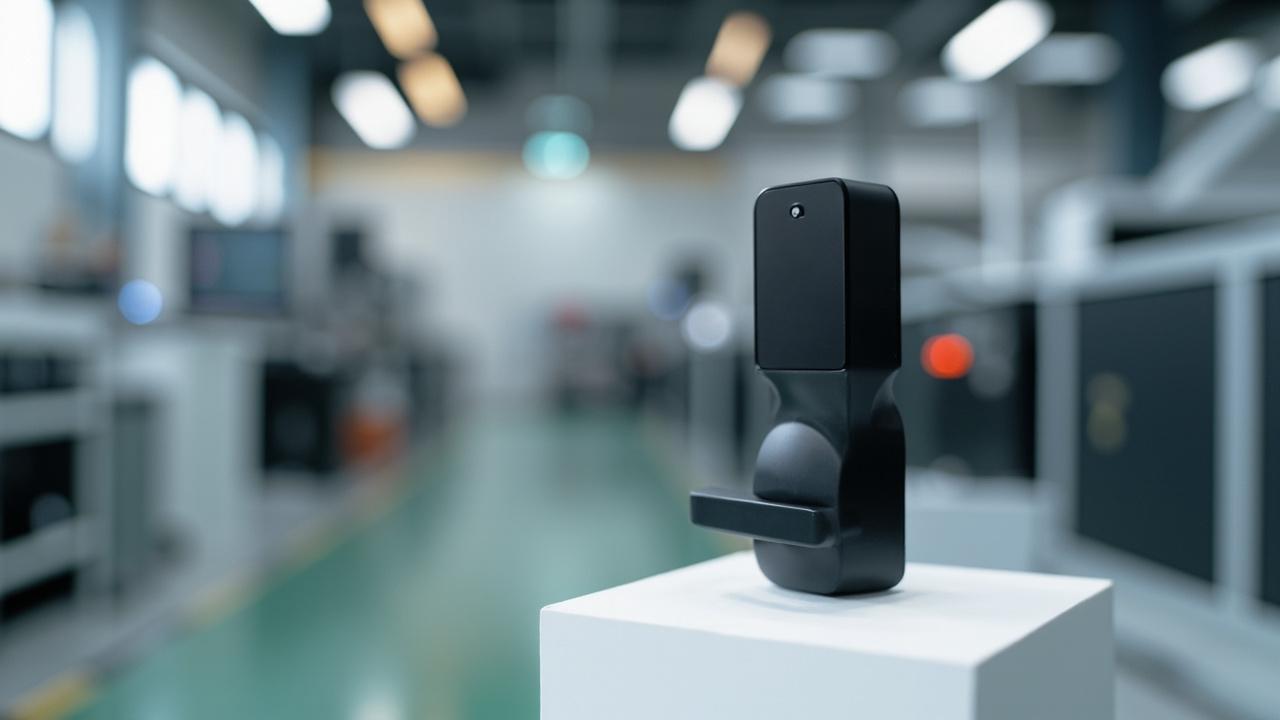
Smart Lock Manufacturer for Hotel Projects
A hotel project is not a lock purchase with a larger quantity attached. It is a system purchase in which the hardware is the smallest of five moving parts: the software, the card program, the front-desk routine, the door preparation that spans two build phases, and the consistency of a fleet that must behave identically for a decade. Most suppliers marketed at hotels can quote the hardware and stop there. The buyers who get hurt are the ones who treated a hospitality lock like a commodity line item.
Direct answer: A smart lock manufacturer for hotels is a supplier that delivers, per model number, the whole operating stack a property runs on — hotel door-lock hardware that fits existing door preparation, management software that runs standalone or against a centralized database, a defined card hierarchy (guest, floor, engineer, master) the front desk can encode and re-encode, an audit/event log the property can export, mechanical emergency access, and a body/finish range that survives coastal and high-traffic wings — and that can hold every one of those identical across a phased rollout. A generic lock supplier sells a lock. A hotel-project manufacturer supplies the room-side half of the property's access system and keeps it stable from renovation through new build-out. That distinction, not the unit price, is what a hospitality buyer should evaluate.
This is the hotel lens on our manufacturer-selection cluster. The general supplier process lives in how to choose a reliable smart lock manufacturer; this guide assumes you already screen for basic reliability and now need to test a shortlist specifically against a project — multiple doors, multiple phases, multiple staff hands, ten years of reorders.
Why Hotel Lock Sourcing Is Not Lock Shopping
A residential or retail buyer optimizes for one lock working well in one hand. A hotel buyer optimizes for two hundred locks behaving the same way across six housekeepers, three shift supervisors, a renovation contractor and a guest who loses a card at 2 a.m. The failure modes are different in kind, not degree.
Three properties define the hospitality angle. First, the lock is part of a workflow, not the workflow itself — it only matters if the front desk can issue, revoke and re-encode cards against it without friction. Second, the lock is bought in phases, so the unit specified in the RFP and the unit that arrives eighteen months later for the annex must be the same animal: same software, same card format, same mortise, same finish lot behavior. Third, the door is fixed before the lock arrives — renovation projects inherit whatever carpentry already exists, so fit range and mechanical reuse decide whether the swap is cheap or expensive.
A supplier who cannot talk about all three is selling hardware into a hotel project and hoping the operations team solves the rest. Our own hotel lock category exists because 24 hotel-specific models, inside a 79-model range, behave differently from consumer locks in exactly those three dimensions. The rest of this guide turns those dimensions into evaluation tools.
The Four Separators of a Hotel-Project Manufacturer
Strip away catalog gloss and a hotel-project manufacturer is judged on four things a generic lock supplier either fakes or ignores. Each maps to a section below, so treat this as the table of contents for your evaluation.
| Separator | What it demands of the manufacturer | What a generic supplier offers instead |
|---|---|---|
| Hotel software ecosystem | Management software that runs standalone and centralized, per model, multilingual | A one-off encoder tool, or "use the app" |
| Card hierarchy | A defined guest / floor / engineer / master scheme the front desk can operate | A single card type with no role model |
| Front-desk workflow | Check-in, check-out, lost-card, and room-freeing handled at the desk, offline or online | Re-encoding that requires a technician or a return visit |
| Fleet consistency across phases | Identical software, card format, mortise and firmware for the 2nd and 18th-month order | Silent component or revision drift between batches |
The next three sections give each separator its own evaluation table, then the scenario stitches all four onto one 92-room job.
Hotel Software Ecosystem: Standalone vs Centralized
The single biggest tell is whether the manufacturer's hotel software exists at all, and whether it can be run in the two modes real properties actually use. The SLK-9936S block from our own catalog advertises both — "standalone or centralized database modes" with "multilingual management software" — and that is the baseline you should demand in writing from every supplier on the shortlist.
| Dimension | Standalone / offline mode | Centralized database mode |
|---|---|---|
| Where room state lives | On the lock and the guest card itself | On a property server or cloud database |
| Check-out handling | Card encodes the checkout; lock frees on next read | Server frees the room in real time |
| Network dependency | None at the door — survives internet drops | Depends on property network staying up |
| Front-desk hardware | Handheld or desk encoder per shift | Encoder plus a running station tied to the database |
| Multi-property view | Per-property, manual | Shared schema if the software supports it |
| Best fit | Renovations, low-bandwidth sites, single buildings | New-build towers, groups wanting one console |
The wrong answer is not "pick one." The right answer is: know which mode your property runs, confirm the exact model supports it, and confirm both modes use the same card format so a mid-project switch does not strand a wing. A supplier who treats the software as an afterthought will not be able to name the card technology per mode — check it against the hotel smart lock manufacturer selection guide.
Card Hierarchy and the Front-Desk Workflow
Hotels cannot operate on one card type. The hierarchy is what turns a collection of locks into something housekeeping, maintenance and management can each use without stepping on each other. Ask the manufacturer to state the hierarchy their software ships with, and who can re-encode what. This is the front-desk reality a hospitality lock must survive:
| Card role | Opens | Held by | Lifecycle event at the desk |
|---|---|---|---|
| Guest card | One room, date- and stay-bound | Guest | Encoded at check-in, expires or re-encodes at check-out |
| Floor / section master | A defined floor or wing | Housekeeping | Issued per shift, returned and wiped |
| Block master | A planned group of rooms | Supervisor, events team | Scoped to a booking block, then revoked |
| Engineer card | Commissioning and bypass range | Installer, maintenance | Used during build, then removed from service |
| Grand master / emergency | All rooms | GM, security, night audit | Locked away, logged, never casually duplicated |
| Lost-card handling | Invalidate and re-encode the room | Front desk | Guest reports loss; old card dead, new card live, no door work |
The lost-card row is where a weak system reveals itself: on a true offline hotel lock, a lost card is handled at the desk by re-encoding the room, not by sending someone to the door. When you evaluate the front-desk fit, read it against the credential mechanics in the RFID hotel door locks: how they work piece and the spec-selection logic in how to choose hotel smart locks.
Fleet Consistency Across Renovation, Build-Out and Punch List
Hotels are rarely delivered in one motion. A renovation project re-locks a standing wing, a build-out fills new rooms, and a punch list backfills stragglers six months later. Across all three, the fleet must act like one product. Fleet consistency is an engineering-controls property, not a promise, and it decomposes into four items you can each verify per model:
- Card format stability. The same Mifare-family credential works on phase one and phase three locks; a silent change to a reader revision means re-issuing every card mid-project.
- Mortise and latch reuse. The 5-pin cylinder and 3-point latch on the SLK-9936S are fixed attributes — a project should not discover a new strike dimension between orders.
- Firmware and software revision control. Units leaving the line 18 months apart must register identically against the property's software; ask how versions are marked per batch.
- Finish and body lot behavior. Coastal and poolside wings are unforgiving; a "stainless steel + alloy body" that quietly changes its alloy lot is a cosmetic-corrosion claim waiting to happen.
This is the item most buyers skip because it is invisible at sample stage and only surfaces on the second or third order. It is also the reason a hotel buyer should prefer a manufacturer with a genuine, stable hotel line over one whose hospitality "range" is a token model or two.
Door-Fit Reality: The 36–100 mm Datasheet Test
Everything above can be talked around. Door fit cannot — it is physical, and it is where hospitality retrofits either stay cheap or turn expensive. During a renovation you inherit existing door preparation, so a wide published thickness range and a standard mortise mean the smart lock bolts onto the joinery already in the door, with no new machining and no door-side wiring.
Here is the published specification set for the SLK-9936S hotel lock from our own catalog, used as the yardstick for how specific a competent manufacturer's datasheet should be. Full detail lives on the SLK-9936S product page.
| Specification | Published value |
|---|---|
| Door thickness range | 36–100 mm |
| Card technology | RFID Mifare 1 at 13.56 MHz |
| Read distance / read time | 0–5 cm / under 0.25 s |
| Power | 4 × AA batteries |
| Battery operating cycles | over 15,000 |
| Audit / event records | up to 1,000 |
| Cylinder | 5-pin |
| Latching | 3-point latch |
| Body and finish | stainless steel + alloy, multiple finish options |
| Emergency access | mechanical key |
| Software modes | standalone or centralized database, multilingual |
| Positioning | 1–5 star hotel properties |
Read the two cells that matter most for a no-rewire retrofit: 4 × AA power and 36–100 mm thickness. Offline card locks already run on door-side batteries, so a battery-powered smart lock drops onto the same power architecture — no conduit, no opening walls, no low-voltage runs per door. And a thickness window that wide means most existing hotel doors, old and new, fall inside the envelope without carpentry. If a supplier's datasheet has fewer populated cells than this table, you have found your qualification gap before the first site visit. The door-fit upgrade guide carries the same block into a retrofit checklist.
The aesthetic and environmental angles branch from here. Where a design or flagship property wants the credential zone almost invisible on the door, the SLK-9905A hidden-reader hotel lock answers a different question — same retrofit discipline, quieter faceplate — with a published door-thickness window of roughly 38–100 mm. Where the property has a seaside or poolside wing, stainless-steel body options exist across our legacy hotel series (the 019 / 022 / 309 family) and in the stainless-and-alloy construction of the 9936S itself. Those are finish-derating decisions, and they should be tested against your specific site before you standardize.
Project-Readiness Evaluation Table
Use this as the actual scoring instrument when you compare two or three shortlisted suppliers for a hotel job. It scores the four project dimensions — catalog depth, software, spares, documentation — as a hotel buyer sees them, not as a generalist does. Weightings are yours to adjust; the point is to force evidence into every cell.
| Dimension | What "project-ready" looks like | Warning sign | How to verify | Weight |
|---|---|---|---|---|
| Catalog depth (hotel line) | A real hospitality range — a benchmark is 24 hotel models in a 79-model catalog — with distinct formats (standard, hidden-reader, stainless, glass) | Two cosmetically renamed "hotel" locks | Count the models and check each is a mechanism, not a sticker | 3 |
| Hotel software | Named software, standalone and centralized modes, per-model card format, multilingual | "Just use a phone app" | Ask them to state the mode a specific model runs in | 3 |
| Spares & consumables | Named spare set — cylinders, readers, battery covers, encoder heads — offered per hotel line | "Contact us if needed" | Request a spares list keyed to the model | 2 |
| Documentation per model | File set keyed to the exact model, held under the manufacturer's own name | Catalog-level "we are certified" | Ask which files exist for this model number | 2 |
Score each cell 0 / 1 / 2 the way the general question bank scores its groups; the full method with weights is in what questions to ask a smart lock manufacturer. A hotel project that averages below the catalog-depth and software rows should not advance to sampling regardless of price — those two rows are where a hospitality job either works for ten years or unravels in year two.
Illustrative Scenario: Replacing 92 Offline Card Locks During a Coastal Resort Retrofit Without Re-Opening the Doors
Treat this as a worked selection logic, not a customer story.
Consider a 92-room coastal resort replacing offline card locks during an off-season retrofit, and the operator wants the access upgrade done without re-opening doors or pulling new wiring — the joinery is already cut, the walls are finished, and disruptive carpentry or low-voltage runs would stall the rooms being returned to service. The lock swap must ride the existing preparation.
Step 1 — fit first, features second. The buyer measures a representative sample of door thicknesses across the 92 rooms. Every one must fall inside the datasheet's thickness window before any other question is asked. The SLK-9936S 36–100 mm range is the kind of envelope that swallows older and newer doors alike, so a retrofit onto existing preparation is plausible; a narrower window would force door work and kill the "no re-opening" constraint. This is a buyer-side survey number — the manufacturer supplies the range, the buyer proves the fit.
Step 2 — match the power architecture. The departing offline card locks are battery devices. Staying on 4 × AA battery power means the retrofit changes the lock and nothing else — no transformer, no per-door cable, no wall chase. A supplier who pushes a wired networked lock here is quietly proposing a different, far more disruptive project; the buyer says no.
Step 3 — keep the card program alive at the desk. The existing credential is an RFID card. Re-encoding 92 rooms' worth of access has to run at the front desk against the new locks in the same card format, with the guest / floor / master hierarchy intact, so housekeeping shifts do not change. The buyer confirms the new lock's software reads the same Mifare-family card and that a lost card is handled by re-encoding, not a technician visit.
Step 4 — branch the finish by wing. Two wings ask for special answers. The flagship / design wing wants a near-invisible credential zone — the hidden-reader SLK-9905A route fits that aesthetic while keeping the same retrofit discipline. The poolside / coastal wing wants derating against salt and humidity — a stainless-steel body option, as on the 9936S and the 019/022/309 stainless series, is specified there instead of the standard finish. Both branches must still share one card format and one software so the fleet behaves as one.
Step 5 — hold consistency across the phase split. If the 92 rooms are re-locked in two waves, the buyer locks down firmware/card-format/mortise consistency in writing before wave two, so the annex arriving months later registers identically. Failure to do this is the single most common way a phased hospitality project bifurcates into two incompatible fleets.
The scenario is illustrative; the mechanic is not. The buyer who runs fit → power → card program → finish branches → phase consistency in that order buys a system. The buyer who starts with the unit price buys a problem.
Phased-Rollout Worksheet
A hotel project succeeds on gates, not hopes. Fill this worksheet with your own quantities and property details — the left columns are fixed project logic, the input cells are yours. It pairs with the hotel smart lock project planning guide.
stateDiagram-v2
    [*] --> Survey: exact export samples · door fit checked
    Survey --> Pilot: fit proven · mode per product page
    Pilot --> ReLock: card hierarchy live at the desk
    ReLock --> BuildOut: second order matches first SKU
    BuildOut --> PunchList: late doors inside datasheet range
    PunchList --> SteadyState: as-built register handed over
    SteadyState --> SteadyState: reorder · desk-only re-encode
    Pilot --> Survey: pilot fit-check fails
    ReLock --> Pilot: batch or firmware drift detected
| Phase | What is ordered / encoded | Fit-check gate | Software milestone | Documentation per phase | Spares / consumables to hold |
|---|---|---|---|---|---|
| 0 — Survey | Samples of the exact export version | Door thickness on representative rooms inside datasheet range | Confirm standalone vs centralized mode | Per-model file set received | Encoder head, 1 spare cylinder |
| 1 — Pilot (a floor) | Small first order for one wing | Full carpentry-free fit proven on the pilot | Card hierarchy encoded and tested at desk | Pilot acceptance signed | Reader covers, battery lot |
| 2 — Renovation re-lock | Majority of re-lock rooms | Existing preparation reused, no re-machining | Guest / floor / master roles live per shift | Batch firmware marks logged | Suggested overage per supplier terms |
| 3 — Build-out / new rooms | New-build doors | New bores match same mortise & thickness window | Centralized DB wired if chosen | Second-order docs match phase 2 SKU | Cylinders, latches, cards |
| 4 — Punch list & handover | Backfill stragglers | Any late door falls inside 36–100 mm | Audit/event export enabled per lock | As-built per-room model register | Emergency-key control handover |
| 5 — Steady state | Reorders only | — | Lost-card re-encode is desk-only, offline | Spares list kept current | Consumable cards + encoder heads |
Cells marked — have no documented value in this article’s sources; obtain the figure from the supplier’s written specification.
Two notes keep this honest. Quantities, spares ratios and any lead-time sequencing are not asserted here — they are commercial terms that resolve through a quote, not a blog post; order a small overage on the terms the supplier states, not on an assumed percentage. And the fit-check gate at every phase is the buyer's own site measurement, never a manufacturer claim. For the RFQ that converts this worksheet into numbers, use the hotel smart lock procurement guide.
Hotel-Specific Questions to Add to the Generic Question Set
The guide What Questions Should You Ask a Smart Lock Manufacturer? gives you a 44-question, seven-group bank. It is the right spine for any supplier call. A hotel project needs questions that bank does not carry — the project lens below goes on top of the generic set, not instead of it.
| Hotel-project question | Why the generic set misses it | Green-flag answer |
|---|---|---|
| Is the hotel software your own, and does it run standalone and centralized modes per model? | The generic bank asks platform, not property operation mode | Names both modes and which models run each |
| Walk the card hierarchy you ship and how a lost guest card is re-encoded at the desk | The generic bank mentions hierarchy exists, not the desk routine | Describes encode / re-encode / room-freeing offline |
| On an offline lock, how does the front desk free a room when a guest skips check-out? | A hospitality-only workflow question | Explains checkout encoding on the card itself |
| Can one model family span a renovation's existing prep and a new build-out's fresh bores? | The generic bank covers fit, not cross-phase fleet reuse | Confirms same mortise/thickness window across both |
| What is the audit/event log capacity per lock and how is it exported? | Property records need this; the generic bank only asks "does it log" | Cites a figure like up to 1,000 events, exportable |
| What emergency mechanical access and key-control scheme protects a multi-tower property? | Key control is a hospitality liability | Explains key hierarchy and blank control |
| Do the locks run door-side batteries or wired power? A no-rewire retrofit needs battery. | Determines whether the project opens walls | States battery architecture per model |
| Which body/finish survives a coastal or poolside wing, and how is it derated? | Environment-specific, not general fit | Names stainless/alloy options and the models |
| How do you keep card format, reader and firmware identical across orders 18 months apart? | The phased-project failure mode | Describes batch version marking and change notices |
Ask these to a shortlist, keep the generic bank for the first round, and treat any hospitality supplier who cannot answer the cross-phase and card-hierarchy rows as hardware-only, whatever the catalog says. For the OEM/private-label side of a branded group standard, route process questions to OEM/ODM program rather than re-asking them here.
Where This Sits in the Hotel Lock Cluster
This guide is the manufacturer-for-hotel-projects lens of the hotel cluster — it decides who to buy from; the other articles decide what to buy and how to run it. Depending on where you are stuck, jump straight across: hotel smart locks complete guide for buyers for the whole category, how to choose hotel smart locks for spec selection, hotel lock replacement guide for the retrofit path, RFID hotel door locks: how they work for the credential mechanics, and the hotel lock total-cost-of-ownership piece when you move from fit to life-cycle cost. The applications hub at Applications shows where each hotel lock family is deployed across property types.
FAQ
Do I need a manufacturer that also writes its own hotel software?You need a supplier that can state, per model, exactly which software the lock runs and in which mode. Whether the code is fully in-house matters less than whether they can operate and document it for a property; if the answer is "use an app," keep looking.
Can smart locks really replace offline card locks without new wiring during a renovation?Yes, when both the old and new locks are door-side battery devices. A battery-powered smart lock (4 × AA on the SLK-9936S) rides the same power architecture as the offline card lock it replaces, so no conduit, no per-door low-voltage runs, no opening walls. Wired networked locks are a different, more disruptive project.
Standalone or centralized — which does a mid-sized retrofit project need?Decide by workflow, not fashion. Standalone survives internet drops and suits single buildings and low-bandwidth sites; centralized gives one console for a new-build tower or a group standardizing several properties. The real requirement is that the model you pick supports the mode, and both modes share one card format so a mid-project change does not strand a wing.
How many hotel-lock models should a supplier offer before it counts as a real hotel line?Treat a token "hotel" pair as a red flag. A benchmark is breadth that reflects real mechanism engineering — a genuine hospitality range (our catalog lists 24 hotel models within 79 total) covering standard, hidden-reader, stainless and glass formats — so each project wing has an on-catalog answer instead of a customization request.
What exactly is "fleet consistency," and why does a phased rollout depend on it?It is the guarantee that the phase-two lock is the same animal as the phase-one lock: same card format, same mortise and latch, same firmware revision, same body/finish behavior. Without it, a hotel ends up operating two incompatible fleets, and re-encoding and spares double.
How is a lost guest card handled on an offline hotel lock?At the front desk, by re-encoding the room so the lost credential stops working and a new one starts — no technician trip to the door. That desk-only recovery is a core hospitality requirement; a supplier who cannot describe it cleanly is not a hotel-project manufacturer.
Can one supplier cover a design hotel's hidden-reader look and a coastal wing's stainless need?Prefer suppliers who carry both as catalog options rather than one-offs. The hidden-reader SLK-9905A answers the design-facade aesthetic, and stainless-steel body options (on the 9936S and the 019/022/309 series) answer coastal and poolside derating — provided all branches share one card format and one software so the fleet behaves as one.
What per-model documentation does a hotel FF&E buyer need before a group standardizes?A file set keyed to the exact model number — software/mode statement, card format, datasheet, firmware-marking and change-notice process — held under the manufacturer's own name, plus a per-room model register at handover. Standardizing across properties fails silently when phase-three paperwork does not match phase-one hardware.
Run the Project Lens Before You Request Numbers
Everything here turns the question from "what does the lock cost" to "can this supplier hold a working system across a real project." Take the four separators into your shortlist calls, run the door-fit datasheet test against a sample of your own doors, score catalog depth and software on the project-readiness table, and only then convert the survivors into commercial terms. When the operating stack is proven, submit your room counts, door measurements, phase plan and target finishes through the request-a-quote page so every supplier answers the same hospitality brief — and before committing a fleet across phases, order samples of the exact export version and encode a pilot floor against your own front-desk workflow.