
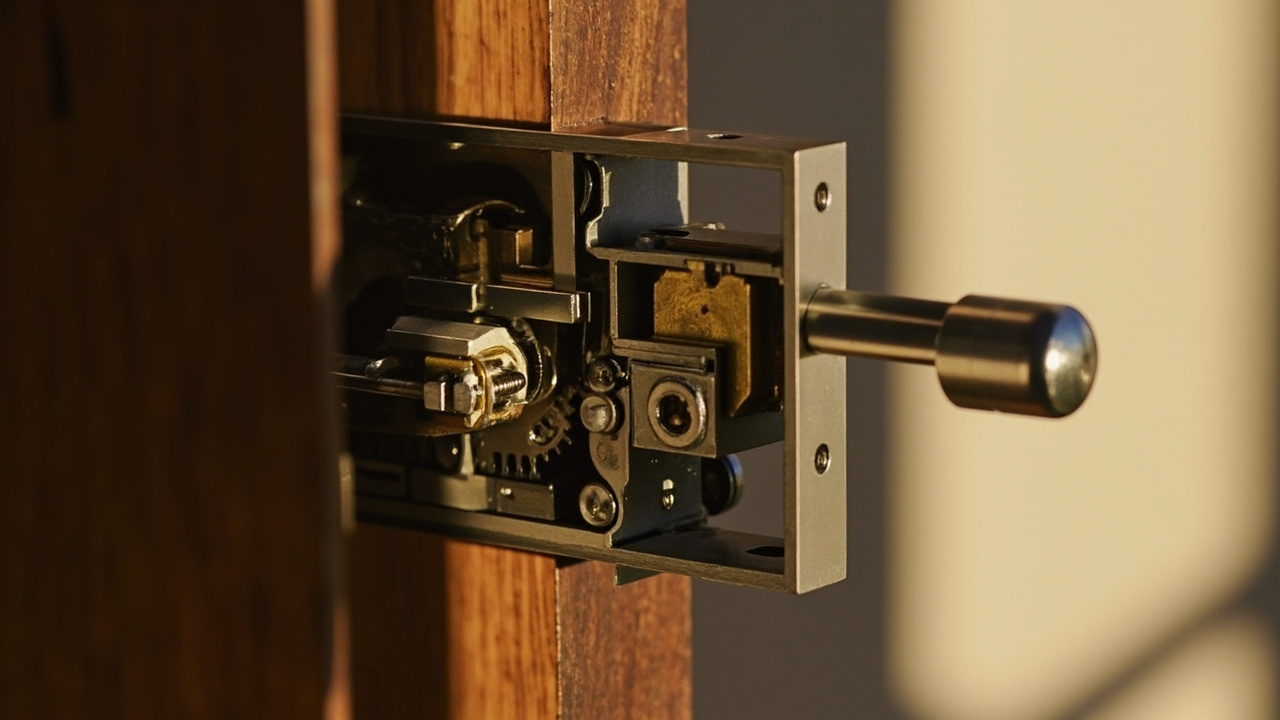
SLK-232 Fitting Notes: What to Measure Before You Order
Slk 232 door fit notes is what this piece examines at component level. This is a cross-border diary, and the project inside it is illustrative: a 48-door serviced-apartment conversion where an operator replaced tubular locks with hotel card locks. The reader is the procurement manager who owns the order and the installer who owns the drill. The diary runs from an early-April specification request to a late-September handover, written as dated entries because that is the only honest shape for a story whose real subject is a sequence — measure before order, order before packing, pack before crossing, cross before installation.
Direct answer. The one-line answer — slk 232 door fit notes is the working record for slk 232 door fit notes. slk 232 door fit notes is worthless until slk-232 is attached to it as evidence. A slk 232 door fit notes is a component behaviour guide. It covers limits. It covers failure modes. slk 232 door fit notes decides whether slk 232 door fit notes is acceptable for this build.
The reason this particular project earned a diary is a gap in the paperwork. The buyer asked for slk 232 door fit notes — a plain list of the measurements to take before committing to an order — and the catalogue record for the SLK-232 came back with its Door fit row empty. Every other row is written down: access methods, platform and connectivity, body and panel, power, packing, versions, services. Door fit: nothing. The measurement burden moved from the supplier's data sheet to the buyer's own site survey, and that relocation — not the lock, and not the software — is what these SLK-232 door fit notes are about.
Two framing notes before the entries start. First, every number in this diary belongs to the building being surveyed, not to the SLK-232. The lock's own figures appear only where the catalogue records them, and even then each one goes back to the dated product page for the specific SKU before it drives a decision. Second, the project is an illustrative scenario rather than a client story: no names, no contract, no volume taken from our order book, and no figure a reader could mistake for a published specification.
6 April — the specification request returns a row with nothing
The request that opened the project was four lines long: model, quantity, finish, and a request for the door-fit data behind the model. The answer came back within the week and covered almost everything asked. Access is recorded as RFID/IC card standard, passcode and mobile app optional by model version, mechanical override standard. The platform line reads hotel lock management software on PC, TTLock on keypad versions, connectivity Bluetooth, with guest card issuance, floor and room permissions, check-in validity windows and unlock records. The body is a 304 stainless steel RFID hotel card lock in a flush or flip reader style, silver brushed finish, No. 2 hotel mortise, panel 330 × 70 × 19 mm. Power is 4 × AA alkaline with a standard low-battery alert. Packing is a 605 × 405 × 365 mm carton, 10 pieces per carton, 25.3 kg gross. Versions are passcode keypad and TTLock smart-app, with the instruction to confirm configuration on the order or quotation. Services offer dimension drawings, an installation guide and a full datasheet on request.
Then the Door fit row, which reads as a dash: no leaf-thickness band, no backset, no mortise pocket drawing, no list of suitable door types. That is not the lock being shown not to fit; it is the fit data not being published where the buyer was reading. A blank row is not a published band of absence, and treating it as one is how a project ends up drilling a door it cannot close.
| Field group | What the SLK-232 record states | What the record does not state |
|---|---|---|
| Access | RFID/IC card standard · passcode optional by model version · mobile app optional by model version · mechanical override standard | Which credential methods ship with an order |
| Platform and network | Hotel lock management software on PC · TTLock on keypad versions · Bluetooth · guest card issuance, floor and room permissions, check-in validity windows, unlock records | How many rooms one installation point supports |
| Body and panel | RFID hotel card lock, flush or flip reader · 304 stainless steel · No. 2 hotel mortise · panel 330 × 70 × 19 mm · silver brushed finish | Which axis the panel dimensions refer to, and the cut-out and projection they imply |
| Power | 4 × AA alkaline · low-battery alert standard | Cell chemistry preference and access to the battery compartment |
| Door fit | — | Leaf thickness band, backset, pocket geometry, suitable door types |
| Packing | Carton 605 × 405 × 365 mm · 10 pcs per carton · 25.3 kg gross | Pallet configuration and stacking limits |
| Versions | Passcode keypad, TTLock smart-app — confirm configuration on the order or quotation | Which version is standard for an order |
| Environment | — | Operating temperature and humidity range |
The decision that followed took four sentences. The order cannot be placed until the survey exists; the survey cannot be finalised until the factory returns drawings; and the drawings must be compared against the dated product page for the specific SKU before anything is drilled. The record is published at the keypad RFID hotel smart lock product page, and it is where the finished datasheet will sit once the SKU is settled.
9 April — the doors turn out to be three different doors
The operator's asset register described the building as forty-eight guest doors, solid oak finish, single leaf. That sentence is technically accurate and practically useless, and it is the kind of sentence that produces a bad order.
A walk-through with the installer on 9 April found three generations of door in the same corridor. Thirty-one came from the original fit-out and already carry a mortise case pocketed into the edge. Eleven came from a 2019 refurbishment where the locks were swapped to tubular sets, leaving the leaves un-pocketed and the faces re-finished with a thin veneer over paint. The remaining six are the aluminium and glazed common-area doors, where the corridor meets the stair and the bin store.
Each generation fails differently. The pocketed doors fail if the case geometry differs from the pocket that is already cut. The refurb doors fail because there is no pocket at all and cutting one into a finished leaf is a decision, not a measurement. The aluminium doors fail at the most basic level, because they are not the kind of door a mortise case can be installed into — and because the catalogue record for the SLK-232 does not list suitable door types either, nobody in the project could say from the paperwork which door the model was designed for.
The lesson was recorded on the survey sheet and it shaped everything after: a door schedule is an index of rooms, not a measurement of doors. The survey's denominator is the door list, and before that afternoon it had been the guest-room count.
13 April — three pairs of hands and one sheet
The survey was split three ways on purpose. The site installer holds the tape and takes the readings. The buyer's project engineer checks the sheet for blank cells, out-of-band values and doors that appear on the list but not on the sheet. The factory side confirms each figure against the drawing it will drill from. The buyer keeps the record and carries it across the border.
The sheet is deliberately dull: one row per door, one column per measurement, no prose, no photographs in place of numbers, no "about 40" in a cell. A survey that cannot be read as a table cannot be checked, cannot be sent to a supplier in a single attachment, and cannot be defended at handover. The published measurement library sets out the discipline behind each column — Smart Lock Door Measurement Guide covers the ordering of the pillars, Smart Lock Door Thickness Measurement covers the first one, and Smart Lock Backset Measurement covers the convention problem that bit us later.
flowchart TD
    A["Specification request"] --> B["Record received with the Door fit row empty"]
    B --> C["Gate A - survey every door before the order"]
    C --> D{"Every door carries a complete row"}
    D -- "No" --> E["Re-survey the doors with blank or doubtful cells"]
    E --> C
    D -- "Yes" --> F["Gate B - written gap analysis to the factory"]
    F --> G["Drawings and installation guide returned"]
    G --> H["Gate C - arrival check against the survey annex"]
    H --> I["Accepted into the handover file"]
The three gates matter because the failure mode of a cross-border order is asymmetric. A wrong measurement found in April costs a survey; the same wrong measurement found in July, after the container has crossed, costs a leaf, a day of labour and a freight leg back. The gates exist to move every possible discovery backwards in time, and the wider sequence is set out in Smart Lock Installation Requirements.
The nine measurements, taken in a fixed order
The sheet has nine columns. The order is not arbitrary: the first three decide whether the case drops into the door, the next three decide how the door operates and how the reader is reached, and the last three decide what else changes on the leaf.
| # | Measurement | How to take it | Tool | Owner |
|---|---|---|---|---|
| 1 | Leaf thickness at hinge, mid and latch stile | Door closed, three points, record the smallest | Vernier or tape plus a note of which point was smallest | Installer |
| 2 | Backset from the door edge to the spindle centre | State the convention in words next to the number | Tape or rule | Installer |
| 3 | Mortise pocket depth from edge, pocket height, follower centre height | Measure the pocket with the case fitted, then again with it removed | Steel rule, depth gauge | Installer |
| 4 | Faceplate and strike geometry | Latch bolt position, deadbolt projection, handing, swing direction | Tape, photograph of the open door | Installer |
| 5 | Leaf-to-frame gap at head and both stiles | Measure with the door closed in three places | Tape or wedge set | Installer |
| 6 | Reader face build-up | Face material, veneer or skin thickness, flat or raised panel, available cut-out depth | Tape, feeler gauge | Installer and engineer |
| 7 | Cylinder and override cut-out | Diameter, centre distance, distance to the spindle line | Tape | Installer |
| 8 | Spindle and follower size and position | From the existing case, not from the lock catalog | Calipers | Installer |
| 9 | Interior routing space | Room for the battery compartment, cable path and escutcheon fixings on the inside face | Tape, sketch | Installer and engineer |
Two rules attach to the table. The smallest reading wins, and the door leaf thickness survey column is where that rule bites: a leaf of 44 mm at the hinge and 42 mm at the latch is a 42 mm leaf for planning. And every figure is provisional until compared against the drawing — which is why the diagram below routes each measurement to the decision it governs, rather than nine numbers that look equally important.
graph LR
    T["Leaf thickness at three points"] --> D1["Does the panel sit flat on the leaf"]
    B["Backset and pocket centre"] --> D2["Does the case enter the existing pocket"]
    M["Pocket depth and follower height"] --> D3["Is the pocket a No 2 hotel mortise pocket"]
    F["Reader face build-up and cut-out"] --> D4["Flush or flip reader and corridor projection"]
    S["Faceplate and strike geometry"] --> D5["Handing and latch throw"]
    G["Leaf to frame gap"] --> D6["Latch and deadbolt clearance"]
    K["Cylinder and override cut-out"] --> D7["Alignment with the building key system"]
    P["Interior routing space"] --> D8["Battery compartment and cable path"]
Who signs for which number
An unsigned survey is a survey nobody owns. On 13 April the three parties split the nine columns the same way the roles split, and the rule was that each column carries exactly one name.
| Measurement group | Taken by | Checked by | Confirmed against | Signed off by |
|---|---|---|---|---|
| Columns 1, 2, 5, 6, 9 — leaf and reader face | Site installer | Buyer's project engineer | Factory dimension drawing | Project engineer |
| Columns 3, 7, 8 — case, cylinder, spindle | Site installer with the case removed | Buyer's project engineer | Factory installation guide and case drawing | Project engineer |
| Column 4 — faceplate, strike, handing | Site installer | Project engineer | Factory fitting note | Project engineer |
| The version line on the order | Buyer | Buyer | Factory quotation line | Procurement manager |
| The drawing and guide returned | Factory | Buyer | Dated product page for the specific SKU | Procurement manager |
The row that catches people out is the fourth. The measurements belong to the doors, but the configuration belongs to the order, and configuration decided on site is a conversation with no record. Version selection is dealt with in SLK-232: Card, Code, Biometric and App Options Compared, and how it should land on paper in Ordering SLK-232: What to Lock Down on the Purchase Order.
21 April — the mortise pocket is where the survey earns its cost
The survey results arrived on 21 April and the first decision came out of them immediately. Of the thirty-one pocketed doors, twenty-two showed a pocket whose centre sat 60 mm from the door edge and nine showed 70 mm. The eleven refurb doors had no pocket at all, and nobody on site could say what those two numbers referred to, because the 2019 installation paperwork was gone.
That is the backset convention problem in its raw form, and it decides the case: 60 mm from the edge to what? To the centre of the spindle bore, the cylinder, or the follower? The three conventions give three different numbers for the same door, and the installer drills from whichever the template uses. Smart Lock Backset Measurement sets out the convention question in full; the fix here was that the survey sheet was amended on 21 April to require the reference point to be written in words beside every figure.
The second decision came from the pocket itself, and it is where the hotel mortise case measurement earns its keep. The catalogue records the mortise for this model as a No. 2 hotel mortise. What that case requires of a pocket — the depth of the case body, the height of the pocket, the position of the follower, the faceplate length, the fixing screw centres — is not in the record, and no amount of reading the record will produce it. The case drawing does. Until the drawing is in hand, the twenty-two doors with a 60 mm pocket and the nine with a 70 mm pocket are both simply unclassified, and the eleven un-pocketed doors are a separate problem: cutting a pocket into a finished leaf is a decision the operator takes with a cost attached, not something the survey can resolve.
What the pocket does tell you, immediately, is which doors are worth a second look and which are not. Twenty-two and nine are known geometry that a case drawing can be tested against. Eleven are a leaf decision. Six aluminium doors are a different product family entirely.
28 April — the reader face is the part that touches the door
Everything in the previous entry was about the edge of the door. This entry is about the face, and it is where the flush and flip reader style in the catalogue record earns its place.
The record gives panel dimensions of 330 × 70 × 19 mm and a style of RFID hotel card lock with a flush or flip reader. It does not say which of those numbers runs in which direction, whether the panel figure describes the visible escutcheon or the overall assembly, how deep a cut-out a flush reader needs, how far the assembly stands proud of the door face, or how much clearance a flip cover needs to swing. The record need not say all of that to be complete in its own terms — the dimension drawings and installation guide offered on request carry that layer. But a buyer cannot order from a dimension they cannot locate.
So 28 April was spent on the reader face, with two people in the corridor. The questions and the answers:
- Face material and build-up. Thirty-one doors are solid timber with a lacquered finish and a shallow recessed profile. The eleven refurb doors carry a thin veneer over paint, so a cut-out through the face may expose a different substrate at the edge of the opening.
- Flat or raised. A raised profile changes where the escutcheon can sit, and a flush reader set into the flat area of a raised door looks like an error rather than a design.
- Cut-out depth. The survey recorded the available recess depth at each face, with veneer thickness noted separately.
- Projection. The assembly stands proud of the leaf. In a corridor where cases pass at shoulder height, projection is not a cosmetic preference; it is a snag and a tamper surface.
- Presentation side. A card is presented from the side the guest walks. The survey recorded every door's swing direction so the reader can be oriented to face the approach, not the exit.
- Reach and height. Staff carry lanyards and trays, and the reader's height on the face decides whether housekeeping uses the card or reaches for the override key.
This is the practical content of Smart Lock Door Compatibility Matrix applied to one model and one building: the compatibility question is not about the lock in the abstract, it is about a specific face on a specific leaf in a specific corridor. The catalogued panel size is a fact to check against the dated product page for the specific SKU; every consequence listed above is a question to ask, not a tolerance to assume.
6 May — one letter, twelve questions
The gap analysis was written on 6 May as a single page — the RFQ specification request for this project — and it worked because it separated questions from paperwork. A question answerable with a number was written as a number request. A question answerable only with a drawing was written as a drawing request, with "please answer on the drawing, not in an email" at the top. A question that is really a confirmation of a published figure was written as a confirmation request, so the reply could be filed against the dated product page for the specific SKU.
The twelve lines were: leaf-thickness band with tolerance; backset convention named on the drawing; pocket dimensions for the No. 2 hotel mortise case, including depth, height and follower centre; faceplate and strike dimensions; handing options; spindle and follower size; cylinder and override cut-out dimensions; reader cut-out dimensions and whether a template is issued; projection from the door face; clearance in front of a flip cover; the axis convention behind the 330 × 70 × 19 mm panel figure; and the drawing revision number the factory intends to ship with the goods.
The final line was the one that mattered most: the drawing revision had to be stated, because a drawing without a revision number cannot be attached to a purchase order.
quadrantChart
    x-axis Deadline pressure Low --> High
    y-axis Evidence in hand Low --> High
    quadrant-1 Order on the survey record
    quadrant-2 Order on the drawing alone
    quadrant-3 Measure before ordering
    quadrant-4 Escalate before ordering
    A: [0.20, 0.85]
    B: [0.85, 0.85]
    C: [0.20, 0.15]
    D: [0.85, 0.15]
The chart stops a deadline from quietly rewriting the evidence standard. A question in the lower right — high deadline pressure, little evidence in hand — is not one to answer faster; it is one to escalate, because a fast answer with no evidence behind it is a guess with a purchase order attached. The reader-face and pocket rows sat in that quadrant in early May and were escalated rather than answered from the catalogue. The discipline behind this, and how to ask it without inviting a brochure, is in Smart Lock Replacement Measurement Checklist.
14 May — the sample unit arrives before the drawing does
A sample was requested in parallel with the gap analysis, through the sample order flow, because a sample and a drawing answer different questions. It arrived on 14 May. The drawings had not.
Measuring the sample on a bench in the buyer's own building produced the most useful finding of the project, and it was not a fit finding. It was a vocabulary finding. The panel figure reads 330 × 70 × 19 mm, and the bench showed that the visible escutcheon height and the overall assembly length could be read two different ways depending on where the tape started. Nobody at the bench could settle which convention the number used, because a number does not carry its own reference convention.
The bench did settle other things no data sheet would have. The projection from the door face was confirmed against the corridor width on a mock-up, with a case rolled past at the height staff carry it. A card was presented from the approach side, then the exit side, and the orientation was fixed there rather than in a corridor argument after handover. The override was tried and its access route sketched against the interior face.
What the bench could not do was confirm fit, because the survey had measured doors and the bench had measured a product, and the two sets of numbers spoke different languages. Only the drawing reconciles them. The lesson survived into the second project: a sample measures the product, a survey measures the door, and the drawing is the bridge. How each line of the record reads once the drawings are in hand is the subject of SLK-232 Explained: Reading the Product Data Sheet Line by Line.
27 May — the aluminium door that will not take a mortise case
Six doors out of forty-eight still had no owner by late May, and the reason was not a missing measurement but a category error: those six are glazed aluminium common-area doors, and a mortise case does not belong in them.
The catalogue record does not list suitable door types for this model, and the blank Door fit row means the paperwork cannot tell the buyer whether the model is appropriate for an aluminium leaf — so the question has to be asked rather than answered by inference. The honest reading is that the record offers no basis for saying the SLK-232 suits those doors, and equally no basis for saying it does not. It says nothing, which in procurement terms means: ask, and put the answer in writing.
The project answer was to split the door list by fit method rather than by room type. Forty-two doors are a mortise decision handled by this model. Six are a different product decision — a surface-mounted or glass-mounted lock from the same catalogue family, with its own survey, frame measurements and access-method decision. The card reader category is on the hotel door lock category page, and the fitting route for hotel card locks is covered in RFID Hotel Lock Installation Guide.
The expensive mistake in this entry was not the aluminium doors themselves; it was the two weeks in May where a single model was being quietly assumed to cover all forty-eight doors because the record was silent. Silence in a specification is not permission.
3 June — packing arithmetic before the container is booked
The packing row in the catalogue is usually read as a logistics footnote. On this project it was read as a door-fit input, because the goods have to arrive where the doors are.
The record gives a carton of 605 × 405 × 365 mm, 10 pieces per carton, and a gross weight of 25.3 kg per carton. Forty-eight units therefore travel as five cartons weighing roughly 126.5 kg before any pallet is added. That calculation answers several questions at once: how many cartons an inspection might open, how many an installer will open, the weight to be moved from the goods lift to the door, and whether five cartons fit the vehicle delivering to the building rather than to a warehouse.
The measurement discipline applies here too. The packing figures are the catalogue's, and the carton configuration for a given order is a figure to confirm on the dated product page for the specific SKU before it drives a freight quotation or a customs description. The freight side of a cross-border hardware order is covered in Smart Lock Installation Tools and in the shipping material the factory provides for project orders.
One rule stayed in the diary: every carton is checked against the packing list before it is opened, and the carton labels are photographed, because the label is the first place a version mix becomes visible.
11 June — the documents that have to travel with the goods
A border is a paperwork event as much as a physical one, and on 11 June the project listed everything that had to cross with the hardware.
The commercial invoice description had to match the record: hotel card lock, RFID and card access, the model and version as ordered. The packing list carried carton dimensions, unit counts and gross weight. The survey annex and the drawing, with its revision number, travelled as attachments to the order confirmation rather than as separate emails that might be re-sent with a different revision by accident. The confirmation itself carried the version line, the finish, the reader configuration and the drawing reference.
Two questions in that list were not ours to answer and were routed to the parties who could. The destination country's rules on imported alkaline cells, and the importer's obligations in respect of them, are a per-shipment question, not a catalogue question. And the building's own fire, escape and door-closer rules for a converted serviced apartment are a per-building question: which authority signs off, and what the escape device, hold-open device and door closer on the corridor doors have to be, none of which a lock data sheet decides.
CONFIRM-WITH-LOCAL-CUSTOMS-BROKER: confirm the import classification, the description wording and any cell or battery restrictions that apply to the specific shipment before the cartons are booked.
CONFIRM-WITH-LOCAL-BUILDING-AUTHORITY: confirm which escape, fire-door and closer requirements apply to this conversion, which authority signs off, and whether any part of the lock specification depends on the answer — this is a per-product question to put to the factory, not a market-wide rule.
The practical outcome was a decision to treat the survey annex as a shipping document. If it is worth signing, it is worth attaching. The handover logic is developed in Smart Lock Door Gap Measurement.
24 June — opening cartons at the border
The shipment arrived on 24 June. Five cartons, and the arrival inspection was done against the survey annex rather than against a delivery note alone.
| Arrival check | What was compared | Result recorded on 24 June |
|---|---|---|
| Carton count and gross weight | Packing list against the catalogue packing row | Five cartons, weights consistent with the published figure per carton |
| Units per carton | Count inside the opened carton | Ten units per carton, as published |
| Version marking | Unit label against the version line on the order | Matched on all units inspected |
| Panel size | Measured unit against the dimension drawing | Agrees with the drawing revision quoted on the order |
| Accessories | Contents of the box against the supplier's packing list content list | Recorded per unit; the catalogue record does not list box contents, so this came from the factory's list |
| Carton labels | Photographed and filed | Two labels retained with the handover file |
The version check is worth dwelling on: it was the only row where the inspection could have failed without anybody noticing. The order named a model, and a model name does not carry a version. The units were marked, the marking matched, and the check passed — but only because the order carried a version line, the lesson of an earlier entry in this diary, taken further in Ordering SLK-232: What to Lock Down on the Purchase Order.
The border is the last moment at which a substitution is cheap. Everything discovered here is cheap to correct; everything discovered in the corridor in July is not.
8 July — install day with the drill template
The first installation day was 8 July, and it produced the clearest evidence for why the pocket survey was worth four months of attention.
For the thirty-one pocketed doors the template landed on the existing pocket and the case dropped in; where the survey recorded 60 mm and the drawing confirmed the same reference point, the fit was immediate. For the eleven refurb doors with no pocket, the installer had to cut one into a finished leaf, and those eleven consumed more time than the thirty-one that were already prepared. The template and the survey agreed; the leaf simply had nothing to receive the case.
The reader face took longer than the case. The projection measured on the bench in May matched the projection on the installed unit, and the corridor traffic test was repeated with the real trolleys and the real staff. The card presentation side was fixed from the survey's swing record, so no door was found with the reader facing the wrong way.
Two operational details were settled on the day and written into the operator's procedures. The mechanical override is standard on this model, so every door has a key; the operator chose a controlled key system with one key per door and a signed register rather than one master key for the corridor, and that decision belongs to the building's security policy rather than the lock. The record's power arrangement is 4 × AA alkaline with a standard low-battery alert, which puts a battery round on the housekeeping schedule and a named person in charge of it — an alert is only useful if someone is listening. The handover checklist is shared: Smart Lock Installation Requirements.
21 July — the model code is not a configuration
On 21 July the operator escalated a configuration question that the paperwork had not answered, and the answer was uncomfortable: the model number identifies a family, not a delivery.
The record lists two versions, a passcode keypad version and a TTLock smart-app version, and instructs the reader to confirm the configuration on the order or the quotation. The purchase order had named the model, the quantity and the finish, and had not named the version, because at the time the order was written the requirement had not been settled between the operator's operations team and their self-managed wing. The units that arrived were the standard card version. The self-managed wing needed the app-capable version, and the software and credential side of that choice sits with SLK-232: Card, Code, Biometric and App Options Compared.
Nothing about the delivery was wrong. The units were what had been ordered, because the order said nothing else. The finding was a paperwork finding, recorded as one: a configuration requirement still open when the order is written will be settled by whoever happens to be on site, the worst possible place to settle it.
The fix was a version line, a reader-configuration line, a finish line, a carton and unit line, and the drawing reference, all in the same block of the purchase order, with the versions confirmed on the quotation. The pattern of how those lines get written is in Ordering SLK-232: What to Lock Down on the Purchase Order.
4 August — the doors nobody measured
The variance log opened on 4 August, because the survey sheet had a denominator and the denominator was wrong.
The original survey covered forty-eight guest and common-area doors. The building also had a staff entrance, a service door to the refuse area, a plant room, a linen store and an office door, none of which appeared on the guest-room schedule because that schedule was never a door list. Five doors were fitted with no survey row behind them, and one had a frame and leaf geometry no part of the survey had prepared the project for.
The shape of the cost is worth naming because it is not symmetrical. An unmeasured door can be returned, which costs a freight leg and a re-delivery date. It can be adapted, and an adaptation is the sort of thing done on the day by whoever holds the drill, without a drawing and without a record. Or it can be resolved by replacing the leaf, the most expensive option and the one that surfaces only when the first two are refused. All three are avoidable by counting doors instead of rooms.
| Variance log column | Entry for a door not in the original survey |
|---|---|
| Door reference | Where it sits in the building, and how it was discovered |
| Why it was missed | Schedule, room list or assumption |
| Readings taken on site | The nine columns, filled in the same way |
| Fit method decided | Mortise, surface-mounted or glass-mounted |
| Decision and cost owner | Who accepted the leaf change or the adaptation |
| Date | So the pattern is visible at the next project |
The rule went into the reusable worksheet: the survey's denominator is the door list, and the door list is produced by walking the building, not by reading the property schedule.
25 August — turning the survey into a contract annex
On 25 August the survey stopped being a working document and became an annex. The change was mostly structural, and it is the single most transferable thing in this diary.
The annex carries a door schedule with one row per door and one column per measurement; the drawing reference and its revision; the tolerance source, named as the drawing rather than the survey, because the survey records what the door is and the drawing states what the lock accepts; the version statement, so the goods on the container and the goods in the rooms are the same goods; the door list as surveyed, including the variance entries, so a door discovered later is a change to a known document rather than a surprise; and the change procedure, saying who may add a door row, who may change a fit method, and what evidence each change needs.
The state machine below is the acceptance flow the annex supports. Each transition has an entry document, and no transition happens on a verbal assurance.
stateDiagram-v2
    [*] --> Requested
    Requested --> Surveyed : survey returned and checked
    Surveyed --> Specified : drawings and installation guide received
    Specified --> Ordered : order names version and drawing revision
    Ordered --> Packed : carton count and weight checked
    Packed --> Crossed : documents issued with the goods
    Crossed --> Accepted : arrival check against the annex
    Accepted --> [*]
The "Specified" state is where this project had no evidence, and it stayed there for six weeks while the factory produced drawings for a record that had been published with an empty Door fit row. That gap is not a complaint about the record; it is what an unpublished fit column does to a schedule. The confirm-on-the-dated-product-page rule for the specific SKU applies to the finished data sheet that eventually arrives, and to every figure in it that will drive an order line.
15 September — handover and the file the operator keeps
Handover on 15 September, with a punch list short enough to read in one sitting, which is the best possible outcome for a project of this size and was not a foregone conclusion in April.
The operator keeps a file, and that file is the real deliverable of a project like this one. It holds the door schedule, the survey annex, the drawing with its revision number, the installation guide, the full datasheet for the specific SKU, the version statement, the packing list, the arrival inspection record with the carton label photographs, the variance log, the key register for the override cylinders, the battery-round procedure, and the contact route for the factory's technical support. The measurement library behind the file — pocket, case, strike and cylinder readings — is covered in Smart Lock Lock Case Measurement, Smart Lock Strike Plate Measurement and Smart Lock Cylinder Measurement.
Two lessons from handover fed straight into the operator's procedures. The battery round exists because the low-battery alert is standard on this model and an alert with no listener is not a control. And the card issuance workflow, the check-in validity windows and the floor and room permissions all live in the hotel lock management software, so the operator needed to know, before the first guest arrived, who issues cards and who revokes them — a software question the door survey never touches, and one easily left to the last week.
29 September — the three artefacts worth keeping
The project closed on 29 September with a review of what had actually earned its place. A cross-border hardware order diary is only worth writing if something transferable comes out of it, and three things did.
The first is the survey sheet: nine columns, one row per door, a stated convention beside every number, the smallest reading recorded, and the rule that the denominator is the door list. Boring on purpose, and reusable unchanged on the next wing.
The second is the gap analysis letter, which separated number requests, drawing requests and confirmation requests, and asked for the drawing revision every time. It turned an empty catalogue row into a specific set of deliverables, and it is the reason the factory produced drawings rather than a brochure.
The third is the annex — the survey plus the drawing reference plus the version statement plus the change procedure — and it is what makes the next project cheap: the second wing's survey starts from a template that already knows the door types, the pocket geometry and the reader face.
The wider measurement discipline behind all three is published rather than private, and a buyer working on a different door set should read it rather than rediscover it: Smart Lock Door Measurement Guide for the ordering of the pillars, Smart Lock Door Thickness Measurement for the first one, Smart Lock Mortise Measurement for the pocket, and Smart Lock Installation Tools for what arrives on the day.
What this diary leaves with the buyer
It leaves a process, not a product story. The SLK-232 is a hotel card lock with a flush or flip reader, 304 stainless steel body, No. 2 hotel mortise, 4 × AA power and two recordable versions; that much is on the record and on the dated product page for the specific SKU. What the record does not carry is the door-fit layer, and that layer has to be built by the buyer from a survey, a drawing and a version line, in that order, before anything crosses a border.
Three neighbouring subjects are deliberately not retold here: the line-by-line reading of the data sheet belongs to SLK-232 Explained: Reading the Product Data Sheet Line by Line, the credential and software choices belong to SLK-232: Card, Code, Biometric and App Options Compared, and the purchase-order discipline belongs to Ordering SLK-232: What to Lock Down on the Purchase Order.
If this diary describes a project you are running, the next step is not an order. It is a request for the dimension drawings, the installation guide and the full datasheet for the specific SKU, plus a sample unit to sit on a bench beside your own survey sheet. Send those in one request through the quote request form, and ask for the documentation set on its own terms through the catalogue request. For the wider programme context, the hotels and rental solution page and the hotel door lock category are where the rest of the family sits. The signed survey annex is the document that makes the next order safe.