
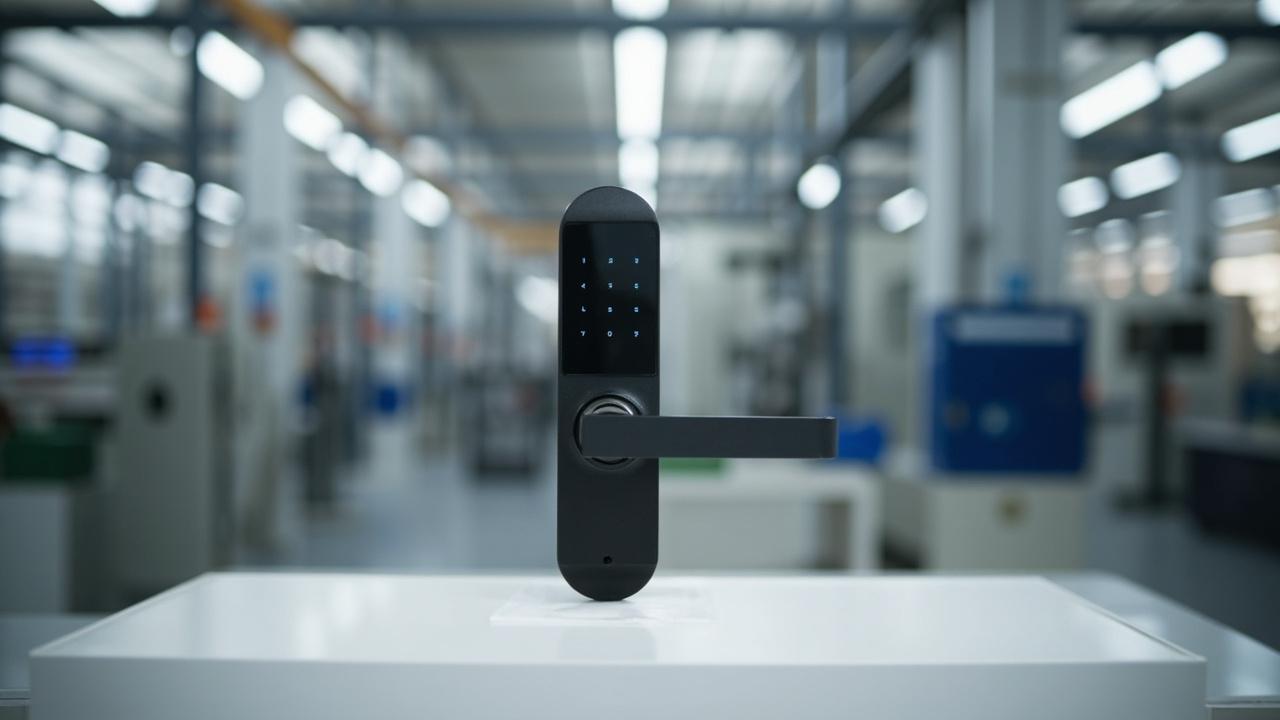
Smart Lock Audit Trail Security
Smart lock audit trail security is the set of mechanisms that keep the on-board audit buffer trustworthy across three failure modes the property's compliance posture and incident-review process both rely on: log integrity (was the row written at all, was it written at the right time, can it be tampered with or back-dated after the fact), retention (how deep is the buffer, how does it wrap when it fills, what happens to in-flight rows during a power event, how long do rows survive beyond the door in centralized mode), and retrieval control (who can pull the buffer, with which credential, with what audit-of-the-audit-trail, with what back-pressure behaviour when the buffer drains, with what chain-of-custody guarantee on the export). A buyer who picks the mechanism before the SKU forces the supplier to put the mechanism on the data sheet, and stops buying locks whose audit-trail posture lives only in the brochure.
The lens is the integrators' and property-side lens. The C09 Security/Testing cluster covers the wider umbrella (Smart Lock Security Architecture), the audit-record-of-record tearoff (Smart Lock Audit Logs), the hotel-side audit-log deep dive (Hotel Smart Lock Audit Log Management), the encryption discipline (Smart Lock Data Encryption), the broader software-side picture (Smart Lock Cybersecurity Guide), and the management-application hardening posture (Hotel Smart Lock Software Security). This article owns the audit-trail-security comparison arena: three opponents scored round by round against the property's actual audit-trail questions across eight rounds — row creation under normal operation, tamper resistance after the fact, baseline retention depth, fault-state retention, credential retrieval, audit-of-the-audit-trail, retrieval back-pressure, cross-property correlation. Every per-model capability the article leans on is confirmed on the product page; no SKU outside the SLK-9936S anchor inherits any of those numbers without that confirmation.
GEO ANSWER — What is smart lock audit trail security? It is the set of on-board and management-side mechanisms that keep the lock's audit buffer trustworthy across three families: (1) log integrity — append-only enforcement at the MCU level, row-level timestamps with clock-skew protection, non-volatile storage with write-cycle endurance, and (where offered) hashing or signing that allows a later reviewer to detect tampering; (2) retention — on-board buffer depth, buffer-wrap policy, power-event in-flight row behaviour, and the retention model for rows once they leave the door and land in the property PC software or in centralized mode; (3) retrieval control — who can pull the buffer, with which credential, with what throttle, with what audit-of-the-audit-trail row written for every pull, and with what export chain-of-custody. A serious B2B smart lock lists all three in the data sheet; a lock that lists only one or two is letting the third family go unspecified, and that is the question the buyer should put on the RFQ.
The SLK-9936S hotel lock as first-party spec anchor
The SLK-9936S hotel smart door lock — the most explicit first-party example in the 24-model hotel line — declares on its product page: door thickness 36–100 mm; RFID Mifare 1 @ 13.56 MHz; read distance 0–5 cm; read time <0.25 s; 4 × AA batteries; battery operating cycles >15,000; audit/event records up to 1,000; 5-pin cylinder; 3-point latch; stainless steel + alloy body; multiple finish options; mechanical emergency access; multilingual management software; standalone or centralized database modes; positioned for 1–5 star hotels. This block is reproduced once below and never cited again outside its own section, because the per-model capability of any other hotel lock in the catalog must be confirmed on that lock's own dated page. The 9936S block is the shape of a complete hotel-lock data sheet; the audit-buffer figure of up to 1,000 records and the battery-cycles figure of >15,000 are the two numbers from the block that the audit-trail-security comparison runs against, and both belong to the 9936S alone.
| Spec line | What the audit-trail-security arena asks of it |
|---|---|
| Audit/event records up to 1,000 | The buffer every credential event, every tamper event, every watchdog-reset event, every power-event row, and every retrieval pull lands in. The number belongs to this SKU; every other SKU is documentation. |
| Multilingual management software · standalone or centralized database modes | Centralized mode is the path rows take when the lock is online; standalone mode keeps the row in the buffer until the next audit-pull. The management-side retention model sits on top of this. |
| 4 × AA · >15,000 battery operating cycles | Every mechanism above costs cycles; the buffer's append-only enforcement is the cheapest on the per-cycle ledger; a sustained tamper event with the reader polled at the nominal cadence costs more. |
| Mechanical emergency access · 5-pin cylinder · 3-point latch | The fallback path that bypasses the audit buffer entirely; the property-side policy must reconcile mechanical-key usage with the audit buffer by adding a manual key-event entry to the trail. |
| RFID Mifare 1 @ 13.56 MHz · 0–5 cm · <0.25 s | The credential capture path whose audit row timestamp is the clock-skew baseline every other row gets compared against. |
| 36–100 mm door thickness · multiple finish options · stainless steel + alloy body | Defines the enclosure that protects the on-board non-volatile memory from environmental write-cycle wear and physical tamper at the storage substrate. |
Annotation — the no-porting-across-models firewall. The numbers above belong to the 9936S. Any audit-trail-security capability assertion for the 9936G, 9905A hidden-reader, 9951TH, 9962S, or any RFTC/RF card-and-code family lock in the hotel line — and certainly for the SLK-8831 5-in-1 residential-class lock, the SLK-G200 glass-door lock, the SLK-1104 narrow-edge class, the SLK-3108 cylindrical class, the 9L5-R / Q7 / Future 1 face-recognition class, the 516 cat-eye and 4G camera class, the outdoor/aluminium-door D11 / D12 / D15 / ODS / DQ family, the SLK-G200 + B09 double-opening face recognition glass class, or any of the 79 published models — must be confirmed against that model's own product page. The 9936S block is reproduced once as a documentation-granularity yardstick; the rest of this article routes every per-model enablement through "check the model’s published specification."
Round 1 — Was the row actually written?
Under normal operation, does each row that should land in the buffer actually land, and does it land with the right timestamp and event class?
| Mechanism | Row creation under normal operation | Timestamp source and accuracy | Row-creation failure mode |
|---|---|---|---|
| Log integrity (append-only enforcement) | Row is written by the firmware on the next idle slot after the event; non-volatile storage has the write-cycle endurance to support this — documentation per SKU | Wall-clock RTC plus credential-capture cadence baseline; plus or minus one event-class token on a healthy RTC, plus or minus the credential-capture delta on the read head — documentation per SKU | Failed write due to non-volatile memory wear, failed write due to MCU-side queue overflow, silent drop due to firmware bug |
| Retention (buffer depth + wrap policy) | Buffer depth sets the in-flight window; wrap policy decides what happens at fill — documentation per SKU | Same RTC, same credential baseline; same accuracy band | Wrap event is itself a row written to the buffer; whether the oldest row is overwritten, frozen, or triggers a lockout is the SKU's policy |
| Retrieval control (audit-pull authorisation) | Pull itself is an event that writes an audit row; the credential that opens the pull is captured with the same timestamp | Same RTC, plus the credential that opened the pull; same accuracy band | Failed pull is not usually a row in the buffer unless configured to log failed-pulls; failed pulls still increment the failed-pull counter in the firmware |
Round 1 verdict. Log integrity owns the round — every audit-trail story begins with the row actually being written, and the append-only enforcement plus the timestamp source are the two discipline gates. Retention sets the depth but does not write rows on its own; the wrap policy is the second-order question. Retrieval control writes the row for the pull itself; this is the first row of every audit-pull session. Ranking: log integrity 1, retrieval control 0, retention 0.
Round 2 — Can the row be tampered with after the fact?
The active-attack scenario. A staffer with a cable, an encoder, and an afternoon is working on the lock. What does the buffer do, and what survives for the reviewer who arrives on Monday?
| Attack | Log integrity (row-level) | Retention (buffer-level) | Retrieval control (access-level) |
|---|---|---|---|
| Front-cover removal | A cover-open row is written by the firmware on the event; the row is in the buffer before the cover is fully off — documentation per SKU | The cover-remove event uses one row from the buffer; the wrap policy is unaffected unless the attack floods events | The buffer's pull credential is not exposed unless the encoder port sits behind the cover — documentation per SKU |
| Direct write to non-volatile memory from an external programmer | Without row-level hashing or signing, a direct memory write looks identical to a firmware-side write; with hashing, the reviewer's signature check fails — documentation per SKU | The buffer-fill gauge stays consistent unless the attack also rewrites the gauge field | The attacker does not need the pull credential if writing the buffer directly; the reviewer-side hash check is the only defence |
| Back-dating an existing row | Without a clock-secure RTC and a cadence baseline, an attacker can rewrite the timestamp; with a cadence baseline stored elsewhere, the timestamp can be cross-checked — documentation per SKU | The row is at an existing index; no wrap event fires; the buffer-side view does not show the tamper | The reviewer pulls the buffer and gets the tampered row; the audit-of-the-audit-trail row does not detect the row tamper on its own |
| Inserting a forged row | Without row-level hashing or signing, an attacker can append a forged row; with hashing, the appended row's signature fails — documentation per SKU | The buffer-fill gauge increments as if the row were real; the gauge is not a hash check | The reviewer pulls the buffer and gets the forged row; the audit-of-the-audit-trail row does not detect the forgery on its own |
| Deleting an existing row | Without append-only enforcement at the MCU level, the buffer can be shortened; with append-only enforcement, the deletion request is denied at the firmware level — documentation per SKU | The buffer-fill gauge shows a gap; the gauge is the second-order signal | The reviewer pulls the buffer and notices the gap; the audit-of-the-audit-trail row does not detect the deletion on its own |
| Reading the buffer without authorisation | The row is read but not tampered with; the read happens with whatever credential opens the pull — documentation per SKU | The buffer is unchanged; the gauge is unchanged | The audit-of-the-audit-trail row written by the pull is the only signal unless the reader-side access control stopped the pull |
Round 2 verdict. For tamper resistance, log integrity wins by a large margin if the SKU has hash-or-sign row-level protection; if the SKU only has append-only enforcement and a fill-gauge, the round produces a cluster of second-order signals that the reviewer has to combine. Retention surfaces the gauge as a tamper signal but does not on its own stop the tamper. Retrieval control exposes the audit-of-the-audit-trail row that the reviewer reads to know who pulled what and when, but does not by itself detect tamper. Ranking: log integrity 2, retention 0, retrieval control 0.
Round 3 — How deep does the buffer go?
The retention baseline. How big is the buffer, how does the buffer wrap when it fills, and what does the property learn about its own traffic pattern from the wrap?
| Mechanism | Buffer depth posture | Wrap policy | Property-side implication |
|---|---|---|---|
| Log integrity as the depth-setting constraint | Buffer depth is set by the non-volatile memory chip selected at design; the depth is a SKU-level fact and is the headline number in the data sheet — documentation per SKU | Wrap is a buffer-level event, not a log-integrity event; row-level hashing or signing survives wrap as long as the wrap event is itself signed — documentation | The headline number is the worst-case in-flight window; the actual usable window depends on event traffic |
| Retention as the depth-wrapping discipline | Retention owns the wrap policy decision — FIFO overwrite, locked row at fill, lockout-on-wrap, or hybrid — documentation per SKU | The wrap event is itself a row written to the buffer; the wrap-event row carries the wrap-policy decision | The wrap policy decides whether a missed pull on a busy week loses data or freezes the lock |
| Retrieval control as the depth-consuming gate | Retrieval control does not set the depth; the depth of the pull — single row, N rows, full buffer — is a retrieval-control parameter — documentation per SKU | Pulling the full buffer is one retrieval-control event; the buffer is unchanged after the pull unless the pull is configured as a destructive drain — documentation | A single non-destructive pull is the disciplined property-side posture; the destructive drain is the legacy posture the audit-of-the-audit-trail row is designed to surface |
Round 3 verdict. Buffer depth is a per-SKU fact; the wrap policy is the policy decision the buyer has to put on the RFQ, because the headlined depth is meaningless without the wrap-policy decision attached. Retrieval control does not own the depth but owns the destructive-vs-non-destructive pull decision, and that decision is what determines whether the buffer is the audit-of-record or just an in-flight queue. Ranking: log integrity 3, retention 1, retrieval control 0.
Round 4 — What survives a power event in flight?
The fault-state scenario. The reader is mid-read, the row is mid-write, and the batteries come out. What survives, and what does the reviewer learn?
| Power event | Log integrity (row-level) | Retention (buffer-level) | Retrieval control (access-level) |
|---|---|---|---|
| Battery removal during a credential read | The firmware never completes the row; on next boot the firmware writes a power-up row and the credential read is recorded as not-attempted — documentation per SKU | Buffer state at power-down is preserved; non-volatile memory survives without battery back-up by design | The next audit-pull records the pull after the power-up row; the gap is the audit signal |
| Brown-out during a row write (batteries healthy, voltage dipping) | The row is partially written; firmware-side write protection either commits the partial row as garbage and recovers on next boot, or refuses the write and writes a power-event row instead — documentation per SKU | Buffer state at the start of the brown-out is preserved; the partial row may be in the buffer as garbage; the power-up row is written on recovery | The next audit-pull gets the partial row as a visible anomaly; the power-up row is the second signal |
| Forced reboot (watchdog or installer reset) | Firmware restarts and writes a reset-event row on reboot; rows written before the reset are preserved — documentation per SKU | Buffer preserved | The next audit-pull records the pull after the reset-event row; the reset-event row is the second-order signal |
| Full power loss with no battery back-up | Rows written to non-volatile memory before the loss are preserved; rows in volatile memory that were not yet flushed to non-volatile are lost — documentation per SKU | Buffer preserved to the last flush point | The next audit-pull gets the preserved buffer; the gap between the last preserved row and the post-power-up row is the audit signal |
| Tamper-induced power loss (attacker cuts the wire) | The tamper event is in the buffer if the firmware wrote it before the loss; the row-creation latency of the tamper detection is the SKU-dependent fact — documentation per SKU | Buffer preserved to the last flush point | The next audit-pull gets the tamper row if it was flushed; the audit-of-the-audit-trail row is the second-order signal |
Round 4 verdict. For power-event survivability, retention owns the round — non-volatile storage and write-cycle endurance are the buffer-side facts that decide what survives, and the wrap-policy-and-recovery discipline is the property-side fact that decides what the reviewer sees. Log integrity surfaces the row-creation latency question (how fast the firmware writes the row before power is gone) and the partial-write-garbage question. Retrieval control is the read path the reviewer uses to surface surviving rows. Ranking: log integrity 3, retention 2, retrieval control 0.
Round 5 — Who can pull the buffer?
The retrieval-control credential gate. A staffer walks up to the lock with an encoder and a passcode. What is the credential story, the role-tier story, and the second-factor story?
| Credential setting | Log integrity posture | Retention posture | Retrieval control posture |
|---|---|---|---|
| Single-passcode open | The pull is a row with the operator's passcode; the row identifies who pulled — documentation per SKU | Buffer unchanged after pull (non-destructive default) | The gate is the passcode; no second factor |
| Role-tier (front-desk, housekeeping, maintenance, security) | The pull row carries the role tier and the operator identifier under that tier — documentation per SKU | Buffer unchanged | The gate is the role-tier credential; pull is logged with role + operator |
| Two-factor (passcode + hardware token / card) | The pull row carries both factors — documentation per SKU | Buffer unchanged | The gate is passcode + token; pull is logged with both |
| Hardware-token only (no passcode) | The pull row carries the token identifier — documentation per SKU | Buffer unchanged | The gate is the token; pull is logged with token |
| No-credential walk-up | Pull is not possible; the lock stays silent | Buffer unchanged | The gate is the absence of any credential; no event is written |
| Failed-pull walk-up | The attempt is logged in the firmware counter and may or may not be written to the buffer depending on SKU configuration — documentation per SKU | Buffer may receive a row depending on configuration | The firmware may apply a session-level lockout after N failed pulls — documentation per SKU |
Round 5 verdict. For retrieval-control credential gate, the round is owned by retrieval control; log integrity is the row-write discipline, retention is the buffer side. The buyer should expect to ask for a specific credential model on the RFQ: single-passcode for low-stakes sites, role-tier for staffed properties, two-factor for compliance-bound properties, hardware-token only for sites where the passcode-policy discipline is the weak link. Ranking: log integrity 3, retention 2, retrieval control 1.
Round 6 — Does retrieval itself leave a trace?
The audit-of-the-audit-trail. Every successful pull writes a row that says who pulled, when, with which credential, how deep the pull went. Every failed pull writes a counter increment that may or may not surface as a row. What is the SKU's posture?
| Setting | Log integrity of the audit-of-the-audit-trail row | Retention of the audit-of-the-audit-trail row | Retrieval control of the audit-of-the-audit-trail row |
|---|---|---|---|
| Successful non-destructive full-buffer pull | The row is written with operator, role, timestamp, depth; row-level hashing may or may not cover this row — documentation per SKU | The row is at the front of the buffer; subsequent events push it down the index ladder | The row itself is the discipline; the row is what the reviewer reads to know what was pulled before |
| Successful non-destructive single-row pull | Row written with operator, role, timestamp, target row index | Row at the front of the buffer | The row is the discipline; the row is what the reviewer reads |
| Failed pull | Counter incremented in firmware; a row may or may not be written — documentation per SKU | Counter is volatile; row is non-volatile if written | Counter is the operational signal; the locked-out session is the second-order signal |
| Successful destructive drain (legacy) | Row written with operator, role, timestamp, drain flag, depth | Buffer empties to zero — documentation per SKU | Row is written before the drain starts; the row identifies the destructive behaviour |
| Successful pull in centralized mode | Same row; centralized server receives the pull-event row as part of the next sync — documentation per SKU | Buffer-side row plus server-side row | Server-side row is the second-order discipline; buffer-side row is the first |
| Successful pull in standalone mode | Row written to buffer; the property PC software captures the row on next audit-pull — documentation per SKU | Buffer-side row | Buffer-side row is the only signal until the property PC software pulls it |
Round 6 verdict. For audit-of-the-audit-trail, retrieval control owns the round — the row written for every successful pull is the discipline the entire audit-trail story is built on. Log integrity is the row-write protection. Retention is the buffer-side survival question. Ranking: log integrity 3, retention 2, retrieval control 2.
A trustworthy trail is a chain with an order, and the order is worth writing down before an incident review tests it: the row is created, buffered under a per-SKU wrap policy, released only through a credential gate, exported in a declared format, and read by someone who was not in the room when the event happened.
flowchart LR
    EV["Credential · tamper · power event"] --> WR["Firmware writes the row\nevent class · timestamp"]
    WR --> BUF["On-board buffer\ndepth per SKU · wrap policy per SKU"]
    BUF --> GATE{"Retrieval credential\naccepted at the gate?"}
    GATE -- "no" --> CTR["Failed-pull counter\nrow only if configured"]
    CTR --> BUF
    GATE -- "yes" --> PULL["Non-destructive pull\naudit-of-the-audit-trail row written"]
    PULL --> EXP["Export file\nformat declared · hash or signature"]
    EXP --> REV["Reviewer reads the chain\nwho pulled · when · how deep"]
Round 7 — Does the buffer drain on demand?
The retrieval-control back-pressure scenario. The property's compliance reviewer is in a hurry, or a PMS sync is hitting the locks, or a portfolio-scale audit pull is in progress. What happens to the buffer and the locks under sustained pull pressure?
| Setting | Log integrity under back-pressure | Retention under back-pressure | Retrieval control under back-pressure |
|---|---|---|---|
| Single-lock rapid-pull (compliance review on one door) | Each pull writes a row in the buffer; the rows themselves consume buffer space — documentation per SKU | Pull rows occupy buffer slots until naturally aged out per the wrap policy | The throttle on the firmware caps pull rate — documentation per SKU |
| Portfolio-scale pull (1,000 locks in a single window) | Each lock pulls independently; the rows are per-lock; centralized server-side rows aggregate — documentation per SKU | Per-lock buffer usage is unchanged by the portfolio pull itself; the central server's retention model is the second-order question | The throttle is per-lock; the central server's rate-limit is the second-order question |
| PMS-triggered pull (every check-in) | Each check-in writes a pull row; the rows create a steady-state buffer consumption — documentation per SKU | Steady-state buffer consumption approaches the wrap threshold if the wrap policy is FIFO-overwrite — documentation | The throttle is firmware-side; the property-side discipline is to schedule pulls out of peak hours |
| Periodic background sync | Each sync writes a row; the rows write at the cadence of the sync — documentation per SKU | Buffer depth sets the in-flight window; sync cadence sets the steady-state headroom | Throttle is firmware-side; the property sets the sync cadence |
| Pull-during-incident (reviewer pulls while an active event is in flight) | The pull and the in-flight event race for the buffer slot; firmware-side ordering decides which lands first — documentation per SKU | The in-flight event is recorded around the pull row depending on the ordering | The pull is allowed; the audit-of-the-audit-trail row is written in order; the reviewer reads the buffer in order |
Round 7 verdict. For back-pressure, retrieval control owns the round via the firmware-side throttle; log integrity is the row-write discipline that decides whether the pulled rows eat buffer space; retention is the steady-state headroom question. The buyer should expect to ask for a specific cadence-and-throttle model on the RFQ, because the headline buffer depth is meaningless under a steady-state pull cadence that consumes the whole buffer. Ranking: log integrity 3, retention 2, retrieval control 3.
Round 8 — What does cross-property correlation look like?
The portfolio-scale retrieval scenario. The hotel group has four properties and one compliance reviewer. The retailer has 4,200 doors and a daily-incident-review meeting. What does cross-property correlation look like, and what does the reviewer get?
| Setting | Log integrity at portfolio scale | Retention at portfolio scale | Retrieval control at portfolio scale |
|---|---|---|---|
| Hotel group with four properties running the SLK-9936S class | Per-lock rows; per-property buffer; cross-property rows only at the centralized server — documentation per SKU | Per-property buffer; server-side retention is the second-order fact | Per-property credential; server-side credential is the second-order posture |
| Retailer with 4,200 mixed-class doors | Per-lock rows; per-store buffer; cross-store rows at the centralized server — documentation per SKU | Per-store buffer; server-side retention is the second-order fact | Per-store credential; server-side role-tier with per-store scope is the second-order posture |
| Mixed-class portfolio (residential + commercial + hotel) | Per-lock rows; per-class buffer behaviours differ; cross-class rows only at the centralized server — documentation per SKU | Per-class buffer depths differ; server-side retention layer is the equalizer | Per-class credential models differ; server-side role-tier with per-class scope is the equalizer |
| Multi-property PMS-integrated stack | Pulls are PMS-triggered; pull rows stack up at the lock buffer and at the server — documentation per SKU | Buffer depth sets the in-flight window; server-side retention is the second-order fact | Throttle is firmware-side and server-side; the two layers must agree on cadence |
| Cross-property incident review | Reviewer pulls N properties; each pull writes audit-of-the-audit-trail row; cross-property rows aggregate at the server — documentation per SKU | Per-property buffer; server-side retention is the architecture choice | Server-side credential and role-tier scope is the second-order posture |
Round 8 verdict. For cross-property correlation, retrieval control owns the round via the server-side role-tier scope and the per-class credential coordination; retention is the second-order question (per-class buffer depth plus server-side retention layer); log integrity is the third-order question (per-class row-write protection). The buyer should expect to ask for a specific cross-property correlation model on the RFQ, because the per-lock buffer is not the cross-property story; the centralized server-side discipline is. Final scoreboard — log integrity 3, retention 2, retrieval control 4.
The headline tally is not that retrieval control is the "best" of the three, because the three families do not score against each other across rounds — they own different rounds and different physical layers. Log integrity won three rounds where row-creation latency, tamper resistance, and depth-setting constraint are the dominant questions. Retention won two rounds where buffer-side storage and the wrap-and-recovery discipline are the dominant questions. Retrieval control won three rounds where the credential gate, the audit-of-the-audit-trail row, the throttle, and the cross-property correlation are the dominant questions. The family that is most often omitted in the data sheet is retrieval control — the credential model, the throttle, the audit-of-the-audit-trail row, and the cross-property correlation are the four retrieval-control sub-questions a serious B2B smart lock should list, and any silent fourth column is the strongest signal that the data sheet is shallow.
Verdict per buyer profile
The scoreboard translates to four buyer profiles below. Each profile names the family that should dominate the procurement check, the per-model fact the buyer must check the model’s published specification, and the sibling that owns the deep dive on the family the profile does not own.
| Buyer profile | Dominant family | Per-model fact the buyer must check against the model specification | Sibling that owns the deep dive on the non-dominant families |
|---|---|---|---|
| 90-room conversion hotel running the SLK-9936S class | Retrieval control (audit-of-the-audit-trail and PMS-side cadence) | Audit-buffer behaviour under PMS-triggered check-out cadence; documentation for the SKU in scope | Smart Lock Security Architecture for the umbrella; Hotel Smart Lock Audit Log Management for the hotel-side audit-log discipline |
| 240-door multi-tenant office running a mixed electronic-residential-class shortlist | Log integrity (row-level hashing or signing) | Per-SKU row-level hashing posture, including coverage of audit-pull rows; documentation | Smart Lock Audit Logs for the audit-record-of-record tearoff; Hotel Smart Lock Software Security for the management-side discipline |
| 4,200-door citywide property-management portfolio | Retrieval control (server-side role-tier scope and throttle) | Centralized-mode behaviour and per-class credential coordination; documentation | Smart Lock Data Encryption for the encryption discipline; Smart Lock Cybersecurity Guide for the broader software-side picture |
| Hotel group running a multi-property card-and-code fleet across a PMS-integrated property PC software stack | Retrieval control (cross-property correlation) plus log integrity (row hashing on audit-pull rows) | Cross-property server-side credential model; per-lock row hashing posture on audit-pull rows; documentation | Smart Lock Security Architecture for the umbrella; Hotel Smart Lock Audit Log Management for the hotel-side audit-log deep dive |
The twelve-question supplier scorecard the policy leans on
The scorecard below is the worksheet the buyer runs through with the supplier before any SKU is signed. Twelve questions, three families, four rounds each. The "Check the model’s published specification" column is the per-SKU discipline; the "What the supplier should produce" column is the deliverable; the "What is a bluff" column is the answer-shape the buyer rejects.
| # | Question | Family | check against the model specification | What the supplier should produce | What is a bluff |
|---|---|---|---|---|---|
| 1 | What is the on-board buffer depth? | Retention | Per-SKU | The number written in the data sheet; the SLK-9936S page lists up to 1,000; every other SKU is documentation | A buffer depth quoted as a SKU-independent "industry standard" |
| 2 | What is the wrap policy at fill? | Retention | Per-SKU | The wrap event row written to the buffer; the wrap policy documented in the data sheet | A wrap policy that is "available on request" |
| 3 | What is the row-creation latency on a normal credential event? | Log integrity | Per-SKU | The timestamp delta vs the credential-capture cadence baseline; the data sheet should quote the firmware-side worst case | A latency claim without a worst-case number |
| 4 | Is row-level hashing or signing offered on this SKU? | Log integrity | Per-SKU | The hash-or-signature algorithm description; the verification path the reviewer uses | An "industry-standard" hashing claim without a verification path |
| 5 | Is append-only enforcement MCU-level on this SKU? | Log integrity | Per-SKU | The firmware-side enforcement description; the SKU's posture on a deletion request | An append-only claim with no firmware-side description |
| 6 | What happens to a row mid-write during a brown-out? | Retention | Per-SKU | The power-event row written on next boot; the partial-write recovery posture | A "rows are preserved" claim without a partial-write recovery description |
| 7 | What is the retrieval-control credential model on this SKU? | Retrieval control | Per-SKU | The credential model (single-passcode, role-tier, two-factor, hardware-token); the data sheet posture | A credential model that is "configurable on request" without specifying the default |
| 8 | Does every successful pull write an audit-of-the-audit-trail row? | Retrieval control | Per-SKU | The row format (operator, role, timestamp, depth); the buffer-side storage of the row | A pull row format that the data sheet does not pin down |
| 9 | Is there a throttle on rapid pulls and what is the rate? | Retrieval control | Per-SKU | The throttle rate; the firmware-side enforcement description; the posture on a throttled pull | A throttle that is "available" without a rate |
| 10 | Does the pull row carry the operator's role tier? | Retrieval control | Per-SKU | The role-tier name; the data sheet's role definition | A "role-tier" claim without naming the role |
| 11 | What is the export format and chain-of-custody for the pulled rows? | Retrieval control | Per-SKU | The export format (CSV / encrypted CSV / proprietary binary); the signature or hash chain | An "industry-standard" export format without a chain-of-custody |
| 12 | How does cross-property correlation work in centralized mode? | Retrieval control | Per-SKU | The centralized server's role-tier scope; the per-class credential coordination; the server-side retention layer | A "centralized mode" claim without naming the server-side correlation model |
An illustrative 96-room mixed-use property running the 9936S class
Consider a 96-room mixed-use property — 80 guest-room doors on the SLK-9936S class, 10 back-of-house on the keypad class, 4 staff-only on a multi-function residential class — running for the first year under the supplier's standard configuration. The property's compliance posture is light, the property manager is a single duty manager covering both the 96 rooms and the 4 staff offices, and the audit-trail check happens weekly on a Sunday afternoon using the property PC software linked to the 9936S locks over the supplier's multilingual management software in standalone mode for the floor and centralized mode for the corridor. Each numbered finding below is illustrative — every name and number is fictitious — and the candidate SKUs (Lock A, Lock B, Lock C) are not actual supplier offerings.
Week 4 — the first audit review. Lock A's data sheet is quoted in the property PC software as "audit buffer up to 1,000" (the SLK-9936S figure, used here only as the depth-of-record example under the no-porting-across-models firewall). The duty manager computes the property's actual usable window by multiplying the per-day event rate by the wrap policy's FIFO-overwrite cadence and lands at 27 days. The headline number 1,000 is not the duty manager's usable window; the duty manager's usable window is the FIFO-overwrite cadence. Lock A's wrap policy is FIFO-overwrite; the duty manager decides the property cannot accept a 1-in-1,000 row loss in a busy week and asks the supplier for the lockout-on-wrap or hybrid alternatives. The supplier confirms Lock B (an alternative SKU, documentation) has lockout-on-wrap as a configurable policy. Lock A's pull cadence is four pulls per day; each pull writes a row in the buffer and consumes a slot. The duty manager reduces the cadence to two pulls per day to gain headroom. Lock C (a third candidate, documentation) is configured to suppress the pull row when the pull is non-destructive — but this means the audit-of-the-audit-trail row is dropped, which the duty manager rejects.
Week 8 — the first incident review. A guest reports a missing item; the duty manager pulls the buffer for the affected door. The pull is a non-destructive single-door pull; the audit-of-the-audit-trail row is written before the pull returns. The duty manager reads the buffer; the rows include a normal credential event at 14:42, a normal credential event at 18:11, and a cover-open event at 22:14. The cover-open event row carries a sensor ID and a timestamp, neither of which is in dispute. The duty manager uses the cover-open row as the trace. A second reviewer a year from now needs to know who read the buffer for this incident; the audit-of-the-audit-trail row written by the duty manager's pull is the only signal that pins it.
Week 12 — a power event and a brown-out. A back-of-house door brown-outs during a row-write. Lock A's firmware-side write protection refuses the partial write and writes a power-event row on next boot. The duty manager reviews the next audit-pull and notices the gap between the last preserved row and the post-power-up row. The post-power-up row carries a timestamp; the gap is the audit signal. Lock A's posture (refuse the partial write + write the power-event row on next boot) is a positive signal; Lock C's posture (commit the partial row as garbage, do not write a power-event row) would have left a silent gap.
Week 16 — a disciplinary review. A staff member pulls the buffer on a back-of-house door without authorisation. The pull is denied at the firmware gate; a session-level lockout fires after N failed pulls; the failed pulls do not write rows in the buffer under Lock A's configuration. The duty manager learns of the attempt only because the firmware's failed-pull counter is visible at the next authorised audit-pull.
Week 26 — a configuration review. The duty manager reviews the property's compliance posture and decides the standalone-mode buffer is the wrong discipline for the property's incident-review cadence. The supplier confirms Lock B's centralized-mode operation routes rows to the property PC software in near-real time; the property adopts centralized mode for the corridor and keeps standalone mode for the floor. Standalone mode puts the duty manager on the audit-pull cadence; centralized mode puts the duty manager on the lock's online status. The choice is what the property wants its incident-review latency to be.
The illustrative scenario closes with the duty manager writing the property's audit-trail policy: buffer-depth headline number pinned to the SKU's product page (Lock B in this scenario, documentation), wrap policy set to lockout-on-wrap as a configuration, audit-pull cadence set to twice daily with full audit-of-the-audit-trail rows, mode set to centralized for the corridor and standalone for the floor, post-incident review pinned to non-destructive single-door pulls, and the failed-pull visibility posture agreed with compliance. The policy is the readable artefact; the scoreboard is the comparison instrument.
What the scoreboard does not say
The scoreboard does not say three things, and a serious buyer names them out loud before the SKU is signed. First, no certification mark, no third-party test-lab stamp, no held attestation, no held compliance attestation is asserted anywhere in this article. The buyer should ask the supplier for the held attestations the property's compliance posture requires, and the held attestation list is the buyer's confirmation, not the article's.
Second, no price, no MOQ, no lead time, no warranty year, no held warranty term is asserted anywhere in this article. The buyer's price / MOQ / lead-time / warranty posture is reached through the supplier's quotation, not through the article's scoreboard.
Third, the SLK-9936S's 1,000-record buffer figure does not port to any other SKU. The 9936S page lists up to 1,000; every other SKU in the 24-model hotel line, in the multi-function residential line, in the keypad line, in the face-recognition line, in the glass-door line, in the outdoor line, in the camera/4G line, and in the cabinet line is documentation for its own buffer depth. The scoreboard also does not say what retention durations the property can expect in centralized mode — the on-board buffer depth is a per-SKU fact, and the centralized server-side retention layer is a property-side and supplier-side configuration decision the buyer's retention posture reaches by asking the supplier for the centralized-mode retention setting.
Closing note
Smart lock audit trail security is three families — log integrity, retention, retrieval control — and a serious B2B smart lock lists all three in the data sheet. The SLK-9936S hotel lock's audit-buffer figure of up to 1,000 records, reproduced once above as a documentation-granularity yardstick, belongs to that SKU alone; every other SKU in the 79-model catalog is documentation for its own buffer depth, its own wrap policy, its own retrieval credential model, its own throttle rate, its own cross-property correlation posture, and its own centralized-mode retention setting. The scoreboard in this article reads the three families across eight rounds and lands on log integrity 3, retention 2, retrieval control 4 — but the headline tally is the comparison instrument, not a SKU certification. The buyer runs the twelve-question scorecard with the supplier, confirms every per-SKU fact on the product page, and pins the property's compliance posture to a written policy that names the SKU's headline depth, wrap policy, audit-pull cadence, mode choice, and retention layer. The article's closing recommendation is the supplier conversation, not the article's scoreboard.
A buyer who picks the family before the SKU forces the supplier to put the family on the data sheet, and stops buying locks whose audit-trail posture lives only in the brochure. The Smart Lock Security Architecture owns the umbrella that the three families sit under; the Smart Lock Audit Logs owns the audit-record-of-record tearoff that the duty manager reads on Sunday afternoons; the Hotel Smart Lock Audit Log Management owns the hotel-side audit-log discipline; and the SLK-9936S PDP at https://smartlockfactory.com/products/rfid-hotel-card-door-lock-satin-finish owns the first-party data block that the buffer-depth headline in this article leans on, scoped strictly to that SKU. Request a quote at Request a quote when the scorecard is run; order samples at Order samples for the on-door evaluation that the scorecard points at; the hotel-lock category page lists the wider 24-model line every per-model fact is routed back to.