
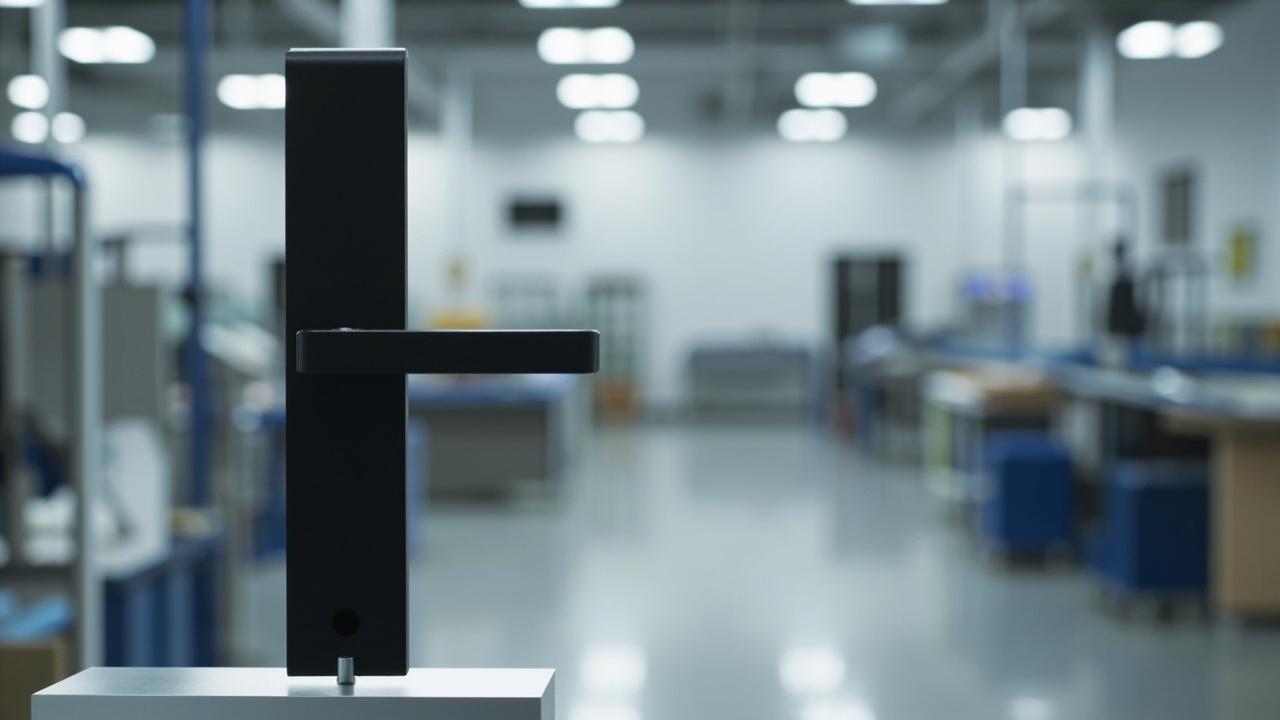
Smart Lock Cycle Testing
Before the transcript opens, the answer that has to come first. Smart lock cycle testing is the disciplined measurement of how many times each wear-bearing surface in a lock — the bolt, the latch, the reader, the motor and clutch, and the battery — can do its job under load before the lock's behaviour stops matching the spec sheet that sold it. It is not one number, it is not one test, and it is not one result.
A buyer who asks "what is the cycle rating of this model?" and gets back a single figure has been handed a brochure headline, not an engineering answer. The honest conversation has at least four separate cycle ratings living inside one lock, each rated independently, each rated on a different axis, and each scoped to a specific model rather than to a brand. In the 79-model catalog carried on smartlockfactory.com, the only first-party product fact that names a cycle number in unambiguous terms is the battery operating cycles >15,000 line on the SLK-9936S hotel lock block. That figure applies to that model, on that spec block, on the battery-axis only. It does not transfer to siblings SLK-9936G, SLK-9905A, SLK-9951TH or SLK-9962S. It does not transfer to residential, keypad, fingerprint, outdoor, glass, face, cabinet or video SKUs. Every other cycle figure for every other shortlisted SKU must be confirmed on the product page before it goes near an RFQ.
What follows is an annotated dialogue. Two voices carry it. Mr. Chen is a lab-test engineer who has run endurance tests on electromechanical locks for twelve years across two certification houses and one factory floor. He thinks in cycles, in duty profiles, in motor-clutch heat-rise envelopes, and in failure-mode catalogues. Ms. Iyer is the supplier's account engineer — the person on the manufacturer side who has to translate what the lab does on a test bench into language a property manager, a hotel GM, or a procurement lead can act on. The dialogue is structured in rounds, each closing with an italicized What's really being said / Verify by annotation that separates the buyer-facing surface from the document the supplier must produce in writing. The discipline is the discipline of the RFQ: every cycle claim either lives on the first-party spec block, or it is a check the model’s published specification line that the supplier must fill in before the order is written.
This article is the cluster test-bench voice for the C09 Security/Testing pillar on SmartLockFactory.com. It sits between the broader architectural lens at Smart Lock Security Architecture and the durability-discussion sibling at Smart Lock Durability Testing, with the environmental-test sibling at Smart Lock Environmental Testing closing the test-bench cluster. It is deliberately distinct from all three: 501 is the threat-by-defense matrix that places cycle testing inside the firmware-and-software compromise row, 533 is the broader durability conversation (mechanical wear, surface finish, fastener retention), and 543 is the environmental conversation (temperature, humidity, salt spray, UV). This article is the narrow lens on the one engineering question buyers ask most often and that brochures answer most loosely: how many cycles, on what axis, at what duty profile, against what failure criterion.
Round 1: "When the brochure says 100,000 cycles, what is actually being cycled?"
Ms. Iyer: The RFQ template the buyer sent over last Tuesday has one cell that asks for a 'cycle rating.' What do I write back?
Mr. Chen: Don't. The first conversation has to be that cycle rating is not a number, it is at least four numbers. There is the mechanical cycle on the bolt and latch, there is the electrical cycle on the battery, there is the reader cycle on the credential read path, and there is the motor-clutch cycle on the engagement mechanism. None of them cycle at the same rate, and none of them fail the same way. A property that buys a lock with a great motor-clutch cycle number and a poor mechanical cycle number will see mortise wear before the electronics fail. A property that buys a lock with a great battery number and a poor reader number will see card-read intermittency long before the batteries die. So the very first thing the buyer needs is a four-row table, one row per wear-bearing surface, one column per shortlisted SKU. Fill the cells that have first-party documentation; mark every other cell check the model’s published specification. That is the floor of the RFQ.
Ms. Iyer: So the buyer's first question to us is "give me four numbers per SKU, not one"?
Mr. Chen: Yes. And those numbers should be tied to a duty profile — cycles per day, cycles per year, expected service life in years — so the buyer can translate them back into a property-side decision. A million-cycle number on a door that is opened three times a day is a fifty-year figure; the same million-cycle number on a hotel guest-room door that is opened twelve times a day is under three years.
What's really being said. "Cycle rating" is an umbrella term covering four engineering axes — mechanical, electrical battery, reader, and motor-clutch. The buyer who treats it as one knob ends up writing an RFQ that names the umbrella and lets the supplier fill in the details, which is how a catalog can sell one strong axis and three weak ones and still print a single large number on the front of a brochure.
Verify by. In writing, ask the supplier for a per-model table of at least four rows — mechanical cycle, battery cycle, reader cycle, motor-clutch cycle — one column per shortlisted SKU, with each cell citing a first-party source or marked check the model’s published specification. Reject any supplier answer that returns a single aggregate number.
| Axis | What is being cycled | What a cycle counts | Typical failure mode | Buyer translation |
|---|---|---|---|---|
| Mechanical | Bolt throw, latch engagement, deadbolt extension, free-rotation handle hub | One full open-close movement under door-spring load and pre-load | Bolt-tip mushrooming, latch engagement shallowness, handle sag, fastener back-out | Door-openings per service life |
| Battery | Cells, voltage regulation circuitry, brown-out detection | One MCU wake + read + drive cycle that draws meaningful current | Capacity loss, voltage sag under load, low-battery false alarms | Battery replacement interval |
| Reader | RFID antenna, optical sensor, fingerprint template match, PIN matrix scanning | One full credential-present event through the read pipeline | Read-distance shrinkage, intermittent reads, sensor contamination, scan latency drift | Credential-present events per service life |
| Motor-clutch | Motor windings, clutch surfaces, gear train, position sensors | One motor engage + drive + return cycle | Stall current rise, clutch slippage, gear-train tooth wear, encoder mis-alignment | Every credential-present cycle, including refused attempts |
Read as a hierarchy, the umbrella term unpacks into four axes hanging off one rating — one branch per wear-bearing surface.
classDiagram
    direction LR
    class CycleRating["Cycle rating · not one number but at least four"]
    class Mechanical["Mechanical · bolt throw, latch engagement, deadbolt extension, handle hub"]
    class Battery["Battery · cells, voltage regulation, brown-out detection"]
    class Reader["Reader · RFID antenna, optical sensor, fingerprint template match, PIN matrix"]
    class MotorClutch["Motor-clutch · windings, clutch surfaces, gear train, position sensors"]
    CycleRating <|-- Mechanical
    CycleRating <|-- Battery
    CycleRating <|-- Reader
    CycleRating <|-- MotorClutch
Round 2: "Where does the >15,000 number actually come from?"
Ms. Iyer: The only first-party cycle number the catalog publishes is "battery operating cycles >15,000" on the SLK-9936S hotel lock. What does that figure actually mean, and what does it not mean?
Mr. Chen: Read the spec block line by line. The figure is the battery-cycle axis only. "Battery operating cycles" is a count of how many complete wake / read / lock-actuation power cycles the four AA cells can deliver before the cells drop below the lock's brown-out voltage under normal operating temperature. It says nothing about the mechanical bolt cycles, the reader cycles, or the motor-clutch cycles on the SLK-9936S, and it says nothing at all about any sibling SKU. The figure is published against a specific operating envelope — ambient temperature, load profile, duty cycle, cell chemistry — and the envelope assumptions are the part the supplier must publish alongside the figure.
Ms. Iyer: So the >15,000 figure is honest only if paired with the envelope. What would you want the envelope to look like in writing?
Mr. Chen: Five fields, minimum. Cell chemistry and cell brand class (the buyer does not need the brand, but the supplier should name whether the rating is on alkaline, lithium-iron, or rechargeable NiMH). Temperature window in degrees Celsius, both ends. Load profile in milliamps during motor drive. Duty cycle expressed as cycles per hour with a defined rest interval between cycles. And a pass criterion — did the lock successfully complete the unlock drive on the final cycle, or did it merely register the wake event?
What's really being said. The >15,000 number is an axis-specific figure, not a universal service-life figure. The figure lives in the right column only when the envelope it was rated against is published in the same paragraph. Without the envelope, the figure is a marketing label.
Verify by. In writing, the RFQ should require the supplier to publish, alongside any cycle figure: (1) cell chemistry class, (2) ambient temperature window in °C, (3) load profile in mA during drive, (4) duty cycle as cycles/hour with rest interval, (5) pass criterion as the exact end-of-cycle state (e.g., successful unlock drive vs. mere wake). For the SLK-9936S the >15,000 figure stands on the battery operating cycles axis only; it must not appear on the SLK-9936G / 9905A / 9951TH / 9962S product pages and must not be ported to residential, keypad or fingerprint SKUs.
Round 3: "Mechanical cycle rating — what is the bolt actually doing 100,000 times?"
Ms. Iyer: Walk me through the mechanical cycle test. When a buyer sees a mechanical cycle number, what does it actually measure?
Mr. Chen: The bench rig holds the lock to a representative door-leaf simulator — a vertical plate with a representative strike, a representative door-spring pre-load, and a representative door-mass inertia. A pneumatic or motor-driven actuator drives the lock through one full open-close cycle: latch retract, deadbolt extend, latch extend, deadbolt retract, all under the pre-load. Every rated cycle means the bolt fully engaged on both sides of the cycle, not a half-throw. The bench records the force profile and the position profile, and looks for three signatures: bolt-tip mushrooming (the tip spreading past spec, which prevents the bolt from seating cleanly), latch engagement shallowness (the latch not extending fully into the strike under pre-load, which raises the entry attack surface), and fastener back-out (the mortise screws loosening under repeated shock load).
Ms. Iyer: What numbers does a buyer see on a typical product page, and what should the buyer demand beyond the number?
Mr. Chen: The number is the easy part. Most reputable product pages publish a mechanical cycle rating of 100,000 to 500,000 cycles — the variation across the industry is wide because the test method is not standardized. The harder question is what the bench attached for a representative door. Door-spring pre-load varies from 10 N on a light interior door to 50 N on a commercial entry door. Pre-load selection changes the failure mode and the cycle count. So the buyer should demand, in writing, the door-spring pre-load in newtons, the door-mass inertia in kilograms, and the bolt-tip tolerance class that the bench is checking against at the end of the test. None of these are usually published. They have to be asked for.
What's really being said. A mechanical cycle number on a product page is the easy half of the picture. The test method — door-spring pre-load, door-mass inertia, bolt-tip tolerance — is the half that determines whether the figure survives the door it actually meets on site. A high cycle number on the bench, tested against a 10 N pre-load, is a soft figure on a commercial door with a 50 N pre-load.
Verify by. In writing, ask for three fields beside any mechanical cycle number: (1) door-spring pre-load in N, (2) door-mass inertia in kg, (3) bolt-tip tolerance class checked at end of test. Demand also that at least one representative door-sag angle (1° to 3°) be in the bench envelope; door sag is the field condition most often missed on the bench.
| Test parameter | Bench setting | Property-side reality | Mismatch risk |
|---|---|---|---|
| Door-spring pre-load | 10 N / 30 N / 50 N | Hotel guest-room doors typically 25–40 N; commercial entry doors 40–60 N | Low bench pre-load inflates cycle count |
| Door-mass inertia | 25 kg / 40 kg / 60 kg | Hollow-core residential 15–25 kg; solid-core commercial 40–80 kg | Low bench inertia understates shock load on motor |
| Bolt-tip tolerance | Class A <0.1 mm / Class B <0.2 mm | Field sag typically drives 0.2–0.4 mm within two years | Tight bench tolerance hides in-service mushrooming |
| Door-sag angle | 0° / 1° / 3° | Hotel guest-room doors often 1°–2° after year one | Bench zero-sag misses the field latch-engagement problem |
Round 4: "Battery cycle rating — how do you actually run 15,001 cycles?"
Ms. Iyer: Battery cycle is the easiest axis to overstate. If a buyer is told the lock runs >15,000 battery cycles, what's actually happening on the bench?
Mr. Chen: The bench holds the lock at a clamped ambient temperature — typically 25°C for the room-temperature rating, with hot and cold envelope runs at 0°C and 50°C as a separate test. Fresh cells are loaded; the bench then drives the lock through a defined cycle: wake on credential present, credential read, motor drive, lock actuation, sleep. Between cycles the bench enforces a rest interval that approximates the field interval between openings — typically a few seconds to a few minutes, depending on how the supplier designed the test. The bench monitors cell voltage under load and motor current. End-of-cycle is the cell voltage dropping below the brown-out threshold during a drive event, or the lock failing to release. The figure published is the cycle at which the lock successfully completed the last full actuation.
Ms. Iyer: What does the buyer not see in that figure?
Mr. Chen: Three things. First, the brand and chemistry of the test cell. A test on premium alkaline gives a very different result from a test on commodity zinc-carbon. The buyer should demand, in writing, the cell chemistry class on which the figure is based. Second, the cold and hot envelope runs; a battery cycle figure rated only at 25°C is meaningless for an outdoor or unheated-stairwell deployment. Third, the cell-voltage sag under motor stall — a lock that passes the cycle count but suffers a meaningful voltage sag on cold mornings will produce low-battery false alarms in the field long before the cells are actually depleted.
What's really being said. Battery cycle figures are sensitive to four envelope assumptions — cell chemistry, ambient temperature window, motor-load profile, and brown-out threshold — and none of those assumptions is usually published. The >15,000 figure on the SLK-9936S spec block is honest only if its envelope is named in the same paragraph.
Verify by. In writing, ask for: (1) cell chemistry class (alkaline / lithium / NiMH), (2) ambient temperature window in °C across the whole test, (3) motor-load profile in mA during stall, (4) brown-out voltage threshold in V, (5) cell-voltage sag profile under the worst-case duty. Reject any answer that publishes a battery cycle figure without naming the chemistry class.
Round 5: "Reader cycle rating — what wears out on the read path?"
Ms. Iyer: Reader cycles — those don't usually appear on the data sheet at all. Why does the buyer need a number here?
Mr. Chen: Because the read path has the most field-failure modes that buyers actually see in year two to year four. For an RFID reader, the bench cycles a representative credential tag against the reader at a defined read distance and a defined orientation. End-of-life signatures are read-distance shrinkage (the reader's effective read envelope pulling in from 5 cm to 3 cm to 2 cm, which is the field symptom of antenna impedance drift or seal contamination), scan latency creep (the read time drifting from the published <0.25 s spec — and yes, the SLK-9936S spec block publishes <0.25 s, scoped to that model only), and intermittent reads that scale up over time. For a fingerprint reader, the bench cycles a representative fingerprint template through the sensor with a defined false-rejection rate target, and looks for sensor-surface contamination that reduces the match rate. For a keypad reader, the bench cycles a representative sequence of PIN entries with a defined debounce and a defined inter-key interval, and looks for matrix wear and contact bounce.
Ms. Iyer: What does the field story look like when the bench number is wrong?
Mr. Chen: A hotel where the bench rating was set at 200,000 read cycles but the door sees 25,000 credential presents a year (ten per day over 2,500 doors) sees the readers start failing in year eight to year ten. That is consistent with the warranty expectations of the property and usually does not produce an RFQ conversation. A serviced-apartment property where the bench rating was set against credential-class tags and the property has moved to mobile-key credentials producing hot-spot electromagnetic stress on the antenna sees earlier degradation. A residential property where the keypad sees salt-air exposure and the bench did not include humidity envelope sees keypad matrix failure in year three. The reader-cycle number is never the headline figure, but it is usually the first figure to break in the field.
What's really being said. Reader cycles are the most field-failure-prone axis and the least documented. A product page that omits a reader-cycle figure is asking the buyer to assume the figure is high; the buyer should not assume that.
Verify by. In writing, ask for: (1) credential type cycled (Mifare 1 / Mifare DESFire / fingerprint template / PIN sequence), (2) representative read distance / sensor class / matrix class used on the bench, (3) read latency envelope at end of test, (4) intermittent-read threshold (X% of cycles pass / Y% fail) at end of test. For RFID SKUs, ask whether the bench envelope included mobile-key credential exposure, which is the fastest-growing site-condition buyer is seeing in the field.
| Reader type | Cycle count target | Field degradation signature | Where the bench envelope usually understates reality |
|---|---|---|---|
| RFID Mifare 13.56 MHz | 200,000–1,000,000 credentials | Read-distance shrinkage, intermittent reads | No mobile-key or EM-stress envelope |
| Optical fingerprint | 200,000–500,000 touches | Sensor surface contamination, FAR drift | No humidity or salt-air envelope |
| Capacitive fingerprint | 500,000–1,000,000 touches | Match-rate drift after surface wear | No abrasion-tape envelope |
| PIN keypad | 1,000,000–5,000,000 entries | Key-cap wear, matrix intermittent bounce | No humidity / sweat / chemical exposure envelope |
The 13.56 MHz number, the 0–5 cm read distance, and the <0.25 s read time on the SLK-9936S block are scoped to that model. They do not travel to siblings SLK-9936G / 9905A / 9951TH / 9962S, and they do not travel to keypad, fingerprint, Bluetooth, or face SKUs. The honest move is verified in writing on the product page, every time.
Round 6: "Motor-clutch cycle rating — the axis the brochure never publishes"
Ms. Iyer: Motor-clutch cycle rating is the one I almost never see in product literature. Why is it missing, and why does the buyer need it?
Mr. Chen: Because it is the axis that determines whether the lock survives a real-world property. Every credential-present event — successful or refused — drives the motor and engages the clutch. The bench test is therefore identical in cycle count to the reader cycle count, but the failure modes are completely different. The bench looks for: motor stall current rising above the published envelope (which raises cell drain even on successful unlocks), clutch slip (which produces an audible and tactile half-engagement that the property interprets as a fault), gear-train tooth wear (which produces a wear-pattern-specific noise as the lock ages), and encoder misalignment (which produces an unlock event that does not correctly register the latch position into the audit log).
Ms. Iyer: Why does the brochure keep this number off the page?
Mr. Chen: Two reasons that are honest and one that is not. The honest reasons are that the bench method varies and the failure criteria vary, so a single figure is hard to defend. The dishonest reason is that the motor-clutch axis is the one where inferior components show up fastest, so a buyer who demands a motor-clutch cycle figure is asking the supplier to publish evidence of an axis where the supplier's BOM choices show. The bench-test rig costs real money, and the result has to be defended in front of a procurement lead who is going to write the number into the RFQ. That is not a conversation every supplier wants to have.
What's really being said. Motor-clutch cycle rating is the hidden axis of cycle testing, and the one where BOM quality shows. A product page that does not name a motor-clutch cycle figure is hiding an axis, not optimizing a page.
Verify by. In writing, ask for: (1) motor stall current envelope in mA, (2) clutch engagement duty (full engage / half engage / refused) that the bench cycles, (3) gear-train material class (metal powder metallurgy / sintered / machined — the buyer does not need the brand, but the class matters), (4) end-of-test pass criterion (full successful actuation vs. wake event only). For the SLK-9936S the catalogue block does not publish a motor-clutch cycle figure; the supplier's per-model documentation is the only honest source. Check the model’s published specification.
Round 7: "Duty profile — how do cycles per day translate into service life?"
Ms. Iyer: Buyers always ask the same follow-up: "How long will the lock last?" How do we translate a cycle figure into a service-life figure honestly?
Mr. Chen: Translation requires four inputs, all named in writing. First, the cycle number on the spec block. Second, the cycles-per-day assumption at the deployment site. Third, the operating days per year (a hotel guest-room door is 365; a residential door that sees weekend use only might be 100). Fourth, the derating factor the buyer applies between bench and field — bench envelopes almost never match field envelopes exactly, and a typical honest derating is 0.5 to 0.7 of the bench figure. Without the derating, the translation is a brochure line; with the derating, the translation is a forecasting tool. The fourth input is the one most suppliers will not publish, because it draws a line between bench reality and field reality and the supplier would prefer the buyer not to see the line.
Ms. Iyer: So if the SLK-9936S block names >15,000 battery cycles and a hotel guest-room door is on ten cycles per day, 365 days a year, with a 0.6 derating, what's the service-life figure?
Mr. Chen: 15,000 ÷ 10 ÷ 365 × 0.6 = 2.47 years before battery replacement under those assumptions. That is a realistic envelope for a high-traffic hotel door. A residential door at five cycles a day, 365 days a year, with the same 0.6 derating gives >5 years on the same battery cycle rating. The point is not that one figure is the answer; the point is that the answer depends on the four inputs, and every one of those inputs has to be in writing.
What's really being said. Cycle numbers do not, on their own, produce service-life figures. The honest translation is a four-input formula: cycle number ÷ cycles-per-day ÷ operating-days-per-year × derating factor = service-life. Without all four inputs the translation is marketing.
Verify by. On every RFQ line, demand that the translation be written out as: cycle-number ÷ cycles-per-day ÷ operating-days-per-year × derating-factor = service-life. The derating factor is the buyer's call; a reasonable starting point for hotel-class doors is 0.5 to 0.7 of the bench figure. Do not let the supplier present a service-life number without the four inputs that produced it.
| Door class | Cycles/day | Operating days/year | Bench figure ÷ field translation | Honest service-life on the >15,000 SLK-9936S figure |
|---|---|---|---|---|
| Hotel guest-room door | 10 | 365 | (15,000 ÷ 10 ÷ 365) × 0.6 | ~2.5 years to battery replacement |
| Serviced-apartment door | 6 | 365 | (15,000 ÷ 6 ÷ 365) × 0.6 | ~4 years to battery replacement |
| Multi-tenant office entry | 25 | 250 | (15,000 ÷ 25 ÷ 250) × 0.6 | ~1.4 years to battery replacement |
| Residential shared entrance | 12 | 365 | (15,000 ÷ 12 ÷ 365) × 0.6 | ~2 years to battery replacement |
| Classroom door (school) | 8 | 200 | (15,000 ÷ 8 ÷ 200) × 0.6 | ~5.6 years to battery replacement |
| Indoor storage room | 4 | 250 | (15,000 ÷ 4 ÷ 250) × 0.6 | ~8.2 years to battery replacement |
Round 8: "What can the buyer verify in the lab and on the first sample?"
Ms. Iyer: Most buyers can't run a million-cycle bench test in their office. What can a buyer's own engineer or third-party lab verify, on the first sample, at a realistic cost?
Mr. Chen: Three things, each useful, none of which requires a million-cycle rig. First, an abbreviated cycle test on the bench — 1,000 to 5,000 cycles under controlled door-spring pre-load and door-mass. That sample size catches the early-failure modes (Bolt-tip mushrooming within the first hundred cycles is a manufacturing defect; fastener back-out within the first thousand cycles is a design defect). Second, a cold-start test — drop the lock to 0°C for four hours, then drive a single full actuation, and capture the stall current on the oscilloscope. That one-shot test catches voltage sag and brown-out behaviour the bench envelope may have averaged away. Third, an orientation test — install the lock on a representative door at the spec'd handedness, then run a single credential-present cycle from a representative read distance and orientation. That sample catches read-distance shrinkage on the first card-tap.
Ms. Iyer: What evidence should the buyer demand on the lab side that the supplier has produced for them?
Mr. Chen: Three artefacts. The bench-test report — duty profile, pre-load, inertia, temperature window, pass criterion. The end-of-test photos — bolt-tip, latch engagement, fastener torque. And the raw data — at least one cycle-stamp showing force profile and position profile, so the buyer can see whether the bench envelope was steady across the full cycle count. Brochures usually publish a summary; the buyer's RFQ should require the bench report and the end-of-test photos in writing.
What's really being said. First-sample cycle testing is a 5,000-cycle abbreviated test, a cold-start one-shot, and an orientation one-shot. None of these require a million-cycle rig; all three catch the most common early-failure modes. The buyer's lab spend is small; the buyer's RFQ demand on the supplier's bench artefacts is the bigger lever.
Verify by. On every shortlisted SKU, run or commission three first-sample tests: (1) 5,000-cycle abbreviated mechanical test under documented pre-load, (2) cold-start 0°C one-shot with stall-current capture, (3) orientation credential-present test from the documented read distance. In writing, also require the supplier to publish the bench report, end-of-test photos, and at least one force-profile / position-profile trace.
Round 9: "What about the catalog models that publish no cycle number at all?"
Ms. Iyer: Most of the catalog — every SKU outside the SLK-9936S spec block — doesn't have a published cycle figure. What does the buyer do when the catalogue is silent?
Mr. Chen: Treat silence as a check the model’s published specification line, full stop. Do not assume silence means "high." Silence can mean "bench test was not run," "bench test was run but the result did not survive review," "bench test was run but the methodology varies from a comparable competitor figure and the supplier does not want to publish a number it cannot defend," or "the supplier chose to spend the engineering-effort budget on a different axis." None of these are the buyer's concern; all of them are the buyer's risk. The buyer's only honest position is that a catalogue that does not name a cycle figure is asking the buyer to either accept an unknown cycle rating or to commission the bench test themselves.
Ms. Iyer: And the Sibling SKUs — SLK-9936G, SLK-9905A, SLK-9951TH, SLK-9962S — they sit in the same family. Can the buyer infer from the SLK-9936S figure?
Mr. Chen: No. Each of those siblings has its own lock body, its own motor-clutch, its own reader module, and its own envelope. The fact that they sit in the same hotel-line family means they share styling and management-software conventions; it does not mean they share cycle ratings. A buyer who infers from one SKU to the others will write an RFQ whose service-life estimate is wrong on three of the four shortlisted SKUs. The honest move is the same on every sibling SKU: check the model’s published specification.
What's really being said. Catalogue silence on cycle numbers is not a high number; it is an unknown number. The only honest move is verified in writing on the product page, on every SKU outside the SLK-9936S first-party block.
Verify by. Treat any SKU whose product page does not publish a cycle figure as a check the model’s published specification line in the RFQ. Reject any supplier response that infers a cycle number from a sibling SKU in the same family. The SLK-9936S >15,000 battery figure is anchored to that model and to that block; it does not travel.
Round 10: "How does cycle testing sit alongside security testing?"
Ms. Iyer: The cluster pillar at 501 places cycle testing inside the security-architecture view. What's the relationship?
Mr. Chen: Cycle testing is one row of the architecture — the long-term reliability row inside the firmware-and-software-compromise threat. A lock that fails its cycle rating is, in security terms, a lock whose audit log becomes unreliable at year three, whose credential revocation starts missing reads at year four, and whose emergency-access override stops functioning under battery sag at year five. Each of those is a security event in property operations — the audit log gap is a compliance event, the revocation gap is an access-control event, the override failure is a safety event. So cycle testing is not adjacent to security; it is a security control in its own right. The architectural frame at 501 walks this; the durability sibling at 533 walks the broader wear-and-tear conversation; the environmental sibling at 543 walks the cold, hot, humidity and salt-air envelope. This article walks the four-axis cycle rating and the bench method. The four pieces together are the test-bench cluster of the C09 pillar.
Ms. Iyer: So an RFQ that demands a cycle figure but does not demand durability and environmental figures is half an RFQ.
Mr. Chen: Correct. The three test-bench lenses — cycle, durability, environmental — cover the three different time-axes of the lock's life: cycle is operations time (openings × years), durability is calendar time (years in service), environmental is exposure envelope (heat, cold, salt, UV). A buyer who writes all three into the RFQ has a defensible test-bench position; a buyer who writes only one of the three is buying on a brochure.
What's really being said. Cycle testing is one of three test-bench lenses the buyer should write into the RFQ; it sits alongside durability and environmental testing as the three time-axes of the lock's service life. The architectural context is at 501; the cycle-specific drill-down is here; the durability sibling is at 533; the environmental sibling is at 543.
Verify by. In the RFQ, write cycle, durability and environmental testing into three separate lines. Reference the cluster architecture at 501, the cycle drill-down at the article you are reading, the durability sibling at 533, and the environmental sibling at 543. Reject any answer that conflates the three into a single "durability" line.
Round 11: "What should the RFQ actually say?"
Ms. Iyer: Last round. If you were writing the RFQ clause for cycle testing today, what would it look like?
Mr. Chen: Five sub-clauses, each with a check the model’s published specification fallback outside the SLK-9936S documented block. (1) Axis definition. The supplier must publish a four-axis cycle figure per shortlisted SKU — mechanical, battery, reader, motor-clutch. (2) Envelope disclosure. Each figure must be paired with its bench envelope: pre-load, inertia, temperature window, duty cycle, pass criterion. (3) Translation. Each figure must be expressible as a service-life estimate under four declared inputs — cycles-per-day, operating-days-per-year, derating factor, expected service life. (4) First-sample protocol. The supplier must publish the abbreviated-cycle, cold-start and orientation test protocol, and accept a buyer-commissioned first-sample test on the buyer's account. (5) Bench artefacts. The supplier must publish, on request, the bench report, end-of-test photos, and at least one force-profile / position-profile trace from the bench.
Ms. Iyer: And what is the firewall — what must not be in the clause?
Mr. Chen: Three firewalls. No held certification claims — the supplier has not earned any, and the buyer cannot accept what is not evidenced. No invented test durations, pass percentages or failure thresholds — every number is either in the supplier's first-party document or it is check the model’s published specification. No portable cycle figures across SKU siblings — the SLK-9936S >15,000 battery figure stands on that block only.
What's really being said. A defensible RFQ clause on cycle testing is five sub-clauses plus three firewalls. The sub-clauses force the four-axis structure, the envelope disclosure, the service-life translation, the first-sample protocol, and the bench artefacts. The firewalls block certification claims, invented test numbers, and SKU-to-SKU inference.
Verify by. Before the RFQ is sent, the buyer should be able to answer yes to all five sub-clauses and no to all three firewalls for every shortlisted SKU. If yes turns to no on any sub-clause, the figure goes back to check the model’s published specification. If no turns to yes on any firewall, the figure is dropped from the RFQ altogether.
| RFQ sub-clause | What it forces from the supplier | Buyer's fallback if not produced |
|---|---|---|
| Axis definition | Four-axis cycle figure per SKU | Treat figure as not published; route to check the model’s published specification |
| Envelope disclosure | Bench pre-load, inertia, temperature, duty, pass criterion | Reject figure; do not infer envelope from a comparable SKU |
| Translation | Service-life estimate under four declared inputs | Refuse the service-life claim until inputs are named |
| First-sample protocol | Abbreviated-cycle, cold-start, orientation test | Commission the buyer's own abbreviated test on the sample |
| Bench artefacts | Bench report, end-of-test photos, force-position trace | Refuse the figure; no figure without artefacts |
| Firewall 1 | No held certification claims | Drop figure from RFQ |
| Firewall 2 | No invented test numbers | Route to check the model’s published specification |
| Firewall 3 | No portable figures across SKU siblings | Reject inference; demand per-SKU first-party documentation |
Round 12: "Closing the test-bench cluster"
Ms. Iyer: One last question. If the buyer walks away with one operating discipline from this whole conversation, what is it?
Mr. Chen: The discipline is that cycle figures are not headline numbers; they are per-axis numbers, paired with envelopes, and translated against the property. The buyer's operating discipline on every RFQ is the same five-question handshake: (a) which axis is this figure on — mechanical, battery, reader, or motor-clutch? (b) what envelope was it rated against — pre-load, inertia, temperature, duty, pass criterion? (c) what is the service-life translation under declared cycles-per-day, operating-days-per-year and derating factor? (d) what is the first-sample protocol on the buyer's account? (e) what bench artefacts does the supplier publish? Any answer to those five that comes back incomplete goes back to check the model’s published specification. The SLK-9936S >15,000 battery figure on the first-party block is the only catalogue-side documentation on cycle numbers; everything else is honest silence that the buyer converts into a written RFQ line.
Ms. Iyer: And the cluster siblings — 501 architectural matrix, 533 durability testing, 543 environmental testing — are the test-bench views next door.
Mr. Chen: Yes. 501 is the threat-by-defense matrix that places the cycle question inside the firmware-and-software compromise row. 533 is the broader durability conversation, including surface finish, fastener retention, and mortise wear. 543 is the environmental envelope — temperature, humidity, salt spray, UV. The four pieces — this article on cycle testing, 533 on durability, 543 on environmental, 501 as the architectural anchor — are the test-bench cluster of the C09 Security/Testing pillar. A buyer who works all four into the RFQ has a defensible test-bench position; a buyer who works only one is buying on a brochure.
What's really being said. The five-question handshake is the operating discipline. The four-piece cluster — this article, 533, 543, 501 — is the test-bench view of the security pillar. The handshake plus the cluster is the buyer's RFQ position.
Verify by. On every shortlisted SKU, write the five-question handshake into the RFQ. Reference the test-bench cluster: 501 for architecture, the article you are reading for cycle testing, 533 for durability, 543 for environmental. Reject any supplier response that cannot populate the handshake against the per-SKU first-party documentation. The buyer's position is built on the handshake plus the cluster, not on a single cycle number on a brochure.
A note on what this article does not assert. This article does not name any held certification. It does not name any published price, MOQ, lead time, or warranty term. It does not name any specific client, distributor, or property operator. It does not invent a test duration, a failure threshold, or a pass rate beyond the >15,000 battery cycle line on the SLK-9936S first-party spec block, and that line is anchored to that model only. Every cycle figure outside that block is a check the model’s published specification line. The handbook of cluster context — the broader security architecture, the durability drill-down, and the environmental envelope — sits at Smart Lock Security Architecture, Smart Lock Durability Testing, and Smart Lock Environmental Testing. The supplier's per-model product page is the document the buyer resolves every check the model’s published specification line against, in writing, before the order is signed.
Closing CTA. Cycle testing is not a brochure figure; it is a four-axis per-SKU envelope that the buyer's RFQ has to write against. For a project-specific RFQ that names the four axes, the envelope disclosure, the service-life translation, the first-sample protocol, and the bench artefacts on every shortlisted SKU, the next step is the request-a-quote page, with the order-samples page as the secondary route for buyers who want a first-sample 5,000-cycle, cold-start and orientation test on their own rig before the procurement is committed. The cluster's architectural and test-bench context sits at Smart Lock Security Architecture, Smart Lock Durability Testing, and Smart Lock Environmental Testing; the catalog-side specification of the SLK-9936S hotel lock is at Keypad Hotel Smart Door Lock; the broader hotel-class specification family is at RFID Hotel Card Lock; and the manufacturer's process and quality discipline is at Smart lock manufacturer.