
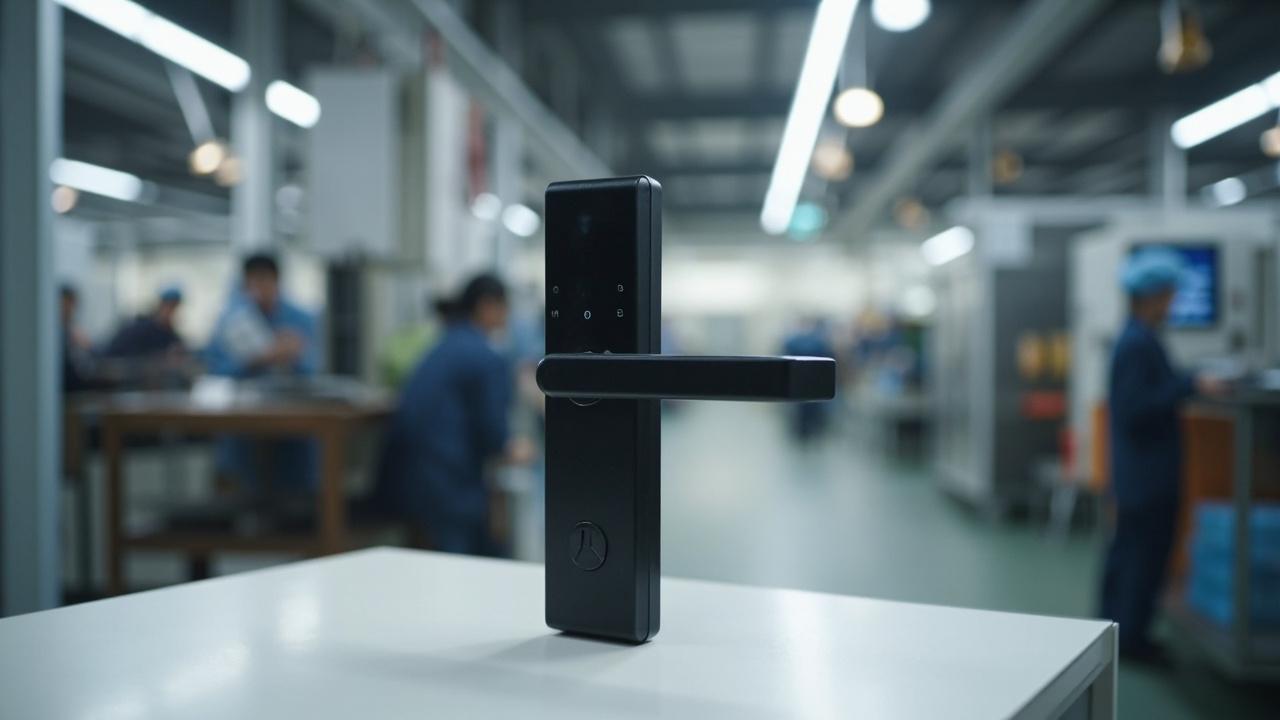
Digital Smart Lock Price Guide — Briefing Memo
MEMOTO: Procurement Manager / Importer / Distributor evaluating a digital smart lock programFROM: SmartLockFactory commercial deskRE: Digital smart lock price-structure briefing — what moves the cost build, what must be confirmed in writing per SKU, and what a published "digital smart lock price" actually meansDATE: October 2026DISTRIBUTION: RFQ evaluation, digital keypad / RFID / PIN-only SKU sourcing, distributor replenishment, private-label digital lock program
Executive Summary
A "digital smart lock price guide" is not a price list. It is the factor-by-factor description of which inputs the factory uses to assemble the offer-letter number on a digital-keypad, RFID-card, PIN-code or app-connected digital lock — and which of those inputs is a structural feature of the buyer's program (volume band, configuration band, finish mix, software bundle, channel services) versus a per-deal figure (per-unit price band, MOQ, lead time, payment terms, warranty scope, certificate coverage, returns window) that must be confirmed against the dated written offer letter on every order.
The nine structural factors that move a digital smart lock cost build, in order of typical weight on the offer letter, are: (1) credential stack (keypad-only PIN vs keypad + RFID card vs keypad + RFID + app/Bluetooth vs keypad + biometric add-on); (2) keypad and display tier (mechanical keypad, illuminated keypad, capacitive touch keypad, OLED-display front, touchscreen front); (3) body material and finish family (zinc alloy vs stainless steel vs stainless + alloy combinations, finish mix across the catalog's PO options); (5) lock-grade mechanics (mortise vs cylindrical, latch class, cylinder class, free-rotation handle, anti-pick provisions); (6) software bundle (standalone firmware vs multilingual management software vs standalone-or-centralized database mode, encoder scope, app protocol TTLock / Tuya / Doodle / hotel PC software); (7) order volume band and configuration band (single SKU vs multi-SKU across the digital category); (8) channel-side services (repack, kitting, label-override, version-locking, on-site commissioning scope); (9) documentation and spare-parts commitment (datasheet, install guide, software pack, encoder notes, spare pool sized to digital category wear parts). All nine are scope decisions the buyer can describe in the move itself; the unit price band that falls out of those decisions is a per-deal figure that lives on the supplier's offer letter.
Decision rule:never compare two suppliers' "digital smart lock price" without first checking that both offer letters were built against the same nine-factor scope. Two numbers built against different scopes are not comparable.
This memo is the briefing the buyer reads before the offer letters arrive — so the offer letters are read back against a checklist the buyer has already agreed with internally, not against a checklist the supplier has unilaterally set.
The cluster of C16 price guides that sit beside this one — Smart Lock Factory Price Guide, Smart Lock OEM Price Guide, Smart Lock ODM Price Guide, Hotel Smart Lock Price Guide, Fingerprint Smart Lock Price Guide, How Much Does a Smart Lock Cost?, and the broader wholesale tier ladder in Smart Lock Wholesale Pricing Strategy — each dissect one slice of the same offer-letter anatomy. This guide is the digital-category slice of that anatomy: keypad / PIN / RFID-card / Bluetooth-app / hybrid digital stacks across the digital subset of the 79-model catalog (24 hotel, 18 keypad-door-lock, 9 rfid-door-lock families are the digital-line neighbors — confirm the specific digital count on the dated catalog page).
The terminology distinction the buyer must hold to before reading any price guide: digital (keypad / PIN / RFID-card credential surface, often with app/Bluetooth on the digital subset) is not the same line as electronic (often implies a managed hotel-class credential pipeline with audit trail and encoder); the procurement SOP that splits those two terms into two line items is in Digital Lock vs Electronic Lock, and the broader digital-versus-smart terminology playbook is in Smart Lock vs Digital Door Lock. A buyer who accepts a supplier's conflation of "digital" and "electronic" on the offer letter is comparing two different cost builds under one price line.
How to read this memo
Every numeric that is a per-deal figure on a digital smart lock offer letter is blank by design in this memo. The blanks are not gaps; they are the point. A price guide that publishes per-deal figures is, by definition, no longer a price guide — it is a price list, and a price list on the buyer's screen has already displaced the buyer who was supposed to be the procurement decision-maker.
The reader reads the memo in this order: (i) the nine-factor cost build below — what each factor does to the offer letter and what kind of figure it produces; (ii) the digital-versus-electronic anchor — why the same credential can carry two different price numbers in different model lines; (iii) the per-deal hygiene table — which cells of the offer letter the buyer must read back against the supplier's written quote and not against the supplier's sales pitch; (v) the order-cadence ladder — how the per-deal figures move as the buyer's order cadence moves from sample to container; (vi) the realistic scenario — how a 200-room mid-scale hotel's procurement desk would use the memo to read back two competing offer letters; (vii) the decision rules — the seven bullets to print onto the buyer's procurement wall before the next RFQ goes out.
The nine-factor cost build of a digital smart lock
The cost build of a digital smart lock is the sum of nine inputs the factory assembles into a unit price band on the offer letter. The buyer's job is to describe each input precisely enough that the offer letter the factory returns is comparable to the offer letter a competing factory returns.
Factor 1: Credential stack. The single largest input on most digital smart lock offer letters. A keypad-only PIN lock and a keypad + RFID-card lock and a keypad + RFID + app/Bluetooth lock and a keypad + biometric add-on lock each carry a different credential reader, a different firmware posture, and a different credential-issuance workflow on the buyer's side. The cost build does not average across these; it prices the credential stack the buyer actually ships. App-protocol choices inside the catalog (TTLock / Tuya / Doodle / hotel PC software) further split the build; the buyer describes the protocol as a scope choice, not as a feature.
Decision rule:describe the credential stack before describing the lock. A buyer who describes the lock first and the protocol third ends up with an offer letter priced against the factory's default credential stack, not against the buyer's stated credential stack.
Factor 2: Keypad and display tier. The second largest input on most digital smart lock offer letters, because the keypad and display tier drives both the front-panel cost and the firmware-development cost. A mechanical keypad, an illuminated mechanical keypad, a capacitive touch keypad, an OLED-display front, and a full touchscreen front are five different cost builds. The offer letter should name the tier; the buyer should not accept "standard keypad" because "standard" is the factory's default and not the buyer's default.
Factor 3: Body material and finish family. The third largest input on most offer letters. Zinc alloy and stainless steel and stainless + alloy combinations are three different body cost-builds; within each body class, the finish family (stock finishes vs special-order vs custom-finish lane) further splits the cost. The product-page-documented SLK-9936S anchor in the cluster names multiple finish options as part of the hotel-class spec block — that detail is documented at the model level, not at the catalog level, and the cost build the factory prices against is the finish band the buyer named in the RFQ, not the finish band the supplier assumes.
Factor 4: Lock-grade mechanics. The fourth input. Mortise vs cylindrical, latch class (single-point vs 3-point), cylinder class (5-pin vs higher-pin), free-rotation handle posture, anti-pick and anti-manipulation provisions — each is a mechanical subassembly that the factory either builds or sources, and each subassembly has its own cost line on the offer letter. The SLK-9936S anchor names 5-pin cylinder + 3-point latch + stainless steel + alloy body as part of its hotel-class spec; the buyer's RFQ should name the lock-grade scope it actually needs, and the supplier's offer letter should respond to that scope line by line.
Factor 5: Software bundle. The fifth input and the one most often left as a scope-blur on a digital smart lock offer letter. Standalone firmware (the lock holds its own audit and access list), multilingual management software (the buyer issues credentials from a desktop software layer), standalone-or-centralized database mode (the lock can run standalone on day one and graduate to centralized mode when the property is ready), and the encoder scope (the device the front desk or the buyer uses to write RFID cards or PIN codes) are different software postures and different cost builds. The offer letter should name which software posture the buyer is paying for; the supplier should not be allowed to substitute "with software" for "with the buyer's named software posture."
Decision rule:never accept "with management software" as a software line item. "With management software" is the factory's default software posture; the buyer's named posture (standalone vs multilingual desktop vs standalone-or-centralized vs hotel PC software) is what the offer letter is supposed to be priced against.
Factor 6: Order volume band and configuration band. The sixth input. Single-SKU at sample volumes, multi-SKU at standard wholesale volumes, multi-SKU-multi-finish at framework volumes, full-catalog at OEM-bridge volumes — each rung carries a different per-unit band and a different MOQ posture. The offer letter should name the volume band the buyer is committing to; the supplier's response should price against that band, not against a default wholesale band.
Factor 7: Channel-side services. The seventh input. Repack, kitting, label-override, version-locking, on-site commissioning scope — each is a service the factory either bundles into the unit margin or prices as a per-kit fee. The offer letter should name which services the buyer expects and which are bundled vs fee-bearing. A buyer who never asks the question ends up paying for the services in the unit margin without knowing the services were there.
Factor 9: Documentation and spare-parts commitment. The ninth input. Datasheet, install guide, software pack, encoder notes, spare pool sized to the digital category's common-wear parts — each is a documentation or spare-parts line that the offer letter either names or absorbs into the unit margin. The buyer should name the documentation and spares posture in the RFQ; the supplier should respond to that posture in the offer letter.
Decision rule:the offer letter that responds to a buyer who has not named these nine factors is an offer letter priced against the factory's defaults. Defaults are the factory's procurement convenience, not the buyer's procurement discipline. The buyer names the factors; the supplier prices the scope.
Nine-factor decision matrix — what the buyer names vs what the factory prices
The decision matrix below maps the nine factors against three columns: what kind of figure each factor produces on the offer letter (structural / per-deal / hybrid), what the buyer's RFQ must name to control that figure, and what the supplier's offer letter must respond to in writing. Every row in the matrix is one factor; every column is one procurement discipline. The matrix is the buyer's scorecard against which the supplier's offer letter is read back.
| # | Factor | Kind of figure | What the buyer names in the RFQ | What the offer letter must respond to in writing |
|---|---|---|---|---|
| 1 | Credential stack | Hybrid — structural choice, per-deal price | PIN-only / PIN + RFID / PIN + RFID + app / PIN + biometric add-on; app protocol named (TTLock / Tuya / Doodle / hotel PC software) | Credential reader spec, firmware posture, credential-issuance workflow, app protocol string |
| 2 | Keypad & display tier | Hybrid — structural choice, per-deal price | Mechanical / illuminated / capacitive touch / OLED / touchscreen | Keypad front-panel spec, firmware-development scope |
| 3 | Body material & finish family | Hybrid — structural choice, per-deal price | Zinc alloy / stainless / stainless + alloy; finish band named | Body material string, finish options list, special-order vs custom-finish lane |
| 4 | Lock-grade mechanics | Hybrid — structural choice, per-deal price | Mortise vs cylindrical; latch class; cylinder class; handle posture; anti-pick scope | Mechanical subassembly spec line by line |
| 5 | Software bundle | Hybrid — structural choice, per-deal price | Standalone / multilingual desktop / standalone-or-centralized / hotel PC software; encoder scope | Software posture spec, encoder line item |
| 6 | Volume band & configuration | Hybrid — structural choice, per-deal band | Tier 1 sample / Tier 2 pilot / Tier 3 wholesale / Tier 4 framework / Tier 5 container; SKU mix; finish band | Volume band spec, MOQ posture, configuration band |
| 7 | Channel-side services | Per-deal | Repack / kitting / label-override / version-locking / on-site commissioning | Service line item, bundled vs fee-bearing |
| 8 | Documentation bundle | Per-deal | Datasheet / install guide / software pack / encoder notes / spare pool | Documentation line item, spare-parts commitment |
| 9 | Certification coverage | Per-deal | Per-shipment / per-lot / per-lot + change-control freeze | Cert coverage line item, continuity across releases |
Digital versus electronic — the anchor that protects the offer letter
A digital smart lock and an electronic smart lock are not the same line item on the offer letter, even when the supplier calls them by the same name. The procurement SOP that splits the two terms is in Digital Lock vs Electronic Lock; the terminology anchor is in Smart Lock vs Digital Door Lock. A buyer who accepts a single offer-letter line item labeled "smart lock" without splitting digital from electronic is comparing two different cost builds under one price.
The product-page-documented first-party anchor for the electronic hotel-class side of the cluster sits in SLK-9936S: door thickness 36–100 mm · RFID Mifare 1 @ 13.56 MHz · read distance 0–5 cm · read time <0.25 s · 4 × AA battery · battery operating cycles >15,000 · audit/event records up to 1,000 · 5-pin cylinder · 3-point latch · stainless steel + alloy body · multiple finish options · mechanical emergency access · multilingual management software · standalone or centralized database modes · positioned for 1–5 star hotels. The offer-letter cost-build the cluster prices against this spec block is the kind of cost-build that has a credential stack (Mifare 1 RFID), a software posture (multilingual management software, standalone or centralized), and a hotel-class audit posture (up to 1,000 event records) — three scope choices the buyer must name. The digital-side offer letter, by contrast, prices against a keypad / PIN / RFID stack without the same hotel-class audit posture and without the same software-management posture; the cost builds diverge at the credential-stack and software-bundle rows of the nine-factor ladder.
The single sentence that protects the offer letter: "This line item is for the digital keypad / PIN / RFID stack priced against the nine-factor scope in this RFQ; the electronic hotel-class line item sits on a separate offer-letter row priced against the SLK-9936S anchor scope." Two offer-letter rows, two cost builds, two prices. One row, two cost builds, no price.
Per-deal hygiene table — what the buyer reads back from the offer letter
Every cell in the per-deal hygiene table below is what the buyer reads back against the supplier's dated written quote. Each row is a per-deal figure the supplier owns; each column is the cell on the offer letter the buyer reads back. The cells are blank by design. A buyer who fills the blanks from memory is filling them from the supplier's sales pitch, not from the offer letter.
| Per-deal figure | What it is | What the buyer reads back from the offer letter | What the buyer writes back to the supplier |
|---|---|---|---|
| Per-unit price band | The factory's headline unit number on this SKU + this credential stack + this volume band | The unit number against the exact SKU string and credential stack the buyer named | "Confirm unit number against SKU 'A1' with credential stack 'A2' at volume band 'A3' — quote dated 'A4'" |
| MOQ | The minimum order quantity on this SKU and band | The MOQ against the SKU and the buyer's stated annual cadence | "Confirm MOQ against buyer's annual cadence 'B1' — quote dated 'B2'" |
| Lead-time window | Production + shipping window | The lead-time window against the buyer's named shipping event | "Confirm lead-time against shipping event 'C1' (sea / air / courier) — quote dated 'C2'" |
| Payment terms | Deposit / balance structure | The payment terms against the buyer's stated deposit posture | "Confirm payment terms against deposit posture 'D1' — quote dated 'D2'" |
| Warranty scope | What the warranty covers and for how long | The warranty scope against the buyer's stated channel | "Confirm warranty scope against channel 'E1' (end-user / installer / distributor) — quote dated 'E2'" |
| Certificate coverage | Which certificates travel with which shipped lot | The certificate coverage against the buyer's stated destination market | "Confirm cert coverage against destination 'F1' — quote dated 'F2'" |
| Returns / DOA window | The window in which DOA is returnable | The window against the buyer's stated acceptance protocol | "Confirm DOA window against acceptance protocol 'G1' — quote dated 'G2'" |
| Sample policy on next tier | Whether the sample cost carries forward to production | The sample policy against the buyer's stated Tier-1 acceptance posture | "Confirm sample policy against acceptance posture 'H1' — quote dated 'H2'" |
Decision rule:every blank in the rightmost column of the per-deal hygiene table is a question the buyer writes back to the supplier in writing, with the quote date in the sentence. A verbal answer to any of these questions is not an answer the buyer can rely on at the PO stage.
Order-cadence ladder — how the per-deal figures move as the buyer climbs
The nine-factor cost build does not produce one offer-letter number; it produces a different offer-letter number at each rung of the order-cadence ladder. The buyer describes the rung in the RFQ; the supplier prices the rung in the offer letter. The rung names are standard: Tier 1 sample (single-SKU or matched-pair, single finish family, datasheet-only documentation), Tier 2 small-lot pilot (up to two SKU families, single finish family, datasheet + install guide), Tier 3 standard wholesale (multi-SKU, multi-finish, full project bundle), Tier 4 framework contract (multi-SKU, multi-finish, multi-property, change-control register), Tier 5 container / OEM-bridge (full catalog ladder, OEM-side configuration-string retention). Each rung carries a different per-deal band on the same nine-factor scope.
A buyer who has described the rung correctly in the RFQ receives an offer letter whose per-deal band sits inside the rung-appropriate envelope. A buyer who has not described the rung receives an offer letter whose per-deal band sits inside whatever rung the supplier has defaulted to — which is usually the rung most favorable to the supplier, not the rung the buyer's annual cadence actually sits on. The offer-letter reading-back discipline is the rung discipline: the buyer reads each per-deal band back against the rung the buyer named, not against the rung the supplier assumed.
The order-cadence ladder below shows how each rung moves the offer letter. The blank cells are blank because the per-deal figures at each rung are quote-only figures; the rung names and the scope-name column are the buyer's RFQ inputs.
| Rung | Volume band | SKU mix | Finish band | Documentation bundle | Channel-side services | Per-deal band position |
|---|---|---|---|---|---|---|
| Tier 1 — Sample / evaluation lot | Single-SKU or matched-pair | Single finish family | Stock finishes only | Datasheet only | None | to verify in writing on the dated written offer letter |
| Tier 2 — Small-lot pilot | Up to 2 SKU families | Single finish family | Stock finishes + 1 special-order | Datasheet + install guide | Repack, light reconfiguration | to verify in writing on the dated written offer letter |
| Tier 3 — Standard wholesale | Multi-SKU | Multi-finish | Stock + special-order band | Full project bundle (datasheet + install guide + software pack + encoder notes) | Repack, kitting, label-override, version-locking | to verify in writing on the dated written offer letter |
| Tier 4 — Framework contract | Multi-SKU, multi-property | Multi-finish + reserved-finish hold | Stock + special-order + reserved-finish | Project bundle + change-control register | Repack + kitting + on-site commissioning where contracted | to verify in writing on the dated written offer letter |
| Tier 5 — Container / OEM-bridge | Full catalog ladder across categories | Stock + special-order + reserved-finish + custom-finish lane | Project bundle + factory-side change-control + warranty register | Repack + kitting + commissioning + spare-pool + on-site as contracted | to verify in writing on the dated written offer letter |
Decision rule:name the rung before naming the SKU. A buyer who names the SKU first and the rung third ends up with an offer letter priced against the supplier's default rung for that SKU, not against the buyer's stated rung for that SKU.
The full tier ladder across categories is in Smart Lock Wholesale Pricing Strategy; the OEM-program-channel pricing structure is in Smart Lock OEM Price Guide; the ODM-program-channel pricing structure is in Smart Lock ODM Price Guide; the factory-channel pricing structure is in Smart Lock Factory Price Guide. The digital-category price guide is the digital slice of that cluster — credential stack (keypad / PIN / RFID / Bluetooth app), keypad and display tier, body and finish family, mechanicals, software bundle — across the digital subset of the catalog.
Scenario — reading two competing offer letters for a 200-room mid-scale hotel's digital lock refit
Consider a 200-room mid-scale hotel group operating three properties in the same ownership that wants to refit its digital lock program from a legacy PIN-only stack to a PIN + RFID + multilingual management software stack across two of the three properties. The procurement desk issues the RFQ against the nine-factor scope — credential stack named (PIN + RFID + app/Bluetooth on guest rooms, multilingual management software on back-of-house), keypad and display tier named (illuminated mechanical keypad on guest rooms, capacitive touch keypad on back-of-house), body and finish family named (stainless + alloy, stock finishes + one special-order), lock-grade mechanics named (3-point latch, 5-pin cylinder, free-rotation handle), software bundle named (multilingual management software, standalone-or-centralized database mode, encoder scope named), volume band named (Tier 3 standard wholesale, multi-SKU across the digital subset), channel-side services named (repack, kitting, label-override, no on-site commissioning at this rung), documentation and spares named (full project bundle, common-wear spares pool sized to digital category). The rung (Tier 3) is named in the opening paragraph; the SKU strings are named in the appendix; the nine-factor scope sits between.
Supplier A returns an offer letter priced against the named scope. Supplier B returns an offer letter priced against Supplier B's default digital scope — same SKU family on the offer-letter line, but the credential stack on Supplier B's offer letter is PIN-only (Supplier B's default for the SKU family), the software bundle on Supplier B's offer letter is "with management software" (Supplier B's default), and the channel-side services are absorbed into the unit margin. The two offer letters are not comparable because the two cost builds are not the same. The procurement desk's first move is to write back to Supplier B with the nine-factor scope restated and the rightmost column of the per-deal hygiene table attached; the second move is to wait for Supplier B's revised offer letter before comparing unit numbers.
The supplier that priced against the buyer's named scope is the supplier whose offer letter enters the second round of the RFQ. The supplier that priced against the default scope is the supplier that gets a written scope-correction letter and one more chance. The buyer does not negotiate against a default offer letter; the buyer writes back to the default and asks for a named-scope offer letter.
The same discipline applies at Tier 1 sample (single SKU, datasheet-only documentation) and Tier 4 framework contract (multi-SKU, multi-finish, multi-property, change-control register). The rung changes; the nine-factor discipline does not.
Decision rules — print these before the next RFQ goes out
- Rule 1 — name the nine factors in the RFQ. Credential stack / keypad-display tier / body and finish family / mechanicals / software bundle / volume band / channel-side services / documentation and spares. A buyer who has not named the nine factors has issued an offer-letter invitation, not an RFQ.
- Rule 2 — name the rung in the RFQ. Tier 1 sample / Tier 2 small-lot pilot / Tier 3 standard wholesale / Tier 4 framework contract / Tier 5 container / OEM-bridge. A buyer who has not named the rung has invited the supplier to choose the rung on the buyer's behalf.
- Rule 3 — split digital from electronic on the offer letter. Two offer-letter rows, two cost builds, two prices. A buyer who accepts one row covering both is comparing two different cost builds under one price.
- Rule 4 — describe the credential stack before describing the lock. PIN vs PIN + RFID vs PIN + RFID + app/Bluetooth vs PIN + biometric add-on. A buyer who describes the lock first has accepted the factory's default credential stack.
- Rule 5 — read every per-deal figure back against the offer letter, not against the sales pitch. Per-unit price band / MOQ / lead time / payment terms / warranty scope / cert coverage / returns-DOA window / sample policy. Every blank in the rightmost column of the per-deal hygiene table is a written-back question with the quote date in the sentence.
- Rule 6 — refuse "with management software" as a software line item. The buyer's named software posture (standalone vs multilingual desktop vs standalone-or-centralized vs hotel PC software) is what the offer letter is supposed to be priced against; the factory's default posture is not.
- Rule 7 — write every per-deal figure against a dated written offer letter. Verbal figures move; written figures stay. The offer letter is the procurement artefact, not the conversation thread.
What this memo is not
This memo is not a published price list. It is the factor-by-factor description of how a digital smart lock cost build is assembled on the supplier's offer letter; the per-deal figures themselves are quote-only figures. Any document that publishes per-deal figures for a digital smart lock — per-unit price band, MOQ threshold, lead-time window, payment terms, warranty years — is publishing, by definition, no longer per-deal figures.
This memo is not a substitute for the dated written offer letter from the supplier. The nine-factor scope the buyer names in the RFQ, the rung the buyer names in the RFQ, the per-deal figures the supplier writes on the offer letter, and the supplier's written answers to the per-deal hygiene table are the only artefacts the buyer's PO can be signed against.
This memo is not a substitute for the supplier-verification protocol the buyer's procurement desk runs before any price conversation. The verification protocol is in Smart Lock Supplier Verification China; the due-diligence checklist is in Content; the factory-audit checklist is in Content; the supplier-comparison sheet is in Smart Lock Supplier Comparison Sheet. The price conversation sits downstream of those four artefacts; it does not sit upstream of them.
This memo is not legal advice on tariff exposure, incoterm allocation, currency-recognition requirements, or destination-market certification requirements. Those are separate workstreams with separate owners and separate artefacts; the offer-letter reading-back discipline in this memo is downstream of those workstreams, not a substitute for them.
Where to send the next move
The next move is the buyer's own nine-factor RFQ. Two paths from here:
Path A — sample path. Send the request-catalog and order-samples requests, receive the catalog and the sample-stage offer letter at Tier 1, walk the catalog against the nine-factor scope, and write the per-deal hygiene table back to the supplier against the Tier-1 offer letter. The sample path costs the buyer the sample-stage per-unit band; the sample path returns to the buyer the supplier's written nine-factor response.
Path B — direct quote path. Send the request-a-quote form against the nine-factor scope at the rung the buyer's annual cadence sits on. The supplier returns the rung-appropriate offer letter; the procurement desk reads the offer letter back against the nine-factor scope and against the rightmost column of the per-deal hygiene table; the per-deal figures are confirmed in writing before the PO is signed.
Both paths land at the same written offer letter. The difference is which rung the buyer arrives at the offer letter from. The sample path arrives at Tier 1; the direct quote path arrives at whatever rung the buyer's RFQ named. Either rung is valid; the buyer's named rung is the rung the offer letter is priced against.
The digital smart lock cost build is the sum of nine factors the buyer names in the RFQ, priced at the rung the buyer names in the RFQ, returned on the supplier's offer letter, and confirmed against the per-deal hygiene table in writing before the PO is signed. A published "digital smart lock price" is not what the buyer is buying; the buyer is buying the dated written offer letter against the named scope. The next move is the buyer's nine-factor RFQ — at request-a-quote. The secondary movement lives in the wholesale tier ladder's fuller description at Smart Lock Wholesale Pricing Strategy, and in the digital-versus-electronic terminology split at Digital Lock vs Electronic Lock and Smart Lock vs Digital Door Lock.