
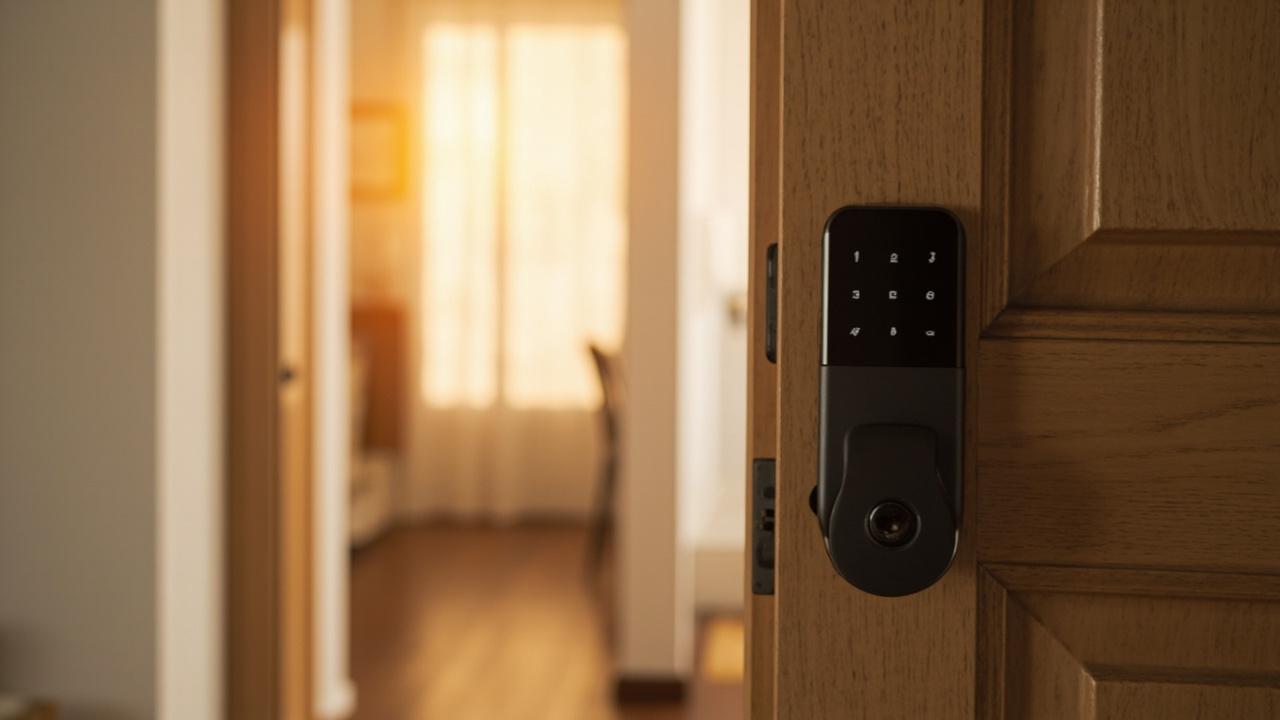
Smart Locks for Airbnb Property Managers
Forty-one units. Twelve owners. Three cleaners who each cover nine doors a day. One contractor who changes his code sharing habit every other month. This is the actual arithmetic a managing company runs, and it is why picking locks for a managed portfolio fails when you pick them the way a single host does.
Short answer: smart locks for Airbnb property managers are standalone electronic door locks selected as a portfolio standard — decided on five operational pillars rather than guest-facing features: a written standardisation policy, a per-owner consent-and-spend process, dedicated credential lanes for cleaners and maintenance, a rehearsed lost-guest-code contingency, and a battery maintenance reality the fleet can actually survive. Connectivity (Bluetooth, app, or keypad-only operation) is a per-product-page question for each model; nothing in this article assumes platform-level integration between the lock and any booking system.
If you operate one home you can make a purchase decision. If you operate forty you make a policy. This article is about the policy. It is the portfolio-scale counterpart to our host-level guide (Smart Locks for Airbnb Hosts); the single-property mechanics of short-term rental access are covered in Smart Locks for Short-Term Rentals, and the broader systems view across residential portfolios in Smart Lock Systems for Property Managers.
The unit is owned, the door is yours: why managing-company logic differs
A host owns the door they bolt a lock onto. A property manager controls a door somebody else owns, often under a management agreement written before smart locks existed. That single difference bends every downstream decision:
- You standardise for procurement, owners diversify for taste. Your ops team services one lock behavior, not four. The moment your portfolio carries more than two lock types, you are paying a hidden tax in training, spares, and diagnostic time.
- Every hardware change is somebody's capital. The lock, the batteries, even the strike plate belong to the owner's cost line. Your consent process is not courtesy; on many contracts it is a legal boundary.
- Your credential population is staff, not guests. Guests pass through. Cleaners, maintenance, and your own admins are the recurring users whose lanes must be engineered.
- A failure is a portfolio event. One guest locked out at 11 p.m. at a single-home operation is a bad night. The same event at forty units under one brand name is a review problem that follows the managing company, not the owner.
From the factory side we see this shape orders: hosts order one or two units and ask what the lock can do. Managing companies — or the distributors who serve them — order the same model repeatedly and ask what happens on door number thirty-seven. The questions are better. Standard finishes, mixed replacement quantities, and repeated orders of one SKU are the fingerprints of an organisation that has decided to run locks like infrastructure.
Pillar 1: the standardisation policy — one lock behavior, written down
Standardisation does not mean one lock for every door. It means one written policy that says which lock classes are approved for which door conditions, so that every future purchase and every replacement lands inside the same envelope. A workable policy has four sentences' worth of content and one table.
The four rules:
- Approved classes, by door condition. Define two or three lock classes maximum (for example: an RFID-plus-code class for standard front doors, a weather-rated class for exterior/aluminum-frame doors, and an exception lane for nonstandard doors). Anything else requires a written exception.
- A fit-first gate. No class is approved until it fits the actual door: thickness, backset, edge profile. Door thickness alone spans a wide range across existing housing stock — the SLK-9936S hotel lock, for instance, is specified for 36–100 mm doors, and the SLK-9905A hidden-reader model covers roughly 38–100 mm. Measure before you standardise, because a standard that fails on the fifth door is not a standard.
- Credential vocabulary fixed by policy. The policy states which credential types exist in your operation — temporary guest codes, cleaner codes, cards for maintenance, mechanical keys held by whom — and forbids inventing new ones unit by unit.
- Connectivity is checked per model, per product page. Whether a given lock is keypad-only, Bluetooth/app-operated (our catalog includes models on TTLock, Tuya, or Doodle ecosystems), or card-and-code only is a product-page fact. The policy records the answer for each approved SKU; it does not generalise across the catalog.
| Policy element | What the document must state | Why it fails at fleet scale if skipped |
|---|---|---|
| Approved classes | Max 2–3 classes mapped to door conditions | Ops learns five lock behaviors; training drifts |
| Fit gate | Thickness/edge measurements required before install | One-off replacements break the standard "just this once" |
| Credential vocabulary | Who gets codes, cards, keys, fingerprints — and who does not | Ad-hoc codes become unauditable; owner disputes follow |
| Connectivity record | Per-SKU note from the product page | Wrong expectation of remote features at install time |
| Exception log | Signed deviation with a review date | Exceptions silently become the real standard |
The honest version of this pillar: standardisation is a discipline your own team will test first. The tech who has used fingerprint locks at his previous employer will push one into unit 14. The policy is what you point at.
Pillar 2: per-owner consent and spend — who actually decides
This is the pillar that separates managing companies from hosts entirely. Ask three questions of every unit before any hardware moves, and write the answers in the unit file:
- Who authorises a lock change? The management agreement, not the guest experience, answers this. Some contracts grant facility decisions up to a threshold; others require sign-off for anything attached to the door.
- Whose capital is it? Lock plus install is either your operating cost (and you amortise it across the fee) or the owner's capital item. That answer changes which lock you can even afford to standardise on.
- Who holds admin control? Someone at the managing company must be able to open the door's digital equivalent of the master key when the owner is unreachable. Owners who want that role for themselves need to accept being on the 11 p.m. call tree.
A consent-and-spend matrix makes this concrete and reviewable. Adapt the rows to your agreements; the columns are the decision rights that matter.
| Arrangement type | Approves the lock | Pays for it | Holds admin credential | Default rule for the manager |
|---|---|---|---|---|
| Full-service, manager decides facility items | Manager | Manager (amortised) | Manager | Install the standard class; notify owner with photos |
| Full-service, capex threshold in agreement | Manager under threshold; owner above | Depends on side of threshold | Manager | Quote above threshold becomes a written ask, never an install-first |
| Owner-supplied hardware, manager operates | Owner | Owner | Shared: manager admin + owner guest-access | Accept the owner's lock only if it fits the credential vocabulary; otherwise written exception |
| Owner self-manages check-in occasionally | Owner | Owner | Owner primary, manager backup | You need the fallback credential in writing, or you are not insuring that unit |
| New owner onboarding | Both, at intake | Contractual | Settled at intake | Lock policy is part of onboarding paperwork, not a later surprise |
Two practices protect you here. First, put the lock standard into the onboarding packet, so consent happens while the owner is still reading everything. Second, when an owner refuses the standard, log it as an exception with consequences: different spares, different training, and a slower emergency path at their unit. The exception should cost the owner a little attention, or exceptions multiply.
No figures appear in this pillar deliberately. What any of this costs, in units or currency, is quote-specific — the structure to ask with is at Request a quote, and nothing here should be read as a price or minimum-order statement.
Pillar 3: cleaner and maintenance credential lanes
Guests are your loudest users and your least important access population. The staff lanes are where a fleet is won or lost. Every managing company needs these lanes separated on the lock itself — not on a spreadsheet someone promises to police.
| Lane | Population | Credential behavior to require | Expiry logic | Why the lane exists |
|---|---|---|---|---|
| Guest | Transient, one booking | Single-entry or window code | Expires with checkout window, automatically where the model supports scheduled codes | Limits the blast radius of shared guest Wi-Fi posts |
| Cleaner | Recurring, daily | Standing code or card with a distinct identity per person | Reviewed monthly, not "until someone complains" | Turnover audit trail belongs to the cleaner lane, not guests |
| Maintenance/contractor | Episodic, sometimes multiple firms | Card or time-boxed code, one credential per firm contact | Expires per work order | Prevents the ex-technician-code economy |
| Owner | Occasional, emotional | Explicitly registered credential | Owner's choice, but recorded | Stops "the owner let themselves in during a guest stay" disputes |
| Emergency | Manager duty phone | Mechanical key and/or a stored admin credential | Rotated on staff departure | The contingency lane; see Pillar 4 |
| Admin | Back-office, few seats | Manager-held | Rotated on policy, never per-booking | Governance, not operations |
Three rules fall out of this table. One person, one identity: shared cleaner codes between three houses destroy your ability to answer "who was in unit 22 on Tuesday," which is the only question that ever comes after an incident. Cards where hands are busy: cleaning staff with wet gloves and laundry are the population where RFID cards beat codes; models built around Mifare-class RFID reading — like the hotel-line locks in our hotel lock category — read in well under a second at a few centimeters, which is what a cart-loading morning actually needs. Mechanical key custody is a lane too: several catalog models keep a cylinder for mechanical emergency access; keys cut for it must be logged like credentials, because an unlogged key is a credential that never expires.
Pillar 4: the lost-guest-code contingency — a rehearsed answer, not an improvisation
Every door-to-door industry runs on a small set of failures repeated at scale. For a managing company the loudest is the guest with a code that does not work, at night, standing in weather. The pillar is not preventing that; it is having the same scripted response at all forty-one units, because you cannot script what differs unit to unit.
Failure modes to write the script against:
- The code was never delivered — a comms gap, not a lock problem. Script: verify the code your team believes is active against the lock's own record (where the model keeps event records, it can tell you what it accepted and when), then re-issue, not re-debate.
- The code expired at the wrong boundary — early-arrival and late-departure friction. Script: re-issue a fresh window code; treat boundary settings as policy, so the same rule is live at every unit.
- The code leaked and the guest used it after checkout — or a previous guest did. Script: rotate that unit's code lane immediately, check the event record for the window, and escalate to the owner notification rule from Pillar 2.
- The lock is dead, not the code. Battery failure looks identical to a code problem from outside the door. Script: the responder asks "is the reader responding at all?" before touching codes; a silent reader is Pillar 5, not Pillar 4.
- The door itself is jammed/latched. Script: mechanical path, then dispatch. The lock is innocent until the reader says otherwise.
A managing company's contingency stack has three rungs: re-issue (remote, by whoever holds the admin lane — possible on Bluetooth-operated models where the phone and person are within range, and models vary here, so record which approved SKUs support it on the product page per model), on-site staff (cleaner or tech with a standing lane, twenty minutes at city density), mechanical key (the last rung that must exist on every unit, verified at install). What makes this a pillar instead of a tip: the ladder is identical everywhere, and you test it. A quarterly "code dead, guest at door" drill on two random units costs an afternoon and tells you which rung is actually missing somewhere in the fleet.
Pillar 5: fleet battery reality — the boring pillar that decides reviews
Hosts discover batteries. Managers get surprised by them, because ninety-eight healthy locks make the fleet look fine and two dead ones create guest lockouts the brand owns. The arithmetic is simple and the discipline is not.
Anchor first-party numbers: the SLK-9936S runs on 4 AA cells and is specified for more than 15,000 battery operating cycles, with event records up to 1,000 entries. That sounds enormous — and a busy short-term rental door is not a busy hotel door, so most units will live long lives. But 15,000 cycles is an engineering ceiling, not a maintenance schedule, and the failure you actually meet is the slow sag in winter, not the cliff. Real-world drivers: cold garages and exterior doors, code-heavy households with five daily users, cheap mixed-brand cells, and readers nobody cleans.
| Check | Cadence at 1–10 units | Cadence at 11–40 | Cadence at 41+ | What you are catching |
|---|---|---|---|---|
| Voltage/low-battery read | Whenever staff visit | Whenever staff visit | Whenever staff visit | Early sag |
| Proactive swap | Yearly, ad hoc | Scheduled by unit quarter | Scheduled by route region | The cliff you didn't see |
| Mixed-cell ban (policy) | Verbal | On the ops card | On the owner-facing SOP | Self-discharge waste |
| Reader cleaning | Skipped | Every swap | Every swap | "Dead code" that is dirty metal |
| Swap log | None | Sheet per building | In the unit file | Who touched what, when |
Two manufacturer observations. First, same-day battery swaps done as a route, on a schedule, cost a fraction of the sum of the emergency call-outs they prevent — this is a structure claim, not a price claim; your numbers come from your own truck-roll reality. Second, locks that also keep an event record give the swap crew a free diagnostic: if the record stops mid-week, the door stopped working and nobody told anyone. If you are choosing between two otherwise equal classes, the one with local records is the one your fleet team can actually service. The 1,000-record ceiling on a given model is a product-page fact to verify in writing per SKU before you rely on it for a particular audit window.
An illustrative scenario: forty-one units, twelve owners
Consider a managing company — call it the Midtown book — with 41 short-term rental units in one metro: 33 condo doors, 5 houses with weather-exposed porches, 3 units with narrow-edge or glass-adjacent entrances. Six owners want zero involvement; four hold keys to their own units; two units double as the owner's personal residence some weeks.
They run the five pillars once, in order:
| Candidate class | Standardisation fit | Consent/audit path | Credential lanes | Contingency support | Battery/ops reality | Verdict in this book |
|---|---|---|---|---|---|---|
| RFID-card + code lock (hotel-line, e.g. SLK-9936S class) | High — one class covers 33 condo doors; multi-finish options help owner-facing units | Event records settle disputes; local admin lane | Cards serve the busy-hands cleaner lane directly | Codes re-issue; mechanical emergency path on the spec sheet | 4 AA, cycle ceiling documented; quarter-swap fits condo density | Core standard |
| 5-in-1 fingerprint/code/card/key/app unit (e.g. SLK-8831 class) | Medium — fingerprint lane adds an identity type the policy must govern | App pairing puts admin on a phone; whose phone must be in writing | Fingerprints suit resident-owners, not rotating cleaners | Bluetooth range limits remote re-issue; record the per-product-page facts | Same AA-class questions | Exception class, resident-occupancy units only |
| Keypad/round-code cylindrical-latch style (e.g. the Tuya-platform model) | Medium — simple vocabulary, codes only | Verify event/record capability per product page before relying on it | No card lane; cleaner codes multiply | Code-centric contingency; mechanical path per model page | Confirm power spec per product page | Under consideration for the porch units — decided by fit test |
The narrow-edge and glass-adjacent doors get a measurement-first exception lane: fit before class, never class forcing a door. Two weeks later the book has one policy document, two approved classes plus exceptions, four owners moved from "whoever fixes it" to a named credential on the cleaner/owner matrix, and — the part that feels like nothing — a quarterly drill date on the ops calendar. The failure that drills into them: unit 19's guest-at-midnight lockout traced not to a code but to a reader nobody cleaned. Pillar 5 had a row for exactly that.
Choosing the hardware behind the policy: catalog reality
The policy decides classes; the class decides what to order repeatedly. What the 79-model catalog gives a managing company to build from: 24 hotel-line locks (card/code behaviors engineered for staff-heavy reuse — the closest thing in any catalog to a short-term-rental-native class), 18 keypad models, 9 RFID models, 37 fingerprint models, 10 outdoor-class options relevant to the porch-unit problem, and 3 glass-door models. App/Bluetooth operation appears across the catalog on TTLock, Tuya, or Doodle platforms, model by model — always as a product-page fact to verify in writing, never as a portfolio-wide assumption.
| Fleet need | Category to evaluate | Example models in that lane | What to verify on the product page |
|---|---|---|---|
| Card + code standard, staff-heavy doors | Hotel locks | SLK-9936S, SLK-9936G, SLK-9905A, SLK-9951TH, SLK-9962S | Door thickness range, records, power type |
| Code-only simplicity at low admin overhead | Keypad locks | SLK-3108, cylindrical-latch round-code Tuya model | Code capacity, admin behavior |
| Mixed credential lanes incl. app | Multi-function | SLK-8831 5-in-1 | Platform (TTLock/Tuya/Doodle), fingerprint storage |
| Weather-exposed entries | Outdoor series | D-series outdoor models | Weather rating wording, fit |
| Nonstandard door edges | Narrow-edge class | SLK-1104-class 4-in-1 | Backset and edge measurements |
Ordering sequence for a policy in motion: pull the shortlist into samples before committing a class — Order samples exists precisely so the fit gate gets tested on your real doors — then route repeat quantities through Request a quote. Quantities, mix, and timing are conversation-stage facts; this article deliberately states none.
The managing-company scorecard: ten lines before you standardise
| # | Line item | Pass test | Y / N / Fix |
|---|---|---|---|
| 1 | Approved-class list has ≤3 entries, each tied to a door condition | You can say it in one breath | |
| 2 | Every class has been fit-tested on a real sample door from your stock | Caliper, not spec sheet | |
| 3 | Credential vocabulary defined: who may hold codes, cards, keys, prints | A cleaner's lane is named | |
| 4 | One-person-one-identity rule written for recurring staff | No shared codes in policy | |
| 5 | Admin credential held by the manager at every unit, in writing | Owner-refusal units flagged | |
| 6 | Consent/spend matrix mapped to each management agreement type | No "we'll figure it out" units | |
| 7 | Lost-code script with three rungs, identical portfolio-wide | Tested by drill, not memory | |
| 8 | Mechanical emergency path confirmed on every approved SKU | Keys logged and custody named | |
| 9 | Battery swap schedule exists per unit, tied to a route | Not "when the app says so" | |
| 10 | Connectivity facts recorded per SKU from product pages | No portfolio-wide platform assumptions |
Eight passes and the fleet is governable. Six or fewer and the locks you already own are the problem, not the solution.
FAQ: five questions managing companies actually ask
Do every unit need the exact same lock? No — the same class and credential vocabulary, yes; the exact finish or generation, less critically. Door conditions vary (thickness, edge, weather), which is why the policy approves classes rather than a single SKU. What must never vary is how staff credentials behave across units.
What if an owner refuses the standard lock? They can usually refuse hardware; they should not be able to refuse lanes. Put it in the agreement: their door must support guest-window codes, a named cleaner identity, a manager admin credential, and a mechanical path, whatever device provides them. If their preferred model cannot, it becomes a logged exception with the extra service cost attached in writing.
Can guest codes be changed remotely without staff driving over? It depends on the specific model's connectivity, and models differ — some app/Bluetooth-operated catalog models (TTLock, Tuya, or Doodle platforms) allow phone-side changes within Bluetooth range; whether your approved SKU does is a product-page fact to record at standardisation time. Design the contingency ladder so rung one works without assuming every door can answer a phone call.
How often should cleaner and contractor credentials rotate? Tie rotation to events plus a calendar ceiling: any staff departure or firm change rotates immediately; standing cleaner identities get reviewed monthly because stale-but-active is the credential state that hurts in an audit. Codes that "everyone in the van knows" are not a credential lane, they are a rumor.
Is one lock type with event records worth standardising on, versus cheaper basic models? At portfolio scale, usually yes: records are what let you answer the post-incident question — who opened it, when, with which credential — without dispatching someone to guess. On the SLK-9936S class the record ceiling is up to 1,000 events (a per-product-page number for your exact SKU). A basic lock saves a purchase and costs investigations.
From policy to a portfolio order
The five pillars convert lock-buying from forty-one individual decisions into one document and a repeat order. Write the standard, fit-test two or three candidate classes on real doors with samples, map consent rights to your actual management agreements, and put the drill on the calendar before the first fleet install. When you are ready to talk quantities — one pilot unit or a full-portfolio mix — the route is Request a quote, with Order samples for the fit gate first. And if the door you are standing in front of is your own single listing rather than a client's, start one level down: Smart Locks for Airbnb Hosts.