
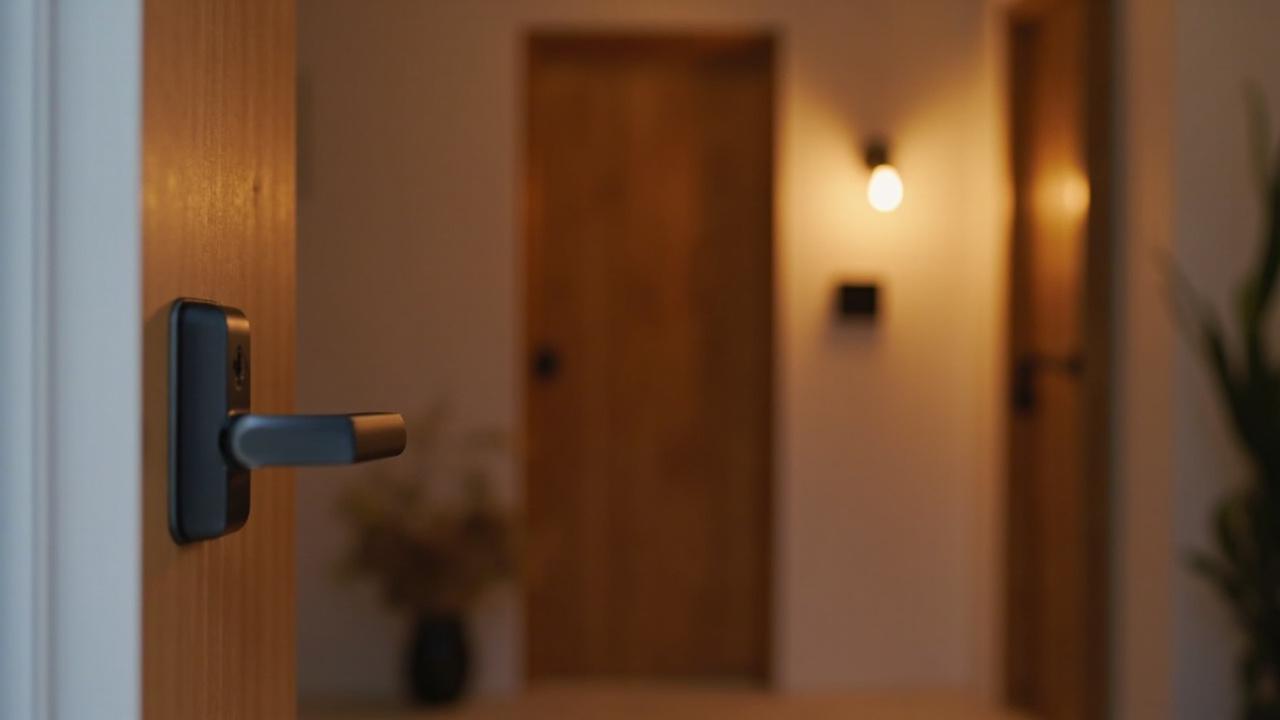
Smart Locks for Apartment Developers
Smart locks for apartment developers is the procurement specification a developer hands the lock supplier before phase one of a new residential scheme goes into production, so that the door schedule, the credential plan at finishing, the credential plan at handover, the shortlisted lock family, and the snag-list acceptance test are all written down before a single cylinder is cut. This is a fill-in-the-blanks pack, not an essay. The article is the worksheet; the developer's filled copy is what travels through phases one, two and three. Every per-model number a factory would normally volunteer — credential capacity, audit depth, door fit, power behaviour — is captured here as a to verify in writing item to verify against the model’s published specification, because copying brochure numbers into a developer spec is how a five-phase scheme ends up with five different locks.
This pack is deliberately the developer side of three sibling articles. It covers the schedule, the shortlist, and the snag list. Per-door-class buying logic for residents is the apartment buildings buyer guide; mixed-tenure policy layering once the estate is live is the multi-family housing article; what happens after handover, when the running operator takes over, is the apartment operators playbook. The developer's job sits between design and handover; this pack is the bridge.
How to Use This Pack
Seven steps. Steps one to four happen before the first purchase order. Steps five to seven happen on the door and after handover. Treat the pack as a single procurement deliverable: a developer fills it in once, then carries the same copy forward through every phase.
- Set the project envelope — fill Section A from a planning brief and a finance model.
- Build the unit-door schedule — every door in the scheme, classified, in Section B.
- Map the door classes — the recurring types and what each class asks of a lock, in Section C.
- Define finishing-phase vs handover-phase credential setup — what is loaded and what is wiped between finishing and handover, in Section D.
- Pop the model shortlist — three to five candidate SKUs against each door class, with to verify in writing captures, in Section E.
- Commission and snag — the on-door tests during finishing and a snag-list acceptance pass at handover, in Sections F and G.
- Hand the pack to the operator — the completed workbook becomes the operator's reference document, not the developer's discardable.
One rule that applies everywhere: write the requirement first, confirm the candidate lock second. Doors that needed "credentials fully revocable at handover" in writing do not get answered by "supports multiple unlock methods" from a brochure. Section K shows one illustrative 240-unit phase-two scheme where every cell in the workbook was filled in this order.
Section A — Project Envelope
Fill these rows first. Every later row is compared to the envelope, not to wishful thinking. Anything you cannot answer yet is an open question, not a default.
| Field | Value (EXAMPLE) | Source |
|---|---|---|
| Scheme name | Project Alder Yard — phased | Internal |
| Total units | 240 | Finance model |
| Phase plan | Phase 1: 80 · Phase 2: 100 · Phase 3: 60 | Planning brief |
| Tenure mix | 60% rental · 30% owner · 10% supported-living | Investment thesis |
| Construction start (phase 1) | Q3 2026 | Main contractor |
| Handover window (phase 1) | Q4 2027 to Q1 2028 | Sales / leasing |
| Door-builder standard | Solid-core timber, 40–45 mm typical; aluminium-and-glass for amenity | Architect spec |
| Corridor and plant-room doors | Fire-rated steel, single-leaf, 60+ minutes on escape routes | Fire strategy |
| Outdoor perimeter doors | Aluminium thermal-break, weather-rated | Façade package |
| Smart-home buyers' expectation level | "Mobile-app enrolment expected; mechanical fallback tolerated" | Sales research |
| Estate-wide IT infrastructure | Wifi in corridors; cellular at perimeter | M&E consultant |
| Lock budget envelope structure | Door hardware only; credential media separate; lifecycle separate | QS |
| Compliance questions owned by | Legal counsel | Internal |
| Estates management handover target | One named contractor on day one | Estate strategy |
Section B — Unit-Door Schedule
This is the document the lock supplier sees first. One row per door in the scheme, sorted by door class. The example column shows how a 240-unit scheme's units collapse into recurring classes, so a supplier does not have to relist 240 distinct front doors.
| Door ID | Floor / Block | Door class | Door material | Door thickness (mm) | Backset (mm) | Bore / prep | Lock target family | Credential lanes expected | Notes / exceptions |
|---|---|---|---|---|---|---|---|---|---|
| U-101 to U-140 | Block A, Floors 1–14 | A1 Unit front | Solid-core timber | 45 | 60 | DIN-style | ☐ | Code · RFID · App | EXAMPLE — 40 doors |
| U-201 to U-240 | Block A, Floors 1–14 | A1 Unit front (mirror) | Solid-core timber | 45 | 60 | DIN-style | ☐ | Code · RFID · App | EXAMPLE — same family as U-101 family |
| C-001 | Block A ground | C1 Common corridor | Fire-rated steel | 50 | N/A | Mortice | ☐ | Card · Code | EXAMPLE |
| C-002 | Block A ground | C1 Common corridor (corridor-extension) | Fire-rated steel | 50 | N/A | Mortice | ☐ | Card · Code | EXAMPLE |
| A-001 | Roof terrace | A2 Amenity door | Aluminium thermal-break | 50 | 35 | Euro | ☐ | App · Card | EXAMPLE |
| A-002 | Bike store | A2 Amenity door | Steel | 45 | 55 | Mortice | ☐ | Card · Code | EXAMPLE |
| P-001 | Plant room | P1 Plant / utility | Steel | 50 | N/A | Mortice | ☐ | Card · Code | EXAMPLE |
| G-001 | Perimeter gate | A3 Outdoor perimeter | Aluminium | 50 | 35 | Euro | ☐ | Code · App | EXAMPLE |
| W-001 | Refuse store | P2 Waste / refuse | Steel | 45 | 55 | Mortice | ☐ | Card | EXAMPLE |
| S-001 | Concierge office | P3 Staff / back-of-house | Timber | 40 | 60 | DIN-style | ☐ | Card · Code | EXAMPLE |
| (Continue) | (Continue) | (Continue) | (Continue) | (Continue) | (Continue) | (Continue) | (Continue) | (Continue) | (Continue) |
Three rules the schedule enforces:
- Group by door class before counting. A 240-unit scheme is rarely 240 distinct decisions; it is usually four to six door classes repeated. The supplier thinks in door classes, not units.
- Every door has a lock target family cell, even if it reads "☐". Empty cells are questions, not defaults. Defaults always fail somebody.
- Notes column is finite. Anything longer than a tweet belongs in a separate risk register, not in the schedule.
Section C — Door-Class Register
Each row below defines a door class. Lock requirements follow the class; the model shortlist in Section E answers each class's row by row.
| Door class | What this door does | Who uses it daily | Lifecycle clock | Lock family implication | check against the model specification |
|---|---|---|---|---|---|
| A1 Unit front door | Apartments' primary access | Resident household, visitors, the operator's contractors on turnover | Move-in to move-out, tenancies turn over | Residential multi-method platform with an estate-level administrator tier | Door thickness band; credential capacity per lane; admin/user role structure; offline event log; mechanical override rules |
| A2 Amenity door (lounge, gym, parcel room, bike, terrace) | Estate-wide amenities booked or shared | Residents, guests, staff, contractors on rota | Resident booking window or staff shift | Platform-compatible with A1, often with time-bound PIN | Time-bounded code capability; online admin schedule; app-and-code simultaneous use |
| A3 Outdoor perimeter door (block entry, refuse gate, service gate) | External access controlled by climate | Residents, visitors, post, trades, waste contractors | Sunrise-to-sunset plus event windows | Outdoor/aluminium-door-rated mechanical and electronics | Outdoor ingress rating; weather envelope; auto-relock behaviour; keypad daylight readability |
| B1 Common corridor, lift lobby | Internal circulation | Residents, visitors, staff | Continuous | Card-and-code platform; visitor chassis management | Card encoding; visitor-PIN mechanics; corridor unlock window |
| C1 Stair and escape corridor | Life-safety egress routes | Everyone in emergencies, staff in normal hours | Continuous | Mechanical fail-safe egress dominant; electronic complement on staff access | Egress hardware relationship; fire strategy alignment; mechanical override custody (route to fire officer, not to spec writer) |
| P1 Plant / utility room | M&E, comms riser, water pump | Maintenance contractor rota | Time-boxed access per engineer | Strong mechanical, controlled electronic | Audit retention; mechanical override; access-window programming |
| P2 Waste / refuse store | Refuse collection | Council / contractor collectors | Rota windows | Robust against weather and rough use | Operating-environment limits; impact resistance; auto-relock |
| P3 Staff / back-of-house (concierge, parcel office, plant corridor) | Staff base | Concierge, building manager, parcel handlers | Continuous during operating hours | Card + code, no biometrics on staff doors | Time-window programming; shared-station handover mechanics |
| C2 Communal garage / car-park gate | Vehicle-pedestrian door (door only, not barrier) | Residents, staff | Booking or shift | Outdoor-rated with credential readers pedestrians side | Pedestrian-credential mechanism; auto-relock; visitor egress |
Discipline: never let a door class be a hidden exception. If a door is not on the register, it gets whatever default the installer brought, which is the developer's name on the next warranty claim.
Section D — Finishing-Phase vs Handover-Phase Credential Setup
This is the step where developer and operator control handover collide most often. The lock is installed during the finishing phase, but the door is handed to a tenant, owner or care operator weeks or months later, and any code, card, finger or app pairing issued during finishing must be wiped, rotated or reissued before handover. A standard that does not separate these two phases produces the most common developer defect: a handover where the finishing contractor's debug PIN still opens a unit.
| Activity | Finishing phase (developer / main contractor) | Handover phase (operator / resident) | Lock family responsibility | Capture point |
|---|---|---|---|---|
| Default factory code | Must be changed from default before any door leaves the construction zone | Operator-only code survives any reset | Confirm commissioning-reset path on the product page | Commissioning record per door |
| Installer debug PIN | Used and revoked during finishing | Destroyed at handover | Confirm who can issue, revoke and read the audit trail of every PIN | Per-door credential log |
| Master / super-admin credential | Held by main contractor site manager in a sealed pack | Transferred in writing to the operator, never reissued to a contractor after handover | Confirm transfer protocol on the product page | Handover register |
| Resident codes (rental) | Not yet issued | Issued at lease signing with explicit expiry equal to the lease end date | Code expiry behaviour must be configurable per credential | Lease pack |
| Resident fingerprint (rental) | Not yet enrolled | Enrolled at move-in; tenant can delete at move-out | Storage and deletion mechanics belong on the product page | Move-in form |
| Owner-occupier admin rights | Not yet issued | Issued at completion, with the owner as the unit administrator | Owner-as-admin role must exist on the platform | Conveyance pack |
| Visitor / delivery PIN (shared) | Not yet issued | Issued by the operator or the resident, with bounded lifecycle | Per-credential expiry by hour or by date | Operator policy |
| Contractor / builder PIN | Active during finishing | Revoked at handover; only reissued if the operator continues the same contractor relationship | One-shot, time-boxed or schedule-bounded credential mechanics | Handover sign-off |
| Staff / concierge card | Not yet issued | Issued at first day of operation | Card write/erase behaviour; bulk issuance path | Operations SOP |
| Plant-room escalation credentials | Not yet issued | Issued per on-call rota | Role-shape vs identity-shape credential support | Rota file |
| Audit trail posture | Captured from first commissioning day | Continuous from handover forward | Storage location and read-out path on the product page | Handover letter |
Three rules worth keeping in bold on the printed copy:
- Finishing credentials die at handover, by protocol. "By protocol" means a written one, not a hope.
- The operator's handover pack starts from a known-empty state, not a cleared state. A clearing report is evidence. The starting state must be empty.
- Master credentials move in a sealed envelope with a signed receipt chain. Not in a phone call.
Run as a process, the phase split is a single pipeline with one hard gate — the wipe-and-verify step that turns a cleared state into a provably empty one before any handover credential is issued:
flowchart LR
    A["Door commissioned in finishing phase\ndefault code changed · commissioning record per door"] --> B["Contractor credentials active\ninstaller debug PIN · builder PIN\nmaster pack sealed with site manager"]
    B --> C{"Handover gate: wipe and verify"}
    C -->|"debug PINs destroyed · contractor PINs revoked"| D["Known-empty starting state\nclearing report as evidence\nnot a cleared state"]
    C -->|"gate skipped"| E["Defect: contractor code survives\ninto a tenanted unit"]
    E --> C
    D --> F["Handover-phase issuance\nresident code with lease-end expiry · finger at move-in\nowner admin at completion · staff cards on day one"]
    F --> G["Master credential transfer\nsealed envelope · signed receipt chain\nnever reissued to a contractor"]
    G --> H["Operator posture from day one\naudit trail continuous · annual credential review"]
Section E — Model Selection Shortlist Grid
Three to five candidate SKUs per door class. Every cell under "Check the model’s published specification" is to verify in writing — the developer or spec writer must copy the live product-page answer into the cell before going to sample-fit, not after. Any cell left as ☐ is an open question to the supplier, not a default.
E.1 A1 Unit-Front-Door Shortlist
| Spec line | Candidate 1: residential multi-method | Candidate 2: keypad-and-card residential | Candidate 3: five-in-one SLK-8831 | Weight (1–5) |
|---|---|---|---|---|
| Door-thickness band (mm) | — | — | — | 5 |
| Credential lanes accepted | — | — | Five (fingerprint, password, card, key, app) | 5 |
| Credentials per device, code lane | — | — | — | 4 |
| Credentials per device, card lane | — | — | — | 4 |
| Credentials per device, fingerprint lane | — | — | — | 4 |
| Admin role structure (household vs estate) | — | — | — | 5 |
| Offline event-log depth | — | — | — | 4 |
| Read-out of event log | Check the model’s published specification: route (app / PC software / cable) | — | — | 4 |
| Mechanical override | Check the model’s published specification: cylinder type, who holds the override key | — | Key method included | 5 |
| Power supply | to verify in writing (cells / mains) | — | — | 4 |
| Low-battery behaviour | — | — | — | 4 |
| App family (where supported) | Check the model’s published specification (TTLock / Tuya / Doodle) | — | — | 3 |
| Sample-fit behaviour on a 45 mm solid-core door | Test on site | Test on site | Test on site | 5 |
| Continuity for phase 2 supply | Check the model’s published specification / quote | Check the model’s published specification / quote | Check the model’s published specification / quote | 5 |
| Backwards compat with phase-1 fittings | n/a (phase 1) | n/a (phase 1) | n/a (phase 1) | N/A |
| Spec writer's provisional verdict | ☐ | ☐ | ☐ | — |
Cells marked — have no documented value in this article’s sources; obtain the figure from the supplier’s written specification.
The same grid template repeats for A2 amenity, A3 outdoor perimeter, B1 common corridor, C1 stair and escape corridor, P1 plant / utility, P2 refuse, P3 staff — each with the appropriate subset of to verify in writing cells. Some cells drop out because they do not apply (e.g. weather-rating matters only for A3 and P2; fingerprint enrolment rarely matters for P1 plant-room).
E.2 A Granularity Yardstick (Use, Do Not Port the Numbers)
The hotel-lock spec block carried on this site's catalog — for the SLK-9936S hotel lock, taken straight from the product page — is a useful yardstick for the granularity a serious product page can carry. It is deliberately a hotel model and nothing about it transfers to a residential lock; the numbers belong to the 9936S spec block only. Reproduced for comparison.
Door thickness 36–100 mm · RFID Mifare 1 @ 13.56 MHz · read distance 0–5 cm · read time <0.25 s · power 4 × AA · battery operating cycles >15,000 · audit / event records up to 1,000 · 5-pin cylinder · 3-point latch · stainless steel + alloy body · multiple finish options · mechanical emergency access · multilingual management software · standalone or centralised database modes · positioned for 1–5 star hotels.
Where the residential shortlist lacks the same level of detail, that is the question. Where it lacks more than two cells of the same granularity, change candidate. A spec page that cannot produce depth on door thickness, capacity per lane, admin structure, audit depth, mechanical override and power behaviour is not the candidate for a 240-unit developer handover.
E.3 The Decision Rule
| Condition | Action |
|---|---|
| All critical to verify in writing cells answered and sample-fit passes | Proceed to small pilot (5–10 doors across multiple door classes) |
| Any cell on door thickness, credential capacity, admin structure, mechanical override or power behaviour is empty after the supplier's response | Reject the candidate for this door class; substitute |
| Continuity confirmed but only after a side-letter | Accept with a written confirmation in the quote, not in a brochure |
| Sample-fit fails on one of three test doors | Reject the candidate for that door class |
Section F — Finishing-Phase Commissioning Checklist
Run this list on every door during the finishing phase. Tick means signed and dated; unchecked means re-test. The list is the developer's evidence base if a handover defect surfaces months later.
| # | Test | Door class applicable | Pass criterion | Sign / date |
|---|---|---|---|---|
| 1 | Door opens from default factory code after install | A1, A2, A3, B1, C1, P1, P2, P3 | YES — flag for mandatory reset before next test | |
| 2 | Default factory code is changed and the new code locks the door | All | YES, with no fault log | |
| 3 | Installer debug PIN is revoked; key reopens the door is not affected | All electronic | YES | |
| 4 | Mechanical override opens the door reliably | All | YES; the override key custody entry is in the site register | |
| 5 | Card credential is enrolled, opens, is revoked | A1, A2, B1, P1, P2, P3 | YES; revocation re-opens to deny | |
| 6 | Code credential is enrolled, opens, is time-bound | A1, A2, A3 | YES | |
| 7 | Fingerprint credential is enrolled, opens, removed | A1 where enabled | YES; remove-and-test cycle passes twice | |
| 8 | App pairing enrols and un-enrols in the management software | A1, A2 (where supported) | — | |
| 9 | Offline event log records at least five events and can be read out | All electronic | YES; read-out path matches the product page (app / PC software / cable) | |
| 10 | Low-battery state is simulated and the lock's behaviour matches the product page | All battery-powered | YES | |
| 11 | Three-point latch / cylinder operation cycles 50 times without fault | All | YES; log the cycle count | |
| 12 | Door alignment under-handling has no binding on the latch | All | YES | |
| 13 | Weather-rating envelope is observed (A3, P2) | A3 outdoor, P2 refuse | YES; no standing water at the seal | |
| 14 | Audit record shape matches the rest of the scheme | All | YES; one format estate-wide | |
| 15 | Door is added to the developer-side asset register with install date and lock family | All | YES |
Section G — Snag-List Acceptance Criteria at Handover
This is the developer's last formal hand-off moment. Each row carries a severity, a pass criterion, an owner for resolution, and a sign-off column. Reject any door that fails severity-1 items; escalate any door that fails severity-2 items to the named owner before acceptance.
| Snag category | Severity | Pass criterion | Owner | Sign-off |
|---|---|---|---|---|
| Any finishing-phase code, card, fingerprint or app pairing still works at handover | S1 — REJECT handover for that door | "Empty-state report" produced and signed; the door opens to no enrolments other than mechanical override | Finishing contractor → main contractor → developer | |
| Master / super-admin credential is not transferred in writing | S1 — REJECT handover | Sealed-envelope handover with two signatures and a date | Developer → operator | |
| Mechanical override fails on any test at handover | S1 — REJECT handover for that door | Override opens reliably three times | Finishing contractor | |
| Door's event log cannot be read at handover | S1 — REJECT handover for that door | Read-out succeeds and one fixture-resident event is exported to a named operator file | Developer → operator | |
| Code-credential residual after lease issuance | S1 — REJECT | Empty-state confirmed | Operator | |
| Outdoor door (A3 / P2) shows water ingress after a 30-minute wet test | S1 — REJECT | No water at the seal; lock operates normally | Façade contractor | |
| Audit record shape differs from the scheme baseline | S2 — ESCALATE | Reshape or accept under named exception | Developer | |
| Sample-fit behaviour diverges from shortlist | S2 — ESCALATE | Re-sample or accept variance in writing | Developer | |
| Phase-2 supply confirmation is unwritten | S2 — ESCALATE | Written confirmation on file before contractor demobilises | Developer | |
| Card-issuance media supply not confirmed for the operator's bulk day | S3 — RECORD | Confirmation accepted for one operator request | Developer | |
| Spare-credential blank stock control has no protocol | S3 — RECORD | Operator SOP referenced | Operator | |
| Credential-capacity test on a sample door has not been run at full population | S3 — RECORD | Threshold documented for future phase | Developer | |
| App family labelling on or near the door is ambiguous | S3 — RECORD | Labelling corrected | Finishing contractor | |
| Door under-finish still opens to mechanical override with a generic key | S3 — RECORD | Override replaced or recorded under the estate's override-key policy | Finishing contractor → operator |
A simple rule of thumb: S1 rejects the door; S2 rejects the deal; S3 records the note. Three severities, three consequences.
Section H — Handover-Pack Contents
The day this pack reaches the operator is the day the developer's lifecycle ends and the operator's begins. The handover pack contains the completed workbook plus the documents in the table below. Empty cells in the workbook are unacceptable at handover; a blank cell in the handover pack is a defect.
| Document | Required signatory | Format | Status |
|---|---|---|---|
| Completed Section A — Project Envelope | Developer | ||
| Completed Section B — Unit-Door Schedule | Developer | PDF + editable | |
| Completed Section C — Door-Class Register | Developer + main contractor | ||
| Completed Section D — Credential Setup Plan | Developer + operator | ||
| Completed Section E — Model Shortlist with to verify in writing captures | Developer | Editable spreadsheet | |
| Completed Section F — Finishing-Phase Commissioning Logs | Developer + main contractor | Editable spreadsheet | |
| Completed Section G — Snag-List Acceptance Record | Developer + operator | Editable spreadsheet | |
| As-installed audit trail captured at empty-state | Developer | CSV or platform export | |
| Master / super-admin credential, sealed | Developer + operator | Sealed envelope with receipt chain | |
| Mechanical override keys, sealed | Finishing contractor → operator | Sealed envelope with receipt chain | |
| Brand / series / firmware line written down | Developer | Plain text on a folder cover | |
| Spare-credential blank stock and card writer (if part of supply) | Developer → operator | Physical handover | |
| Known open items, including any S3 records | Developer → operator | One-page memo |
Section K — Illustrative Scenario (240-Unit Phase-Two Re-Spec, Never a Customer Story)
A developer in mid-2026 holds a partial estate: 80 units delivered in phase one, 160 due in phases two and three. Phase one specified the locks informally — three installers, three models, one software licence. Handover complaints from the first 80 residents and a finance committee's request for an estate-wide standard before the next 160 go into production trigger a re-spec. The developer pulls this workbook out, not a quote.
The envelope (Section A) is filled from the planning brief and the sales team. The door schedule (Section B) lists 240 front doors across six door classes; corridor and plant doors turn out to be a recurring eight-class plan. The door-class register (Section C) is the document the lock supplier sees first, after the envelope. Three candidates are shortlisted per door class (Section E); the to verify in writing cells are emailed to the supplier, who answers with product-page citations rather than brochure copy. Two candidates fail on the admin-role cell — neither expresses an estate-tier administrator above a household-tier one in a way the committee-chair role can be written down — and are dropped. The five-in-one SLK-8831 class survives as the residential multi-method candidate, with two further candidates kept for unit-front-door cross-check.
Section D is written jointly with the operator: finishing-phase credentials die at handover by protocol, handover begins from a known-empty state, master credentials move in a sealed envelope with a signed receipt chain. Section F is run during the finishing of units 81–120; a common fault surfaces — the installer debug PIN policy was written but the install team defaulted to leaving it active while they cleaned the corridor — and the snag list catches it before handover. Section G severity-1 catches a residual card on a single door that was issued during pre-sale tours; the door is rejected for handover and re-snagged, no cost to the operator.
The handover pack (Section H) goes to the operator with every cell filled. The operator's first action is verified in writing the empty-state report for every door; the operator's second action is to begin issuing credentials on day one of tenancy. Three months later, when the operator is asked for an audit record relating to a corridor incident, the as-installed audit trail lives where the workbook said it would live. The estate was not built for that moment; the workbook was.
Section L — What This Pack Cannot Promise
Two honest limits. First, the workbook is only as good as the cells inside it. A floor plan with no door-class tagging produces a model shortlist with no rigour; a model shortlist with no to verify in writing answer produces a sample-fit on faith. The discipline of writing the requirement first is the discipline that survives phases two and three. Second, no manufacturer is the same. The candidate stock used to populate Section E should be cross-referenced with the verified slugs on the product catalogue or browsed at category level from Digital Fingerprint Smart Door Lock, Electronic Keypad Entry Door Lock, Keypad RFID Hotel Door Lock and Round Fingerprint Keypad Smart Lock with TUYA Bluetooth, then individually confirmed on the live product page before each cell is filled in.
The longer sequel to this pack, after handover, is operational rather than procurement. Per-door-class running practice once residents are in occupation is the apartment operators playbook. Buyer-style reading on what separates apartment door categories from one another sits in the apartment buildings buyer guide. The mixed-tenure consequence of a poorly-written developer standard is the multi-family housing article. Use this pack as the bridge between design and operations, and hand the completed copy forward — never backwards.
Send the Pack Forward, Not Backward
The completed workbook is the spec writer's working file, the developer's evidence of a fair procurement, and the operator's first instructions. Treating it as any one of those alone has always been the failure mode. Treat it as all three, fill the to verify in writing cells with product-page citations rather than brochure phrasing, walk the snag list with severity discipline on the day, and the handoff from developer to operator becomes a piece of evidence rather than a polite fiction.
Start the pack with a sample plan and the envelope, not a wish-list of finishes — order the samples from order samples, browse the residential and outdoor ranges from the applications page, then begin the quote loop with the populated workbook at request a quote. The quote process is where the to verify in writing cells turn from questions into written answers, and where phase two's confirmation lands in the same notebook as phase one's.