
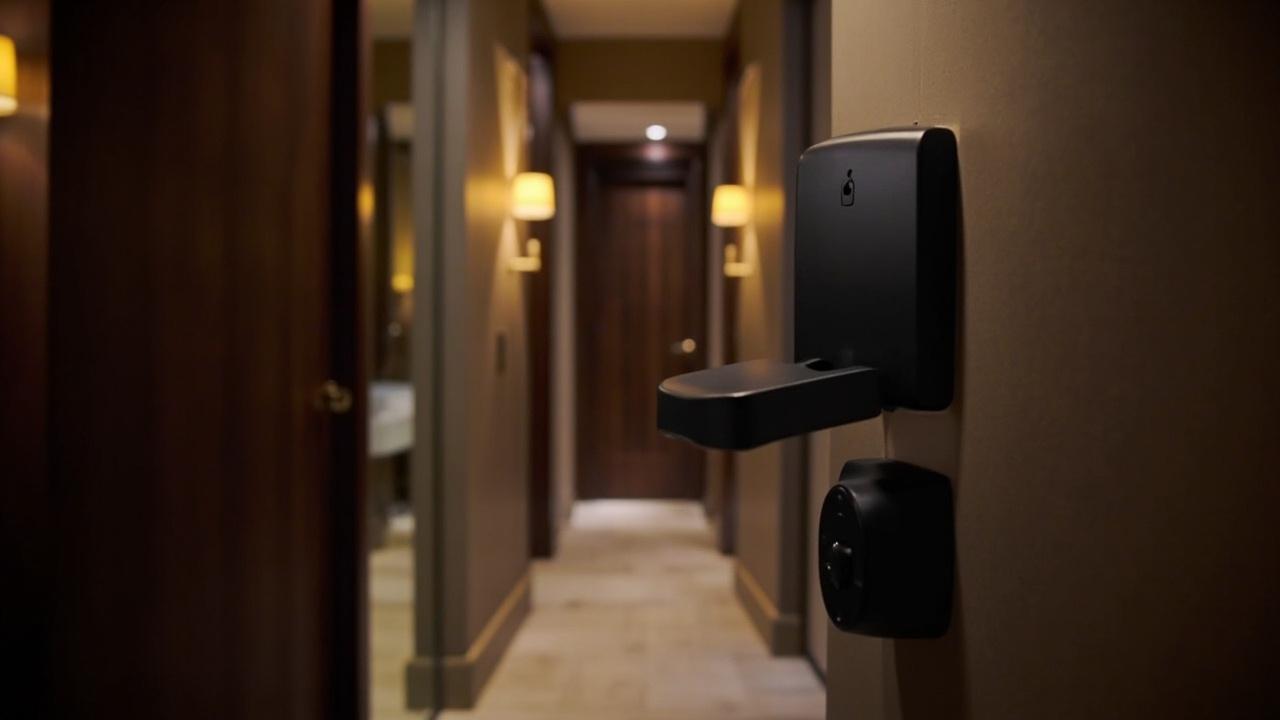
What Smart Lock Should a Boutique Hotel Use?
A boutique hotel should use a hotel-class smart lock — a lock from the dedicated hotel lane of a manufacturer's catalog — specified the way an interior spec gets specified: finish matched to the design scheme, handle form matched to the door and the guest's hand, reader presentation matched to the room tier, and a credential policy that splits standard rooms from signature suites. For most boutique properties in the 20–40 room range, an RFID card-based hotel lock with a mechanical emergency override, per-door audit records, and small-team staff hierarchies is the correct default; everything beyond that is a design decision you annotate line-by-line on the spec sheet before you ever request a quote.
This article is written as an annotated datasheet. A fictional persona — the owner and marketing director of a 27-room boutique hotel with 3 signature suites — reads a real hotel-lock specification line by line through a design-led lens. Each field gets three annotations: what this line means, what to demand from the factory, and what counts as a bluff. Where our fact base does not cover a field, we say so plainly and mark it Check the model’s published specification: confirm with factory rather than invent a number.
The scenario: 27 rooms, 3 suites, one design-led buyer
Consider an illustrative property: a converted townhouse running 27 guest rooms across four floors, of which 3 upper-floor rooms are marketed as "signature suites" with higher rates and a different interior scheme. There is no traditional front desk — reception is a two-person counter — and the staff roster at any moment is roughly five people: owner, one manager, two housekeepers, one maintenance-cum-porter. The building has one main entrance door, one back-of-house door onto a service alley, a small laundry/storage room, and a first-floor lounge that closes at night.
The design language is warm minimalism: oak veneers, brushed brass light fixtures, off-black ironmongery on some floors, undyed stone on others. The marketing director's rule is simple: nothing on the door may look generic. A lock that screams "budget chain" costs brand value on every photograph that reaches a booking platform.
Against that brief, the spec sheet is annotated below. Note what is deliberately absent from the scenario: no claims of 100-room scale, no invented chain name, no price column. Boutique procurement is quote-based, and this article keeps to fields, not figures.
Field 1 — Product class: hotel lane or residential lane?
The line on the sheet: category designation, e.g. "hotel lock."
What this line means. Reputable manufacturers separate hotel-class locks from consumer locks. In the SmartLockFactory catalog, hotel locks are their own category — 24 dedicated hotel models inside a 79-model catalog — and the hotel lane differs from the residential lane in three ways that matter to a boutique: credential logic (issued cards tied to room and stay dates rather than shared user codes), event logging built for incident review, and management software designed around check-in/check-out rather than household members.
What to demand. Ask which of the 24 hotel models the supplier actually recommends for your property type, and why. A supplier who routes a boutique enquiry to a generic fingerprint consumer lock is selling inventory, not solving a problem. Residential-lane unlocks (app/Bluetooth platforms like TTLock, Tuya or Doodle) exist in the catalog, but they belong to different products; whether any specific hotel model offers app functionality is a per-model question — Check the model’s published specification: confirm with factory for every model you shortlist. Do not assume Wi-Fi connectivity on any catalog model; check the model’s published specification whether Wi-Fi is offered for the one you are evaluating.
What is a bluff. "Works like a hotel lock." A consumer lock with a hotel-ish name is not a hotel lock. The tell is the software: hotel lanes ship with hotel PC software as an unlocking/management method; consumer lanes ship with a household app.
Field 2 — Finish options: the first design decision on the sheet
The line on the sheet: "Surface finish: multiple options available."
What this line means. This is the line the marketing director circles first. In our PDP-cited spec block for the SLK-9936S, "multiple finish options" appears as a genuine catalog attribute — the fact base supports that multiple finishes exist, but it does not name them for that model. Elsewhere in the wider market, common hotel-lock finishes include brushed stainless, black, brass-toned and copper-toned variants; treat any specific finish list for a specific model as Check the model’s published specification: confirm with factory, and request physical finish samples rather than photographs, because rendered photos flatter anodized and PVD surfaces.
What to demand. A finish matrix per model, tied to your interior scheme, room by room. Boutique properties rarely need one finish everywhere; they need coordinated finishes.
| Interior cue in the boutique scheme | Finish direction to test | Spec-sheet annotation |
|---|---|---|
| Off-black ironmongery, dark frames | Matte/dark tone family | Ask factory which dark finish options exist for the chosen model — Check the model’s published specification: confirm with factory |
| Brushed brass sconces, warm metals | Brass/gold-toned family | Request physical swatch; confirm finish substrate (PVD vs. painted) — to verify in writing |
| Oak veneer, stone, neutral palette | Brushed stainless / neutral metallic | Usually the broadest availability across hotel models |
| Mixed schemes, standard floor vs. suite floor | Two coordinated finishes, same model | Confirm whether the model supports two finishes in one order without tooling — to verify in writing |
What is a bluff. "Any color you like." On small orders, finish variety is constrained by how the factory anodizes or coats hardware; unlimited color talk usually describes painted consumer hardware, not hotel-grade bodies. For background on how coating choices age under cleaning chemicals and hands, see our guide to how surface finishes change the look of a door.
Field 3 — Handle form factor: what the guest's hand meets
The line on the sheet: body style / handle type.
What this line means. Hotel door hardware broadly comes in two forms: the traditional downward-swing "hotel-style" handle that retracts the latch when turned, and a more architectural lever. In a boutique, the handle is the door's jewelry. It sets the tactile first impression at the room and reads in every wide shot of marketing photography. Our fact base records that stainless steel and alloy bodies exist across hotel models and that at least one hotel line uses a grip-to-open form on a different product family, but per-model handle geometry for boutique-fit applications is not in the fact base — Check the model’s published specification: confirm with factory with photos and dimensions for each shortlisted model.
What to demand. Handle protrusion and strike behavior for your actual doors (boutique properties often have older, heavier doors with non-standard edge profiles), plus how the emergency mechanical key is presented — some designs hide the outside keyway behind a removable escutcheon, which preserves the clean face. The door-thickness envelope on the sheet (the SLK-9936S block, for example, cites 36–100 mm) tells you whether your heritage doors are in range before anyone talks style. Deeper geometry discussion lives in our breakdown of handle and lever design choices.
What is a bluff. "Slim profile" with no dimensions. Ask for the outside-unit depth in millimetres and a photo on a door edge. Design-led buyers should prototype one unit on the least-visible guest door before committing the finish-and-handle decision to 30 openings.
Field 4 — Reader presentation: visible pad or hidden reader
The line on the sheet: RFID reader location / user interface.
What this line means. Most hotel locks expose a touch pad where the card is presented. A design-led alternative is the hidden-reader format: the card zone is invisible, marked at most by a discreet logo, and the front face stays a clean metal plane. In our catalog, the SLK-9905A is exactly that — a hidden-reader hotel lock, with a door-thickness envelope around 38–100 mm per its product page. For a boutique whose marketing director is fighting visual clutter, hidden readers on the guest-room doors are often the single highest-impact aesthetic choice in the whole access package.
What to demand. Confirm how guests learn where to tap when nothing is visible (typically a small engraved mark or a card-sleeve instruction at the desk), and confirm read ergonomics: the SLK-9936S block cites a 0–5 cm read distance and sub-0.25 s read time, which is the shape of the numbers you should ask for on any model. A hidden reader that forces three re-taps undoes the design win.
What is a bluff. "Invisible technology." The reader still needs a coil behind the face; hidden-reader designs trade pad space for read-zone tolerance. Request a sample and test it with gloved hands and a wallet-thin card holder, which is how guests actually present cards. More on the format in how a hidden reader actually works.
Field 5 — Credential choice per room tier
The line on the sheet: supported unlocking methods.
What this line means. The boutique instinct is to differentiate: standard rooms get the utility credential, signature suites get something that feels considered. Constrained by what the catalog actually supports for hotel-class products — RFID/IC cards at 13.56 MHz across the hotel lane, with fingerprint and passcode present in other catalog categories — the honest tier map looks like this:
| Room / door zone | Default credential (fact-backed) | Tier-up option | Spec-sheet status |
|---|---|---|---|
| 24 standard guest rooms | RFID card, encoded per stay | — | Covered by hotel lane (Mifare 1 @ 13.56 MHz per SLK-9936S block) |
| 3 signature suites | RFID card, premium card presentation (sleeve/material) | Fingerprint enrollment for repeat suite guests, only if the chosen hotel model supports it | — |
| Main entrance (staff + after-hours guests) | RFID card with entrance-level permissions | — | Confirm entrance-door model class; to verify in writing |
| Back-of-house / laundry | RFID or passcode per policy | Time-window permissions | Confirm model and software support — to verify in writing |
| Emergency access, all doors | Mechanical key override | — | Present in the 9936S block ("mechanical emergency access") |
Cells marked — have no documented value in this article’s sources; obtain the figure from the supplier’s written specification.
What to demand. One lock family that spans tiers, with the tier difference carried by card presentation and software permissions rather than by three incompatible hardware lines. Every additional technology you introduce (a second credential type, a second platform) multiplies training, spares, and support for a five-person team.
What is a bluff. Credential menus that reference technologies this catalog does not carry. Matter, Thread, Zigbee, Z-Wave, Apple Home Key, UWB and vein recognition are not in the catalog — if a spec sheet or a broker's "equivalent" datasheet lists them, you are not looking at our factory's product. And no phone-in-your-pocket unlock exists on hotel models in the fact base unless a specific product page says so; verify per model rather than assuming.
The firewalled block: SLK-9936S, annotated line by line
The following specifications are quoted only from the product page for the SLK-9936S hotel lock, and apply only to that model. Do not transfer these numbers to other products. This is the datasheet the marketing director had printed and stapled her annotations to.
SLK-9936S — PDP-cited spec block: Door thickness 36–100 mm · RFID Mifare 1 @ 13.56 MHz · read distance 0–5 cm · read time <0.25 s · power 4 × AA · battery operating cycles >15,000 · audit/event records up to 1,000 · 5-pin cylinder · 3-point latch · stainless steel + alloy body · multiple finish options · mechanical emergency access · multilingual management software · standalone or centralized database modes · positioned for 1–5 star hotels.
| Spec line | What it means for a 27-room boutique | What to demand | Bluff check |
|---|---|---|---|
| Door thickness 36–100 mm | Covers most modern doors and many heritage doors; measure before assuming | A measured thickness at each of the 30+ openings, including the two back-of-house doors | "Fits most doors" with no envelope |
| RFID Mifare 1 @ 13.56 MHz | Standard hotel-card credential; cards are replaceable and encodable at the desk | Card procurement path and encoder availability | "Smart card" without stating the standard |
| Read distance 0–5 cm, read time <0.25 s | A single confident tap, no queue at the door | On-site test with real card stock you plan to print | Quoting read range in feet |
| 4 × AA power | Battery service is a housekeeping-adjacent task, not a technician task | Low-battery warning behavior at door and in software | "Months of battery" with no cycle basis |
| Battery operating cycles >15,000 | A published endurance yardstick for the electronics and motor | Whether the figure is per the product page (it is, for this model) — cite it as catalog data, not as a lifetime guarantee | Re-badging the cycle count as a warranty term |
| Audit/event records up to 1,000 | Meaningful incident window for a small property; see the audit section below | How records are read out and what fields each record carries | "Full logging" with unspecified depth |
| 5-pin cylinder · 3-point latch | Mechanical baseline behind the electronics on this model | Cylinder and latch detail drawings for heritage doors | Photos without exploded views |
| Stainless steel + alloy body · multiple finishes | The design-led line: a real catalog claim — but the finish names are not in the fact base | A finish schedule with physical samples for this model | Accepting rendered images as finish confirmation |
| Mechanical emergency access | Cover for dead batteries and worst-case scenarios | Who holds the physical keys on a five-person roster | "Master app access only" as a substitute |
| Multilingual software · standalone or centralized DB | A small team can run it; growth can add centralization later | Which mode ships by default, and migration path | Blurring the two modes as "cloud" |
| Positioned for 1–5 star hotels | The model is intended across quality tiers, so boutique fit is a specification question, not a category question | Reference photos of the unit in design-forward installations | Assuming "positioned for" means "preconfigured for" |
Field 6 — Silent operation: the expectation that must be verified, not assumed
The line on the sheet: (usually, no line at all).
What this line means. In a boutique, a motor that whirs loudly at 6:40 a.m. outside a suite door is a product defect in the guest's eyes, even when the mechanism is working perfectly. Guest expectation splits into three: quiet motor actuation after a card read, quiet latch/bolt movement, and quiet indication (audible beeps and LED flashes at the pad). Here the annotation discipline matters most: the fact base does not contain any noise-level or silent-motor specification for catalog hotel locks. Treat silent operation as Check the model’s published specification: confirm with factory — in writing, per model.
What to demand. Three concrete asks. First: whether the model's audible/visual feedback at the reader can be configured or muted — Check the model’s published specification: confirm with factory. Second: a bench demo where you operate the unit repeatedly in a quiet room, because 20 dB of difference is invisible on a datasheet and obvious at a doorway. Third: what a failed or half-thrown latch sounds like, since a misadjusted strike on an old door produces the banging complaint guests actually file. Do not accept adjectives ("whisper-quiet") as specifications; accept observations, settings, and a physical trial.
What is a bluff. Any decibel figure that appears on a marketing PDF but nowhere in a test report. If a supplier cites a noise level for a catalog model, demand the measurement basis; our own fact base deliberately makes no such claim.
Field 7 — Staff hierarchy for a five-person team
The line on the sheet: "multilingual management software" / permission structure.
What this line means. Hotel lock software is usually built for large properties with front-desk roles, but a boutique's problem is the inverse: too few people covering too many hats. The 9936S block confirms software exists and can run standalone or with a centralized database; what it does not confirm is the granularity of roles — that is Check the model’s published specification: confirm with factory against your roster. A realistic small-team hierarchy to validate with the supplier:
| Role (people) | Should be able to | Should NOT be able to | Question for the factory |
|---|---|---|---|
| Owner (1) | Issue/void any card, read audit events, set room tiers | Nothing withheld | Can owner-level credentials be restricted to the management PC? |
| Manager / reception (1–2) | Issue stay cards, check-in/check-out, reprint lost cards | Delete or edit event records | Does software separate card issuance from record viewing? |
| Housekeeping (2) | Time-window room access during shift | Access outside window; suite access at night | Are shift windows configured per card or per role? — to verify in writing |
| Maintenance/porter (1) | Specific rooms when dispatched; back-of-house | All-room blanket access day and night | Can temporary single-room permissions be issued? — to verify in writing |
What to demand. A permission model where every card is role-bound and time-bound, and where the owner can answer "who opened room 14 and when" without asking the desk. If the software's role structure is richer than a boutique needs, simplify anyway: fewer roles, clearly documented, is an asset at 3 a.m. The mechanics of designing these tiers are covered in our guide to staff access management for hotel locks.
What is a bluff. "Unlimited user levels" as a headline. A five-person property needs four levels that work; depth of hierarchy is only valuable if it is enforced at the card encoder, not just in menus.
Field 8 — Audit records for incident review
The line on the sheet: "audit/event records up to 1,000" (per the 9936S block; per-model for everything else).
What this line means. Boutique incidents are small-scale but high-stakes: a guest who claims the door was opened by staff during a stay, a lost card found by the wrong person, a suite disagreement over minibar timing. The lock's event memory is your neutral witness. Two properties of the record matter: capacity (up to 1,000 events per the product page for that model — roughly weeks to months of door events at boutique occupancy, though the exact window depends on traffic — Check the model’s published specification: confirm with factory for your turnover assumptions) and content (what each record contains: which card, which door, which direction — inside or outside — and what time source).
What to demand. A written answer to: how are events read from the lock (via hotel PC software over the management interface, per the catalog's hotel-PC-software unlocking/management method), can records be exported before they roll over, and does the clock stay accurate across battery changes. Retention and export behavior beyond the 1,000-record capacity is not in the fact base — Check the model’s published specification: confirm with factory.
What is a bluff. "Cloud history forever" for standalone locks. The 9936S block describes standalone or centralized-database modes, not a cloud archive; anyone promising indefinite remote history on an offline hotel lock is describing a different product than the one on the sheet. For a deeper read on log structures and incident workflows, see audit trails and event records.
The annotation workflow, from mock-up to quote request
The marketing director's process, drawn as a gate sequence. Nothing goes to the factory until the internal decisions are closed, and nothing gets ordered until the to verify in writing column is empty.
flowchart TD
    A[Interior scheme sign-off:\nfinishes, ironmongery, photography] --> B[Door survey:\nthickness at 27 rooms + 3 suites\n+ BOH doors, edge condition]
    B --> C[Spec-sheet annotation pass:\nfinish · handle · reader · credential ·\naudit · staff roles]
    C --> D{Design-led gates}
    D -->|finish names unknown| E[See model spec: \nphysical finish samples from factory]
    D -->|silent operation unlisted| F[See model spec: \nwritten motor/beep spec + bench trial]
    D -->|suite credential tier-up| G[See model spec: \nper-model capability check]
    E --> H[Shortlist one hotel-lane model\nacross all room tiers]
    F --> H
    G --> H
    H --> I[Credential + role map signed\nby owner and manager]
    I --> J[Sample unit on one low-visibility door:\n30-day live trial]
    J --> K[Quote request with\nannotated spec sheet attached]
Bluff detector: four phrases that end a datasheet conversation
- "Smart-home compatible." A boutique needs hotel-lane behavior — stay-bound credentials, event records, mechanical override. Residential ecosystem language on a hotel product datasheet means you are reading the wrong lane, or a rebadged third-party sheet.
- "Any RAL color, any finish, unlimited." The catalog supports multiple finish options on at least one hotel model as a documented attribute; unconstrained color talk for hardware bodies is a paint-shop promise, and you should test physical samples either way.
- "Silent motor." An adjective, not a spec. Our fact base carries no noise claim for hotel models; demand settings, service behavior, and a hands-on trial.
- "Full cloud audit." The documented hotel models run standalone or centralized-database modes with on-lock event memory. The word "cloud" on a hotel-lock datasheet deserves an interrogation about what physically stores the records when the network does not.
Bringing it together: a door-by-door map for the 27-room property
To show the annotations resolving into a purchase decision, here is the illustrative output for the scenario property. It names no prices and no lead times; it is a specification artifact, which is exactly what should travel with a quote request.
| Door zone | Openings | Presentation decision | Credential decision | Remaining to confirm items |
|---|---|---|---|---|
| Standard rooms (floors 2–3) | 24 | Dark-toned finish where ironmongery is off-black; hidden-reader format evaluated against read ergonomics | RFID card per stay, mechanical override retained | Exact finish names for chosen model; hidden-reader availability in same family |
| Signature suites (floor 4) | 3 | Neutral warm-metal finish coordinated with sconces; handle form prototyped on mock-up door | RFID card with premium card sleeve; fingerprint tier-up only if model supports | Per-model fingerprint support in hotel lane; software tier handling |
| Main entrance | 1 | Heaviest visual weight; escutcheon cleanliness over feature count | Staff card + guest after-hours card, entrance permissions in role map | Entrance-door lock class and fail behavior |
| Back-of-house + laundry | 2 | Stainless utility finish; appearance low priority, durability high | Time-window staff cards; passcode only if model offers | Whether passcode exists on chosen hotel model — do not assume |
| Owner's office / store | 1 | Match nearest guest-floor scheme | Restricted role cards | Audit readout process from the PC used daily |
Three suites out of 27 rooms is enough to justify a tier difference in card experience and permissions, and almost never enough to justify a second hardware platform. That is the design-led conclusion: differentiation lives in finish coordination, reader presentation, card presentation, and software policy — not in exotic credentials the catalog does not carry.
Your annotated sheet is the RFQ
A boutique hotel should not buy a smart lock; it should buy a finished detail. The spec sheet you annotate — finish samples pinned, handle dimensions measured, reader format chosen, credentials tiered per room class, a five-role permission map validated in the software, and an audit readout path documented — is already most of a procurement document. The remaining blanks are all to verify in writing fields, and closing them is a factory conversation, not a guess.
Send that annotated sheet to the manufacturer with your door measurements and room-tier map attached. Use the hotel lock category page to shortlist models in the hotel lane, then request a quote with your annotations included so the answer addresses your questions line by line — and order physical samples through the sample process before the first finish decision becomes thirty door-front decisions.