
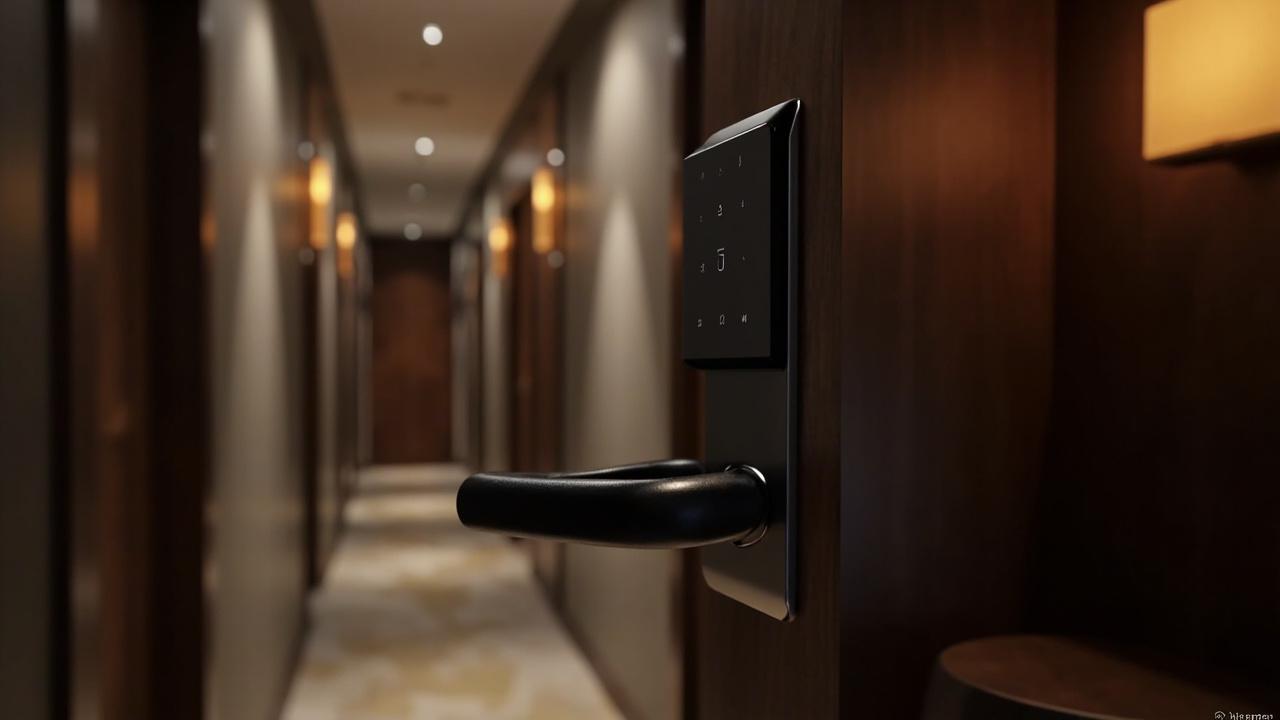
Smart Lock ANSI Mortise
A Latin American hotelier places a Smart Lock in a door that the carpenter routed to U.S. ANSI dimensions; an installer in Berlin cuts a pocket to European DIN 18250 dimensions; a contractor in Bangkok shops for a JIS-profile mortise. The three doors look almost the same in plan view. None of them accepts the same mortise body without re-routing, and a buyer who treats "mortise" as one interchangeable term will absorb the re-work charge on site, not at the sample bench.
This article is a comparison arena for the three regional mortise standards that govern how a smart-lock body sits inside a door: the American ANSI/BHMA A156 family of dimensional standards (commonly referenced around ANSI A156.115 mortise-lock prep), the European DIN 18250 / EN 12209 mortise family (DIN 18250 for the lock-case envelope, EN 12209 for the mechanical performance classes), and the Asian-standard family that mostly traces back to JIS A 4702 / JIS A 4706 in Japan and GB 21556 / GB 17565 in mainland China. They go head-to-head across seven rounds that mirror the questions a cross-region B2B buyer has to answer before committing to a sample order: dimensional origin and reference standard, faceplate geometry, case depth and backset envelope, spindle and cylinder center-to-center, door-edge routing envelope, retrofit posture against existing pockets, and the per-model documentation discipline that the buyer needs to enforce when the catalog language does not name a standard. Per-SKU mortise dimensions are routed to the product page of whichever model lands on the shortlist, because the same catalog line ("fits standard doors") can hide very different pocket geometries.
Direct answer: An ANSI mortise in smart-lock contexts is the dimensional family defined by the ANSI/BHMA A156 standards series (notably A156.115 for mortise-lock door-preparation dimensions) — typically a faceplate around 1-1/8" × 8" (≈ 28.6 × 203 mm) on a rectangular case with a 2-3/4" (≈ 70 mm) backset in the U.S. conventional envelope. A DIN mortise follows DIN 18250 / EN 12209 conventions — typically a narrower case profile, a 55–60 mm backset in many European interior doors, and a center-to-center distance between spindle and cylinder that is shorter than the ANSI version. Asian-standard mortises are not one single standard but a family covering JIS (e.g., JIS A 4702 for door hardware dimensions) and GB mortise dimensions; pocket heights and center-to-center distances follow domestic Japanese or Chinese practice rather than ANSI or DIN. None of the three families is interchangeable. Confirm per-model mortise dimensions on the product page before ordering cross-region; do not assume that any specific catalog model meets any specific ANSI / DIN / JIS / GB grade.
This is the cross-region mortise dimensional half of the engineering decision. The materials-side question (substrate family, body chemistry, finish envelope) belongs to the sibling Smart Lock Materials: Complete Buyer Guide. The pocket-cut measurement governance — what to measure and how to record — lives in Smart Lock Mortise Measurement. The five-pillar qualification discipline that sits around the dimensional question and asks whether a given mortise body fits a given door at all is Smart Lock Mortise Compatibility Guide. Read this article first if you are moving locks across regions; read the siblings when you are working inside one region.
Meet the Three Contenders
The three mortise families are not interchangeable. Their reference standards, faceplate geometries, case depths, backsets, spindle-to-cylinder center-to-center distances, and door-edge routing envelopes differ from each other in ways that turn the same brief — "mortise lock, 38 mm door, satin stainless" — into a clean fit on one door family and a structural gamble on another. Read the baseline before the rounds start.
| Family | Reference standards | Faceplate (typical) | Backset (typical) | Spindle-to-cylinder center (typical) | Door-edge routing envelope |
|---|---|---|---|---|---|
| ANSI mortise | ANSI/BHMA A156 series (incl. A156.115 prep dimensions); UL listed mechanical grades are a separate compliance question | ≈ 1-1/8" × 8" (≈ 28.6 × 203 mm) | 2-3/4" (≈ 70 mm); 2-1/2" (≈ 64 mm) on legacy pockets | 3-7/8" (≈ 98.4 mm) for mortise locks with separate cylinder | Deeper pocket (~ 7–8 mm into the door edge on common 1-3/4" doors) |
| European DIN mortise | DIN 18250 (lock case geometry); EN 12209 (mechanical performance classes) | ≈ 20–22 mm wide × 235–250 mm tall | 55 mm, 60 mm, 65 mm, 70 mm depending on national market | ≈ 72–85 mm depending on cylinder class | Narrower case width; pocket height greater than faceplate |
| Asian-standard mortise | JIS A 4702 / JIS A 4706 (Japan); GB 21556 / GB 17565 (mainland China); regional practice | JIS ≈ 26 mm × 240 mm; GB domestic profile varies | JIS ≈ 51 mm, 64 mm, 76 mm; GB domestic ≈ 50–60 mm | JIS ≈ 74–78 mm; GB domestic closer to 70 mm | Varies by domestic market |
Two of the three — ANSI and DIN — are mature codified families with named reference standards that any major lock manufacturer can name on the spec sheet. The third — Asian-standard — is a working name for a regional practice that splits into JIS in Japan and GB mortise profiles in mainland China, with korean KCS mortise practice sitting adjacent. A "mortise lock" sold for export to all three regions without naming the regional target is a product page that has not told you which pocket it actually fits.
The SLK-9936S hotel-class lock spec block anchors the catalog examples in this article and is used ONCE only as a documentation-granularity yardstick (door thickness 36–100 mm, 5-pin cylinder, 3-point latch, stainless steel + alloy body, multiple finish options, mechanical emergency access, multilingual management software, standalone or centralized database modes, 1–5 star hotel positioning). It is never extended to siblings — every other model sits under the standing "check the model’s published specification" rule for mortise dimensions. In particular, no claim is made that SLK-9936S meets ANSI Grade 1 / Grade 2 / Grade 3, EN class 1–7, JIS grade, or any GB mortise grade; the PDP line does not carry that grading claim and the body does not assert it.
Round 1 — Dimensional Origin and Reference Standard
The three families disagree at the standard-of-origin level, not at the level of "what does a mortise look like." A buyer who reads "mortise lock" on a product page and assumes one geometry is being misled by the catalog language.
ANSI mortise sits inside the ANSI/BHMA A156 series. The dimensional anchor for door preparation is ANSI/BHMA A156.115 (Door Hardware Prep — Mortise). The mechanical-performance grade (Grade 1 / Grade 2 / Grade 3) is a separate compliance dimension covered by A156.13 / A156.36 and the UL listing path — and that compliance claim is not asserted on the SLK-9936S product page or on the catalog generally. The buyer needs to ask which A156 sub-standard the faceplate and case dimensions trace back to.
European DIN mortise sits inside DIN 18250 (Schlösser — Einsteckschlösser für Türen; mortise locks for doors) for the dimensional envelope and EN 12209 (Mechanically operated locks, latches and locking plates) for the mechanical-performance class. The two are paired but separate; EN 12209 grades 1–7 sit alongside the DIN 18250 dimensional case. A buyer who quotes only EN 12209 without naming the DIN 18250 pocket has not yet defined the dimensional fit.
Asian-standard mortise is not a single reference. In Japan, JIS A 4702 (door hardware — locks and latches) and JIS A 4706 (door frames and doorset coordination) anchor the pocket dimensions; in mainland China, GB 21556 (security requirements for door-locks) and GB 17565 (general technical specifications for burglary-resistant door-sets) carry the envelope. A buyer who ships to both Japan and China needs two different mortise-body geometries, even when both markets colloquially call the product a "mortise lock."
Round 1 verdict: the reference standard is the first hard filter on a cross-region purchase order. A product page that names the reference standard is doing the buyer's job; a product page that does not is asking the buyer to do the dimensional homework before a sample is cut.
| Mortise family | Reference dimensional anchor | Mechanical-performance anchor | Grade vocabulary the buyer should expect |
|---|---|---|---|
| ANSI mortise | ANSI/BHMA A156.115 prep dimension; A156.36 / A156.13 case | UL listing path (separate compliance dimension) | Grade 1 / Grade 2 / Grade 3 mechanical (not asserted on SLF catalog) |
| European DIN mortise | DIN 18250 case geometry | EN 12209 | EN classes 1–7 (not asserted on SLF catalog) |
| JIS mortise | JIS A 4702 / JIS A 4706 | Domestic JIS mechanical classes | JIS grade (not asserted on SLF catalog) |
| GB mortise | GB 21556 / GB 17565 | Domestic GB mechanical classes | GB grade (not asserted on SLF catalog) |
The standing rule for this article: when any of these grades or classes are mentioned, the cell reads "not asserted on SLF catalog — check the model’s published specification." No catalog SKU is asserted in this body to meet any specific ANSI / DIN / JIS / GB grade.
Round 2 — Faceplate Geometry: What Sits on the Door Edge
The faceplate is the visible strip that the buyer can see and measure without opening the pocket. It is the cheapest part of the comparison because a tape measure is enough.
ANSI faceplate runs ≈ 1-1/8" wide × 8" tall (≈ 28.6 × 203 mm) on the most common U.S. commercial mortise prep. Some prep variants narrow to 1" (25 mm) on legacy wood-frame residential; some narrow further on narrow-stile doors. The faceplate width sets the door-edge rabbet width the carpenter has to route — typically 1-1/4" (≈ 31.75 mm) on a 1-3/4" (≈ 44.45 mm) commercial door.
European DIN faceplate runs ≈ 20–22 mm wide × 235–250 mm tall — narrower and slightly taller than the ANSI faceplate. The narrower width means the door-edge rabbet is narrower, and the taller height means the case is taller. A lock body that fits a DIN pocket but is offered on a faceplate sized for ANSI will not seat in a door cut to DIN rabbet, and the door-edge router will refuse to cut a 28 mm rabbet on a 38 mm European interior door.
Asian-standard faceplate in Japan runs ≈ 26 mm wide × 240 mm tall (JIS typical), closer to the DIN envelope than the ANSI envelope. In mainland China, GB mortise faceplate widths run ≈ 24–26 mm and heights ≈ 220–240 mm; regional practice diverges, with some factory catalogs quoting 22 mm widths for narrow-edge doors. The Japan–China divergence inside one "Asian-standard" name is the structural reason the buyer needs to ask which Asian market the catalog pocket targets.
| Faceplate dimension | ANSI mortise | European DIN mortise | JIS mortise | GB mortise |
|---|---|---|---|---|
| Width (typical) | ≈ 28.6 mm (1-1/8") | ≈ 20–22 mm | ≈ 26 mm | ≈ 24–26 mm (varies regionally) |
| Height (typical) | ≈ 203 mm (8") | ≈ 235–250 mm | ≈ 240 mm | ≈ 220–240 mm (varies regionally) |
| Door-edge rabbet required | ≈ 31.75 mm (1-1/4") | ≈ 24–26 mm | ≈ 28 mm | ≈ 26–28 mm |
| Visible strip consistency across regions | High within U.S. commercial | High within EU commercial | High within JP commercial | Variable within CN commercial |
Round 2 verdict: faceplate width is the cheapest dimensional check on a cross-region order. If the door-edge rabbet width does not match the faceplate width, no other dimension matters.
Round 3 — Case Depth and Backset Envelope
The backset is the horizontal distance from the door edge (the face of the faceplate) to the centerline of the spindle (and on cylindrical locks, to the centerline of the bore). On a mortise body, the backset is also the front-to-back dimension of the case relative to the door edge.
ANSI backset runs 2-3/4" (≈ 70 mm) on most U.S. commercial mortise preps, with 2-1/2" (≈ 64 mm) on legacy wood-frame pockets and 3-3/4" (≈ 95 mm) on some aluminum-storefront mortise variants. The 2-3/4" backset is so dominant in U.S. commercial that anything outside it is a legacy pocket.
European DIN backset runs 55 mm, 60 mm, 65 mm, or 70 mm depending on national market and door-leaf depth. German interior doors frequently use 55 mm or 60 mm; commercial EU doors more commonly use 65 mm or 70 mm. A buyer who orders a U.S.-backset body to install on a 60 mm European pocket will reject the case physically; the carpenter can deepen the pocket in theory but loses door structure in the process.
JIS backset runs 51 mm, 64 mm, or 76 mm depending on door class — JP commercial more commonly uses 64 mm or 76 mm. GB backset runs ≈ 50–60 mm on common Chinese commercial mortise pockets, with regional divergence. The same "Asian-standard" name covers both markets but the backset envelope is not the same.
| Backset dimension | ANSI mortise | European DIN mortise | JIS mortise | GB mortise |
|---|---|---|---|---|
| Most common | ≈ 70 mm (2-3/4") | 55 / 60 / 65 / 70 mm | 51 / 64 / 76 mm | ≈ 50–60 mm (varies regionally) |
| Case depth envelope (typical) | ≈ 100–115 mm deep | ≈ 85–95 mm deep | ≈ 90–100 mm deep | ≈ 85–95 mm deep |
| Door-leaf implications | ≥ 38 mm (1-1/2") typical commercial | 38–50 mm typical interior / commercial | 36–45 mm typical | 40–55 mm typical |
| Per-model confirmation | — | — | — | — |
Cells marked — have no documented value in this article’s sources; obtain the figure from the supplier’s written specification.
Round 3 verdict: backset is the dimension that determines whether the case physically seats in the pocket. A wrong backset is not adjustable without re-cutting the door; it is the most expensive dimensional error to recover.
Round 4 — Spindle and Cylinder Center-to-Center
On a mortise lock with a separate cylinder (the typical smart-lock case), the center-to-center distance between the spindle bore and the cylinder bore is a fixed mechanical property of the case. A drill template that is wrong for this distance cannot be recovered without a custom plate.
ANSI center-to-center runs ≈ 3-7/8" (≈ 98.4 mm) on U.S. commercial mortise with a separate mortise cylinder. Some U.S. residential mortise uses a smaller 2-7/8" or 3-1/2" center; some profile cylinders use 1-3/8". The 3-7/8" is the most common commercial number and what the catalog language usually assumes.
European DIN center-to-center runs ≈ 72–85 mm depending on cylinder class (DIN cylinder, Kaba cylinder, profile cylinder). 72 mm is the most common European commercial mortise distance; profile cylinders and European rim-cylinder configurations vary. The European distance is shorter than the ANSI distance and not interchangeable — a U.S. commercial drill template will not match a 72 mm European pocket.
Asian-standard center-to-center in JIS runs ≈ 74–78 mm; in GB it runs ≈ 70 mm but varies regionally. The Asian distance is closer to the European than to the ANSI distance. A U.S. distributor buying a "mortise" lock for an Asian hotel will commonly receive a case that expects a 74 mm or 70 mm center — the U.S. drill template is unusable.
| Center-to-center dimension | ANSI mortise | European DIN mortise | JIS mortise | GB mortise |
|---|---|---|---|---|
| Spindle-to-cylinder (typical) | ≈ 98.4 mm (3-7/8") | ≈ 72–85 mm | ≈ 74–78 mm | ≈ 70 mm (varies) |
| Spindle-only single bore (rim / no separate cylinder) | Less common in mortise | Less common in mortise | Less common in mortise | Less common in mortise |
| Drill-template implication | Asia-angle gating dimension | Asia-angle gating dimension | Asia-angle gating dimension | Asia-angle gating dimension |
| Per-model confirmation | — | — | — | — |
Round 4 verdict: the spindle-to-cylinder center is the dimension that the factory's own drill template encodes. A buyer who orders a cross-region product without the matching template is buying one where the door contractor has to fabricate a custom template at install time.
Round 5 — Door-Edge Routing Envelope
The door-edge routing is the volume of wood (or steel, or aluminum) that the carpenter removes from the door edge to seat the mortise case. It is the dimension that determines whether the door stays structurally sound after the pocket is cut.
ANSI routing envelope on a 1-3/4" (≈ 44.45 mm) U.S. commercial door is a pocket ≈ 7–8 mm deep on the door edge (after faceplate rabbet), with a case depth of ≈ 100–115 mm and a backset of ≈ 70 mm. The remaining door structure on the hinge side of the case is the governing structural dimension; ANSI A156.115 publishes the dimensional envelope that U.S. door manufacturers work to.
European DIN routing envelope on a 38–50 mm European interior or commercial door is a pocket ≈ 5–6 mm deep on the door edge, with a case depth of ≈ 85–95 mm and a backset of 55–70 mm. The narrower faceplate and shallower case depth leave more door structure on the hinge side.
Asian-standard routing envelope in JIS is similar to DIN on a 36–45 mm door; in GB, on a 40–55 mm domestic Chinese commercial door, the routing is closer to DIN with regional divergence. The Asian envelope sits between the ANSI envelope (heavier pocket) and the European envelope (lighter pocket) on a like-for-like door thickness — but the Asian envelope has more in-region divergence than either ANSI or DIN.
Round 5 verdict: door-edge routing is the dimension that the door-prep contractor enforces first. The pocket is cut before the lock arrives. A wrong envelope means a re-cut, which costs more than the wrong lock.
Round 6 — Retrofit Posture Against Existing Pockets
The retrofit question is the one that turns an ANSI mortise purchase into a structural decision. A new-build project can route the door to whatever the catalog dictates; a retrofit project has to live with the pockets already in the building.
ANSI retrofit. On a U.S. commercial building with an ANSI A156.115 pocket already routed (and often occupied by a non-smart ANSI mortise body from a previous renovation), the new smart-lock body has to match the ANSI pocket dimensions faceplate, case depth, backset, and center-to-center. The retrofit frequently upgrades the mechanical case to an electronic body while keeping the pocket — but only if the smart-lock body shares the ANSI envelope. A buyer ordering a non-ANSI body for an ANSI pocket will either re-route the door (expensive) or fail at install (catastrophic).
DIN retrofit. European retrofit against a DIN 18250 / EN 12209 pocket has the same logic: the new body has to share the DIN envelope. European DIN retrofit on listed-heritage interior doors is particularly sensitive because the door often cannot be re-routed (the door is protected); a DIN-body smart lock that fits the existing DIN pocket is the right tool, and any pocket that requires re-routing is a heritage-decision, not a procurement decision.
Asian-standard retrofit. JIS retrofit on a Japanese pocket typically shares the JIS A 4702 / A 4706 envelope. GB retrofit on a mainland-China pocket is more variable — older pockets cut to one regional practice may not match a modern factory's GB-default envelope, and the buyer is back to the "check the model’s published specification" discipline.
| Retrofit scenario | Most likely pocket | Compatible body family | Re-route required if body does not fit |
|---|---|---|---|
| U.S. commercial renovation | ANSI A156.115 | ANSI-body smart lock | Yes, on the door edge (expensive, structural) |
| European interior renovation | DIN 18250 / EN 12209 | DIN-body smart lock | Yes, often heritage-prohibited |
| Japanese commercial renovation | JIS A 4702 / A 4706 | JIS-body smart lock | Yes, narrow door |
| Chinese mainland commercial renovation | GB 21556 / GB 17565 | GB-body smart lock (regional) | Yes, regional divergence adds risk |
Round 6 verdict: retrofit posture is a structural decision, not a catalog language decision. The buyer has to know the existing pocket before ordering the body.
Round 7 — Per-Model Documentation Discipline
The seventh round is the discipline the buyer enforces when the catalog language does not name the standard. It is the round that decides whether the procurement order survives a fit-test at the door.
The standing rule on Smart Lock Factory catalog pages is that per-SKU mortise dimensions (faceplate width × height, case depth, backset, spindle-to-cylinder center, door-edge routing envelope, claimed standard conformance, claimed mechanical grade) are routed to the product page of each individual model. No blanket claim is asserted across the catalog; no specific ANSI Grade 1 / 2 / 3, no specific EN 12209 class, no specific JIS grade, and no specific GB grade is asserted on the SLF catalog generally.
| Documentation item the buyer must demand | What is documented |
|---|---|
| Faceplate width × height (mm) | — |
| Case depth (mm) | — |
| Backset (mm) | — |
| Spindle-to-cylinder center (mm) | — |
| Door-edge routing depth (mm) | — |
| Reference standard named (A156.115 / DIN 18250 / JIS A 4702 / GB 21556) | — |
| Mechanical-performance grade claimed (Grade 1 / EN class / JIS grade / GB grade) | ANSI mortise: not asserted on SLF catalog DIN mortise: not asserted on SLF catalog JIS mortise: not asserted on SLF catalog GB mortise: not asserted on SLF catalog |
Round 7 verdict: per-model documentation is the discipline that converts catalog language into a defensible procurement order. The buyer cannot lift dimensional claims from one product page onto a sibling.
The 14-Round Scorecard
A consolidated scorecard collapses the seven rounds into a single decision frame. The buyer fills in the per-SKU-cell for each shortlisted model; the SLF catalog cell defaults to "check the model’s published specification" until the product page is read.
| Dimension | ANSI mortise | European DIN mortise | JIS mortise | GB mortise |
|---|---|---|---|---|
| Reference standard | ANSI/BHMA A156.115 prep | DIN 18250 / EN 12209 | JIS A 4702 / A 4706 | GB 21556 / GB 17565 |
| Faceplate width | ≈ 28.6 mm | ≈ 20–22 mm | ≈ 26 mm | ≈ 24–26 mm |
| Faceplate height | ≈ 203 mm | ≈ 235–250 mm | ≈ 240 mm | ≈ 220–240 mm |
| Backset | ≈ 70 mm | 55–70 mm | 51 / 64 / 76 mm | ≈ 50–60 mm |
| Case depth | ≈ 100–115 mm | ≈ 85–95 mm | ≈ 90–100 mm | ≈ 85–95 mm |
| Spindle-to-cylinder | ≈ 98.4 mm | ≈ 72–85 mm | ≈ 74–78 mm | ≈ 70 mm |
| Door-edge routing depth | ≈ 7–8 mm | ≈ 5–6 mm | ≈ 5–7 mm | ≈ 5–7 mm |
| Typical door thickness | ≈ 44.45 mm | 38–50 mm | 36–45 mm | 40–55 mm |
| Catalog naming convention | "mortise" + ANSI prep number | "mortise" + DIN/EN class | "mortise" + JIS grade | "mortise" + GB grade |
| Mechanical grade asserted on SLF catalog | No | No | No | No |
| UL listing path | Separate compliance | Not applicable in Europe | Not applicable in Japan | Not applicable in China |
| CE marking path | Not applicable in U.S. | EN 12209 pair | Not applicable in Japan | Not applicable in China |
| Cross-region interchangeability | None with DIN | None with ANSI | None with GB | None with JIS |
| Per-SKU documentation source | Product page | Product page | Product page | Product page |
Decision Matrix — Which Family Fits Which Project Profile
Different project profiles point to different mortise families. The buyer fills in the project profile and follows the row to the family that the field site is most likely to accept; the per-SKU-cell is then read from the product page of the shortlisted model.
| Project profile | Likely mortise family | Why | Cross-region risk |
|---|---|---|---|
| U.S. commercial hotel retrofit (1–5 star) | ANSI mortise | Existing pockets are ANSI A156.115 | Re-routing on heritage doors |
| U.S. new-build commercial office | ANSI mortise | New carpenter routed to ANSI | Low (carpenter controls the pocket) |
| European urban hotel renovation | European DIN mortise | Existing pockets DIN 18250 / EN 12209 | Heritage doors may prohibit re-routing |
| European new-build commercial office | European DIN mortise | National practice | Low |
| Japanese commercial hotel renovation | JIS mortise | Existing JIS A 4702 / A 4706 pockets | Heritage / earthquake-code implications |
| Japanese new-build | JIS mortise | National practice | Low |
| Chinese mainland hotel project (new build) | GB mortise | National GB 21556 / GB 17565 practice | Regional divergence inside mainland |
| Chinese mainland mixed-vintage retrofit | GB mortise (regional) | Existing pockets variable | High — measure every door |
| Cross-region multi-property operator | Family varies by property | Each property dictates | Highest — measure each property |
Process Scorecard — Per-Model Mortise Acceptance Checklist
A checklist the procurement officer can paste into a sample-evaluation worksheet. Each item routes to either the product page (the standard documentation discipline) or the field measurement (the physical sample-stage test).
| Item | Severity | Source | CRITICAL / RECOMMENDED / OPTIONAL |
|---|---|---|---|
| Faceplate width × height (mm) on product page | CRITICAL | Product page | CRITICAL — block order if absent |
| Reference standard named on product page | CRITICAL | Product page | CRITICAL — block order if absent |
| Case depth (mm) on product page | CRITICAL | Product page | CRITICAL — block order if absent |
| Backset (mm) on product page | CRITICAL | Product page | CRITICAL — block order if absent |
| Spindle-to-cylinder center (mm) on product page | CRITICAL | Product page | CRITICAL — block order if absent |
| Door-edge routing envelope (mm) on product page | RECOMMENDED | Product page | RECOMMENDED — escalate if absent |
| Mechanical-performance grade claim (if any) | OPTIONAL | Product page | OPTIONAL — out of catalog default |
| Drill template provided for the body | CRITICAL | Supplier | CRITICAL — block install if absent |
| Sample-body pocket test against field pocket | CRITICAL | Field sample | CRITICAL — block order if mismatch |
| Strike-plate routing per drawer integration | RECOMMENDED | Field sample | RECOMMENDED — defer to strike-plate article |
| Cylinder format confirmation (separate vs integrated) | RECOMMENDED | Product page | RECOMMENDED — defer to cylinder article |
| Heritage / listed-building pocket fixity check | OPTIONAL | Field sample | OPTIONAL — only if building is heritage |
| Multi-property measurement plan if cross-region | RECOMMENDED | Procurement | RECOMMENDED — escalate for portfolio orders |
Illustrative Scenario — A 250-Room Cross-Region Hotel Procurement
Consider a 250-room mixed-portfolio operator with one property in Chicago (U.S. ANSI pocket), one in Berlin (DIN 18250 / EN 12209 pocket), one in Osaka (JIS A 4702 / A 4706 pocket), and one in Guangzhou (GB 21556 / GB 17565 pocket). The operator wants a unified smart-lock brand across all four properties for brand consistency, but the carpentry at each property dictates a different mortise family.
The procurement officer does not try to fit one body across all four. The officer asks each property for the dimensional record of the existing pocket (faceplate, case depth, backset, spindle-to-cylinder center, door-edge routing envelope) and routes the brand-shortlist to the family that the pocket already owns. The Chicago property gets ANSI bodies; Berlin gets DIN bodies; Osaka gets JIS bodies; Guangzhou gets GB bodies. The smart-lock brand is unified at the software layer (RFID/IC card protocol, app platform, PMS integration) but is four different bodies at the door.
The catalog exercise the officer performs for each property is the same: the officer pulls the product page for each shortlisted model and reads the dimensional block — faceplate, case depth, backset, spindle-to-cylinder center, door-edge routing, reference standard — and treats any cell absent from the product page as "not asserted on SLF catalog — check the model’s published specification before order." The officer does not import a dimensional claim from one catalog SKU onto a sibling SKU.
The order blocks at the product-page discipline: if a faceplate dimension is missing on the product page of a shortlisted model, that model is dropped from the shortlist. The officer moves to the next shortlisted model. This discipline costs nothing at the catalog-reading step and saves the re-route charge at the field-install step.
The scenario illustrates the central rule of cross-region mortise procurement: the brand is at the software layer, not the body layer. The body layer is governed by the existing pocket. The catalog language "mortise lock" does not collapse the four regional families into one; it names a category that has four sub-categories, and the procurement officer's job is to read the sub-category off the product page before the body ships.
Where the Sibling Articles Pick Up
This article owns the cross-region dimensional comparison. The siblings own the dimensions and decisions that live inside one region.
- Smart Lock Mortise Measurement owns the measurement governance: how to measure each dimensional field, what unit convention to enforce, what to record in the project log, and what to do when the measurement fails to match the product page. Read this before cutting the door.
- Smart Lock Mortise Compatibility Guide owns the five-pillar qualification discipline: door envelope fit, mortise pocket geometry, spindle-cylinder-faceplate alignment, door-material and structural compatibility, per-model evidence. Read this when the pocket exists and the body has arrived; it is the framework that turns a dimensional match into a fit decision.
- Smart Lock Materials: Complete Buyer Guide owns the substrate side of the body decision. The mortise question is body-into-door; the materials question is body-as-substrate. A buyer who reads both reads the body twice — once as a geometry, once as a material — and the combination is the actual procurement decision.
Closing the Mortise Decision Is a Cross-Region Dimensional Question
The cross-region mortise question is not a brand question and not a price question. It is a dimensional question with four regional families and one shared software layer. The buyer who reads the dimensional block on the product page of each shortlisted model — faceplate, case depth, backset, spindle-to-cylinder center, door-edge routing, reference standard — and who treats every cell absent from the product page as "check the model’s published specification before order" makes the mortise decision in the catalog-reading step, not at the install step. The buyer who reads the brand badge first and the dimensional block second makes the mortise decision at the install step, which is the most expensive step on the calendar.
For the cross-region operator, the next step is to send the dimensional record of each property's existing pocket (or each property's planned door specification, for a new-build) to the factory and ask which body family each property needs, and what per-SKU mortise dimension the factory confirms on the product page. Send the request through request-a-quote with the property-by-property pocket record attached; the factory reads each pocket and routes each property to the right body family. Order a sample of the recommended body for each property and run the pocket-fit test against the field pocket before committing to a bulk order. The first sample-stage test costs less than a single door re-route, and a clean record at the sample stage is the only documentation that survives a portfolio expansion.
For a single-region operator, the path is shorter: confirm the regional family on the property, pull the per-SKU dimensional block from the product page of each shortlisted model, run the field-pocket-fit test at sample stage, and order. Order samples through order-samples and the procurement order through request-a-quote. The single-region decision is the cross-region decision with one property instead of four.