
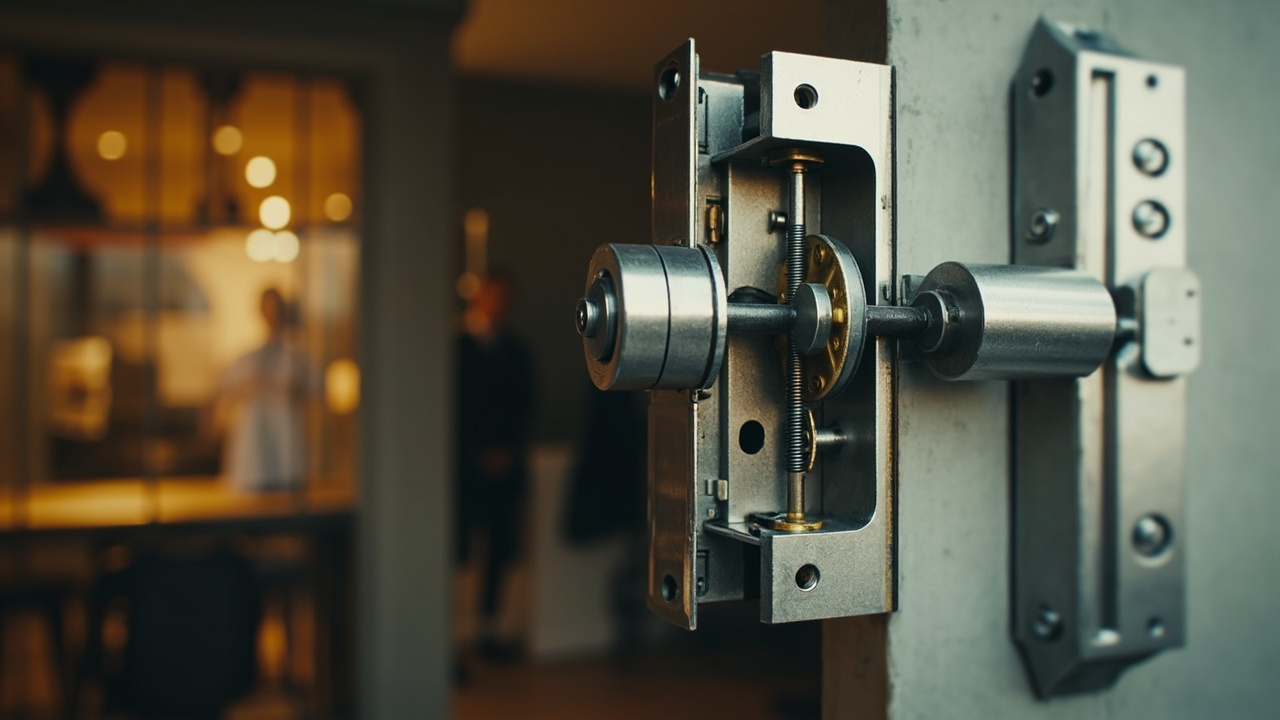
How Deadbolt Throw and Strike Drives Smart Lock Reliability
Technology claims are cheap and verification is not, so deadbolt throw and strike reliability link is treated here as a set of checks. At a qualification bench, a smart lock can do everything the demonstration makes possible: accept a credential and energize the motor before reporting an unlock. The installed door can still remain open. The deadbolt must move from its retracted position, cross the clearance in the door edge and enter the strike keeper without binding or loading the bolt sideways.
Direct answer. In brief, this article covers deadbolt throw and strike reliability link from deadbolt throw and strike reliability link to deadbolt-throw-and-strike. It states what to confirm about deadbolt throw and strike reliability link on the dated product page where a figure is involved. A deadbolt throw and strike reliability link is the engineering view of one component. deadbolt throw and strike reliability link is the behaviour that has to be reproduced. Then deadbolt throw and strike reliability link can be signed off.
On deadbolt throw and strike reliability link, this article uses deadbolt throw and strike reliability link as the definition. It treats deadbolt throw and strike reliability link as a working definition specific to this market and product, rather than a general one.
The deadbolt throw and strike reliability link is therefore not a secondary mechanical detail. It is the point where a command becomes a secured door. A system integrator has to qualify the complete interface: the lock body and mortise, latch or bolt drive, deadbolt, strike plate, strike keeper, door leaf, frame rebate and backset.
Different projects need different evidence because not every product uses the same lock architecture. The useful question is not whether a brochure contains the word “deadbolt.” It is whether the proposed assembly can complete a repeatable and recoverable locking cycle on the actual door family.
A successful command is only the beginning
The first command in the chain proves less than it appears to. A credential can reach the control PCB, the motor and gearbox can turn, and the app can display a successful command. None of those observations alone proves that the bolt completed its path. Deadbolt engagement is the physical result that matters: the bolt must enter the strike keeper and remain seated when the door is closed.
flowchart TD
    A[Credential accepted] --> B[Command reaches control PCB]
    B --> C[Motor and gearbox move bolt drive]
    C --> D{Deadbolt reaches strike keeper}
    D -->|Yes| E[Door becomes mechanically secured]
    D -->|No| F[Misalignment binding or incomplete travel]
    F --> G[Inspect geometry and mechanical drive]
That is where the word throw needs discipline. A supplier may use it for bolt travel, projected length or another defined operating dimension. Ask for the drawing, start condition, end condition and measurement method instead of accepting the word as a specification. Likewise, a strike description should distinguish the strike plate attached to the frame from the strike keeper that receives the bolt. A clear definition separates a geometry mismatch from a drive or control problem. If the answer has to survive a supplier meeting, Deadbolt Throw and Strike in High-Traffic and Harsh Environments is the next one to read.
Each arrow in the diagram represents a different owner: electronics, mechanics, the door and the installer. That division is useful during fault finding because a symptom should be assigned to an interface before somebody changes hardware. The same discipline belongs in procurement, where a motor specification is not yet a door specification.
The door is part of the lock
A deadbolt is accurate only relative to where it is mounted. The backset positions the lock body in the door leaf, while the mortise case pocket, frame rebate, door thickness, handing and the position of the strike plate determine whether the bolt can actually meet the strike keeper. Smart lock door fit is therefore a combined mechanical result, not a single catalogue dimension.
Deadbolt and strike plate alignment must be checked with the door closed, the latch fully extended and the lock body installed. If the bolt axis does not meet the keeper opening cleanly, the mechanism may carry sideways load, the motor may stall, or the bolt may stop short. A drawing can show intent; only the assembled interface shows what the parts will do.
| Interface | Qualification record | Reliability question |
|---|---|---|
| Door leaf and frame rebate | Leaf thickness, rebate geometry and fixing condition | Is the strike position stable and clear of other hardware? |
| Backset and lock body and mortise | Measured backset, case drawing and installed position | Does the body place the bolt on the intended axis? |
| Deadbolt | Supplier definition of throw, end position and section detail | Can the bolt enter the keeper without binding? |
| Strike plate and strike keeper | Plate dimensions, cavity position and fastener access | Does the keeper accept the projected bolt as intended? |
| Door hardware | Closer, hold-open device, escape device and handing | Is the operating path obstructed on the active leaf? |
This worksheet is deliberately about relationships. A correct strike dimension cannot rescue a wrong backset, and a powerful motor cannot correct a bolt being asked to enter the wrong cavity. Record the assembled condition, not a collection of disconnected parts.
Following one door through qualification
Consider an illustrative retrofit in which a system integrator is asked to replace an existing lock without changing the door family. The request sounds simple, but the useful work begins before a catalogue is opened. The integrator uses a structured field process such as the Smart Lock Retrofit Site Survey to distinguish a standardized doorway from a one-off condition.
The door is first held in its normal closing position. Its edge, frame rebate, backset, existing strike and nearby hardware are recorded. The installer then checks whether the proposed lock body and mortise can occupy the available pocket and whether the deadbolt axis lands where the strike keeper is intended. Nothing here proves that the sample lock will work; it defines the problem the sample must answer.
Next comes the assembly step. With the lock body positioned, the deadbolt is moved manually and then through the controlled actuator test. The strike plate remains visible, so the observer can distinguish incomplete travel, rubbing, rotation under load and a bolt that enters but does not seat. Any exception is recorded before power is trusted as the source of the movement.
During this walk-through, the deadbolt throw and strike reliability link is evaluated as a sequence of physical questions rather than as a headline feature. Does the body fit the pocket? Does the bolt reach? Does the keeper receive it? Can the door close under the intended hardware arrangement? If manual movement binds, electronics remain outside the initial diagnosis.
The outcome is a qualification record that travels with the sample: door type, measurements, handing, intended bolt and strike arrangement, test sequence, observed exceptions and the agreed retest condition. That record is more valuable than a generic statement that the lock fits most doors because the next installer can reproduce it and the factory can investigate it.
Telling a command failure from an interface failure
Suppose the electronic record says a credential was accepted, but the door stays open. The first branch is not “replace the lock.” Ask what the event actually proves. Did the motor move? Did the gearbox move the bolt drive? Did the bolt approach the frame? Did it meet the strike keeper? These are separate observations, and a log entry may represent only one part of the command path.
That distinction prevents a common diagnostic error: treating every failed opening as an RF problem. It also separates a jam in the lock body from a strike outside the bolt’s usable envelope. The systematic branching in Deadbolt Throw and Strike Failure Modes Seen on Smart Lock Projects provides a useful symptom map; Deadbolt Throw and Strike Test Evidence a Buyer Can Actually Request turns that map into an evidence request.
For a qualification programme, ask the supplier to state what was observed, what method produced the observation and what acceptance condition was met. “The motor operated” is an observation. “The deadbolt entered the keeper and the door latched from the defined start condition” is closer to an acceptance statement. The gap between those sentences is where project ambiguity grows.
Recovery is part of reliability
Reliability also includes the route back in when the first route fails. The first-party catalogue records a mechanical override key on 63 of the 79 published models. That is catalogue coverage, not a reliability score, but it makes the override architecture too important to leave as a checkbox. For any proposed SKU, qualify the key, cylinder, cylinder collar or rose and the mechanical path from the key to the latch or bolt drive.
A mechanical override may be present while still being awkward to use, obstructed by an escutcheon, dependent on a specific cylinder position, or unable to recover from a partially jammed bolt. Ask whether the key retracts or projects the locking element independently of the battery and electronics, and have that behavior shown on the sample. Do not infer it from a key icon in an interface.
External power override through a USB terminal is a separate recovery route from a mechanical override. The catalogue glossary includes an emergency power port and external power override via USB terminal as distinct attributes, so a buyer should ask which proposed SKU has either feature and confirm on the dated product page for the specific SKU. Recovery design is part of the reliability chain, not an accessory to discuss after commissioning.
Three ways to buy confidence, and what each one proves
At qualification, three evidence routes are common: validate on a representative door, inspect an interface sample, or review the supplier’s documents. They answer different questions, so the decision should not be reduced to the most impressive demonstration.
| Evidence route | What the buyer can observe | Best use | Blind spot |
|---|---|---|---|
| Representative-door validation | Lock body, mortise, deadbolt, strike plate, strike keeper and door hardware assembled | Approve a door family and repeat the qualification | Each other door type still needs its own record |
| Interface sample | Lock body and representative strike geometry assembled without the final door | Compare mechanisms and expose early geometric faults | It cannot prove fit on the final leaf and frame |
| Documentary review | Drawings, defined measurements, proposed test method and terminology | Normalize proposals before samples arrive | It cannot prove the physical interaction |
None of these routes is universally best. Documentary review is efficient for narrowing a shortlist. An interface sample can expose a mechanism that should not proceed. Representative-door validation is the stronger basis when a door family will be repeated. A good purchase request may use all three in sequence, with the evidence requirement stated for each.
That distinction is especially important when comparing supplier language. Reading Deadbolt Throw and Strike Claims in a Supplier Datasheet focuses on the meaning of the claims, while Deadbolt Throw and Strike and Door Compatibility: The Fit Envelope frames the surrounding door conditions. The buyer’s task is to require a definition, an observation method and an acceptance condition for each disputed term.
A catalogue fact is a starting point, not a verdict
The scale of the first-party catalogue is also easy to misread. It contains 79 published models, including 77 smart door locks, but that composition does not make their deadbolt geometry interchangeable. Category membership tells a buyer where to look; it does not resolve a strike position, bolt projection or fit condition.
A concrete catalogue example illustrates the distinction. The SLK-9936S hotel lock is listed with a 3-point latch, a 5-pin cylinder and mechanical emergency access. Those fields make it a useful named example of a multi-point locking architecture, but they are not evidence for a proposed smart deadbolt or a particular retrofit.
The same question is worked through in more detail in smart locks for large office buildings. That is the same question deadbolt throw and strike reliability link has to answer here.For the candidate lock, ask for dimension drawings, the installation guide and a datasheet on request, as the catalogue conventions allow. Then mark the deadbolt, strike plate, strike keeper, mortise case and backset on those documents. The question is whether the proposed geometry has a defined relationship that can be inspected on a sample, not whether the model family has the right label.
For the measurement side of this, see smart locks for conference rooms. That is the same question deadbolt throw and strike reliability link has to answer here.
The handoff that keeps qualification honest
A qualification package should travel with the commercial request. Give the supplier the door schedule, key measurements, intended bolt and strike arrangement, drawings of the installed hardware and the operating scenario. Ask for a sample through the order samples page, a response that identifies assumptions, and a method for recording exceptions and retesting a corrected assembly.
Then request a project-specific quotation through the request a quote page. A useful response should identify the proposed lock body and mortise, the deadbolt and strike assumptions, available drawings, the sample or validation route and any information still missing. It need not carry a headline reliability claim if it defines the interface and the evidence required to approve it.
The smart lock becomes dependable when the command path, mechanical movement, fixed strike and recovery route are treated as one engineered system. For an integrator, that is the practical meaning of reliability at the door.