
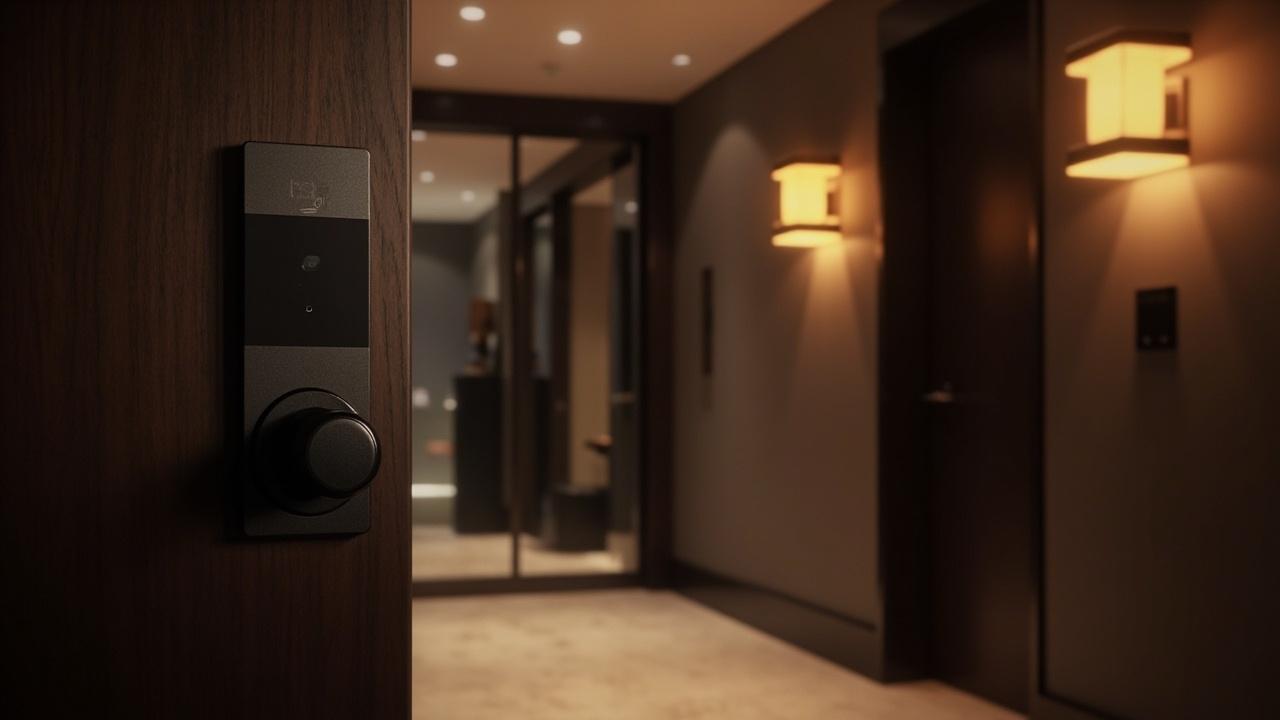
RFID Hotel Lock Security Features
The short answer, stated plainly
An RFID hotel lock is secure only as a system, and the system has exactly five layers you can inspect: the credential (the card and how its data is organized), the reader interface (radio frequency, distance, timing), the access logic (what the lock accepts, expires and revokes), the evidence layer (audit trail and event logging), and the fallback (mechanical emergency access and how it is governed). Every security feature claim a supplier makes maps into one of those five layers — or it does not map anywhere, which is its own answer. This article builds the inventory: for each layer, what the feature actually does, how it fails, and the precise question to put to the supplier before any hotel RFID lock order goes through. Nothing here is a certification claim; certifications belong on your own verification list, not in a feature conversation.
The anchor example throughout is the SLK-9936S hotel lock, whose published specification block is the first-party data we quote directly. Each line is a security feature in disguise, and most buyers read them as performance numbers instead.
| SLK-9936S spec line (product-page-documented) | Security reading of the same line |
|---|---|
| RFID Mifare 1 @ 13.56 MHz | Smart-card credential family with sector/key structure — the key plan, not the family, decides security |
| Read distance 0–5 cm | Deliberate-touch geometry; no casual long-range read at the door |
| Read time <0.25 s | Fast completed exchange during an intentional presentation |
| Audit/event records up to 1,000 | Per-lock rolling evidence buffer, independent of any network |
| 4 × AA · battery operating cycles >15,000 | Endurance; the security questions live at the end of cell life |
| 5-pin cylinder · 3-point latch | Physical resistance layer under the electronic decision layer |
| Mechanical emergency access | Sanctioned fallback path — a governance subject, not a defect |
| Standalone or centralized database modes | Two distinct revocation and audit postures, not two price tiers |
| Multilingual management software | The encoding rules (expiry, access levels) live here; who controls it matters |
Use this table as the decode key for the rest of the article: every section takes one of these lines and turns it into questions, tests and written evidence demands.
Layer-by-layer inventory: where security features live
Here is the full inventory table. Use it as a coverage checklist when reading any supplier datasheet: a serious supplier can speak to every row; a bluffing supplier will retreat to two or three rows they memorized.
| # | Security layer | Feature to inventory | What the spec line may look like | What it defends against | Buyer question to the supplier |
|---|---|---|---|---|---|
| 1 | Credential | Card data organization (sectors, keys) | "RFID Mifare 1 @ 13.56 MHz" | Generic readers, casual copying | Which Mifare family/variant does the lock read, and how is the card memory partitioned between room ID, validity dates and access level? |
| 2 | Credential | Encryption / key structure on-card | rarely printed on datasheets | Cloning, data tampering | Does the lock support per-property key configuration, and what documentation defines the sector/key plan? |
| 3 | Reader interface | Short read window | "read distance 0–5 cm, read time <0.25 s" | Relay-style opportunistic reads, wallet skimming at distance | Confirm measured read distance on the actual lock body, not the reader module alone. |
| 4 | Access logic | Time-limited credentials | encoded checkout date | Stale cards, lost cards still working | Where is expiry enforced — on the card, in the lock, or both? What happens if the lock's clock has drifted? |
| 5 | Access logic | Immediate revocation path | "standalone or centralized database modes" | Insider delay, lost-card exposure window | In standalone mode, what is the shortest realistic time from "card reported lost" to "card refused at the door"? |
| 6 | Evidence | Audit trail capacity | "audit/event records up to 1,000" | Unattributed access, disputes | What actions fill a record slot, does the buffer roll over silently, and how is it exported before it overflows? |
| 7 | Evidence | Event field depth | not printed | Log that proves nothing | Give one real exported record: which fields (user ID, room, result, timestamp) does each unlock event carry? |
| 8 | Fallback | Mechanical emergency access | "mechanical emergency access" | Dead-battery lockout, life-safety entry | Who holds emergency keys, how are blanks controlled, and is the cylinder a standard profile or proprietary? |
| 9 | Fallback | Power and tampering behaviour | "4 × AA, >15,000 cycles" | Lock-up at the worst moment | What does the lock do at low battery: still accept cards, still write audit records, alarm locally? |
Five of these rows — card encryption, revocation timing, log export, key blank control, low-battery behaviour — will not appear on any datasheet you are handed. That is the point of the inventory: hotel RFID lock security is mostly negotiated, not published.
The physics of the reader: 13.56 MHz, short range, and why it matters
High-frequency (13.56 MHz) RFID, which the SLK-9936S uses, is not the same technology as the long-range vehicle tolling or warehouse-tag systems people fear when they hear "RFID." The published 0–5 cm read distance means a guest's card must be held essentially against the escutcheon. There is no practical in-pocket harvest at arm's length in this geometry, and the sub-0.25 s read time indicates the lock completes its exchange during a deliberate touch, not a pass-by.
Two engineering consequences follow. First, the attack surface shifts from the radio link to the credential itself and to the operations around it — nobody "sniffs a hotel door" from a corridor; the realistic problems are copied cards, expired cards still working, and unmanaged emergency keys. Second, read distance is a spec you should re-verify on the assembled product. A reader module rated wider than 5 cm can end up reading through a thin door from the wrong side if the installation geometry allows it. Put this in your sample-evaluation protocol: measure read distance with the lock mounted on the actual door construction, not on a bench.
The hidden-reader variant, the SLK-9905A, adds a different security-relevant property: the touchpoint where credentials are presented is discrete rather than a visible keypad-like target. That reduces casual probing and vandalism-driven tampering, at the cost of a guest-education step. Note which tradeoff your property actually wants.
Encryption on the card: the questions that separate real setups from borrowed vocabulary
Every supplier in this category will use the word "encrypted." Treat that word as a lead, not a finding. The Mifare ecosystem spans families and generations with very different real-world security properties, and a published line like "RFID Mifare 1" identifies a contactless smart card family with sector-based access keys — but the security value in a hotel deployment comes entirely from how those sectors and keys are configured and controlled. A card family is a lock cylinder blank; the key plan is what makes it secure.
This is a gated claim area: what the specific lock model supports must be confirmed with the supplier per model, because it is not something any article or datasheet summary can responsibly assert for you. Here are the exact questions to paste into an RFQ or supplier email, with the reason behind each.
| Buyer question on on-card security | What a useful answer contains | What a hollow answer sounds like |
|---|---|---|
| Which Mifare family and variant does this lock read, and is the hotel data area write-protected independently of the transport area? | Named family/variant; sector map for the hotel application; write-protection behavior | "It reads all cards" or "Mifare, very secure" |
| Can the access keys controlling the hotel sectors be set per property, per project, or are they global/default? | A key-plan discussion; who holds the master key values; whether defaults are changed before shipping | "Factory standard keys, plug and play" — meaning shared, guessable defaults |
| How is a card's validity window (check-in/check-out) encoded, and can the card itself alter it? | Encoder-software responsibility chain; where expiry is enforced; anti-tamper behavior on re-encode attempts | Blaming the PMS, or silence |
| What stops an ordinary hotel guest from copying their key card at a library or office card writer? | Reference to protected sectors/keys that a generic copier cannot duplicate onto a blank; or an honest statement of limits | "RFID cards cannot be copied" — false and amateurish |
| How are staff/master cards protected from being cloned by an employee with a phone and a blank card? | Distinct credential area or access level that general guest cards cannot hold | Same answer as guest cards |
| If you support key diversification per property or per card, show the mechanism in writing for this model. | Documented diversification approach for the quoted model, not the catalog's flagship only | Evasive "our algorithm is confidential" |
A supplier who answers the second and sixth rows concretely has an encryption story. A supplier who answers them with adjectives does not. Whatever the answers are, get them in writing and attach them to the purchase order — that document is the thing your security insurer, your brand's IT reviewer, or your own future auditor will want, not a datasheet PDF.
Replay and clone resistance: enumerate the attack paths, then the lock's side of each
Clone resistance is not a single feature; it is an outcome produced (or not) by several mechanisms working together. Rather than ask "is it clone-proof?" — a question with no honest yes — walk the attack paths.
| Attack path | How it is attempted in a hotel setting | Mechanism that resists it | Where the mechanism lives | Buyer verification step |
|---|---|---|---|---|
| Straight copy of a guest card | Employee or guest writes card contents onto a blank at a desk | Protected sectors whose keys a copier does not possess | Card + lock key configuration | Ask supplier: can a generic cloner reproduce a working guest card from a read-only copy of your issued card? Get the answer in writing. |
| Replay of captured reads | Recording the radio exchange and replaying it later | Challenge-response interaction rather than static ID broadcast | Lock firmware protocol | Ask whether the authentication exchange is challenge-based for this model; static card-number checks replay trivially. |
| Valid-but-stale card | Yesterday's guest card used on an unturned room | Expiry date enforced at the lock, plus housekeeping check-in status | Card data area + lock logic | Bench test: encode a 1-day card, verify refusal the next day without touching the lock. |
| Revoked card | Reported-lost card still opens because revocation never reached the lock | Centralized mode push, or standalone-mode re-sync procedure | Software + operations | Time the revocation path in your pilot; in standalone locks revocation is an operational workflow, not a button. |
| Brute-force card fleet | Issuing many cards hoping one has elevated rights | Access-level separation (guest / floor / master) in card data | Encoding software rules | Ask to see how the management software distinguishes access levels and who can issue a master. |
| Physical relay at the door | Third party holds the guest's card near the reader while a second person is elsewhere | Short 0–5 cm deliberate-touch geometry | Reader interface | Confirm the model's measured read distance on your pilot door. |
The honest summary to expect from a good supplier: clone and replay resistance on hotel RFID locks is a joint product of protected card sectors, per-property key configuration, expiry enforcement in the lock, and disciplined card operations. If any of the four is missing, the other three carry a weaker load than marketed. Gate every strong claim — "uncloneable," "military-grade," "bank-level" — as a written question, and accept only model-specific answers.
Your card fleet is an attack surface: the lifecycle nobody budgets for
Hotel lock security failures in practice are mostly lifecycle failures: cards issued and never revoked, master cards copied at the laundry, seasonal staff credentials from three seasons ago still valid. The lock features support good operations; they do not replace them. Inventory your credential lifecycle the way you inventory linens.
| Lifecycle stage | Security-relevant decision | Failure mode if unmanaged |
|---|---|---|
| Blank card purchasing | Which encoding system the blanks are compatible with; batch discipline; keeping stock secured | Mixed blank batches with different memory layouts; blanks sold or stolen from housekeeping shelf |
| Encoding at check-in | Validity window accuracy, room binding, access level | Front desk "fixing" a card by extending validity manually |
| In guest's hands | Card is a bearer token: whoever holds it holds the room | Lost card reported late or not at all |
| Checkout / lost | Expiry date arrives; revocation if early loss | Stale-card entry to an uncleaned room; incident reports with no log trail |
| Staff credentials | Floor masters, sectional keys, IT/engineering cards issued by role | Staff cards copied, shared, or never recalled after departure |
| Emergency/master tier | Tightest control: numbered, logged, counted at shift change | Unnumbered master card circulating for years — the single worst exposure in a hotel RFID estate |
| End of life / property change | Re-key of the electronic estate: new key configuration across locks and cards | "Same cards, new operator" — inherited credentials from the previous owner |
The end-of-life row deserves emphasis for acquisition and rebrand projects: replacing locks but carrying over the old card fleet and encoding defaults means inheriting the previous operator's credential knowledge. Ask any supplier selling you replacement locks how a full key-plan reset is executed across the fleet, and whether previously issued cards are definitively dead afterward.
The audit trail: 1,000 records is a buffer, not a reporting system
The SLK-9936S specification block states audit/event records up to 1,000. That number is PDP-cited first-party data, and it tells you something real: each lock is a standalone evidence source holding a rolling window of recent events even if no network touches it. In a 120-room hotel, a 1,000-record-per-lock buffer is deep for a single door — a busy room might generate a handful of unlock events a day, so 1,000 records can cover months of activity at one door. Depth is not the risk.
The risks are retrieval, rollover, and content.
- Rollover. A 1,000-slot buffer either overwrites the oldest record or refuses new records. Which behavior this model exhibits, and what the management software does when pulling from a full buffer, are per-model facts to verify in writing with the supplier before you rely on logs in any dispute.
- Retrieval. In standalone mode, pulling logs means connecting the management software at the lock or via the workflow the model supports. The question is not "does it have logs" but "what is the complete procedure to extract logs from 120 locks in one afternoon, and how many staff-hours does it cost?" If the answer is "you won't want to do that," the audit feature is decorative.
- Content. A record that says "card used" is trivia. A record usable in an incident is: timestamp, credential ID, access level presented, result (granted/denied), and — where the lock knows it — which credential class was refused and why (expired, revoked, wrong room).
| Audit capability to demand | Weak implementation | Hotel-grade implementation | Question to supplier |
|---|---|---|---|
| Record depth | "Some events stored" | Published, e.g. up to 1,000 records per lock (PDP-cited for SLK-9936S) | What is the exact per-lock capacity of the quoted model? |
| Event classes | Unlocks only | Unlocks, denials, battery warnings, mechanical-key use if detectable, programming events | List every event type that writes a record. |
| Timestamp integrity | Clock reset on every battery swap | Clock behavior across battery changes specified | How does the lock preserve its clock during battery replacement, and what happens to record ordering? |
| Export format | Screen you photograph | File export from management software, per-lock or fleet | Show one real export file. |
| Rollover policy | Undefined | Defined overwrite or halt behavior plus alert | What does the software show when a buffer is full? |
| Modes | One-size-fits-all | Standalone buffer plus centralized database aggregation, per spec's "standalone or centralized database modes" | In centralized mode, do events reach the server live or on sync? |
The standalone-versus-centralized line in the spec block is genuinely two different security postures, not two convenience levels. Standalone: evidence lives at the door, is collected on a schedule you define, and can be quietly missed. Centralized: events aggregate to a database, revocation and reporting get stronger, and the property now has an IT surface to secure — server access, network segmentation, backup. Both are legitimate; the wrong move is choosing by price per lock without costing the operational model.
Event logging as evidence: a worksheet you fill in with the supplier
Turn the vague feature "logging" into an acceptance test. Fill the target column for the model you are actually quoting, not for the brand in general.
| Field a defensible log record should carry | Present in quoted model? (Y/N/per supplier note) | Exported as readable file? |
|---|---|---|
| Lock/room identifier | ||
| Timestamp with time-zone/offset handling | ||
| Credential identifier (card serial or mapped ID) | ||
| Access level of the credential presented | ||
| Result: granted / denied | ||
| Denial reason where known (expired / wrong room / revoked) | ||
| Battery state at event time | ||
| Programming or configuration changes | ||
| Mechanical/emergency access indication if detectable | ||
| Clock events (set, drift correction) |
Rows where the supplier says "not in the record" are not disqualifiers; they are documented limits you can then compensate operationally. The disqualifier is not knowing which rows are empty. For context on how this spec-line-by-spec-line interrogation works on other feature areas of the same lock, the customization guide dissecting the 9936S datasheet uses the same frame; incoming-goods checks against a written spec live in the quality inspection checklist.
Mechanical fallback: emergency access is a feature, and a policy problem
The SLK-9936S spec lists mechanical emergency access. In hotel operations this is sanctioned and unavoidable: fire response, medical entry, dead-battery lockouts, and maintenance all require a path that does not depend on radio, firmware or battery state. The security conversation is therefore never "should there be a mechanical override?" — it is "how is the override governed?"
| Emergency-access question | Why it is security-relevant | What to demand |
|---|---|---|
| What emergency key system ships with the lock, and are blanks commercially available? | A proprietary or controlled blank materially raises the bar; an off-the-shelf blank means any hardware store is a key source | Blank control statement for the quoted model |
| Does mechanical key use generate any detectable signal or record? | If not, your audit trail has a known silent channel | Honest written statement of whether mechanical entry is visible in logs |
| Is the cylinder the same across the property or per-door varied? | One lost emergency key's blast radius | Keying strategy options in the catalog's hotel line |
| How are emergency keys counted, stored, and shift-logged operationally? | The classic hotel incident is a master key, not a hacked card | Supplier guidance plus your own SOP (housekeeping/FB/security tiers) |
| What is the door's behavior when mechanical and electronic access conflict (card presented while key-side engaged)? | Edge-case jam-outs and false denials | Bench-test item in your pilot |
| Does the 5-pin cylinder and 3-point latch arrangement change the forced-entry picture versus a plain deadbolt? | Physical resistance of the latch/bolt work, not just the credential layer | Confirm bolt/latch engagement depth and frame-strike requirements for your door construction |
Two engineering notes. The published 5-pin cylinder and 3-point latch are physical-security features in the same inventory as the electronics — they determine pry resistance and how much the credential layers matter at all; a lock mounted on a frame that kicks in has a poor security chain no matter what the card holds. And because emergency access is mechanical, it survives the failure mode every electronic feature shares: none of them work when power is gone. That is the next layer.
Power, tampering and failure modes: the unglamorous security rows
Battery operating cycles above 15,000 (PDP-cited for the 9936S) is endurance language, but the security questions live at the ends of the battery's life, not the middle:
- Low-battery warning chain. Does the lock signal early enough for housekeeping to swap cells before a guest is stranded, and is the warning itself an event record? Confirm the per-model behavior.
- Power loss and the clock. If timekeeping resets on cell replacement, expiry enforcement and log timestamps inherit that drift. Ask what maintains RTC across a battery swap, and what the re-sync procedure is.
- Data survival. Do buffered audit records survive complete power loss? The answer is model-specific firmware behavior; get it in writing before trusting logs in a dispute.
- Tamper physical surface. Visible-reader designs invite taped-over readers, scratched escutcheons, and glue in the card slot as harassment tactics; hidden-reader models trade visibility for that exposure. Which failure mode your property actually sees (guest mischief vs. targeted intrusion) should be an evidence question to your own operations team before it is a spec question to the supplier.
- The door and frame. Every hotel lock feature is downstream of door construction: sagging frames mis-align latch work, warped doors press bolts hard, and maintenance-deferred properties see denials that look like security failures but are carpentry. The maintenance guide covers the recurring care that keeps the security story true.
Standalone versus centralized: choosing the security posture, not the price point
The catalog's hotel line, including the 24 hotel models published on the site, spans designs from simple standalone card locks to models supporting centralized database modes. For security purposes the choice is a trade table:
| Dimension | Standalone posture | Centralized posture |
|---|---|---|
| Revocation speed | Bound by physical re-sync workflow; measure it in your pilot | Faster, driven by system design; confirm sync mechanism per model |
| Audit evidence | Up to the per-lock buffer (e.g. 1,000 records, PDP-cited on 9936S); pull it deliberately | Aggregated to a database; stronger reporting, new IT surface to protect |
| Failure independence | Each lock fails and is fixed alone; no property-wide outage | Shared services create shared outages; ask about offline behavior at the door |
| Attack surface | Almost entirely physical/credential-side | Adds server, credentials to the server, and whatever links locks to it |
| Staff model | Front-desk encoding + scheduled collection rounds | IT-adjacent skills required; define who owns the server |
| Best fit | Small properties, simple estates, phased retrofits | Multi-property groups, brands with IT standards, high-turnover urban hotels |
The mistake to refuse: buying centralized-capable hardware and running it standalone forever because nobody owns the software. That pays for a security posture you never operate. Equally bad: choosing standalone economics for a 300-room high-turnover property and discovering the revocation workflow is a second job. The hotel lock category pages list which models support software management; match posture to property profile, then let the model shortlist follow.
Illustrative scenario: a security walk-through of a 140-room hotel
Consider a 140-room city hotel, mid-scale, two elevators' worth of identical corridor construction, currently running key cards on an aging lock fleet. Management has had two incidents this year: a guest card reused the day after checkout, and an unaccounted master card. They evaluate RFID hotel locks with a security lens. Here is how the inventory above plays out, floor by decision.
Credential layer. The evaluator asks each candidate supplier the on-card key-plan questions from the encryption table. One vendor answers "encrypted Mifare" and nothing further; two provide written, model-specific statements about sector protection and per-property key setup. The first vendor is dropped — not because their product is insecure, but because their knowledge is unprovable.
Revocation. They pilot 10 locks of the shortlisted model (a card lock in the SLK-9936S family) on one floor, time the lost-card workflow end-to-end from front desk report to tested refusal at the door, and put the measured number into the staff SOP. Whatever the lock supports, the workflow is what fixes the day-after-checkout incident: expiry dates are encoded at check-in by default, and the pilot confirms the lock refuses the expired card without any network involved.
Evidence. During the pilot they pull the audit buffer weekly, exercise the export, and inspect one real record against the event-field worksheet. Three fields exist (room, time, result), two they wanted do not. The team documents this as a known limit and compensates: master-card movements are logged on paper at shift change because electronic logs will not show them.
Fallback. The unaccounted master card incident forces the mechanical conversation: numbered emergency cylinders, blanks held at one desk, quarterly reconciliation, and a written note from the supplier on whether mechanical use appears in logs for the chosen model. If it does not, the paper reconciliation is permanent.
Power. The battery-warning behavior is tested deliberately: one pilot lock is run to depletion to observe what the guest-side and housekeeping-side signals look like. The outcome feeds the PM schedule — annual cell replacement by calendar, not by complaint.
At the end of the pilot the evaluator holds artifacts, not opinions: written key-plan statements, a measured revocation time, an exported log sample, a stated mechanical-access logging behavior, and a battery SOP. Every one of those came from asking the inventory questions.
The supplier evidence scorecard
Score shortlisted suppliers on security evidence, not security adjectives. Weight it the way your risk actually falls: in hotel RFID, operations and credential control outrank radio exoticism.
| Criterion (weight) | 0 — nothing in writing | 1 — generic claims | 2 — model-specific written answers |
|---|---|---|---|
| Card/key-plan transparency (25%) | "Encrypted" as the whole answer | Family named, configuration vague | Written key-configuration options for quoted model |
| Clone/replay position (20%) | "Cannot be copied" | Hand-wavy | States mechanism and honest limits |
| Audit trail depth (20%) | Capacity unknown | Capacity quoted | Capacity plus export sample and rollover behavior |
| Revocation path (15%) | Never discussed | "Easy" | Documented workflow pilotable on sample locks |
| Emergency key governance (10%) | Blanks unaddressed | "Standard keys" | Blank-control and keying-strategy statement |
| Failure behavior (10%) | Unasked | Reassurances | Written low-battery, clock and data-retention behavior |
A 9-point maximum is not a pass mark; the criterion-level zeros are the signal. One zero in card/key-plan transparency should stop evaluation regardless of total, because every other layer's security depends on it. For the broader supplier-selection frame this scorecard plugs into, see how to choose hotel smart locks and the RFID lock category.
What changes a purchase order
Three habits convert this inventory into procurement leverage. First: attach the supplier's written security answers to the purchase order, so a sample that behaves differently than the quoted model is a contractual mismatch, not a disappointment. Second: pilot before bulk — order samples, run the revocation timing, pull the audit buffer, drain a battery, and read one log export. Third: keep certification claims out of your specification text entirely; you ask suppliers for documentation and verify independently, and you write acceptance tests, not certificates, into what you order.
The features themselves — short-range 13.56 MHz reads, protected card sectors, expiry enforced at the lock, rolling audit buffers up to 1,000 records on models like the SLK-9936S, governed mechanical fallback — are all available in the published hotel line. Which model carries which, at what depth, is a per-model conversation. Put the tables in this article in front of a supplier, and their answers will tell you more about their security posture than any brochure. When the questions are answered, request a quote with the agreed feature list attached, or order samples to run the pilot yourself.