
Video Intercom and Door Station for a Multifamily or Office Portfolio
An integration failure is usually a sequence failure, so video intercom and door station portfolio case is traced here from handover to commissioning. The question a portfolio buyer brings is rarely which video intercom and door station to buy. A property group holding a residential block and an office building does not have one entrance: it has a lobby, a service door, a car park barrier and shared cores that behave nothing alike.
Direct answer. Short version — video intercom and door station portfolio case is treated here as video intercom and door station portfolio case first. video-intercom-and-door-station comes second. The evidence for video intercom and door station portfolio case is named in the sections below. A video intercom and door station portfolio case is an integration view. Lock, door, reader and system have to behave together. video intercom and door station portfolio case is where the first interface behind video intercom and door station portfolio case fails.
- Trace the interface — write down what hands over between lock, door and system at video intercom and door station portfolio case
- Verify the handover — record the sequence that proves video-intercom-and-door-station works end to end
- Preserve the trail — store the commissioning evidence with the file for four ways
- For video intercom and door station portfolio case, the order below is fixed and video intercom and door station is the reference point.
Each entrance wants a different answer to who takes the call, what the answer is worth, and what gets written down. One model and one platform do not remove that work; they relocate it into the part of the project nobody has named.
In a video intercom and door station portfolio case, the useful arena is not the catalogue. It is a comparison of operating models: how a portfolio answers a call, where the release decision is taken, and what the doors do when the platform cannot be reached.
Four ways to run one estate
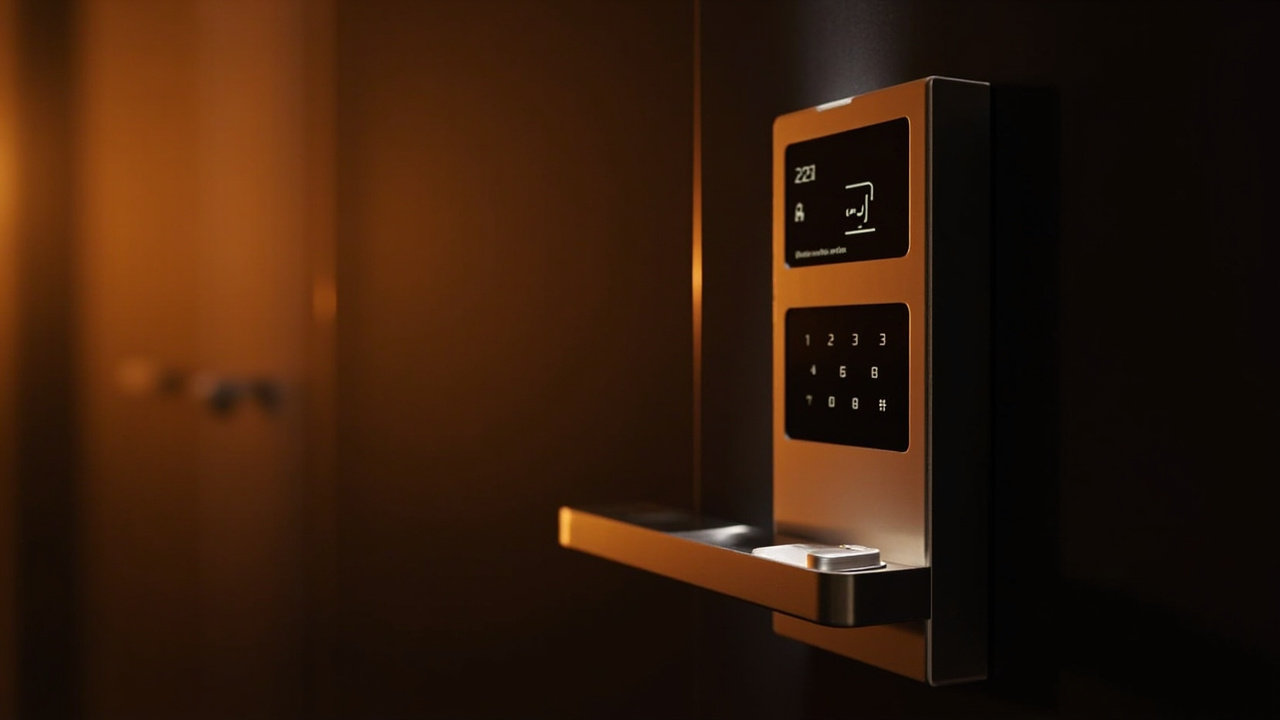
Four models recur in multifamily and office portfolios. They differ in where a call is answered, where release authority sits, and what survives an outage. The closest catalogue record is the SLK-1105 3D Face Recognition Smart Lock with Remote Video Intercom; confirm the specific SKU on its dated product page.
| Model | Call answered at | Release authority | Weakest point |
|---|---|---|---|
| Central desk | One operations centre | The centre | One roster gap silences all lobbies |
| Local answer | Each entrance, on site | The site | Depends on staff who leave at six |
| Template replication | Each site's own instance | The site | Uniform at handover, divergent later |
| Class-split hybrid | Centre for lobbies, site for service | Split by class | Needs the class list settled |
The choice is not about features. The portfolio intercom operating model turns on where authority concentrates and how far one failure travels. A central desk widens the blast radius; local answering keeps failures narrow but depends on a roster.
The entrance classes that decide the comparison
Split the estate's doors into classes before comparing models: groups that share who answers, what the answer is worth and what must be recorded.
| Class | Who answers | Release authority | Record that must exist |
|---|---|---|---|
| Residential lobby | Resident, concierge on request | Site controller | Call, credential, decision, release |
| Office lobby and shared core | Reception, badge out of hours | Site controller | Call, badge, decision, release |
| Service and loading door | Nobody, call routed | Site controller, restricted class | Call, decision, release |
| Contractor holding point | A dated credential | Site controller, dated rule | Credential issue, decision, expiry |
An estate rule written for one class and applied to all of them sends a courier to a night desk. The Office Smart Lock Site Survey records door conditions before the classes are fixed, because a class boundary follows the hardware and power arrangement.
Where the release decision should sit
A call is not a release. The door station reports that somebody wants to come in; it does not decide. Three places can hold that decision: the door station, which holds no authority to lose; the site controller, which holds the door state and can decide locally against the rule it holds; and the estate platform, which holds the estate rule but no knowledge of the physical door, so its fallback must be local and named in advance.
flowchart TD
  A[Call raised at a door station] --> B{Call routed to}
  B -->|Local station| C[Resident or guard answers]
  B -->|Central desk| D[Remote operator answers]
  B -->|No answer| E[Local policy decides alone]
  C --> F[Authorisation request]
  D --> F
  E --> F
  F --> G[Controller holds the door state]
  G --> H[Release command]
  H --> I[Event written to the estate record]
The lock reports the state and the system decides what the state means, so call path and release path are drawn separately. A request to exit signal says the door was operated from the escape side; it is not a release command.
Portfolio buyers also ask whether one credential and one platform can cover every building. Ecosystems such as Matter, Thread, Zigbee, Z-Wave, Apple Home Key, HomeKit and UWB come up — confirm on the dated product page for the specific SKU which of them, if any, applies to the proposed door station and controller.
Residential entries and office entries pull in opposite directions
A portfolio that mixes housing and offices does not have a traffic pattern; it has two. This multifamily door station comparison is less about the hardware than about the demand patterns behind the estate.
| Dimension | Residential block | Office building |
|---|---|---|
| Visitor profile | Deliveries, contractors, guests | Couriers, appointed visitors, colleagues |
| Credential lifetime | Follows a tenancy that ends | Follows employment or a contract |
| Reporting question | Who let a stranger past, and where | Which company a visitor came for |
The Video Intercom and Door Station for a Hotel Property covers the third demand pattern that often joins these two. Offices are usually better served by badge-first access; housing needs the intercom for the ordinary arrival. Compare Smart Locks for Office Buildings with Smart Lock Access Management for Rentals. Averaging the two produces an estate wrong in both directions.
A credential that crosses the estate and stays scoped to it
A credential is what a person holds, identity is the person behind it, and personalisation is the per-person data on it. Portfolios break when the third is used as the first: one card number then opens a door in a building the holder has never visited.
The directory should hold identity and the site should hold scope, and the estate must answer in writing what happens to that scope when someone moves between buildings or leaves the group. A decision record has to name the site, the door and the credential.
The visitor side carries its own scope questions, from the notice a visitor sees to the expiry that ends the credential; Smart Lock Visitor Management sets out the issuance mechanics an estate inherits.
Multi-site intercom records and the reader allowed to open them
The audit log is a record of an event with a time and a source; event memory is the buffer a device keeps when it cannot reach the server. In a portfolio the gap between the two is where a release disappears: the controller buffered the event, the platform was unreachable, and nobody reconciled it afterwards.
The estate needs three things written down per class: where events go when the platform is healthy, where they queue when it is not, and who reconciles them after an outage. Exports must be readable by someone who was not on site.
CONFIRM-WITH-LOCAL-PRIVACY-OFFICER: Confirm which call, video and access records may be viewed, exported or retained in each jurisdiction in the estate, with the approved purpose and retention period.
CONFIRM-WITH-LOCAL-PRIVACY-OFFICER: Confirm the lawful basis, notice requirements and recording scope for call, voice and video material captured at entrances.
The blast radius when the centre disappears
The right question for each dependency is what still works at the door when it is gone. Intercom degraded mode planning is part of the operating model, and the offline case is the design rather than the exception.
| Failure | Central desk | Local answer and replication | Class-split hybrid |
|---|---|---|---|
| Platform unreachable | No new call routing | Unaffected at the site | Lobbies lose routing, service doors work |
| Site controller down | That site cannot be commanded | Same | Same unless a fallback exists |
| Network path down | Centre may route calls elsewhere | Site operates locally | Class behaviour holds if it matches |
Fail-safe and fail-secure describe the state a lock takes when power is removed; which is correct follows the door's role and the approval. The Video Intercom and Door Station Failure Patterns and How to Recover sets out the recurring failure shapes.
CONFIRM-WITH-LOCAL-EGRESS-AUTHORITY: Confirm escape-side operation, permitted force and motion, and release behaviour under loss of power for each entrance class.
CONFIRM-WITH-LOCAL-FIRE-ENGINEER: Confirm any fire-alarm interface, the release sequence and the authority-to-release boundary before a lobby is connected to a life-safety system.
One clock for an estate spanning more than one time zone
Events with two clocks cannot be reconciled, and an estate multiplies the problem: a call raised at a lobby, answered by an operator in another region and released by a controller on site time produces three timestamps for one action. The estate needs one named clock authority, a mapping between source time and record time, and a drift check per site.
The practical test is whether one call can be reconstructed from the record: which door, who answered, what was decided.
Scoring the four models against what a property manager asks
Score the models in two passes: a gate that fails cannot be offset by strength elsewhere, so gates come first and the ranking applies only to the survivors. The Video Intercom and Door Station: The Test Plan a Buyer Should Demand supplies the evidence each model would have to produce.
| Question a property manager asks | Why it is a gate | Where the models differ |
|---|---|---|
| Who let a visitor in? | An incident question, no blank | Central desk keeps one voice; local models may not |
| Does a service door ring my phone at night? | Noise disables equipment | Local answer and class-split; central desk fails |
| What happens when the platform is down? | Doors must still have an answer | Local answer and replication with fallback |
Call routing and release authority sit at the top of this list because the other answers follow from them. The weighting belongs to the property manager; the integrator's contribution is to make the comparison explicit enough that the weighting is a choice, not an inheritance.
Rolling out across an estate that cannot stop working
Portfolio rollout is a sequence question, and the sequence decides which class's rules get written first. One class across the estate proves the class rule in several sites and suits portfolios with a dominant lobby class. One building followed by a template proves the whole model end to end and suits estates whose buildings differ most. An estate-wide cut-over suits a portfolio with a single entrance class.
The estate-wide door station template should carry its exceptions as a named list, not an unwritten understanding.
What to obtain in writing before the comparison is scored
Each model is only as good as the evidence behind it. Before scoring, ask every supplier for the dated product page for the specific SKU behind each device, the interface definition between door station, site controller and platform, the degraded behaviour for each dependency, the record set produced at a call and a release, and the credential scoping model.
CONFIRM-PER-SUPPLIER: Request dated interface documentation and degraded-mode descriptions for the specific proposed configuration, and verify them against the delivered build.
A video intercom and door station portfolio case is settled by those documents and by the estate schedule, not by the demonstration. The Who Owns Video Intercom and Door Station: Supplier, Integrator or Client matters more in a portfolio, where more parties can change a setting without telling the others.
Where the comparison leaves the decision
The deliverable is an estate schedule. For each entrance class it names the answer point, the release authority, the record written, the degraded behaviour when a dependency is missing, the clock that stamps it and its owner. One schedule, applied to every site, with exceptions written down as exceptions.
The Hotel Smart Lock vs Access Control System comparison and the Smart Lock Factory Audit Checklist for International Buyers close the loop from estate design to supplier evidence, and the SmartLockFactory buyer resources library carries the rest. Send the schedule with the device list and the class rules through request a quote, so the quotation answers the estate rather than a product sheet.