
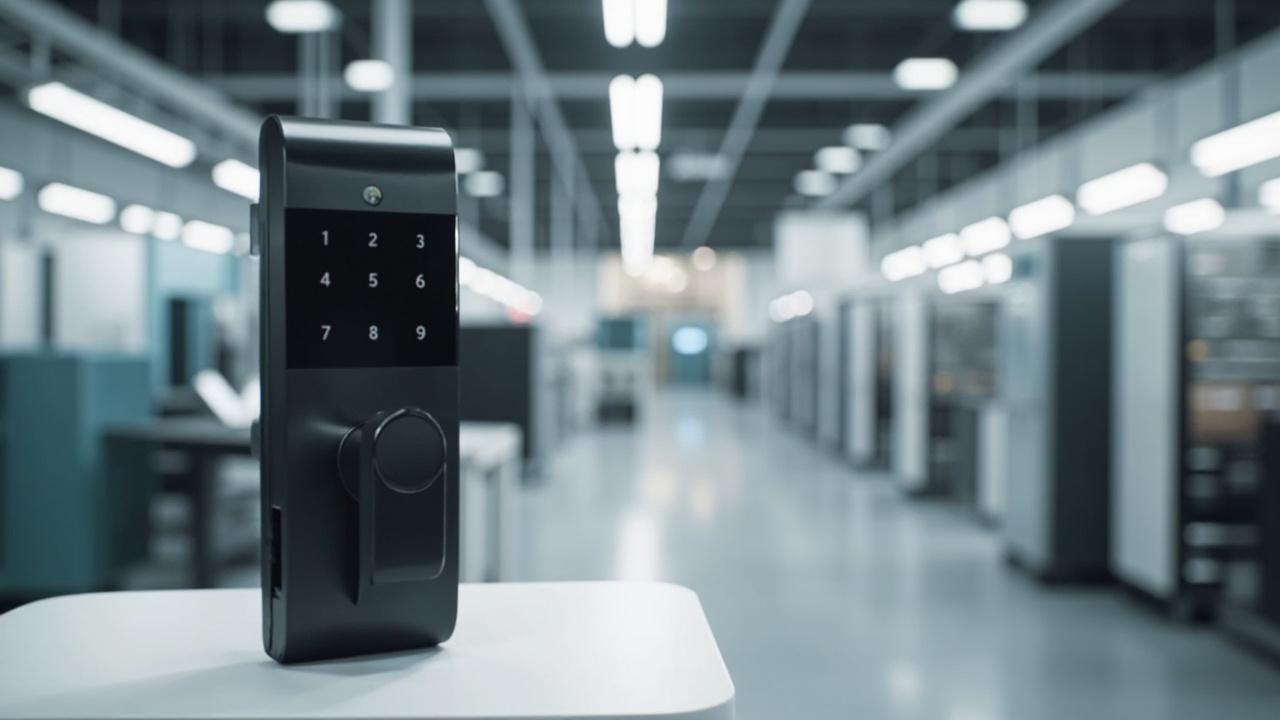
Smart Locks for Executive Offices
Consider an executive floor in a corporate headquarters. The floor is quiet at 07:30 when the CEO, whom we will call Celine, walks in through the service lift with a coffee in one hand and a briefcase in the other. She is followed, six paces behind, by her executive assistant, whom we will call Mara, carrying a stack of paper-board binders and a phone already ringing. The CEO's office door, the boardroom next door, and the corridor door at the lift lobby are the three doors that matter most on this floor today. A fourth door, the after-hours service entry at the back of the floor, is the door that will matter most at 22:10 tonight when Celine's driver arrives to collect her from a charity dinner and the building's front desk is closed. Four doors, four personas, one floor. Treat every name and number below as fiction built to illustrate a decision.
Direct answer: the executive floor is a four-door specification, not a hardware list. The hardware is the second-order decision; the first-order decision is the assignment of credential class to four distinct access patterns — the partner-grade CEO office (permanent personal credential plus a mechanical-hallow fallback), the EA's role-bound standing access (a credential that travels with the desk, not with the individual), the boardroom's ad-hoc guest lane (a time-bound PIN or single-use card issued at the door), and the after-hours car-collect discipline (a service-lane credential scoped to a fixed evening window). A catalog of 79 published models supports all four, but no single SKU covers every pattern on a single door — the floor needs two lanes on the CEO door and one lane on each of the other three doors, and the lock plan has to express that explicitly before any model is named. Per-model lines — template capacity, user-role structure, time-bounded PIN behaviour, audit log depth, mechanical-key override design, app/Bluetooth lane family, door-thickness envelope, finish, battery class — check the model’s published specification.
This piece is deliberately narrower than its siblings. Smart locks for corporate offices walks a 150-employee multi-floor HQ and treats the executive floor as one zone among many. Smart locks for meeting rooms zooms into the boardroom with a turnover-based lens that fits hotels and co-working but misses the executive floor's specific combination of CEO office, EA standing, boardroom ad-hoc, and after-hours service lane. Fingerprint smart locks for private offices is one door for one partner, told in one aisle at single-door scale; the executive floor is the same door problem multiplied by four and run against a different boss. If you are buying the executive floor as a sub-pilot of a larger HQ rollout, you are in the right room.
Why the executive floor is its own lock plan
Three differences separate the executive floor from the rest of the building, and they make a corporate-spec lock plan the wrong document for this floor.
- Population is small but political. The floor admits fewer than ten people on a permanent basis — the CEO, the EA, one or two senior direct reports, occasionally a deputy — and a handful of guests a week. The credential database is short, but every name on it is a political fact. A fingerprint on the CEO's door is not the same object as a fingerprint on a junior employee's door; the smaller the list, the louder each name reads.
- The EA stands in for the boss. No other floor in the building routinely delegates its principal's standing access to one named individual. The CEO may arrive at 06:00, leave at 23:00, work from home, take a two-week vacation, or be unreachable on a flight; in every case, the EA is the person who must be able to enter the office, manage guests in the boardroom, and hand the after-hours room to the driver. The lock plan has to express that delegation explicitly, on paper, in hardware, and in custody of the mechanical key.
- After-hours traffic is real and bounded. The CEO does not leave at 17:00 with the rest of the building. She leaves when the work is done, often after 21:00, and she is met at a service entry by a driver, not at the front desk. The car-collect routine is the most predictable after-hours pattern on the floor and the one most often handled casually. The lock plan has to express it as a service-lane credential, scoped to a window, with a custody chain that does not depend on the front desk being staffed.
A 79-model catalog with 77 smart-door-lock SKUs, 37 fingerprint locks, 18 keypad locks, and 9 RFID locks can render all four patterns, but the question is not which model to pick. The question is which combination of credential classes the floor needs, in what governance lane, with what fallback. The article treats hardware as the second-order decision.
The four doors of the executive floor
The executive floor in our scenario is a single wing with four doors. Each door is a row in the four-door specification below.
| Door | Primary persona | Secondary persona | Credential class | Governance lane | Mechanical fallback |
|---|---|---|---|---|---|
| CEO office door | CEO (Celine) | EA standing access when CEO is absent | Personal biometric + role-bound second lane | Executive-security | Yes — sealed envelope, EA custody + supervisor spare |
| Boardroom door | CEO as host | Direct reports; ad-hoc guests; visiting counsel | Host credential + single-use, time-bound PIN | Executive-security | Yes — same envelope, EA custody |
| Lift-corridor door | All executive-floor credential holders | After-hours staff alone (who on call) | Personal credential (biometric / card) | Executive-security | Mechanical-key route via service door |
| After-hours service door | CEO's driver | After-hours staff; building security rounds | Time-window service PIN | Domestic-servicing | Mechanical-key envelope, building-security custody |
The four rows are the spine of the floor's lock plan. The first three sit on the same governance lane because the events they record are the same kind of evidence (executive decisions, boardroom attendance, EA standing). The fourth row sits on a different governance lane because the events it records are service events — who brought the CEO her car, when the building was checked, who held a service key overnight. Check the model’s published specification and in the software configuration whether a given model and software combination supports the two-stream governance split the floor requires.
People map for one floor
The clean way to design the floor's access constitution is to list every human being the floor will meet in a year and sort them by what their relationship with the floor actually is. For our scenario the list runs to about ten entries.
| Person or group | Relationship to the floor | Standing they need | What the lock does for them | Lane to check against the model specification |
|---|---|---|---|---|
| The CEO (Celine) | Owns the office and most of the floor's events | Always, unconditionally | Settles daily use; removes the key hunt; survives a phone-dead morning | Failure behaviour on wet or worn finger; second-enrollment capacity; mechanical-key override |
| The EA (Mara) | Role-bound delegation, daily, sometimes when CEO is absent | CEO office when CEO is out; boardroom always; service door in window | Removes the awkward "who has the spare key" question at 22:10 | Deletion route on EA handover; whether role can be reassigned without re-enrolling every direct report |
| Two senior direct reports | Standing presence, daily | Their own offices and the corridor and boardroom | Settles daily access; preserves their names from the executive door's enrollment list | User-role structure (does a direct report get a separate role, or is the EA's lane re-used?) |
| Visiting counsel / bankers / regulators | Occasional, ends on schedule | Boardroom only, never by hours at the CEO office | Wrong tool for a finger; right tool for a one-shot PIN issued at the door | Whether the model supports a genuinely one-use or time-bounded PIN, as opposed to a permanent code |
| The CEO's family (rare, after-hours) | Depends on the firm | Service door, late evening | Wrong tool for the office door; right tool for the car-collect lane | Whether non-staff enrollment is a conversation the firm wants on the executive door at all |
| The CEO's driver | Recurring, late, scoped window | Service door only, in a fixed evening window | Wrong tool for the office door; right tool for the service PIN | Time-bounded PIN support; rotation cadence; window-discipline policy |
| The after-hours security officer | Recurring, scheduled | Service door and corridor, all hours | Wrong tool for the office door; right tool for a building-side credential | Building-side roster integration, if any |
| The cleaning crew | Recurring, unsupervised, rotating bodies | Office, boardroom, corridor in fixed windows | Wrong tool for biometrics; right tool for a windowed PIN | Windowed PIN support; roster rotation cadence; mechanical-key envelope on the service door |
| The boardroom caterer | Episodic, scheduled | Boardroom only during set-up and strike | Wrong tool for the office door; right tool for a windowed PIN on the boardroom | Windowed PIN support; how the caterer's PIN is issued and revoked |
| The IT or security auditor | None, but a veto in practice | Reads logs; does not enter | Not applicable | Audit-log depth, read-out path, retention cadence |
The middle of that table is the answer to most of the executive-floor questions. The CEO is the only person whose relationship with the floor is permanent in a personal sense. The EA is permanent in a role sense. Everyone else is bounded in time, in space, or in both. The floor needs one biometric lane for the personal-credential rows, one role-bound lane for the EA, one time-bounded PIN lane for the guests and scheduled rows, and one service-window PIN lane for the after-hours rows. Two lanes for the CEO door (biometric + role-bound EA), one lane for the boardroom (host + PIN), one lane for the corridor (personal credential), one lane for the service door (windowed PIN). The hardware question collapses to: which catalog models support the lane mix each door needs, and confirm the per-model capability on the product page.
The CEO's office door — partner-grade specification
The CEO's office door is the partner-grade door of this article. The phrase "partner-grade" comes from fingerprint smart locks for private offices, which treats a similar door at single-partner scale. The executive-floor version is the same door problem with two added rows (the boardroom ad-hoc and the after-hours car-collect) and one removed row (the partner's own assistant, replaced by the EA as delegate).
Six lines must be tested on the actual door before any model is named.
- Door thickness. Executive-floor office doors are typically 38–55 mm solid-core wood, sometimes 60 mm or thicker for soundproofing. Confirm against the product page's stated thickness envelope. A lock that fits 36–100 mm on its PDP is a wide envelope; a lock that fits 38–55 mm is narrower; the door survey number, not the brochure number, decides.
- Handing and existing prep. Executive floors often retrofit into older buildings with non-standard preps. Measure backset, handing, and existing bore pattern before raising the order. A non-standard prep is the install-day event that most often breaks the schedule.
- Mechanical-key override. The CEO's door must have a mechanical-key override that opens the lock when electronics fail, when the CEO's phone is dead, when the EA is on holiday, and when the battery has been allowed to run flat. Confirm the override design — key-in-cylinder, hidden cylinder, removable core — on the product page and confirm the keyway and key-blank policy in writing with the supplier.
- Finish. Executive floors are finished interior space. Confirm the finish schedule per door against the office interior before ordering. A lock that does not match the floor's hardware set is the small visual defect that most often lands as a complaint in the first month.
- Reader class. Biometric (fingerprint), RFID card, keypad PIN, and Bluetooth/app unlock all appear as unlocking methods across the catalog. The CEO's door benefits from carrying two lanes on the same hardware — biometric for the personal credential, PIN or app for the EA's role-bound standing access — so a multi-method model such as SLK-8831 (fingerprint, password, card, key, app on a single chassis) is a reasonable class to evaluate. Confirm the lane combination on the product page.
- Audit log. The CEO's door is a place where audit matters even when no one admits they care about audit. Confirm the buffer depth, the read-out path (app, software, hardware dump), and the retention cadence on the product page and in the supplier datasheet. Without a written answer to the audit question, the door is a credential with no evidence trail.
Extractable answer: the CEO's office door is a partner-grade door that needs a measured-thickness fit, a real mechanical-key override, a finish that matches the interior, two lanes on one chassis (biometric plus a second lane for the EA), and a written audit-log depth and read-out path. Confirm every line on the product page before the sample is ordered.
EA access is the executive floor's deepest question
The executive-assistant question is the deepest version of the assistant question that fingerprints for a private office treats at single-partner scale. At executive-floor scale, the question widens, and so does the cost of getting it wrong.
Three honest positions are available, and they have to be picked on paper, not by hardware accident.
Position one: the EA holds a personal biometric. Defensible when the EA is permanent, trusted, and known to outlast the next hiring cycle. The cost is delegation by hardware — every entry by the EA looks identical to an entry by the CEO in the audit log, and the door's memory of "who entered when" carries the EA's finger as if it were the CEO's. The benefit is the door is closed to everyone without a finger, including the CEO's own family, the building security officer, and the driver. Confirm whether the chosen model separates owner-class events from delegate-class events in the audit log on the product page.
Position two: the EA holds a role-bound second lane (PIN or app). Defensible when the firm wants to keep the biometric lane short and to put the delegation in the lane whose nature is delegation. The EA enters the office on a PIN or via an app unlock issued against a software device account; the CEO enters on a finger. The audit log distinguishes the two lane types by credential class even when both happen in the same hour. The cost is the EA has a number to type or an app to operate, which is a small daily cost in a structured product and a large cost when the EA is rushing.
Position three: the EA holds the mechanical key and uses the office door's override route. Defensible when the firm wants the EA's standing to be physical, not digital, and when the office door's mechanical override is a real, well-custodied cylinder, not a paper afterthought. The cost is the mechanical key is a parallel record the audit does not see; the benefit is the lock cannot lock out the EA even in a total electronic crash, as long as the cylinder has been re-keyed on the EA's last day and re-issued on the next EA's first day.
The mistake is letting the hardware pick the position. A model whose brochure says "fingerprint + password + card" is not a position; the position is the firm's written answer to the question of who holds what, and the model is chosen to express it.
Extractable answer: pick the EA's position on paper before choosing the model. Biometric for the EA is permanent in a person and weak at handover. A second lane (PIN or app) is role-bound and the lane's nature matches the delegation. A mechanical key is physical and survives every electronic failure; its cost is a custody chain the firm has to write down.
Two design rules follow. First, the EA's lane choice is a delegation decision, not a credential decision, and it has to be made by the firm (the CEO and HR or the CEO and her direct report) before the lock order is raised. Second, the EA handover event — every handover event, including the next one — has to have a written deletion-then-reissue sequence with a named owner, dates, and a sign-off. Confirm whether the chosen model supports role-based reassignment (so the next EA inherits the role without re-enrolling every direct report) on the product page.
The boardroom ad-hoc lane
The executive boardroom is the door most often under-specified, because it sits next to the CEO's office and is treated as a side door. It is its own problem.
The boardroom admits four distinct kinds of people. The host (the CEO) and the host's direct reports hold personal credentials. The host's guests — visiting counsel, bankers, regulators, candidates for senior roles — arrive on time-bound PINs or one-shot cards issued at the door by the EA. The boardroom caterer arrives on a windowed PIN scoped to set-up and strike. The boardroom itself, when not in use, sits empty.
Two design rules follow. First, the guest PIN is one-shot or time-bounded, never a recurring code. A banker who has held the same PIN for a quarter is a banker who has stopped being a guest and started being standing, and the boardroom's audit log should never carry that ambiguity. Second, the caterer's PIN is windowed, scoped to the day and duration of the event, and re-issued for every event. The caterer who held last week's PIN is not the caterer of this week's board dinner.
Walk one board dinner through that lane and the four admission types appear in sequence, each on its own credential:
journey
    title One boardroom day on the executive floor
    section Standing use
      CEO and direct reports enter on personal credentials: 5: CEO, direct reports
      EA stages the room ahead of the guest: 4: EA
    section Ad-hoc guest lane
      Visiting counsel admitted on a one-shot PIN issued at the door: 4: visiting counsel, EA
      Guest PIN expires when the meeting ends: 5: EA
    section Scheduled service
      Caterer enters on a windowed PIN scoped to set-up: 4: caterer
      Strike done and the caterer credential is spent until re-issued: 5: caterer, EA
The hardware question is small and answerable: the boardroom door carries the host's personal credential class plus a model that supports a one-shot or time-bounded guest lane. Whether the specific model supports genuinely time-bounded behaviour — a code that expires on its own at a set time, as opposed to a permanent code the EA has to remember to delete — confirms on the product page. Confirm the caterer's windowed PIN support on the same page. The boardroom's spec class is a single door's spec; it is not a building-wide question.
After-hours car-collect discipline
The car-collect lane is the most predictable after-hours pattern on the executive floor and the one most often handled casually. The driver arrives at a fixed window (typically 21:30 to 23:30), walks to a service entry, opens a service door, walks to the lift lobby, waits for the CEO, and reverses the walk. The whole routine happens when the building's front desk is closed and the executive-security officer on duty is the only staff member in the building.
Three design rules govern the lane. First, the driver does not hold a credential that opens the CEO's office door, the boardroom, or the corridor. The driver's lane is the service door only, and the service door's lock ends the flow at the lift lobby, not at the office. Second, the driver's credential is a windowed PIN valid only in the documented car-collect window, rotated on a fixed cadence (weekly is typical; the cadence is a firm-policy choice, not a hardware choice). Third, the after-hours security officer on duty holds a separate building-side credential and a written custody chain for the mechanical-key envelope, so a missing driver or a wrong window does not turn into a CEO standing at a locked service door.
The mechanical-key envelope is the load-bearing element. The envelope is a sealed, signed-for document that contains (a) one or more mechanical keys for the executive-floor doors, (b) the names of the people authorised to break the seal, (c) the date the envelope was sealed and the date it must be re-sealed, and (d) a written withdrawal log. Check the model’s published specification that the chosen service-door model carries a real mechanical-key override and that the cylinder is a model the office has the key-blank for in writing. A mechanical override that the firm cannot re-cut to itself is a paper override, not a real one.
Extractable answer: the car-collect lane is a windowed PIN on the service door only, scoped to the documented car-collect window, rotated on a fixed cadence, with the driver authorised for the service door and not for the office, boardroom, or corridor. The mechanical-key envelope is real, sealed, and audited. Confirm the service-door lock's mechanical override design on the product page.
The mechanical-key envelope and who holds the spare
The mechanical-key envelope is the executive floor's quietest asset and the one whose absence is most often discovered under the wrong circumstances. Three rules govern it.
- The envelope is sealed and signed. The envelope carries the mechanical keys for the executive-floor doors, a custody list naming who is authorised to break the seal, the seal date, and the re-seal date. The envelope lives in a locked drawer at the executive floor's EA workstation when the floor is staffed, and in a locked safe at the building's security office when the floor is closed.
- The EA holds one set, the building security supervisor holds one set, and the CEO holds one set. Three sets, three named individuals, no overlaps. The CEO's set travels with her and is not held at the office. The EA's set is at the workstation. The supervisor's set is at the security office. Check the model’s published specification that each lock's keyway is a model whose blank can be cut by a locksmith the firm uses, and that the supplier will not refuse to ship blanks with the order.
- Withdrawal is logged. Every withdrawal from the envelope is logged with the date, the time, the person's name, the door opened, and the reason. The log is reviewed by the building security supervisor at the end of each month, and a copy is held against the firm's incident records. Whether the chosen lock's audit log captures the key event at all is a model question; check the model’s published specification whether the lock distinguishes a key event from a credential event in the log.
The decision matrix for one floor
The decision matrix turns the four doors and ten personas into a per-door model-and-class decision. The weights are illustrative; the matrix is a structure, not a score.
| Criterion | Weight | Why it matters for an executive floor |
|---|---|---|
| Multi-method lane support (biometric + PIN / app + key) on one chassis | 25% | The CEO door needs three lanes on one lock; a model that splits lanes across two devices creates two custody problems |
| Door-fit envelope for executive-floor doors (38–60 mm typical, sometimes thicker) | 20% | The single most common install-day surprise on an executive floor is a non-standard prep |
| Time-bounded or one-use PIN behaviour | 15% | The boardroom's guest lane and the service door's car-collect lane depend on a credential whose expiry lives in the credential |
| Mechanical-key override design and key-blank policy | 15% | The envelope depends on a real, re-cuttable mechanical override |
| Finish and aesthetic match to executive interior | 10% | Executive floors are finished interior space; the lock is part of the finish schedule |
| Audit log depth and read-out path | 10% | The CEO door and the boardroom both produce evidence the firm wants pullable |
| App / Bluetooth lane on supported models (TTLock / Tuya / Doodle) | 5% | Useful for the EA's role-bound lane; not the only lane the firm should rely on |
Two design rules follow. First, multi-method support is the highest-weighted criterion because the four-door pattern depends on it; a model that requires a separate device for each lane adds cost, custody and service routes the firm did not budget. Second, app / Bluetooth lane is deliberately modest in weight — the catalog mentions TTLock, Tuya and Doodle as app families, but the firm should not treat the app lane as the only lane for the EA's standing access. Confirm the lane support for the specific model on the product page.
Pre-quote capture sheet
The capture sheet below is what the facilities lead hands the supplier before the quote is raised. Every row is a per-door confirmation that resolves to the product page or to a written supplier answer.
- CEO office door — door survey. Thickness measured at three points; backset, handing, and existing prep recorded with photos. Evidence: signed survey worksheet.
- CEO office door — multi-method lane. The chosen model carries biometric plus a second lane (PIN or app) on one chassis. Evidence: product-page screenshot and supplier confirmation in writing.
- CEO office door — mechanical-key override. The override is a model whose blank the firm can re-cut, with blanks shipped with the order. Evidence: key-blank shipping confirmation in writing.
- CEO office door — finish schedule. Finish confirmed against the executive interior's hardware set. Evidence: signed finish schedule.
- Boardroom door — guest PIN behaviour. PIN is one-shot or time-bounded; behaviour confirmed on the product page. Evidence: product-page screenshot of the relevant setting.
- Boardroom door — caterer PIN behaviour. PIN is windowed and re-issued per event. Evidence: written issue-and-revoke procedure signed by the EA and the caterer.
- Service door — car-collect PIN window. Windowed PIN scoped to the documented car-collect window, rotated on a fixed cadence. Evidence: written window policy and rotation cadence signed by the CEO and the security supervisor.
- Service door — driver authorisation scope. The driver is authorised for the service door only, not for the office, boardroom, or corridor. Evidence: written authorisation card signed by the CEO and held by the security supervisor.
- All four doors — audit log depth and read-out path. Depth, format, and read-out path confirmed on the product page and in writing. Evidence: supplier datasheet attachment.
- All four doors — finish schedule. Finish per door matches the executive interior. Evidence: signed finish schedule.
- All four doors — mechanical-key envelope custody. Envelope sealed, custody list signed, withdrawal log drafted. Evidence: signed envelope custody document.
- EA handover procedure. Written deletion-then-reissue sequence with named owner, dates, and sign-off. Evidence: signed handover template held by HR.
Every row carries a severity implicit in its position. The first four rows are blocking; rows 5–7 are blocking; rows 8–9 are risk; rows 10–12 are risk; later items (multi-property template, enterprise directory tie, glass-partition meeting-room door) are noted and held for the broader HQ rollout.
Pilot and rollout within one floor
The executive floor is the wrong pilot for the broader HQ rollout, because the executive floor's failure modes are personal and political rather than operational and statistical. The executive floor is, however, a sensible sub-pilot of the executive-security governance lane, run on its own, for a defined observation window, with the EA and the building security supervisor as the named owners.
- Sub-gate 0 — Survey sign-off. Every door on the floor has a measured thickness, a recorded prep, and a finished-schedule line. Exit condition: signed survey worksheet with photographs.
- Sub-gate 1 — Envelope sealed. The mechanical-key envelope is sealed, signed, and stored. Exit condition: signed custody document on file.
- Sub-gate 2 — Install. The four locks are installed; the multi-method lanes are configured per door; the two governance streams are separated in software. Exit condition: every door admits the planned credential class and rejects every other class.
- Sub-gate 3 — Observation window. The floor runs under the real plan for a defined number of business days (the window is set in writing before the pilot starts). Exit condition: at least one of each persona type has been admitted under the policy.
- Sub-gate 4 — Pilot review. The CEO (or her named delegate), the EA, and the building security supervisor review the audit log pull, the guest PIN lifecycle, the caterer's windowed PIN, and the car-collect discipline. Exit condition: a written go/no-go for the remaining executive-floor doors, with any change-control items recorded.
The pilot window for the executive floor is typically shorter than the building's pilot window, because the floor's traffic is the busiest operationally; the events arrive faster. Confirm the lock's buffer depth against the chosen window on the product page; a buffer that fills inside the window is the evidence the policy cadence is wrong, not that the lock is wrong.
Sibling links
The executive-floor specification above links into four adjacent decisions that the facilities lead should be aware of before commissioning.
The partner-grade private-office lens. The CEO's office door is a partner-grade door at executive-floor scale. The single-partner version is the article Fingerprint smart locks for private offices; this article assumes that single-partner lens and adds the EA-delegate, boardroom-ad-hoc, and after-hours-car-collect layers on top.
The corporate-HQ lens. The executive floor is one zone in a larger HQ. The broader floor-by-floor, governance-lane-per-door specification is the article Smart locks for corporate offices; read it for the building-wide floor plan and the corporate-security vs domestic-servicing governance split, and read this article for the executive-floor specifics that the building-wide lens collapses.
The boardroom-ad-hoc lens. The boardroom is a door with a turnover, but the executive boardroom's turnover is different from a hotel meeting room's turnover or a co-working meeting room's turnover. The article Smart locks for meeting rooms treats meeting-room turnover generically; this article's boardroom section assumes that generic lens and adds the executive-floor governance.
Enterprise directory integration. The catalog mentions consumer-side app families (TTLock, Tuya, Doodle) as known unlock methods. Enterprise directory protocols (SSO, SCIM, AD-bind) are not in the catalog scope. If the executive floor requires a directory tie, that is a separate procurement conversation outside this article; confirm with the supplier before assuming.
Closing
An executive floor is a four-door specification, not a hardware list. The four doors are the CEO office (personal biometric plus a role-bound second lane, mechanical-key override, finished-schedule match, written audit log), the boardroom (host credential plus a one-shot or time-bounded guest PIN plus a windowed caterer PIN), the lift corridor (personal credential), and the after-hours service entry (windowed PIN scoped to the car-collect window, with the driver held to the service door and not to the office). The EA's standing is a delegation decision — biometric, second lane, or mechanical key — chosen on paper and expressed by the model, not chosen by accident and discovered after a handover. The mechanical-key envelope is real, sealed, and audited. The hardware resolves to the product page; the policy resolves to the firm.
For sites ready to issue the purchase order, the request-a-quote page below is the next step; for sites that want a sample of any model before committing, the order-samples page is the parallel route. The pre-quote capture sheet above is the document the facilities lead hands the supplier, and the four-door specification is the document the facilities lead walks into the pilot review with.