
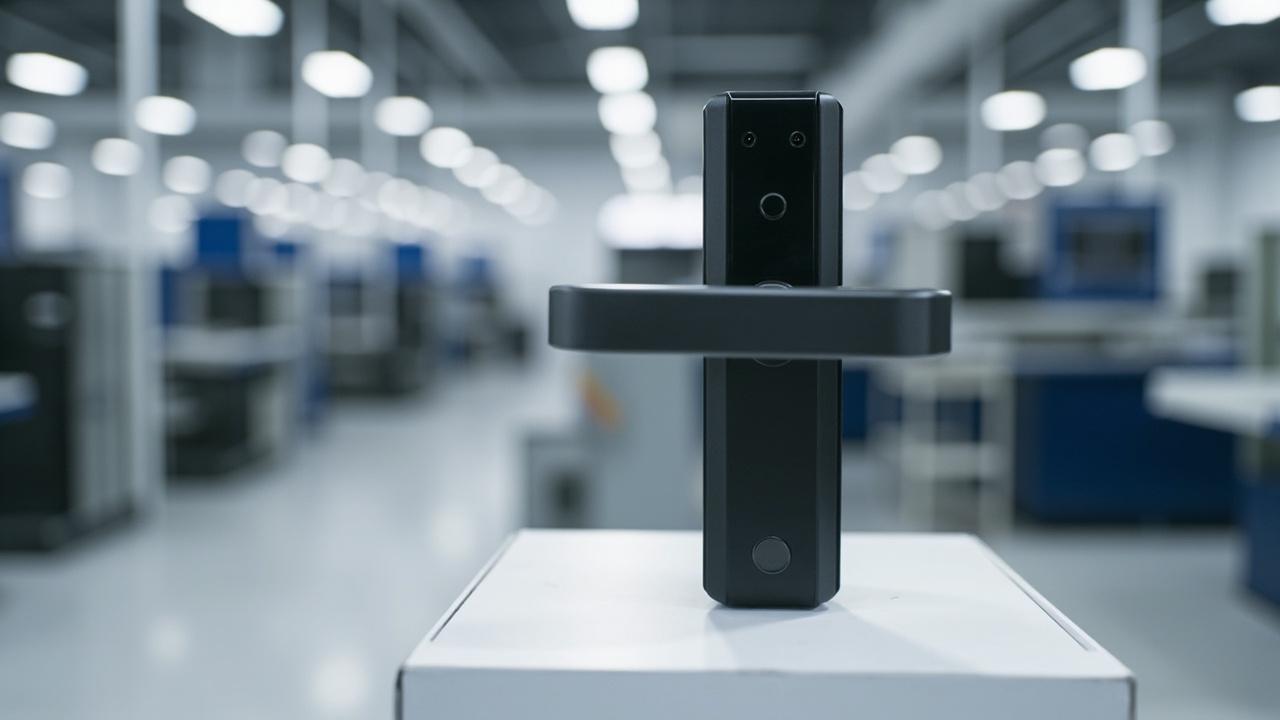
Smart Locks for Bank Offices
Short answer: Smart locks for a bank branch fit a narrow, honest set of doors — the staff-only back door, the manager office, the IT closet and the back-of-house corridor between them — and explicitly do not fit the rest of the branch. The customer entrance door, the vault-room door, the safe-deposit vault door, the ATM room behind the lobby wall and the armoured-transit vestibule are governed by hardware, regulators and operational procedures that the door-lock catalog does not supply, and a procurement manager who lets the catalog answer any of those questions is buying a door-lock product for a job it was not designed to do. The article below is a door-by-door technical resource: which branch doors the catalog serves, which it does not, what to verify in writing on each product page before quoting, and how to write the per-branch lock plan as a per-door honest-scope document rather than a model list.
A bank branch looks, from the parking lot, like one building. From inside the building it is five to seven distinct doors with very different jobs, and the jobs do not share a credential class, an audit posture or a hardware family. The customer-facing entrance is an enterprise access-control question that the lock catalog does not answer. The vault is a vault, governed by hardware, regulator or insurance regime and handled entirely outside the door-lock catalog. The staff back door, the manager office, the IT closet, the back-office corridor and the after-hours service door are the catalog-eligible doors, and they are the only doors in scope for this article. For each of those catalog-eligible doors the lock plan must answer the same six questions: which credential class, what audit-log posture, which mechanical-fallback policy, what after-hours discipline, which environmental exposure, and which per-model fact must be confirmed on the product page before the order is raised.
The branch-door lens is deliberately distinct from the sibling pieces it sits beside: smart locks for financial offices covers the financial-advisor scenario where the door is an office inside a commercial tenancy and the credential population is dominated by client meetings; fingerprint smart locks for server rooms covers the small-named-population, audit-driven IT closet at finer resolution; smart locks for government buildings covers the visitor-and-administrative-annex SOP at municipal scale. The bank-branch lens sits between the financial-advisor office and the government annex — fewer public-facing doors than a government building, fewer compliance-classified doors than a regulated vault, more credential-class diversity than a single-advisor office, and a back-of-house corridor discipline that no other sibling owns.
Reading rule: where this article says "check the model’s published specification," the answer belongs to the per-model product page, not to the catalog summary, not to a sales conversation and not to a competitor's marketing material. The catalog publishes 79 models; the per-model fact — credential capacity, audit depth, mechanical-override behaviour, app-platform support, door-thickness envelope, battery platform — lives on the page for that specific model, and the page is the only defensible source.
1. The Bank-Branch Door Inventory, Class by Class
A branch is not five doors. It is at least seven, and sometimes eleven. The inventory below is the canonical list for a mid-size urban branch; suburban and rural branches look similar but with different environmental exposure. Each door is named, classified and labelled as either catalog-eligible or out of catalog scope. The labels are the spine of the lock plan.
| # | Door | Position | Catalog-eligible? | Primary instrument family |
|---|---|---|---|---|
| 1 | Customer entrance | Façade to lobby | No | Enterprise access-control system, mantrap, or staffed reception — outside lock-catalog scope |
| 2 | Teller-line staff door | Teller line to back office | Yes | Credentialed lock on the lock catalog; the lock is the second-order decision |
| 3 | Staff-only back door | Back of building to staff parking | Yes | RFID or PIN, audit-driven |
| 4 | Back-office corridor | Connects staff back door to manager office and IT closet | Yes | RFID, mechanical override |
| 5 | Manager office | Inside the back-office corridor | Yes | Biometric or RFID, named-credential |
| 6 | IT closet / network room | Inside the back-office corridor | Yes | Biometric with audit, small population |
| 7 | Operations room behind the teller line | Behind the cash-recycler or cash-handling desk | Yes | Biometric or RFID, very small population |
| 8 | After-hours service entrance | Back of building, contractor side | Yes | Time-bound PIN, roster-driven |
| 9 | Vault room | Inside the back office | No | Vault hardware, regulator / insurer regime — outside lock-catalog scope |
| 10 | Safe-deposit vault | Inside the vault room | No | Vault hardware, dual-control regime — outside lock-catalog scope |
| 11 | ATM room behind the lobby wall | Behind the lobby wall, separate envelope | No | ATM room hardware and serviced by the ATM operator, not the lock-catalog |
| 12 | Armoured-transit vestibule | Back of building to the cash-in-transit vehicle bay | No | Armoured-transit hardware and procedures, not the lock-catalog |
The catalog-eligible doors are doors 2, 3, 4, 5, 6, 7 and 8. Everything else is out of scope for this article and out of scope for the lock catalog at all. The procurement manager who lets the lock-catalog answer a question on door 1, 9, 10, 11 or 12 is buying a lock-catalog product for a job the catalog was not designed to do, and the failure mode is not a broken reader — it is a regulator finding.
2. Why the Customer Door, the Vault Door and the ATM Door Are Out of Scope
The most expensive mistake in a branch lock project is buying a door-lock product for a door that a door-lock product was not designed to protect. Three doors in every branch carry this risk, and they are not adjacent to one another on the floor plan.
The customer entrance door. A branch's customer entrance is a public-access door. The lock question on that door is not "which reader class" — it is whether the door is held open during business hours, how it is staffed at the threshold, whether the door has a mantrap, how the door fails closed on a fire alarm and how after-hours access is controlled. Those questions are answered by an enterprise access-control system, by a building-management system and by a fire-code regime — not by the lock catalog. A door-lock product on the customer entrance is a fail-secure detail inside a much larger system, and the procurement conversation for that detail belongs to the system integrator, the building-management vendor or the bank's own facility team. The door-lock catalog lists 79 models; none of them is the right instrument for the customer entrance decision.
The vault room door and the safe-deposit vault. A vault door is not a lock product in the catalog's sense. Vault hardware is a separate category — time locks, combination locks, dual-control mechanisms, day gates, night depositories, audit-trail standards, regulator classifications (UL, TL, CEN, EN 1300) and insurer regimes — none of which the door-lock catalog supplies, certifies or warrants. The procurement manager who specifies a catalog-eligible fingerprint or RFID lock for the vault is mis-categorising the door. The vault is out of scope for the lock product, and any claim about a catalog lock being "vault-rated" is a claim to verify with the vault hardware vendor and the bank's own compliance function, not with the lock supplier.
The ATM room behind the lobby wall. The ATM room is an envelope inside the branch, served by the ATM operator, the cash-in-transit carrier and the bank's ATM-security protocol. The door on that envelope is a serviced door; the access policy is owned by the ATM operator, the door hardware is selected by the ATM operator, and the audit posture is part of the ATM franchise agreement. The lock catalog does not supply that hardware and should not be asked to. Where the box sits at the back of the lobby and the access policy is held by a third party, the procurement conversation belongs to the third party.
The armoured-transit vestibule. The door between the back of the branch and the cash-in-transit vehicle bay is part of the armoured-transit contract. The hardware is part of the carrier's SOP, the audit trail is part of the carrier's SOP, and the access policy is part of the bank's contract with the carrier. The lock catalog does not serve the vestibule. Where a vestibule exists, the lock question is "what hardware does the carrier require" — and the carrier's SOP, not the lock catalog, is the answer.
The honest summary. Out of twelve canonical branch doors, the lock catalog serves seven and explicitly does not serve five. The five out-of-scope doors are the most visibly secured doors in the branch — and that visibility is the trap. A reader on a vault door looks like a credentialed decision; in reality, it is a credentialed decision layered on top of hardware, regulators and procedures that the lock product does not replace. The lock plan's first job is to refuse to answer those questions, and to route them to the system owner who actually owns them.
3. The Catalog-Eligible Doors — Per-Door Honest Scope
The seven catalog-eligible doors share a common shape: each has a small, named population; each is audited at the door layer; each is served by a credentialed lock on the lock catalog; and each is governed by a per-model fact that belongs to the product page. The honest-scope block below captures what a lock-catalog product can and cannot do on each door, in the same shape for every door.
| Door | Population | Audit posture | Mechanical fallback | Lock-catalog can do | Lock-catalog cannot do |
|---|---|---|---|---|---|
| Teller-line staff door | Teller-line staff, shift supervisors, vault cashiers | Per-shift, per-individual | Cylinder + key, sealed envelope | Hold a per-shift credential database; produce a per-event audit; deliver a record for HR review | Replace the dual-control regime on a cash-handling event; time-lock a cash drawer |
| Staff-only back door | All staff, cleaning crew, contractors | Per-individual, daily | Cylinder + key, sealed envelope | Hold a per-individual credential database; produce a per-event audit; enforce a contractor window | Replace the building-fire-alarm interface; replace the staffed-reception function above the door during business hours |
| Back-office corridor | All staff who pass through it | Per-individual, real-time-pass | Cylinder + key, sealed envelope | Hold the corridor credential database; produce a transit record per event | Replace the door between the corridor and the customer-facing lobby |
| Manager office | Branch manager, named visitors | Per-individual, named-visitor bound | Cylinder + key, sealed envelope | Hold a named-population credential database; produce a per-event audit | Replace the bank's document-handling protocol for documents inside the office |
| IT closet / network room | IT staff, named contractors | Per-individual, very small population | Cylinder + key, sealed envelope | Hold a small named credential database; produce a per-event audit; support an escorted-vendor lane | Replace the bank's enterprise network-access controls inside the room |
| Operations room | Operations staff, vault cashiers | Per-individual, very small population | Cylinder + key, sealed envelope | Hold a named-population credential database; produce a per-event audit | Replace the dual-control regime on cash handling; replace the regulator regime |
| After-hours service entrance | Cleaning crew, contractors, after-hours staff | Per-window, roster-bound | Cylinder + key, sealed envelope | Hold a windowed credential database; produce a per-event audit; enforce a roster-rotation policy | Replace the building-fire-alarm interface; replace the after-hours security officer role |
The block is the same shape for every door: population / audit / fallback / can-do / cannot-do. The shape forces the honest answer. Where the cannot-do column is empty, the lock catalog is the right instrument. Where the cannot-do column is non-empty, the lock catalog is layered on top of a larger system, and the larger system is the one the procurement manager must ask the system owner about, not the lock supplier.
4. The Per-Door Six-Question RFQ Block
The six questions below apply to every catalog-eligible door in the branch. The questions are identical for every door; the answers differ. Each answer is routed to the product page for the specific model under consideration, not to the catalog summary.
- Credential class support. Which credential classes does the model support — PIN, RFID (Mifare 1 @ 13.56 MHz or other), fingerprint, mechanical key, Bluetooth, app? Which are simultaneous on a single unit, and which require a hardware revision?
- Enrolled-user capacity. How many named credentials does the model hold? How many administrators? What happens at the limit — over-write, refusal, or silent failure?
- Event-record depth and read-out path. Does the model keep events on-device? Up to what count? How are events read out — app, PC software, offline export, network sync? What fields per event (timestamp, credential ID, grant/deny, credential class)?
- Time-bound and role-bound lane support. Does the model support a per-window PIN, a single-use PIN, a role-bound credential that can be re-assigned without re-enrollment? Where the model has app-platform support (catalog-known families include TTLock, Tuya and Doodle), what role structure does the platform support, and does that role structure operate on-device or only when the lock is paired?
- Mechanical-override design. What is the cylinder class? Is the key blank supplied with the order, and is the keying strategy single-keyed, master-keyed or grand-master-keyed? How is the sealed-envelope doctrine expressed — seal, withdrawal log, custodian register?
- Door-fit envelope. What is the door-thickness range? What is the handing? Is the model suitable for glass, solid-core timber, fire-rated, or steel-clad doors? Where the door is a glass door (the manager office in some branches is glass-partitioned), does the model include a glass-door variant or does the catalog route to a separate glass-door sub-line (e.g. SLK-G200)?
The questions are identical for every door. The answers differ by door and by model. The point of asking the same six questions on every door is to make the per-door answer comparable. A branch with seven catalog-eligible doors and three models under consideration produces a 7 × 3 matrix of answers, and the matrix is the procurement decision document.
5. The Credential-Class Map Per Door
The credential class on each catalog-eligible door is the first-order decision. The model is the second-order decision. The credential-class map below captures the first-order answer for each door, with the rationale.
| Door | First-order credential class | Why | Second-order hardware |
|---|---|---|---|
| Teller-line staff door | Named RFID, with PIN backup | Teller-line staff are a stable, named population; card-tap is faster than biometric through glove and mask during a shift change; PIN backup covers a forgotten card | RFID + PIN lock on a cylindrical or mortice chassis |
| Staff-only back door | Named RFID, with PIN backup | Staff back door sees the full population daily; throughput at opening time matters; PIN backup is the missing-card recovery path | RFID + PIN lock on a mortice or cylindrical chassis |
| Manager office | Fingerprint, with PIN and key fallback | Manager office is a single-occupant room; biometric identity ties to a named person; the audit is per-manager | Biometric lock (fingerprint), with PIN and sealed mechanical key |
| IT closet / network room | Fingerprint, with PIN and key fallback | IT closet is a small, named population; biometric identity is the strongest evidence at this scale | Biometric lock (fingerprint), with PIN and sealed mechanical key |
| Operations room | Fingerprint, with PIN and key fallback | Operations room is a very small population; dual-control regime is on the cash-handling side; the lock is the door, not the cash-control | Biometric lock (fingerprint), with PIN and sealed mechanical key |
| Back-office corridor | Any back-office credential | The corridor is a transit zone; the credential class is the staff credential class, not a separate corridor credential | RFID lock on a mortice or cylindrical chassis |
| After-hours service entrance | Time-bound PIN, roster-rotated | The service entrance is a roster-controlled door; the cleaning crew and contractors come on a named window; time-bound PIN enforces the window | Keypad lock with time-bound PIN support, or app-platform time-bound credential |
The map is the lock plan's first artefact. Where the first-order credential class is biometric (manager office, IT closet, operations room), the catalog's fingerprint category (37 models) and the 5-in-1 multi-method class (e.g. SLK-8831 by slug) are the candidate families. Where the first-order class is RFID, the catalog's RFID category (9 models) and the hotel-platform RFID (e.g. SLK-9936S by slug, used here as an RFID-platform reference and not as a branch recommendation) are the candidate families. Where the first-order class is PIN, the keypad category (18 models) and the cylindrical-latch Tuya round-code class are the candidate families. Every per-model fact — credential capacity, audit depth, app-platform, mechanical override — is confirmed on the page.
6. The After-Hours and Roster Discipline
A branch does not sleep the way a hotel sleeps. The staff back door opens at 07:30 for shift opening, admits the cleaning crew at 18:30, admits the night-drop or after-hours contractor window at 22:00, and closes at 06:30 for the next shift opening. The after-hours discipline is the single hardest part of the lock plan because the door is locked for fewer hours than it is unlocked, and the after-hours population is not the staff population.
Three after-hours rules govern the seven catalog-eligible doors:
- The windowed credential. The cleaning crew, the plant engineer and the after-hours contractor hold a time-bound PIN that is active only during the named window. The PIN expires at the window end. Where the model supports an app-platform time-bound credential (catalog-known families include TTLock, Tuya and Doodle), the time-bound credential is provisioned and revoked on a roster rotation. Where the model supports a keypad with a per-window PIN, the PIN is set in the lock and rotated on the same cadence as the roster. Check the model’s published specification which windowed-PIN class the specific model supports.
- The roster rotation. A cleaning crew that holds the same PIN for six months is a credential that has outlived its job. The roster rotates the PIN on a named cadence — typically every 30 to 90 days — and the rotation is logged in the cleaning crew register. The lock does not enforce the rotation; the register does. The lock provides the audit trail that says "PIN X was used on date Y," and the register says "PIN X was rotated on date Z."
- The end-of-window test. At the end of each named window, the cleaning lead or the contractor lead runs the negative test — attempts to use the just-expired PIN — and initials the register. The negative test is the cheapest control that converts a battery lock into evidence, and the test is the discipline the lock plan must document before commissioning.
The after-hours discipline is the same shape on every branch, but the roster schedule is per-branch. The lock plan expresses the schedule as a register, not as a hardware feature. The hardware supports the schedule; the schedule is owned by the facilities lead.
7. The Audit Posture Per Door, Honestly Framed
The audit posture is the per-door answer to "what evidence does the lock produce, who reads it, how often, and on what cadence does it become evidence rather than noise?" The honest framing on a branch is that the audit posture is layered: the lock produces per-event evidence, the door register produces per-window evidence, the HR system produces per-individual evidence, and the bank's compliance function produces per-policy evidence. The lock is the first layer. It is not the only layer.
| Door | Owner of the audit record | Self-archived by the lock? | Read-out cadence | Read-out path | What the lock can do | What the lock cannot do |
|---|---|---|---|---|---|---|
| Teller-line staff door | Branch manager | Confirm per model | Daily | Confirm per model | Per-event record per staff credential | Replace the bank's shift-reconciliation record on cash handling |
| Staff-only back door | Branch manager | Confirm per model | Daily | Confirm per model | Per-event record per staff credential | Replace the building-fire-alarm interface record |
| Back-office corridor | Branch manager | Confirm per model | Daily | Confirm per model | Per-event record per staff credential | Replace the building-management-system access record |
| Manager office | Branch manager | Confirm per model | Weekly | Confirm per model | Per-event record per manager and named visitor | Replace the document-handling log inside the office |
| IT closet / network room | IT lead | Confirm per model | Weekly | Confirm per model | Per-event record per IT staff and named contractor | Replace the network-access-control record inside the room |
| Operations room | Branch manager | Confirm per model | Daily | Confirm per model | Per-event record per named population | Replace the dual-control record on cash handling |
| After-hours service entrance | Branch manager | Confirm per model | Daily | Confirm per model | Per-event record per cleaning or contractor window | Replace the after-hours security officer's log |
The lock audit posture is the first layer. Where the bank's compliance function needs evidence, the cascade is lock → register → HR / facility system → compliance function, and the lock is the bottom layer of the cascade. Check the model’s published specification which events the specific model records, what fields per event, how many events the buffer holds and how the buffer is read out. Confirm, in writing, that the read-out path is real — not "we can check" — before any model is shortlisted.
8. The Door-Fit Worksheet for a Mid-Size Urban Branch
The single most expensive surprise in a branch lock plan is the door that does not fit the lock. The door-fit worksheet below is the minimum set of fields to capture per catalog-eligible door before procurement. The worksheet is deliberately TBC-driven: every "TBC" becomes a real number at survey, and the lock order should not be raised until the survey is signed.
| Door ID | Material | Thickness (mm) | Handing | Frame type | Existing prep | Reader side | Mechanical override location | Notes |
|---|---|---|---|---|---|---|---|---|
| B-Teller | Solid-core timber | TBC | TBC | TBC | TBC | Pull side | TBC | TBC = confirm on site |
| B-StaffBack | Steel-clad or aluminium | TBC | TBC | TBC | TBC | Pull side | TBC | Exterior exposure — confirm weather duty |
| B-BOCorridor | Solid-core timber | TBC | TBC | TBC | TBC | Pull side | TBC | Confirm fire-rated door class |
| B-Manager | Solid-core timber or glass-partition | TBC | TBC | TBC | TBC | Pull side | TBC | Glass-partition variant — confirm glass-door model |
| B-ITCloset | Solid-core timber | TBC | TBC | TBC | TBC | Pull side | TBC | Confirm cable-against-port environmental exposure |
| B-OpsRoom | Solid-core timber | TBC | TBC | TBC | TBC | Pull side | TBC | Confirm cash-handling environment sealing |
| B-ServiceEntrance | Steel-clad | TBC | TBC | TBC | TBC | Push side | TBC | Confirm after-hours envelope design |
Every "TBC" becomes a real number at survey. The branch facilities lead walks the floor with a tape measure and a camera; the lock order is not raised until the survey is signed. The glass-partition variant (manager office in some branches) is the one most likely to surprise: a glass-partition office needs a glass-door-lock class, not a wood-door-lock class, and the catalog coverage for glass doors is a separate sub-line (e.g. SLK-G200 by slug). Confirm the glass-door model fit on the product page before locking the procurement.
9. The IT Closet at Branch Scale — A Sibling-Lens Note
The IT closet inside a branch is a small room with a named population and a tight audit posture, and the per-door logic on that door is the same shape as the broader IT-room discipline in the sibling piece fingerprint smart locks for server rooms. The branch IT closet is usually smaller than the head-office server room; the population is usually two or three named people plus a tightly escorted contractor lane; the audit requirement is usually the bank's internal IT-compliance function, not a regulator. The product page for the specific model under consideration answers the same six questions (credential class, enrolled-user capacity, event-record depth and read-out path, time-bound and role-bound lane, mechanical-override design, door-fit envelope) and the per-model answer is the same shape as for any other catalog-eligible door in the branch. The IT-closet door is not a special case at the lock layer; it is a small-population door with the same six questions as the manager office, and the IT-rooms door reference covers the same discipline at a different scale.
10. The Sealed-Key Envelope Doctrine
Every catalog-eligible door on a branch carries a mechanical-fallback cylinder. The cylinder is the bank's policy-grade fail-secure path: when the lock fails, when the network is down, when the battery is dead, when the credential holder is unavailable, the cylinder is the path that opens the door. The cylinder is also the path that an auditor or a regulator will ask about first. The sealed-key envelope doctrine is the procurement manager's answer.
- Seal. Every mechanical key is sealed in a numbered tamper-evident envelope before it leaves the supplier. The envelope number is logged in the sealed-envelope register, on the door ID and in the key custodian's record.
- Sign-out. Withdrawal of a sealed envelope is signed for, dated and witnessed. The witness is not the same person who signs out. The sign-out is logged in the sealed-envelope register, in the door register and in the facilities lead's record.
- Return. The envelope is returned, sealed if unused, broken-and-re-sealed by the supplier if used. The return is logged in the same three places.
- Audit. The sealed-envelope register is reviewed monthly. The review is logged. The review fires when an envelope has been opened and the key was not re-prescribed within the named cadence.
The doctrine is the same shape on every door. The hardware — cylinder type, key blank, keying strategy (single-keyed, master-keyed, grand-master-keyed) — is a per-model fact. The doctrine is the bank's discipline on the cylinder, and the cylinder's per-model fact belongs on the product page. The SLK-9936S hotel-class spec block quotes a 5-pin cylinder as one line in a representative hotel-model spec block; the same line on a branch-eligible model is per-model and must be confirmed on the product page. The 5-pin-cylinder line does not transfer from the hotel-model spec to a branch recommendation; it is invoked here as documentation-format yardstick only.
11. The Procurement Decision Matrix
The decision matrix turns the per-door credential-class map and the per-door audit posture into a per-door model-and-class decision. The weights are illustrative; the matrix is a structure, not a score.
| Criterion | Weight | Why it matters for a branch |
|---|---|---|
| Credential class support (PIN / RFID / fingerprint / app) | 25% | Determines whether the door can carry the first-order credential class on the map |
| Audit-log depth and read-out cadence | 20% | The audit posture is the lock plan's first deliverable; depth and read-out cadence determine evidence |
| Time-bound and role-bound lane support | 15% | The after-hours discipline runs on time-bound lanes; the staff back door runs on role-bound lanes |
| Door-fit envelope (thickness range, glass option) | 15% | The single most common source of install-day surprise in a branch |
| Mechanical fallback (cylinder + sealed-envelope doctrine) | 10% | The bank's policy-grade fail-secure path; the doctrine is the bank's, the cylinder is the model's |
| Two-stream governance support (cleaning / staff / contractor) | 5% | The after-hours and contractor windows are governed separately from the staff population |
| App / Bluetooth family in catalog | 5% | TTLock / Tuya / Doodle are catalog-known; enterprise directory integration is not in catalog scope |
| Battery platform and service route | 5% | Affects the after-hours battery-discharge protocol on a staff back door |
Three design rules follow. First, credential-class support is the highest-weighted criterion because the per-door credential-class map cannot be expressed without it. Second, the audit-log depth and read-out cadence criterion is the second-highest weight because the audit posture is the lock plan's first deliverable. Third, the "app / Bluetooth family in catalog" row is deliberately modest — the catalog lists TTLock, Tuya and Doodle as app families, but does not include enterprise directory protocols (SSO, SCIM, AD-bind) in scope. Where the branch requires an enterprise directory tie, that is a separate procurement conversation outside this article; confirm with the bank's IT team before assuming.
12. What the Lock Plan Hands the Bank's Compliance Function
The lock plan is a per-door honest-scope document. The bank's compliance function reads it as the lock layer of the cascade. The plan expresses, for each of the seven catalog-eligible doors, the per-door credential class, the per-door audit posture, the per-door mechanical-fallback doctrine, the per-door after-hours discipline and the per-door fact list to verify against the model’s published specification. The plan also expresses, in the same document, the five out-of-scope doors and the system owner each out-of-scope door is routed to. The plan does not answer the out-of-scope doors. The plan is honest about not answering them.
The compliance function is also the audience for the seal-cadence table — the monthly sealed-envelope register review, the quarterly key-blank policy, and the annual cylinder refresh plan. These are not hardware questions; they are governance questions expressed on hardware. The lock plan documents them.
13. Illustrative Scenario — A Mid-Size Urban Branch, Five Doors Locked, Two Doors Defer
The following is an illustrative scenario, not a customer story.
Consider a mid-size urban branch — twelve staff, four on the teller line, two in operations, four in back office, one branch manager, one IT lead who works out of head office but visits weekly. The branch has twelve doors on the canonical inventory. The procurement lead starts with the catalog-eligibility test and writes down: doors 1, 9, 10, 11 and 12 are out of scope (customer entrance, vault, safe-deposit, ATM room, armoured-transit vestibule) and are routed to their system owners. Doors 2, 3, 4, 5, 6, 7 and 8 are catalog-eligible. The lock plan begins with seven doors, not twelve.
The first-order credential-class table assigns biometric to the manager office, the IT closet and the operations room (small named populations, audit-driven), RFID with PIN backup to the teller-line staff door, the staff-only back door and the back-office corridor (stable named populations, throughput at opening), and time-bound PIN with roster rotation to the after-hours service entrance (windowed population). The matrix produces a shortlist of one RFID + PIN model for the transit doors, one biometric model for the small-population rooms, and one keypad model for the service entrance. The per-model six-question RFQ block is filled in for each shortlist model, and the per-door survey worksheet is walked with a tape measure on a quiet morning.
The audit posture table assigns the IT lead to the IT closet record, the branch manager to every other catalog-eligible door, and the daily read-out cadence to the teller-line, staff-back and service-entrance doors (highest traffic) and the weekly cadence to the manager office and IT closet (low traffic). The sealed-key envelope doctrine is documented for every cylinder, with the sealed-envelope register, the sign-out log and the monthly review. The hardware order is raised after the survey is signed. The audit cadence is read out by the branch manager and the IT lead, the register is reconciled monthly, and the bank's compliance function is given the per-door honest-scope document at the end of the quarter.
What the procurement lead does not do in this scenario is buy a catalog-eligible fingerprint or RFID lock for the vault door, the safe-deposit door or the ATM room. Those doors are out of scope for the lock product; they belong to the bank's vault hardware vendor, the ATM operator and the armoured-transit carrier respectively. The lock plan's first job is to refuse to answer those questions, and to write the routing in the document so the next procurement lead cannot mistake the door for a catalog-eligible door.
14. Closing — Where This Branch Lock Plan Goes Next
Three pages, in order. If a door in your branch looks like the seven catalog-eligible doors in the inventory above — small named population or stable named population, audit-driven or throughput-driven, environmental exposure bounded by the building envelope — start with the per-door credential-class map, fill in the six-question RFQ block on each shortlisted model from the product page for that specific model, and let the empty cells drive your questions rather than the highlights. Then put a physical lock in your hands: order samples of two or three shortlisted models, run a one-week in-branch test on one catalog-eligible door with the branch manager and the facilities lead in the room, and test the denial as seriously as the grant. Begin at Order samples.
When your shortlist, your after-hours roster and your sealed-envelope register are written, take the per-door fact list and the per-door six-question answers to Request a quote as explicit questions, and bring the out-of-scope door list with the system-owner routing. A 79-model catalog, 10+ years of making these locks, shipments into 80+ countries — those are facts about the factory. Whether a given door belongs on the catalog-eligible side of the line is a fact about your branch, and only the branch facilities lead, the branch manager and the bank's compliance function can finish that sentence. The lock plan's first job is to make the line visible. The plan's second job is to keep the line visible through every procurement cycle and every audit request.
For branches still scoping the back-office corridor and the staff back door at finer resolution, the sibling piece smart locks for financial offices is the financial-advisor-scenario companion; for branches ready to design the IT-closet discipline at finer resolution, fingerprint smart locks for server rooms is the next-door neighbour; for branches ready to compare the branch back-of-house discipline to the public-building visitor-and-administrative-annex SOP, smart locks for government buildings is the focused companion.