
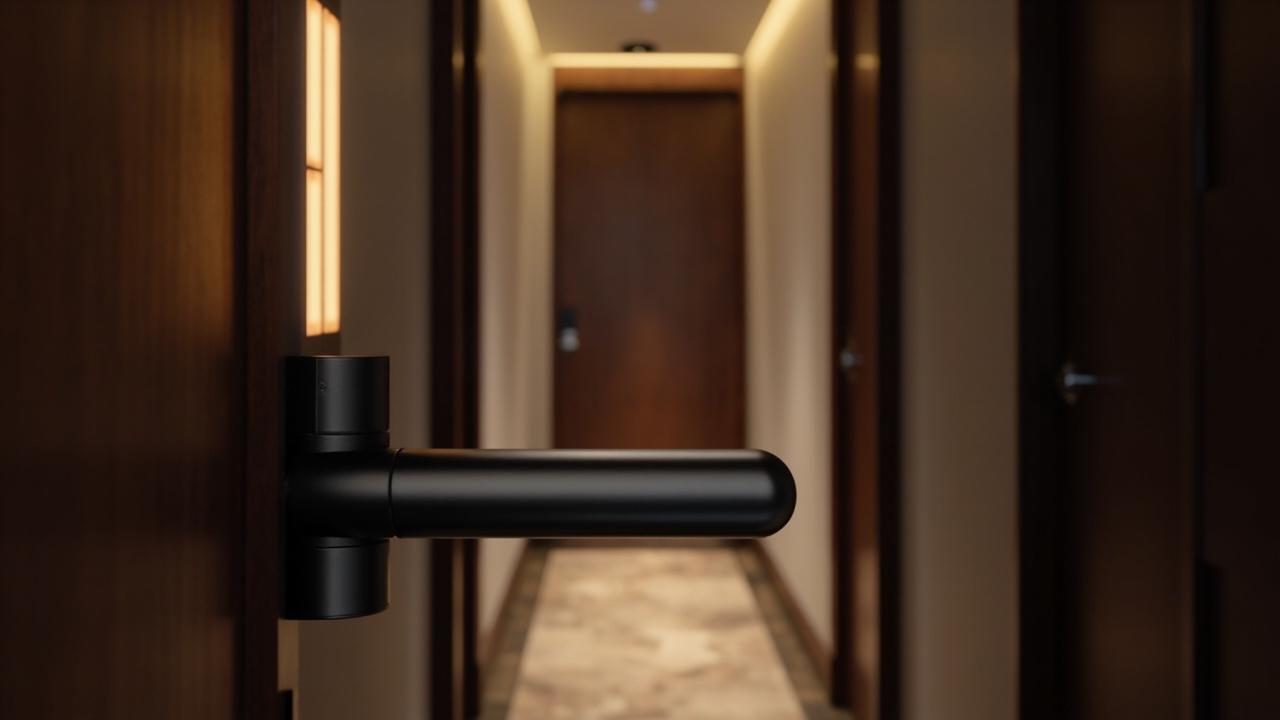
RFID Hotel Lock Maintenance Guide
Direct answer: RFID hotel lock maintenance is the planned care of four wear subsystems — the reader surface and window, the card fleet, the battery compartment and its contacts, and the front-desk card encoder. Each subsystem fails in its own visible way. A working program reads those failure signatures the way an engineer reads a datasheet: each spec line predicts where wear will appear, what "normal" looks like, and what evidence tells you to intervene before a guest stands locked out at a door.
Most hotel lock content treats maintenance as a checklist on a clipboard. That framing misses the physics. An RFID lock is not one machine; it is four assemblies with four different wear mechanisms, bolted together into one handle. Clean the reader but ignore the encoder head, and every card on the floor keeps arriving at a slightly damaged credential. Swap batteries but never inspect the compartment, and leakage eats the spring contacts until a "healthy" fresh cell can't make connection. The lock itself stays functionally identical through all of it.
This guide is the wear anatomy. The schedule for it — which track, how often, who walks it — lives in the companion cadence tearoff, Hotel Smart Lock Maintenance Guide. Read the two together: that maintenance guide tells you when and who; this page tells you what is actually degrading and why. If you are a distributor or operator comparing lock platforms before an order, the subsystem map here doubles as a service-burden yardstick — a model whose four subsystems all produce readable wear signatures is cheaper to run than one that only complains through guest call-outs.
How to Read a Datasheet as a Maintenance Document
Open any credible hotel lock datasheet and you are looking at a maintenance plan in disguise. Every rated number implies a degradation path and an inspection target:
- A read distance rating implies a coupling margin, and margins erode from both ends — dirty or hazed reader windows on one side, bent or delaminated cards on the other.
- A power source rating implies a corrosion story. Any battery compartment with springs and terminals inside a humid corridor envelope is a chemistry problem, not an electrical one.
- A credential technology rating implies a card fleet with a physical lifespan, which in turn implies the desk device that writes it needs care of its own.
- A mounting range implies fasteners, and fasteners loosen on doors that swing thousands of cycles.
We will use the SLK-9936S, a PDP-cited hotel model in the hotel lock line, as the dissected specimen. The same reading exercise works on any RFID lock datasheet you receive — that is the transferable skill here. If your existing stock is a different model, pull its spec block and run the same line-by-line annotation before trusting any vendor's maintenance advice.
Subsystem Map: Four Wear Surfaces, Four Owners
The whole maintenance burden of an RFID hotel lock distributes across four subsystems, and each one naturally belongs to a different pair of hands. Assigning ownership by subsystem — not by calendar — is what makes a program survive staff turnover.
| Subsystem | What physically wears or degrades | First failure signature | Normal owner | Where it is covered below |
|---|---|---|---|---|
| Reader surface / window | Hazing from harsh cleaners, edge micro-scratch, adhesive lift, sensor bezel grime | Read distance shrinking toward "must touch exactly here" | Housekeeping + engineering | Reader section |
| Card fleet | Laminate delamination, coil cracks from flex/bending, corner abrasion, print wear | Same guest's card works sometimes, fails at one door style repeatedly | Front office + engineering | Card wear atlas |
| Battery compartment and contacts | Alkaline leakage crust on springs, terminal oxidation, gasket set | Fresh batteries, still low-power events in audit log | Engineering / maintenance | Corrosion checks |
| Front-desk encoder head | Head window soil, weak writes from positioning habits, cable/strain damage, software drift | Cards encoded at one desk fail read-back at another | Front desk supervisor + IT | Encoder care |
A fifth assembly — latch, cylinder, spindle — carries mechanical wear, but its cadence and passes are already walked in Track 4 of the Hotel Smart Lock Maintenance Guide; this guide maps wear anatomy for the four electronic subsystems where hotel teams most often improvise.
The Annotated Spec Block: SLK-9936S Lines Under a Maintenance Lens
The PDP-cited spec block for the SLK-9936S, verbatim:
Door thickness 36–100 mm · RFID Mifare 1 @ 13.56 MHz · read distance 0–5 cm · read time <0.25 s · power 4 × AA · battery operating cycles >15,000 · audit/event records up to 1,000 · 5-pin cylinder · 3-point latch · stainless steel + alloy body · multiple finish options · mechanical emergency access · multilingual management software · standalone or centralized database modes · positioned for 1–5 star hotels.
Now the same block annotated for maintenance. This is the datasheet-dissection method this article teaches; the row content is specific, the method is portable to any RFID lock platform on the RFID door lock line.
| Spec line | What it means under wear | What to inspect | What is a bluff if a vendor skips it |
|---|---|---|---|
| RFID Mifare 1 @ 13.56 MHz | Contactless coupling through the window; no contacts to polish, but everything that obstructs the radio path degrades reads | Window clarity, bezel seating, non-metal overlay items guests add (promotional stickers near reader) | Claims of "no maintenance needed because no contacts" — the radio path still fouls |
| Read distance 0–5 cm | A margin. A clean system reads at a relaxed tap; degradation shows as the effective distance collapsing before total failure does | Note whether a tap that used to read at 2–3 cm now demands precise placement | Vendors who say read range never drifts |
| Read time <0.25 s | Baseline for "normal." Retry behavior — holding the card longer, re-tapping — is early evidence, not user error | Staff reports of "guests have to try twice" as a genuine diagnostic stream | Treating re-tap complaints as guest clumsiness |
| Power 4 × AA | Four cells in series: one weak or leaking cell drags the whole string; compartment access is a physical door in the inner escutcheon | Contact springs, terminal plating, seal lines, cell-change discipline | "Any batteries are fine" — mixed chemistries distort the voltage floor the lock reads |
| Battery operating cycles >15,000 | Endurance budget per cell set, not per lock. Converts directly into spare-cell planning per floor per service interval | Audit log low-power events trending per wing | Quoting cycles once and treating them as a warranty number |
| Audit/event records up to 1,000 | The lock's own maintenance telemetry: failed reads, openings, low-power flags sit here until overwritten | Download cadence per the Hotel Smart Lock Maintenance Guide; export before the buffer wraps | Systems where nobody ever pulls the log — a diagnostic channel left unplugged |
| Door thickness 36–100 mm | Wide mounting range means spacer/collar stacks; those stacks loosen with door swing and seasonal timber movement | Screw torque, collar seating, reader-plate alignment on heavy or solid doors | Installers who never mark torque-check dates on wide-range mounts |
| Mechanical emergency access | A keyed path exists; keys wear too, and emergency keys are the least-used, worst-maintained items in the building | Keyway clearness, emergency key storage condition, operation by hand | "Emergency key always works" — unused cylinders seize; exercised keys are tested keys |
| Multilingual management software / standalone vs centralized modes | Two software estates to keep consistent: encoder stations and (in centralized mode) the database and backups | Version parity across desks, backup verification, host power stability | Programs that update one front desk and call the fleet current |
Reader Surface and Window: The Cheapest Wear to Fix
The reader window is the most-touched, most-abused piece of plastic in the hotel, and almost all of its abuse comes from well-meaning cleaning. Three degradation channels matter:
Chemical hazing. Ammonia-based glass cleaners and aggressive solvents attack many window polymers, leaving a micro-cloudy film. The film is cosmetically invisible and radio-visibly irrelevant at first — then taps that used to read loosely start demanding placement. Rule: mild detergent on a soft cloth, sprayed on the cloth and never directly at bezel seams; no abrasives, no window cleaner, no solvent wipes on the outer escutcheon unless the finish schedule for your model says otherwise.
Bezel and seam grime. Housekeeping spray, floor wax mist, and guest-handled residue collect where the window meets the bezel. Left uncured, waxy buildup at the seam edge creeps inward. A quarterly pointed-cloth seam pass prevents what a daily panel wipe never will.
Adhesive and sticker damage. Promotional overlays, tape ghosts, and the residue of removed signage near the reader are silent coupling blockers — metalized foil stickers are the worst. Inspect the reader vicinity during any deep clean, and peel-test anything unexpected on the outer face with solvent-safe method appropriate to the finish.
What to demand from your own program, in writing: a named cleaning agent for lock fronts, listed in the housekeeping chemical schedule, and a one-line rule in the housekeeping SOP that nothing is sprayed directly at a lock. This costs nothing and eliminates the majority of reader-window pathology.
Card Wear Patterns: An Atlas for the Credential Fleet
The card is half of the RFID pair, and it is the half guests bend in back pockets. Card failure signatures are distinctive once you sort them — which is why a wear atlas beats guesswork at the service desk.
| Wear pattern | What it looks like on the card | What it means electrically | Signature behavior at the lock | Correct response |
|---|---|---|---|---|
| Corner abrasion / edge polish | Whitened, rounded corners; laminate feathering | Cosmetic only | None | Re-issue at natural expiry; not a fault |
| Flex crease (back-pocket sit-bend) | Visible crease line across body | Cracked antenna coil under the laminate — often intermittent contact through the crack | Works at some doors, not others; works sometimes at the same door | Retire on first occurrence; do not re-encode a bent card |
| Laminate delamination | Layers lifting at edge, pocket of air under print | Coupling detune from thickness/air-gap change | Short read distance; read time stretches past the <0.25 s feel | Retire; check whether one card batch delaminates early — that is a card-stock question for your supplier |
| Deep surface scratches / gouges | Nail or key scoring across face | Usually cosmetic; deep gouge near edges can admit moisture into layers | Typically none until layers lift | Monitor; retire if lifting starts |
| Hot-environment warp (car dashboard, laundry room shelf) | Cupped or twisted card | Coil geometry shifts; resonance detunes | Erratic reads that "fix themselves" as the card cools | Coach the staff; store spare stock flat and cool |
| Staple/punch damage (staff clipboards) | Small hole or metal foreign body near edge | Metal detunes the 13.56 MHz field locally | Dead-angle reads: works flat, fails angled | Ban metal clips on card holders |
Two program rules fall straight out of this atlas. First, a card that fails should be inspected, not just re-issued — the wear pattern tells you whether the fault is the card, the reader, or the encoder that wrote it, and re-issuing without looking throws that evidence away. Second, card stock is part of the lock system. Blank stock bought on price alone can delaminate early or read thin against the same datasheet, and the wear atlas is how you prove that to your supplier with samples rather than opinions.
Battery Compartment Corrosion Checks: The Chemistry Problem Wearing an Electrical Costume
Four AA cells in series inside a sealed escutcheon is a small chemical plant. The lock's power spec is the starting point — SLK-9936S runs on 4 × AA with battery operating cycles rated above 15,000 — but the maintenance problem is not cell capacity. It is what leaked cells do to the path between the cell and the board.
What leakage actually is. Alkaline cells vent a caustic paste (the familiar white-to-greenish crust) at the spring or the flat end. That crust is non-conductive, hygroscopic, and corrosive to plated steel springs and brass terminals. A compartment with visible crust has two problems: the obvious bad connection, and an active corrosion site that will eat the next fresh cell's contact point too.
The corrosion-check sequence. Run this as a full pass inside your existing battery replacement cadence — the interval itself is set in the battery track of the Hotel Smart Lock Maintenance Guide:
- Open the compartment with the inner escutcheon removed; note whether the seal line on the cover is intact and seated.
- Photograph before touching anything, if the property runs an evidence discipline. Crust patterns tell a story about which cell leaked and how long ago.
- Inspect spring contacts specifically: spring tension and shape (a corroded spring loses compression), plating color (dull grey-green means active corrosion), and crust at the battery flat-end terminal, which people forget.
- If crust is present: mechanical removal of loose deposits, then a targeted clean of contact surfaces with an appropriate neutralizing wipe followed by isopropyl, per your engineering standard. Never leave residue wet near the board edge.
- Assess whether the contact is still serviceable. Pitted springs are replaceable consumables on most hotel lock platforms — keep them in the spare kit, not in a purchase order filed after a lockout.
- Check compartment interior for moisture tracks: a cover that sweated condensation in a humid corridor, or a bathroom-side door where steam found the seam, tells you your environmental exposure differs by door location.
Cell discipline rules that prevent most of this: replace all four cells as a set; never mix old with new; never mix alkaline with rechargeable chemistries in the same string, since their voltage floors differ and the lock's low-power behavior tracks the weakest cell; log the change (wing, room, date, who). Dead cells left in a drained lock corrode faster than cells swapped promptly — so a lock known-dead is a maintenance visit queued, not forgotten.
One corollary for buyers evaluating platforms: a battery compartment whose contacts and cover are serviceable without removing the lock from the door is a materially cheaper fleet to run. That is a datasheet-and-sample question, not a brochure question — order evaluation samples through order-samples and open the compartments before you commit a floor to a model.
Front-Desk Encoder Care: The Subsystem Nobody Owns
Every card in circulation passed through an encoder. A dirty or mistreated encoder head silently degrades write quality across the whole card fleet, and the failure resurfaces days later at guest doors — far from its cause. This is the subsystem that most hotels never assign an owner to; it deserves a named supervisor.
The encoder head window. Like the lock's reader window, the encoder cradle/head face collects finger oil, card dust (laminate particles off worn stock), and desk-surface debris. Wipe it on a defined schedule with a lint-free cloth and the same mild method used for reader windows. Do not scratch it with metal tools lifted from the desk.
Positioning habits. Contactless encoding has a sweet spot. Staff leaning cards at angles, stacking multiple cards while writing one, or resting the card pouch on the head all produce marginal writes — cards that carry just enough charge to read at the desk test station and not enough at a tired reader two floors up. Train one habit: single card, seated as designed, wait for the completion indication every time, no shortcuts at check-in rush.
Read-back verification. The single most powerful encoder maintenance control is also the simplest: after encoding, present the card to an independent reader — the desk verification reader, or a lock in the back-of-house test rig — before it reaches a guest. A read-back failure at the desk costs thirty seconds; the same failure discovered by a guest at 11 pm costs a service recovery. Make read-back standard at every desk and treat the failure rate per desk as a standing health metric.
Cable, power, and station hygiene. Encoder USB/link cables get yanked by rolling luggage and vacuumed around; strain at the connector kills ports quietly. Route and dress the cable once, check it during any desk reshuffle, and keep the encoder PC on the same stable power path as the property network. In centralized-database mode, the encoder station is a network client: it inherits every uptime obligation that mode implies.
Software and version parity. Encoder software, lock management software, and the property database should run one consistent version across desks, updated through your supplier's documented channel — not one desk freelancing an update during a busy arrival block. Version drift between desks reproduces itself as cards that encode correctly at Desk 2 and fail at Desk 4, which staff will misread as a "bad lock." Keep a dated version register per station; the goods-received inspection discipline in the Hotel Smart Lock Quality Inspection Checklist extends naturally to software estate records.
Symptom-First Diagnosis: Which Subsystem Owns This Complaint?
Front-line teams experience maintenance as symptoms. Route symptoms to subsystems before touching anything:
| Reported symptom | Test to run | Most likely subsystem | If that tests clean, next suspect |
|---|---|---|---|
| Card works at some doors, not one specific door | Bring a known-good card to the problem door | That door's reader window / mounting alignment | Card coil dead-angle vs door-specific field shadow |
| Card works at one desk, not another | Cross-encode the same card at both desks, read back | Encoder head/positioning at the failing desk | Software version parity between stations |
| Reads need exact placement, previously forgiving | Inspect window and bezel seam under light | Reader window haze/grime | Card laminate lifting at that fleet segment |
| Fresh batteries, still low-power events in log | Open compartment, inspect contacts | Battery compartment corrosion (bad connection, not bad cells) | One weak cell in a mixed set — cell discipline failure |
| Whole floor complains after guest returns from errands | Sample failed cards against the wear atlas | Card stock batch (delamination/flex) | Environmental exposure on that wing (laundry/steam) |
| Guest reports "took three tries," log shows repeated attempts | Time a read yourself | Cross-check: window, card, and mount alignment in that order | Loose spacer/collar stack on a settling door |
The discipline is the point: each subsystem gets tested and cleared on paper, because "tried new batteries" without contact inspection is how corrosion damage is scheduled two months ahead.
Run the whole loop as a lifecycle with named states, and a shift lead can see exactly which state a room is sitting in and what evidence moves it on:
stateDiagram-v2
    direction LR
    state "Fleet in service · four subsystems wearing" as Svc
    state "Wear signature surfaces" as Sig
    state "Symptom routed to one subsystem" as Routed
    state "Reader window path" as Reader
    state "Card fleet path" as Card
    state "Battery compartment path" as Cell
    state "Encoder station path" as Enc
    state "Subsystem cleared on paper" as Cleared
    state "Intervention applied" as Fixed
    state "Read-back verified at an independent reader" as Verified
    state "Evidence filed · log pulled · register dated" as Filed
    state "Guest lock-out" as Lockout

    [*] --> Svc
    Svc --> Sig : tap demands placement · staff report a second try
    Sig --> Routed : symptom-first diagnosis
    Routed --> Reader : window haze · seam grime · sticker residue
    Routed --> Card : wear atlas pattern on the returned card
    Routed --> Cell : crust on springs · terminal discoloration
    Routed --> Enc : read-back fails at the desk
    Reader --> Cleared : named cleaning agent · seam pass
    Card --> Cleared : card retired · batch raised with supplier
    Cell --> Cleared : contacts serviced · four cells set-replaced
    Enc --> Cleared : head wiped · seating habit retrained
    Cleared --> Fixed : control entered against the wing scorecard
    Fixed --> Verified : independent reader before the guest has the card
    Verified --> Filed : audit pull · version register updated
    Filed --> Svc : cadence walk continues
    Verified --> Routed : read-back still fails · suspect the next subsystem
    Svc --> Lockout : an unowned subsystem escalates
    Lockout --> Routed : service recovery first · wear anatomy after
    Filed --> [*] : fleet reaches end of service life
Subsystem Health Scorecard: Grade What You Can See
Run this as a walk-through instrument per wing. Score 0–2 per line (0 = evidence of neglect, 1 = serviceable, 2 = demonstrated control). Wing totals make floors comparable; the comparison drives where labor goes next quarter.
| Line to inspect | Evidence for a 2 | Typical 1 | What a 0 looks like |
|---|---|---|---|
| Reader window clarity | Clean, no haze, seams free | Slight seam soil, reads normal | Film/sticker residue, reads demand placement |
| Mount integrity | Fasteners marked torque-checked, plate aligned | Tight now, no check record | Rocking escutcheon or visible collar gap |
| Battery compartment (sample 1-in-10) | No crust, springs bright, cover seal seated | Minor terminal discoloration clean | Crust on contacts, moisture tracks |
| Cell discipline records | Dated set-change log per room | Log exists but patchy | Ad-hoc swaps, mixed cell sets found |
| Card return inspection | Retired cards sorted by wear pattern | Some inspection, no sorting | Failed cards binned unexamined |
| Encoder head condition | Cleaning schedule visible at station | Head clean, no schedule | Scratched/dirty cradle, cable yanked |
| Read-back control | Read-back is standard practice at desk | Done when busy | Guest is the test reader |
| Audit pull status | Logs downloaded on cadence, issues flagged | Downloads happen, nobody reads | Buffer wraps unseen |
| Software version register | Dated per-station register, uniform | Uniform, undocumented | Desks drift independently |
A floor scoring 16–18 runs itself; anything under 10 means complaints arriving as lock-outs. Scores in the middle are the normal state of most properties — the lines that stay at 1 across every wing are the ones to attack first because they are systemic, not local.
Illustrative Scenario: A 120-Room Coastal Property
Consider a 120-room property five blocks from a salt-air coastline, running four-wire hotel locks on the SLK-9936S pattern across six floors, two front desks, and a housekeeping team on a rotating deep-clean cycle. Wear anatomy reads differently in that environment than the generic checklist suggests:
The corridor-side exterior doors near the pool deck carry visible bezel-seam residue sooner — salt-laden air plus floor-cleaning chemistry concentrates at the escutcheon seam. The wing nearest the laundry room shows card delamination early, and the cause is not laundry: staff park spare cards flat on the warm shelf above the boiler duct until the laminate lifts; moving the card drawer fixed an entire "flaky lock" complaint cluster on that floor without touching a single lock. Battery compartments on the sea-facing wing show faster terminal discoloration, and gasket seating on those covers — checked each cycle — became the routine item, not just cell replacement. Desk 2 (the late-shift desk) ran a higher guest-reported failure rate until the read-back metric exposed a habit: cards seated at an angle against the cradle edge during night check-ins. Re-training the seat, not servicing the encoder, corrected it.
The audit log did the rest of the work: low-power events clustered in one stairwell group of rooms pulled the maintenance crew to a shared door-frame alignment problem — seasonal movement on a heavy solid-core door had torqued the reader plate out of the comfortable read window while every cell in the building read as "fine." Nothing in this scenario required exotic tooling. Each fix fell out of matching a symptom to the right subsystem, and each subsystem already had an owner assigned by the scorecard walk.
What the Wear Map Changes Before Your Next Order
For operators, this anatomy converts a vague "maintenance burden" into four concrete diligence questions at purchasing time, each verifiable against a datasheet and a physical sample rather than a promise:
- Is the battery compartment serviceable without de-mounting the lock, and are contact springs listed as a spare part? A platform whose springs and cover seals are consumables you can stock is a platform you can run past its first leak.
- Does the audit log actually surface low-power and failed-read events on your download cadence, in the software you were given — in your language? The telemetry channel only exists if someone can read it.
- Is card stock offered as part of the system, with defined behavior under your environment? Blank-stock choice is a maintenance decision wearing a stationery budget line.
- How does encoder software get versioned across multiple desks? Ask for the update path and the register format before you need it at midnight on a busy arrival day.
Distributors and integrators reading the same four questions get a stronger sales instrument than a spec sheet: the ability to show a hotel group exactly how their existing fleet is failing and where the platform choice pays it back. And for anyone specifying a new hotel project end-to-end, the install-time habits that decide half of this wear map — torque marking, spacer stack discipline, reader-plate alignment — are already laid out in the Hotel Smart Lock Installation Guide, while incoming-goods identity checks that stop mixed-chemistries-and-suspect-card-stock problems upstream sit in the Hotel Smart Lock Quality Inspection Checklist.
Maintenance schedules ask "when." Wear anatomy asks "what, and why is it telling me that." Put the two together — this page beside the Hotel Smart Lock Maintenance Guide, walked per wing against the scorecard above — and the same lock fleet stops generating lock-out call-offs and starts generating evidence. When you are ready to test a platform against the four diligence questions, the conversation to open with your supplier is exactly what a project brief for request-a-quote should already contain: model, door conditions, environment, encoder estate, and the subsystem checks you intend to run on it.