
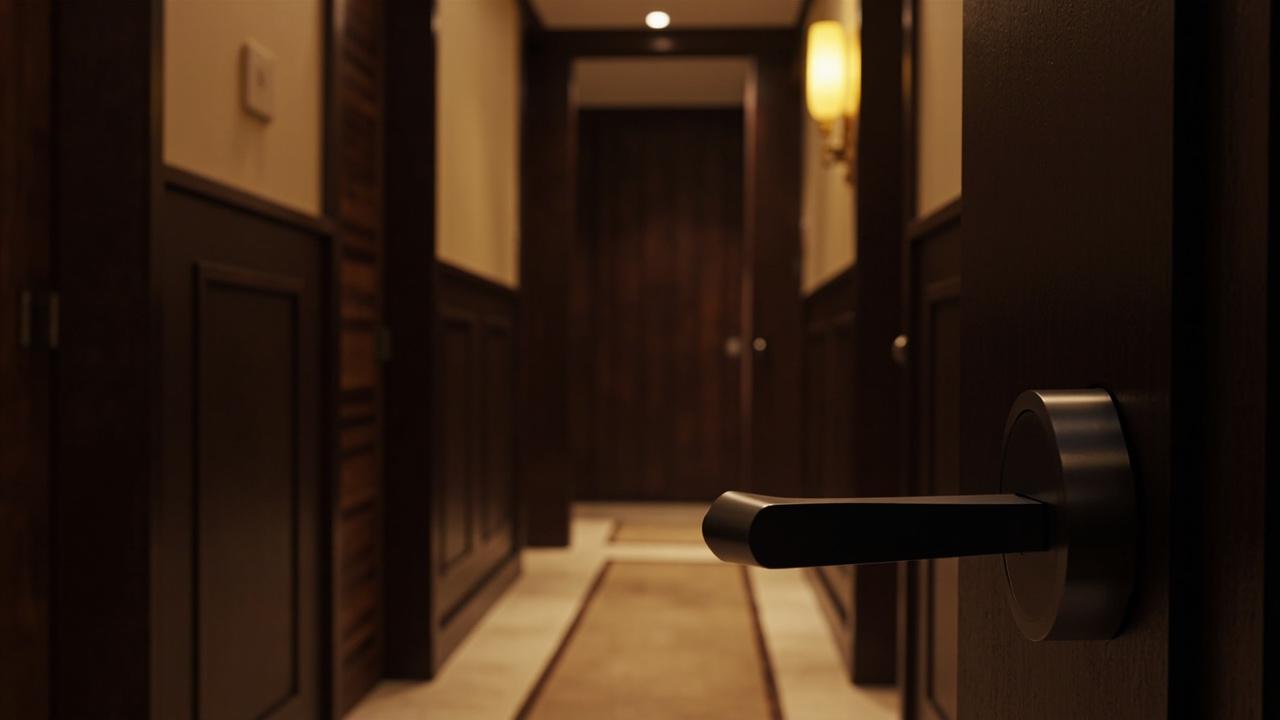
Smart Lock Free-Rotation Handle Security
Smart lock free-rotation handle security is the stage-gated discipline that separates outside-handle freedom (a designed anti-forced-entry property) from inside-handle commitment (a designed panic-egress property), traces each handle through its locked / unlocked / failure-mode lifecycle, and forces every per-SKU handle claim onto the dated product page rather than onto a brochure. A handle that turns freely when the lock is locked, and a handle that always opens from the inside, are two different design statements; the same physical handle carries both at once, and the spec has to say which face does what under which state. This document walks that statement through six stages — Stage 0 design intent → Stage 1 locked state → Stage 2 authorized unlock → Stage 3 unlocked use → Stage 4 relock → Stage 5 failure modes — with a per-model handle-behavior confirmation matrix and a procurement handoff at the close.
The handle sits in the narrow slice that Smart Lock Security Architecture maps under "physical install / door-side" defense and that Smart Lock Mechanical Security treats as the cylinder-and-bolt conversation, while Smart Lock Anti-Picking Design treats the cylinder-side attacks separately. This article does not duplicate any of those three. It picks up where the cylinder-side geometry leaves off — the handle the cylinder releases, the spindle the handle drives, and the clutch the handle sits in. Every handle-side fact that touches a specific SKU is routed to that SKU's dated product page; the SLK-9936S figures are used once as the documentation-granularity ruler under a strict no-porting-across-models firewall.
Why free-rotation handle security is a lifecycle, not a feature
A handle looks like a single product surface. A buyer sees a lever or a knob, the word "free-spinning" or "clutched," maybe a material note, and that is the end of the conversation. The threat model, however, is a sequence. The same handle behaves differently at each of five points in its own life:
- Before credential presentation — the door is locked; the question is what the outside handle does when a hand grabs it without authority, and what the inside handle does when a hand grabs it during an emergency.
- At credential presentation — the question is what the handle is asked to do by the reader, by the motor, by the clutch, and whether the handle's mechanical movement is gated by an electronic decision.
- During authorized use — the question is whether the handle remains clutched (free-spinning) or engages (driven) for the duration of the open state, and what happens if a second user presents a different credential while the first is still inside.
- At relock — the question is whether the handle returns to free-rotation immediately on relock, on a delay, on door-close sensing, or on next credential, and whether the relock path can be subverted by holding the handle.
- At failure — power-loss, motor-fault, clutch-fault, mechanical-key-only state, and the question of what the handle does in each one.
A buyer who treats "free-spinning handle" as one feature has missed the lifecycle. A buyer who walks the lifecycle can demand one spec line per state per SKU, and refuse to accept any line that the supplier cannot fill against that SKU's product page.
Stage 0 — Design intent: why free-rotation exists at all
Free-rotation is a defense against a specific attack: forced handle manipulation. The classic version is a thin tool slid behind an exposed lever, or a cable fed through a door gap, used to grab the handle and rotate it. If the handle is rigidly connected to the latch, the rotation retracts the latch. If the handle is clutched — decoupled from the latch when the lock is locked — the rotation spins in place. Free-rotation is therefore not a stylistic choice. It is a designed answer to a specific mechanical attack.
Two design facts sit on top of that answer and the spec has to keep separate.
- Outside handle. The handle a non-authorized party can reach. The design intent is freedom when locked, drive when unlocked.
- Inside handle. The handle the room occupant or egressing person reaches. The design intent, in almost every jurisdiction and every product category we have shipped into, is always free — i.e. retraction of the latch independent of credential and independent of lock state. This is the panic-egress property. A smart lock that gated the inside handle behind an electronic decision is, in most reading, not a compliant hotel / residential / office lock. That is not a manufacturer-stamped compliance statement — it is a buyer duty routed to local authority-having-jurisdiction (AHJ) and counsel for the property's specific occupancy class. The spec has to call the duty, not assert the answer.
Two consequences follow. First, the outside-handle free-rotation claim is per-SKU, per-firmware-revision, per-handle-set revision — and the supplier is asked to verify in writing the behavior on the dated product page for every shortlisted model. Second, the inside-handle always-free claim is a baseline the buyer writes into the spec without negotiating, because it is a baseline the buyer cannot negotiate away on life-safety grounds. The discipline of writing both lines separately is the discipline the rest of this article keeps.
Decision matrix — what each side of the door has to do
The first table is a per-stage × per-side matrix the spec carries forward into every RFQ.
| Stage | Outside handle — what it must do | Inside handle — what it must do | Per-SKU confirmation |
|---|---|---|---|
| Locked (no credential) | Free-rotation; no latch retraction under hand-tool or cable attack | Always-free; latch retracts under hand pressure | Outside behavior: check against the model specification. Inside behavior: check against the model specification; life-safety duty routed to local AHJ |
| Credential presented, accepted | Transition from free to driven within supplier-defined window | No change in always-free behavior | — |
| Credential presented, rejected | No transition; handle stays free | No change in always-free behavior | — |
| Authorized open state | Driven for the duration of the open window | Always-free | — |
| Mid-use second credential | Behavior depends on anti-passback / multi-user policy | Always-free | Check against the model specification; multi-user policy is a software-side decision, not a handle-side one |
| Relock | Return to free-rotation at relock event | Always-free | Check against the model specification; relock trigger (immediate / delay / door-close / next-credential) is per-SKU |
| Power loss | Per-SKU behavior; clutched handle stays free; motor-driven handle may revert to free or lock | Always-free; mechanical fallback required by life-safety duty | Check against the model specification; mechanical-key override is a separate spec line |
| Mechanical-key-only state | Free unless mechanical override path engages | Always-free | — |
Cells marked — have no documented value in this article’s sources; obtain the figure from the supplier’s written specification.
The matrix is a worksheet. Filling them with what the supplier documents for the specific SKU is the work.
Stage 1 — Locked state: outside free, inside committed
This is the security-relevant state. The door is shut, the lock is engaged, and the question is what each handle does under hand pressure.
For the outside handle, free-rotation has three acceptable realizations at the mechanical layer. The first is a clutched lever — a spring-loaded or cam-driven decoupling between the lever and the spindle, so the lever can rotate through its full arc without transmitting torque to the spindle. The second is a direct-drive lever with electronic gating — the spindle is mechanically connected, but the latch is held by a motor or solenoid that releases only on credential presentation, so lever rotation transmits torque but the latch does not retract. The third is a clutched knob — the rotational knob form factor with a similar decoupled behavior. Which realization a given SKU uses is a per-SKU fact on the dated product page; the spec asks for the realization, not the adjective.
For the inside handle, the realization is mechanical: a direct-drive lever or a panic-bar whose rotation or depression physically retract the latch. The handle does not consult the electronics, does not consult the credential reader, does not consult the firmware. It moves the bolt. That is the property the spec writes down without negotiation.
The locked-state failure modes are honest and the spec has to name them.
- Cable-through-gap attack. A thin cable passed under the door or through a letterbox to grab the inside handle. Inside-handle always-free means the cable retract the latch. This is a door-side and frame-side failure, not a handle-side one — a letterbox restrictor, a door-edge seal, or a through-gap seal defeats it. The spec carries the attack to the door prep section, not the handle section.
- Fishing attack through the door interior. A tool inserted into the door to reach the inside handle from the outside. Same routing as above — a door-side or installation-side control.
- Handle-set seizure. A handle whose clutch mechanism fails in the driven state because of wear, debris, or a vendor defect. The lock stops being free-spinning; the outside handle retracts the latch. This is the failure mode the spec's per-SKU confirmation matrix exists to surface — check the model’s published specification, ask for the field-failure rate, ask for the documented clutch design.
- Spindle shear. A handle whose spindle (the square shaft the handle sits on) shears under attack, leaving the spindle end inside the lock and the handle outside. The lock is still secure (the latch is still engaged), but the door cannot be operated from the outside even with credential. The spec asks for the spindle material and shear rating on the dated product page.
A buyer who names these four failure modes in writing has bought more handle-side security than a buyer who read the brochure.
Per-SKU behavior worksheet — locked state
The first worksheet is locked-state behavior. Each cell is a per-SKU blank.
| Model | What is documented |
|---|---|
| SLK-9936S hotel-class lock | Inside always-free?: life-safety duty routed to AHJ Notes: SLK-9936S product-page-documented spec block (5-pin cylinder, 3-point latch, stainless steel + alloy body, multiple finish options, mechanical emergency access, multilingual management software, standalone or centralized database modes) is documented for the SLK-9936S only and is never ported across |
| SLK-9936G | Notes: distinct SKU |
| SLK-9905A hidden-reader hotel lock | Notes: distinct SKU; hidden-reader form factor may change the outside-handle face design |
| SLK-9951TH | Notes: distinct SKU |
| SLK-9962S | Notes: distinct SKU |
| SLK-8831 5-in-1 multi-function | Notes: residential-class SKU; handle-side behavior distinct from hotel class |
| SLK-G200 glass-door smart lock | Notes: glass-door SKU; frameless-glass mounting changes the handle-side substrate |
| Other catalog SKUs | Notes: per-SKU; never port from sibling rows |
The table is a procurement discipline. It is also a discipline that prevents the most common handle-side buying error — copying the outside-free / inside-always-free line from one SKU's product page onto another SKU's spec, where the realization is different.
Stage 2 — Authorized unlock transition
The transition from locked to unlocked is the moment the outside handle changes behavior. There are three patterns in the catalog, each with a distinct security reading, and the supplier is asked to verify in writing which pattern the SKU uses.
The first pattern is clutched handle + electronic latch release. The handle is clutched; the latch is held by a motor, solenoid, or magnetic catch that releases only when the credential is accepted. Lever rotation is decoupled from the spindle, and the latch is held electronically; on credential acceptance, both events coincide. The handle becomes driven, the latch retracts.
The second pattern is direct-drive handle + clutch-on-relock. The handle is mechanically connected to the spindle at all times. The clutch engages and disengages at relock and unlock events. The lever movement is gated by the clutch state, not by an electronic latch.
The third pattern is motor-driven handle. The handle's rotation is driven by a small motor in response to credential presentation, rather than by a hand. The user does not rotate the lever; the lever rotates itself. The free-rotation property when locked still holds (no motor activation, no drive), but the open path is not hand-powered.
Each pattern has a security reading the spec carries forward.
- Pattern 1 (clutched handle + electronic latch release). The free-rotation property is mechanical, independent of power. Power loss with the latch released is a per-SKU behavior — some patterns fail-secure (latch re-engages), some fail-safe (latch retracts). Check the model’s published specification. The clutched handle stays free through the entire power-loss event; the latch state is the only thing that changes.
- Pattern 2 (direct-drive handle + clutch-on-relock). The free-rotation property depends on the clutch being properly seated. A clutch-fault state is a handle that drives the spindle when it should not. The failure-mode worksheet is therefore larger for this pattern.
- Pattern 3 (motor-driven handle). The free-rotation property still holds, but the transition is motor-actuated, not hand-actuated. A motor-fault state is a handle that does not move under credential or under hand. The transition timing (how fast the motor drives) is a per-SKU spec.
What the spec has to ask for, in writing, is the pattern the SKU uses, the transition timing (the window between credential acceptance and handle engagement), and the power-loss behavior (does the latch re-engage, retract, or hold the last state). Each is a per-SKU fact on the dated product page.
| Spec line | What is documented |
|---|---|
| Unlock pattern | Question the spec must ask: Clutched + electronic release / direct-drive + clutch / motor-driven / other |
| Transition timing | Question the spec must ask: Window between credential acceptance and handle engagement, in supplier-defined units |
| Power-loss behavior of latch | Question the spec must ask: Fail-secure / fail-safe / hold-last / per-credential |
| Inside handle during transition | Question the spec must ask: Always-free; verify mechanical-only path (no electronics in the inside-handle circuit) |
| Anti-passback interaction | Question the spec must ask: Behavior of second credential presented during first user's open window Per-SKU confirmation: software-side policy |
The five spec lines are the unlock-transition handoff. The supplier answers each on the SKU's dated page; the buyer reads each into the spec without line-extension.
Stage 3 — Unlocked use phase
The door is open, the user is passing through, and the question is what the handles do during the open window.
For the outside handle, the open-window behavior falls into two camps. Camp A: handle stays clutched free. The user opens the door; the handle does not stay driven; the next person who touches the handle from outside must present credential again. Camp B: handle stays driven until the lock relocks. The user opens the door; the handle is mechanically connected to the latch for the entire open window; a second outside user can open the door without credential if the first user is still inside.
Camp A is more secure against opportunistic tail-gating. Camp B is more convenient for high-traffic interior doors and for hotels where a guest walks back and forth during the open window. Which camp a SKU uses is a per-SKU fact; the supplier answers on the dated page. The spec writes the choice the property wants, not the choice the brochure defaults to.
For the inside handle, the use-phase behavior is the same as the locked-state behavior: always-free, mechanical, independent of electronics. The inside handle does not consult the credential reader or the firmware during the use phase.
The use-phase failure modes are honest and the spec has to name them.
- Tail-gating. A second person follows the first through the open door without presenting credential. Free-rotation when locked prevents handle manipulation, but does not prevent tail-gating during the open window. The control is anti-passback, which is a software-side decision (whether to require credential re-presentation inside a window), not a handle-side one. The handle-side spec writes the failure-mode ownership: handle-side cannot solve tail-gating; software-side can, and the buyer writes the software-side line in a sibling spec.
- Handle-set fatigue. A driven handle used at high cycle counts accumulates wear at the spindle interface. The spec asks for the rated cycle count and the documented wear behavior. For hotel-class locks with audit/event record up to 1,000 events, the use-phase cycle count is part of the long-life arithmetic — not a marketing figure.
- Spindle slip. A spindle whose set-screw or interface wears so the handle rotates without driving the latch. The handle moves, the latch does not. The property is annoying rather than insecure (the door does not open), but it is a per-SKU reliability question the spec asks for.
Use-phase checklist the buyer runs on samples
The second worksheet is a sample-stage checklist — things the buyer can verify on the sample bench before any commitment is made. Severity ratings are buyer's lens, not a factory claim.
| Check | What to do on the sample | Severity | Evidence to file |
|---|---|---|---|
| Outside handle free-rotation under locked state | Hand-grab the outside lever, rotate fully; verify no latch movement | Critical | Photo / video / signed bench note |
| Outside handle clutched vs driven pattern | Rotate the outside lever slowly under locked state; feel for decoupled vs direct feedback | Critical | Photo / signed bench note |
| Inside handle always-free under locked state | Hand-grab the inside lever, rotate fully; verify latch retraction independent of electronics | Critical | Photo / signed bench note |
| Inside handle always-free under power-loss | Remove the batteries (or supplier-recommended power-down); verify inside handle still retracts latch | Critical | Photo / signed bench note |
| Credential-presented → handle-driven transition timing | Time the window between credential acceptance and handle engagement | Major | Time-stamped note |
| Use-phase open-window behavior | Open the door with credential; without closing, attempt second credential-less outside handle rotation | Major | Time-stamped note |
| Spindle interface | Inspect spindle material and set-screw or spring-clip retention | Major | Photo |
| Handle-set finish and material | Verify against supplier-declared finish options and material spec | Recommended | Photo / supplier doc |
The eight-row checklist is the sample-stage handoff. A buyer who runs the eight checks has answered Stage 0–3 on the bench and is no longer buying adjectives.
Stage 4 — Relock transition
Relock is the moment the handle returns to the locked-state behavior. It is also the moment several attack paths become available again, and the spec has to name the relock trigger the property actually wants.
There are four relock triggers in the catalog, each with a different security reading.
- Immediate relock on door-close sensing. The lock re-engages the instant the door closes. Outside handle returns to free-rotation immediately. This is the most secure trigger for hotel guest-room doors and for most residential and office applications.
- Delayed relock (supplier-defined delay window). The lock re-engages after a delay. Useful for high-traffic doors where the door is opened and closed several times in a short window. The delay is a per-SKU value on the dated product page.
- Manual relock on credential. The lock re-engages on a specific user action (credential re-presentation, button press). Most common on interior office doors and on doors with frequent in-and-out traffic. The relock event is contingent on user behavior, which means the security reading depends on whether users actually re-present.
- No automatic relock; relock only on credential. Reserved for high-traffic interior doors where the door remains unlocked through the open window. The outside handle stays driven for the entire unlocked window. The failure mode is the use-phase tail-gating pattern above.
The spec asks for the trigger type per SKU, the trigger delay (where applicable), and the behavior of the outside handle during the delay — is the handle still clutched free during the delay, or driven. For hotel-class locks and most residential and office applications, the trigger type is the immediate-on-door-close pattern, and the spec writes that without negotiation.
The relock failure modes are honest.
- Hold-handle-during-relock attack. A person holds the outside handle while the door closes, preventing the latch from re-engaging. The outside handle remains driven; the door can be opened without credential on the next attempt. The control is a per-SKU handle-state sensor that detects a held handle and aborts the relock, or a per-SKU relock mechanism that drives the latch past the handle-held state. Check the model’s published specification.
- Door not-fully-closed sensing. The door is shut to within a small gap, the latch misses the strike, and the lock returns to its locked-state behavior. The door appears locked, the latch is not engaged. The control is a per-SKU door-position sensor that reports latch-state separately from credential-state. Check the model’s published specification.
- Tamper during relock. An adversary tampers with the lock during the relock event (forces the lever, removes the cover, breaks the cable). The relock completes anyway because the credential has already been read. The control is a per-SKU tamper input that inhibits relock on tamper, and an audit-event write that records the tamper event. Check the model’s published specification.
The three failure modes are the relock-handoff honesty. They are also the failure modes that distinguish a brochure "auto-relock" from a defensible relock specification.
Stage 5 — Failure modes and the honest security framing
The honest security framing of free-rotation handle design is that free-rotation is one defense among several, not a stand-alone guarantee. A handle that spins freely when locked is a strong defense against forced handle manipulation, but it is not a defense against door-side attacks (gap, letterbox, fishing), against credential-side attacks (cloning, replay, sharing), against firmware-side attacks (a firmware revision that fails to clutch on relock), or against physical attacks that bypass the door altogether (frame removal, hinge attack). The architecture decision — which layers cover which threats — sits in Smart Lock Security Architecture; this article names the layer the handle owns and the layers it does not.
The catalog of failure modes the buyer writes into the spec, in priority order:
- Forced handle manipulation with clutch failure. A handle whose clutch fails in the driven state retracts the latch under attack. The control is the supplier's per-SKU clutch design and field-failure rate — check the model’s published specification.
- Door-side gap attacks. Cable-through-gap, letterbox fishing, fishing through the door interior. The control is door prep, frame reinforcement, letterbox restrictor — out of scope for the handle, in scope for the door and frame.
- Credential-side attacks. Cloning, replay, sharing. The control is the credential-side architecture — out of scope for the handle, in scope for the reader and the firmware.
- Firmware-side attacks. A firmware revision that fails to clutch the handle on relock, that fails to release the latch on credential acceptance, that fails to write the audit event. The control is the firmware-supplier's revision control and audit-trail discipline — out of scope for the handle, in scope for the firmware.
- Mechanical-key override failure. A mechanical-key override path that engages the handle directly, bypassing the clutch, on a property where the override key is mismanaged. The control is the mechanical-key custody policy — out of scope for the handle, in scope for the operational discipline.
- Power-loss with motor-driven latch. A pattern-1 or pattern-3 lock whose latch fails-safe on power loss. The control is the supplier's fail-state declaration — check the model’s published specification; the property's life-safety assessment sits with the AHJ.
- Spindle shear on attack. A handle whose spindle shears under sustained torque. The lock remains secure (latch engaged), but the handle is broken. The control is the spindle material and shear rating — check the model’s published specification.
The seven failure modes are the honest security framing. The brochure says "free-spinning handle resists forced entry." The spec says "free-spinning handle resists forced handle manipulation; the other six failure modes are owned by other layers and by other specs." The latter sentence is the one that goes into the RFQ.
Failure-mode scorecard the buyer runs per shortlisted SKU
The third worksheet is a per-SKU scorecard. Each row is a failure mode; each column is a shortlisted model. Cells route to the dated product page for the supplier's written answer; cells that cannot be answered in writing are recorded as such.
| Failure mode | SLK-9936S | SLK-9936G | SLK-9905A | SLK-9951TH | SLK-9962S | SLK-8831 | SLK-G200 | Other |
|---|---|---|---|---|---|---|---|---|
| Forced handle manipulation under clutch failure | — | — | — | — | — | — | — | — |
| Door-side gap attacks | out of handle scope; door-side spec | same | same | same | same | same | same | same |
| Credential-side attacks | out of handle scope; reader/firmware spec | same | same | same | same | same | same | same |
| Firmware-side attacks | out of handle scope; firmware spec | same | same | same | same | same | same | same |
| Mechanical-key override failure | out of handle scope; operational discipline | same | same | same | same | same | same | same |
| Power-loss with motor-driven latch | — | — | — | — | — | — | — | — |
| Spindle shear on attack | — | — | — | — | — | — | — | — |
The seven-row × eight-column matrix is the failure-mode handoff. A buyer who reads it row by row has named every handle-side question a defensible RFQ has to ask.
Per-model handle behavior confirmation matrix
The fourth worksheet consolidates the per-SKU blanks-fill into one matrix the spec carries forward. Every cell that depends on a specific SKU's design is verified in writing and routed to the dated product page. The SLK-9936S row carries the only anchor figure from the PDP-cited spec block (multiple finish options, mechanical emergency access) and is invoked once under the explicit no-porting-across-models firewall.
| Handle-side fact | What is documented |
|---|---|
| Outside handle type (lever / knob / other) | — |
| Outside free-rotation when locked | — |
| Unlock pattern (clutched / direct-drive / motor-driven) | — |
| Transition timing (credential-accepted → handle-driven) | — |
| Power-loss behavior of latch | — |
| Inside handle always-free under locked state | SLK-9936S: life-safety duty routed to AHJ |
| Inside handle always-free under power-loss | SLK-9936S: mechanical emergency access is the PDP-cited fallback path for SLK-9936S only |
| Relock trigger (immediate / delay / manual / credential) | — |
| Handle-state sensor (hold-handle-during-relock) | — |
| Door-position sensor | — |
| Tamper input during relock | — |
| Spindle material and shear rating | — |
| Handle-set finish options | SLK-9936S: multiple finish options (product-page-documented for SLK-9936S only; never port across) |
| Handle-set material (stainless / alloy / zinc / other) | SLK-9936S: stainless steel + alloy body (product-page-documented for SLK-9936S only; never port across) |
| ADA / panic-egress implications | SLK-9936S: out of factory scope; routed to local AHJ and counsel for the property's occupancy class |
Every row is a per-SKU question; every cell is a documentation answer. A buyer who finishes the matrix has a written handle-side specification for every shortlisted model.
Decision matrix — which handle-side architecture fits which property profile
The fifth worksheet is a property-profile × handle-architecture decision matrix. The handle-side architecture is not chosen in isolation; it is chosen against the property's traffic, occupancy class, and threat model.
| Property profile | Recommended handle-side pattern | Trigger type | Inside-handle baseline | Spec lines to emphasize |
|---|---|---|---|---|
| Hotel guest-room door | Clutched handle + electronic latch release (Pattern 1) | Immediate relock on door-close sensing | Always-free (life-safety duty) | Unlock pattern, transition timing, fail-secure on power loss, door-position sensor, handle-state sensor |
| Hotel back-of-house / staff door | Clutched or direct-drive (Pattern 1 or 2) | Manual or credential-triggered relock | Always-free | Unlock pattern, anti-passback, audit-event on each transition |
| Serviced apartment front door | Clutched handle + electronic latch release (Pattern 1) | Immediate relock on door-close | Always-free | Unlock pattern, fail-secure on power loss, multi-user behavior during long stays |
| Multi-tenant residential unit | Clutched handle + electronic latch release (Pattern 1) | Immediate relock on door-close | Always-free | Unlock pattern, fail-secure on power loss, multi-user behavior |
| Office single-tenant interior | Direct-drive + clutch-on-relock (Pattern 2) | Manual or credential-triggered | Always-free | Anti-passback, anti-tail-gating, audit-event on each transition |
| Office multi-tenant / shared | Clutched or motor-driven (Pattern 1 or 3) | Immediate relock on door-close | Always-free | Unlock pattern, transition timing, fail-secure, audit-event |
| Retail staff-only door | Direct-drive + clutch-on-relock (Pattern 2) | Manual relock | Always-free | Anti-passback, audit-event, mechanical-key custody |
| Industrial / infrastructure room | Clutched handle + electronic latch release (Pattern 1); consider motor-driven for high-cycle | Immediate relock on door-close | Always-free | Cycle rating, spindle shear rating, fail-secure |
The eight-row matrix is the property-fit handoff. It does not name a single SKU; it names the handle-side pattern the property should ask for, and the spec carries that pattern into the per-SKU matrix above.
Illustrative scenario — a 120-room property split across two door populations
Consider a 120-room property split across two door populations. Eighty rooms are guest-room doors with hotel-class SKU under consideration (SLK-9936S or a sibling); forty rooms are back-of-house staff doors with a different SKU. The two populations have different handle-side profiles, and the spec carries them separately.
Guest-room population (80 doors). The handle-side pattern is clutched + electronic latch release (Pattern 1). Outside handle is free-rotation when locked. Inside handle is always-free, mechanically decoupled, with mechanical emergency access as the documented fallback path. The relock trigger is immediate-on-door-close sensing. The handle-state sensor is present and reports held-handle events to the audit log. The door-position sensor is present and reports latch-state to the audit log independently from credential-state. The transition timing window is short enough that a guest does not notice a delay. The audit log, sized at audit/event records up to 1,000 (the PDP-cited SLK-9936S figure used here only as documentation-granularity ruler), is enough for several months of guest-room activity at typical event-per-day rates.
Back-of-house population (40 doors). The handle-side pattern is direct-drive + clutch-on-relock (Pattern 2), because staff traffic during shift change is high and credential re-presentation at every door would slow operations. Outside handle is clutched during relock state and driven during the open window. Inside handle is always-free. The relock trigger is credential-triggered (the staff member re-presents credential on exit). Anti-passback is on, so a second staff member presenting credential during the first's open window is logged.
The two populations produce two separate handle-side specs, two separate per-SKU confirmation matrices, and two separate sample-stage checklists. The buyer walks both into the RFQ and refuses a single spec line that covers both populations with one SKU and one set of claims. The supplier is asked to fill the per-SKU blanks on the dated product page for each SKU the property actually buys.
The scenario is illustrative. It is not a customer story; it is a worked example of the discipline the spec carries. The catalog facts (79 published models; 24 hotel locks; 10+ years; 80+ countries; OEM/ODM factory) sit behind the scene; the per-SKU handle facts route to the dated product page.
Closing — the handle-side handoff is a six-stage worksheet, not a feature
A buyer who walks into an RFQ with the word "free-spinning handle" in the spec has written a brochure line. A buyer who walks into the RFQ with six stages — design intent, locked state, authorized unlock, unlocked use, relock, failure modes — has written a specification the factory has to answer on its dated product page for every shortlisted SKU.
The handle-side handoff is five worksheets and one matrix: the design-intent decision matrix, the locked-state per-SKU worksheet, the unlock-transition spec line set, the sample-stage checklist, the failure-mode scorecard, and the per-model handle behavior confirmation matrix. Each is a blank-fill exercise that ends at the supplier's dated product page. The SLK-9936S figures are used once as documentation-granularity ruler and are not ported across to any sibling SKU; every other SKU's handle behavior is its own fact on its own page.
The honest security framing is that free-rotation handle security is one layer of a stack — it owns the handle-side attack surface and nothing else. The door-side attacks live in the door-and-frame spec. The credential-side attacks live in the reader-and-firmware spec. The mechanical-key attacks live in the operational-discipline spec. The architecture decision that ties the layers together sits in Smart Lock Security Architecture; the cylinder-side mechanical conversation sits in Smart Lock Mechanical Security; the cylinder-pick conversation sits in Smart Lock Anti-Picking Design. This article is the handle-side rung of that ladder, and it does not duplicate the three siblings.
For the property-side handoff, the supplier's per-SKU dated product pages are the documentation source for every handle-side fact named in the matrices above. The supplier's written confirmation is the only sanctionable answer to a handle-side RFQ question. Pricing, MOQ, lead time, and warranty are routed to the quote workflow so the handle-side conversation stays a security conversation, not a commercial one. Sample-stage verification of the eight-row bench checklist above is the practical handoff between spec and order, and the sample order path is where that handoff runs.