
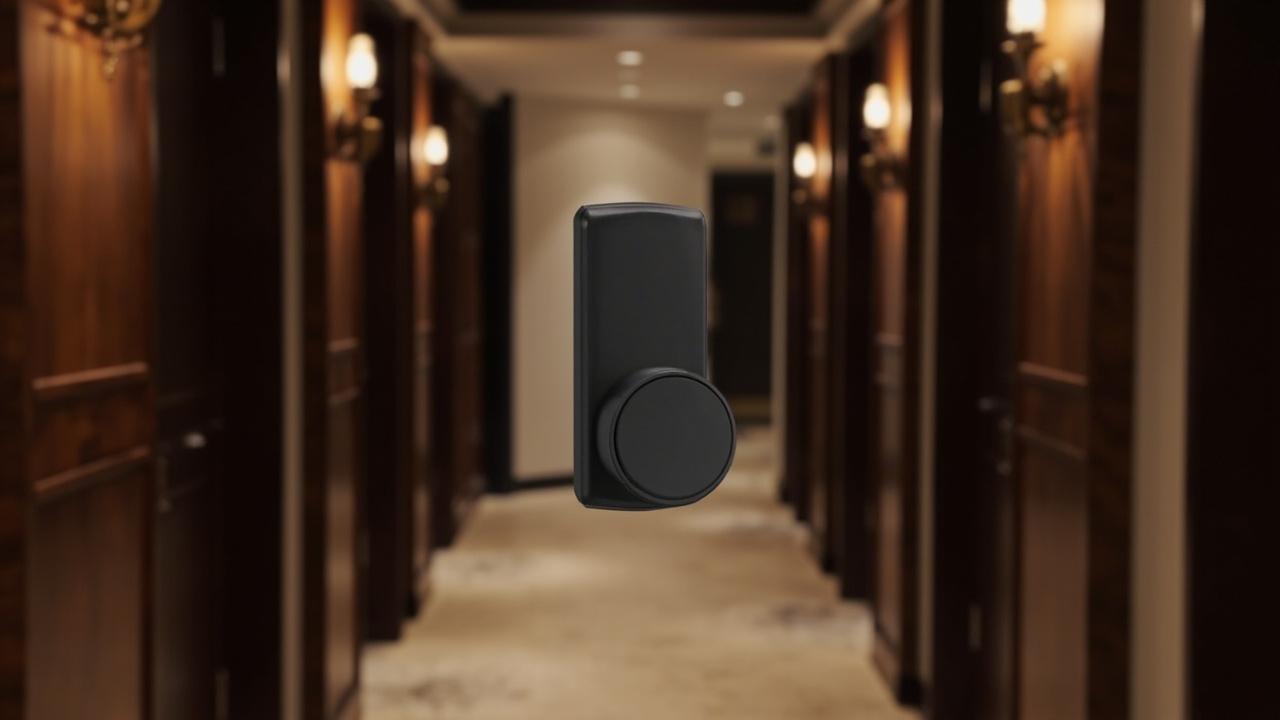
Hotel Smart Lock Staff Access Management
Hotel smart lock staff access management is the lifecycle of every non-guest credential that opens a hotel door — the issuance of an RFID card or PIN to a front-desk agent, a food-and-beverage server, a housekeeper, a maintenance technician, and a duty manager; the time-window and door-group scope that credential carries; the shift, property, and contract boundaries that bind it; the revocation discipline that ends it; and the audit trail that proves it happened. The staff lifecycle lives on the same hotel lock hardware as the guest lifecycle (Hotel Smart Lock Guest Access Management), and it shares the same management software, the same RFID Mifare 1 @ 13.56 MHz card technology where the SLK-9936S hotel-class lock is the documented anchor, and the same door-by-door scope grammar — but the policy questions are different. A guest card answers: which door, for how long, for one stay. A staff card answers: which doors across all shifts and inside which scope window, until revoked or until contract end.
This article is written as a process / timeline document. The spine is a five-stage staff-credential lifecycle — application, intake review, written confirmation, installation & training, in-life operation, decommission — applied to five named hotel roles (front desk, food & beverage, housekeeping, maintenance, manager) with explicit per-role stage gates, per-stage owner, per-stage artefact, and per-stage exit criterion. Around the lifecycle, six discipline tables translate the policy into rows a hotel operator can sign against: a per-role scope matrix, a per-stage artefact list, a shift-window cheat sheet, a master-hierarchy decision table, a revocation playbook, and an audit-trail-of-record card that links to the C07 audit-log content (Smart Lock Audit Logs). Every per-model capability is marked check the model’s published specification outside the SLK-9936S anchor row; no prices, MOQs, lead times, or warranty claims appear.
How to use this lifecycle
The six sections that follow are designed for two distinct moments in a hotel's life. The first three sections are pre-deployment artefacts the hotel group or property fills before staff credentials are first issued. The last three are in-life artefacts the duty manager or security owner re-runs every shift change, every quarter, and every incident.
| Symbol | Meaning |
|---|---|
| ☑ | Done, with the named artefact filed where the next reviewer can find it |
| ☐ | Not done — read the "if absent" column before moving on |
| — | Not applicable to this hotel; write the reason once, initial it |
Cells marked — have no documented value in this article’s sources; obtain the figure from the supplier’s written specification.
Rule that outranks every line in this article: a staff credential with no role scope, no shift window, no revocation owner, and no audit row is not a credential — it is a card that happens to exist. Staff access discipline begins before the card is encoded.
Stage 0 — Application (the role contract)
Before any front desk, F&B, housekeeping, maintenance, or manager card touches a hotel lock, the hotel group writes the role contract — a single signed document per role that names the duty holder, the door-group scope, the shift envelope, the contract boundary, and the audit-trail obligation. The application stage is the moment in the lifecycle when the buyer-side question who is this person to the property is answered before any technical question is asked. If the role contract is missing or unsigned, every downstream stage is paper.
| Stage gate | What must be true before the gate closes | Owner | Artefact filed |
|---|---|---|---|
| Role defined in writing | Five roles enumerated (front desk, F&B, housekeeping, maintenance, manager) with door-group scope named against a door-class list | Operations or duty manager | Role-contract template, signed |
| Door-class inventory complete | A single door-class list naming staff-only doors, staff-and-guest doors, manager-only doors, mechanical-override doors, public-area doors, and emergency-only doors — written against the actual property floor plan | Engineering or duty manager | Door-class inventory, signed |
| Shift envelope drafted | A shift envelope per role specifying start time, end time, day-of-week binding, and contract-end binding | HR or duty manager | Shift envelope table, signed |
| Audit-trail-of-record owner named | A named owner (security manager or duty manager) who owns the audit row when a staff credential is used | Security or general manager | Audit-trail-of-record assignment, signed |
| Revocation owner named | A named owner (HR or duty manager) who is paged when a cardholder's contract ends, is suspended, or reports the card lost | HR or duty manager | Revocation playbook, signed |
Exit criterion for Stage 0: five role contracts exist on file, the door-class inventory is signed, and the shift envelope is signed.
Stage 1 — Intake review (the role contract meets the card technology)
Stage 1 takes the signed role contract from Stage 0 and reviews it against the lock line the hotel has procured. This is where the per-model capability firewall is enforced: every cell the role contract depends on is checked against the published spec block of the actual hotel lock the buyer is committing to. The hotel-class SLK-9936S spec block — door thickness 36–100 mm · RFID Mifare 1 @ 13.56 MHz · read distance 0–5 cm · read time <0.25 s · power 4 × AA · battery operating cycles >15,000 · audit/event records up to 1,000 · 5-pin cylinder · 3-point latch · stainless steel + alloy body · multiple finish options · mechanical emergency access · multilingual management software · standalone or centralized database modes · positioned for 1–5 star hotels — is the only first-party capacity figure sanctioned for citation and belongs only to that model. Every other hotel SKU cited in this article (SLK-9936G, SLK-9905A, SLK-9951TH, SLK-9962S, plus the RFTC / RF card-and-code series 118, 118E, 228, 230, 232, 238, 239, 253, 305, 306, 308, 309, 502, 620, 621, 911, 002, 019, 022, 2020, 760) is a check the model’s published specification item for the specific capability cell.
| Stage gate | What must be true before the gate closes | Owner | Artefact filed |
|---|---|---|---|
| Door-thickness envelope confirmed per door | Each door in the door-class inventory is measured and confirmed against the lock's 36–100 mm (or ~38–100 mm for SLK-9905A) door-thickness envelope | Engineering or installer | Door-fit worksheet, signed |
| Card technology confirmed per door | The RFID Mifare 1 @ 13.56 MHz card type is confirmed compatible with the actual reader face at each door | Installer | Card-reader compatibility worksheet |
| Multilingual management software lane confirmed | Multilingual management software is confirmed available where the hotel operates in more than one language; otherwise the deployment operates on the management software the published spec block actually names | Operations | Management-software language worksheet |
| Standalone vs centralized database mode decided | The deployment has decided whether each hotel operates on the standalone database mode (per-lock issuance from the management software at the front desk) or the centralized database mode (one credential issuance server across all locks at the property) — or, for multi-property hotel groups, across properties | IT or operations | Database-mode decision sheet |
| Mechanical-emergency-access path confirmed | Mechanical emergency access — the cylinder-and-keyway path that opens the door when card, battery, or reader fails — is confirmed present on every door in the role contract | Installer | Mechanical-access worksheet |
| Battery format confirmed per door | Battery format (4 × AA on the SLK-9936S) and the documented battery operating cycles envelope (>15,000 cycles on the SLK-9936S) is confirmed for each door and the property's battery-replacement cadence is written | Engineering | Battery-cadence worksheet |
Exit criterion for Stage 1: every door in the role contract has a check the model’s published specification answer for door-thickness, card technology, management software language, database mode, mechanical access, and battery cadence.
Stage 2 — Written confirmation (the issuance policy is signed)
Stage 2 binds the Stage 0 role contract and the Stage 1 intake review into one written issuance policy the duty manager, HR, and security owner all sign. The issuance policy is the document a hotel auditor shows when a staff-card question is asked in an investigation. Without it, every card issuance is a discretionary act by the front-desk supervisor on shift, and discretionary issuance is the most common cause of orphaned staff credentials.
| Stage gate | What must be true before the gate closes | Owner | Artefact filed |
|---|---|---|---|
| Per-role door-group scope locked | A single per-role scope table naming which door classes each role may enter, signed by duty manager and security owner | Duty manager | Per-role scope table, signed |
| Per-role shift-window locked | A single per-role shift-window table naming start time, end time, day-of-week binding, and contract-end binding for each role | HR or duty manager | Per-role shift-window table, signed |
| Card-encoding chain of custody named | A single named owner (front-desk supervisor or security officer) who is the only person authorised to encode a staff card; every card encoding is logged | Security | Card-encoding chain-of-custody worksheet |
| Re-issuance and lost-card protocol signed | A signed protocol naming how a lost card is reported, who revokes it, how the audit row is generated, and what the re-card turnaround is | Security | Lost-card protocol, signed |
| Mechanical-override-key custody policy signed | A signed policy naming who holds the mechanical-override key for each door, how it is stored, and how each use is logged — for any door whose role contract permits mechanical access | Security | Mechanical-key custody policy, signed |
Exit criterion for Stage 2: five per-role scope tables exist on file, the card-encoding chain of custody is signed, the lost-card protocol is signed, and the mechanical-override-key custody policy is signed.
Stage 3 — Installation & training (the lifecycle begins)
Stage 3 is the moment the first staff card is encoded and handed to the first cardholder. The hotel opens the management software, encodes the card against the role contract, sets the time-window and door-group scope, and hands the card over with a signed acknowledgement. The acknowledgement is the document the duty manager shows when the cardholder later disputes the door group, the shift envelope, or the contract-end date.
| Stage gate | What must be true before the gate closes | Owner | Artefact filed |
|---|---|---|---|
| First-card issuance tested | A first-card issuance is encoded on the management software, set to the role contract's door-group scope and shift window, tested at one door in each door class, and verified | Front-desk or installer | First-card test report |
| Cardholder acknowledgement received | The cardholder signs an acknowledgement naming the door-group scope, the shift window, the contract-end date, the lost-card reporting channel, and the audit-trail disclosure | HR or duty manager | Cardholder acknowledgement, signed |
| Mechanical-override-key handover logged | Any mechanical-override key handed over to a manager or maintenance role is logged with the recipient, the key serial, the door(s) handover, and the date | Security | Mechanical-key handover log |
| Training completed | The cardholder is trained on the lost-card reporting channel, the mechanical-override use (where the role permits it), the audit-trail disclosure, and the disciplinary boundary if the card is shared | Duty manager | Training completion record |
Exit criterion for Stage 3: every cardholder has a signed acknowledgement on file, every mechanical-override key handover is logged, and every cardholder has completed training.
Stage 4 — In-life operation (the lifecycle runs)
Stage 4 is the running state — the hotel is open, the staff are working, the doors are opening. This is where the discipline of the previous stages pays off or fails. The five named hotel roles — front desk, F&B, housekeeping, maintenance, manager — each carry a distinct scope grammar against the door classes. The matrix below is the operational core of the article: it binds the role contract to the door-class inventory and shows, at a glance, where each role is expected to open a door.
| Role | Front-of-house guest areas | Guestroom doors (occupied) | Guestroom doors (vacant) | Staff-only offices | Plant rooms & storerooms | Mechanical-override keys held? |
|---|---|---|---|---|---|---|
| Front desk agent | — | — | — | — | — | — |
| F&B server / bartender | — | check the model’s published specification (room-service delivery only — check the model’s published specification) | check the model’s published specification (room-service preparation only — check the model’s published specification) | — | check the model’s published specification (kitchen & cold-room only — check the model’s published specification) | — |
| Housekeeping attendant | — | check the model’s published specification (occupied rooms on a defined service block — check the model’s published specification) | check the model’s published specification (vacant rooms on the daily block — check the model’s published specification) | — | check the model’s published specification (linen & supply rooms — check the model’s published specification) | — |
| Maintenance technician | check the model’s published specification (engineering rounds — check the model’s published specification) | check the model’s published specification (work-order only — check the model’s published specification) | check the model’s published specification (work-order only — check the model’s published specification) | — | — | check the model’s published specification (named key recipient only) |
| Duty manager / security officer | — | check the model’s published specification (incident response only — check the model’s published specification) | — | — | — | check the model’s published specification (named key recipient only) |
The role-to-door-class grammar is the policy the hotel writes; the per-SKU per-door capability is the engineering answer the buyer must convert into a written supplier answer before deployment.
Shift-window cheat sheet — the five roles against a 24-hour clock
The shift-window cheat sheet answers the question when is each role allowed to use the card. Times are inherited from the Stage 0 shift envelope; the cheat sheet is the operational one-page view the front-desk supervisor prints and pins behind the front desk. Per-SKU time-window granularity — whether the management software binds a shift to 15-minute blocks, 1-hour blocks, or day-of-week calendars — is a check the model’s published specification item.
| Role | Typical shift window | Override path |
|---|---|---|
| Front desk agent | 06:00–14:00 / 14:00–22:00 / 22:00–06:00 (three-shift rota) | Duty manager grant, logged |
| F&B server / bartender | 06:00–11:00 / 11:00–15:00 / 17:00–23:00 (F&B service windows) | F&B manager grant, logged |
| Housekeeping attendant | 08:00–16:00 / 09:00–17:00 (cleaning block, room-status driven) | Housekeeping supervisor grant, logged |
| Maintenance technician | 07:00–15:00 / on-call rota outside hours | Engineering manager grant, logged |
| Duty manager / security officer | 24/7 (with named duty-rota slots) | No override — manager scope is the override |
The shift-window cheat sheet does not assert a per-SKU granularity. The buyer converts each row into a written supplier answer before contract signature.
Master-hierarchy decision table — who can grant overrides
The master-hierarchy decision table binds the role contract to the override path. In a hotel hierarchy, the duty manager holds the master credential; the F&B manager, housekeeping supervisor, and engineering manager hold department-level credentials; front-desk agents, F&B servers, housekeeping attendants, and maintenance technicians hold role-scoped credentials. The override path is named in writing in the Stage 2 issuance policy.
| Level | Role | May grant a role-scoped override? | May write to the per-lock registry? | May hold mechanical-override keys? |
|---|---|---|---|---|
| 1 | Duty manager / security officer | Yes (override of any role-scoped credential) | Yes (signs every issuance) | — |
| 2 | F&B manager / housekeeping supervisor / engineering manager | Yes (department-scoped only) | Yes (department issuance) | — |
| 3 | Front desk agent / F&B server / housekeeping attendant / maintenance technician | No (request-only) | No | No (default) |
The buyer converts the master-hierarchy decision table into a written supplier answer before contract signature.
Stage 5 — Decommission (the lifecycle ends)
Stage 5 is the closing state of the staff credential — when a cardholder's contract ends, when a card is reported lost, when a cardholder is suspended, or when the cardholder transfers to a property that does not run on the same hotel lock line. Decommission is the stage that the discipline of the previous stages protects: a hotel that cannot decommission a staff credential within the time window named in the issuance policy cannot answer the question is this person still authorised to be here in real time. The decommission playbook is the document the security owner re-runs at every contract change.
| Stage gate | What must be true before the gate closes | Owner | Artefact filed |
|---|---|---|---|
| Card revocation event triggered | A revocation event has been logged in the management software: contract end, suspension, loss report, transfer, or disciplinary action | HR or duty manager | Revocation event log entry |
| Card returned or declared lost | The physical card has been returned, or a signed lost-card declaration has been filed | Cardholder or security | Card-return or loss declaration |
| Audit row for revocation generated | The management software has written an audit row for the revocation (cardholder, card serial, door-class scope, revocation owner, time of revocation) — the SLK-9936S hotel-class lock is documented to retain up to 1,000 audit/event records per its published spec block, with every other SKU a documentation item | Security or duty manager | Audit-row verification |
| Mechanical-override-key returned (if applicable) | Any mechanical-override key the cardholder held is returned and logged against the recipient, the key serial, and the door(s) | Security | Mechanical-key return log |
| Cardholder exit interview completed | A signed exit interview acknowledges that the cardholder's access has ended, the contract-end date, and any post-employment access (returning guest, contractor, etc.) | HR | Exit interview record |
Exit criterion for Stage 5: every cardholder whose contract ended has a revocation event log entry, a card-return or loss declaration on file, an audit row in the management software, and a mechanical-key return log where the role permitted a key.
Audit-trail-of-record card — the SLK-9936S anchor and the per-model firewall
The audit row written in Stage 3 (issuance), Stage 4 (every door open), and Stage 5 (revocation) is the deliverable a hotel operator hands to a regulator, an insurer, an internal auditor, or counsel when a forensic question is asked. The SLK-9936S hotel-class lock is documented to retain up to 1,000 audit/event records per its published spec block, and the lock ships with standalone or centralized database modes plus multilingual management software — every other hotel SKU's audit-trail depth, retrieval method, export format, time-stamp granularity, retention-after-full behaviour, tamper-evidence attribute, and read-access role separation is a check the model’s published specification item. The figure belongs only to the SLK-9936S hotel-class row; it is never imported onto any fingerprint, keypad, RFID, Bluetooth, outdoor, face, glass, cabinet, or video SKU in this article.
| Hotel lock line (representative SKU / line) | What is documented |
|---|---|
| Hotel RFID card lock — SLK-9936S (1–5 star hotel positioning) | Audit / event-record depth: up to 1,000 audit/event records (PDP-cited, SLK-9936S only) Read-access role separation: multilingual management software; standalone or centralized database modes per published spec block Per-model documentation scope: Door thickness 36–100 mm · RFID Mifare 1 @ 13.56 MHz · 0–5 cm read distance · <0.25 s read time · 4 × AA · >15,000 battery operating cycles · 5-pin cylinder · 3-point latch · stainless steel + alloy body · mechanical emergency access · multilingual management software · standalone or centralized database modes |
| Hotel — SLK-9936G | — |
| Hotel — SLK-9905A (hidden-reader, ~38–100 mm door thickness per published line) | — |
| Hotel — SLK-9951TH | — |
| Hotel — SLK-9962S | — |
| RFTC / RF card-and-code series (118, 118E, 228, 230, 232, 238, 239, 253, 305, 306, 308, 309, 502, 620, 621, 911, 002, 019, 022, 2020, 760) | — |
The audit-trail-of-record card does not assert a capability on any cell outside the SLK-9936S anchor row. Every other row is the buyer's written supplier answer.
Revocation playbook — the four trigger events and the time-window answer
The revocation playbook binds the Stage 5 decommission stage gates to the four trigger events the hotel operator faces in real time. The discipline is identical across all four events — log, return card, write audit row, return key, complete exit interview — but the trigger event drives who fires the playbook and how quickly. The time-window answer is a check the model’s published specification item; the hotel operator writes the answer in the issuance policy before the first card is encoded.
| Trigger event | Who fires the playbook | Audit-row content |
|---|---|---|
| Contract end (planned) | HR or duty manager, 7 days before contract-end date | cardholder, card serial, door-class scope, contract-end date, revocation owner |
| Suspension (disciplinary) | Duty manager or HR, immediately on decision | cardholder, card serial, door-class scope, time of suspension, revocation owner |
| Loss report | Cardholder, immediately on discovery; security fires the playbook on receipt | cardholder, card serial, door-class scope, time of loss report, time of revocation, revocation owner |
| Transfer (to a property outside the lock line) | HR or duty manager, on transfer decision | cardholder, card serial, door-class scope, transfer date, receiving property, revocation owner |
The four trigger events do not assert a per-SKU time-window. The buyer converts each row into a written supplier answer before contract signature.
Illustrative scenario — a 220-room three-star property walks the lifecycle
Consider a 220-room three-star property that has procured the SLK-9936S hotel-class lock as the property-wide guestroom lock and is now standing up the staff-credential lifecycle. The five roles — front desk, F&B, housekeeping, maintenance, manager — are walked through the six stages of the lifecycle, with the per-stage owner, the per-stage artefact, and the per-stage exit criterion named.
Stage 0 — Application. The duty manager writes the role contract: five roles enumerated, the door-class inventory completed against the property floor plan (six door classes — front-of-house guest areas, back-of-house service corridors, guestroom doors, staff-only offices, plant rooms, mechanical-override doors), the shift envelope drafted, the audit-trail-of-record owner named (security officer), the revocation owner named (HR). Exit criterion met: five role contracts on file, door-class inventory signed, shift envelope signed.
Stage 1 — Intake review. Engineering measures every guestroom door against the 36–100 mm door-thickness envelope and confirms fit. Installer confirms the RFID Mifare 1 @ 13.56 MHz card type against the actual reader face at each door. Operations confirms the multilingual management software lane because the property runs in two languages. IT confirms the centralized database mode because the property has one credential issuance server across all 220 guestroom locks. Security confirms mechanical emergency access on every door. Engineering writes a battery-cadence worksheet against the 4 × AA format and the documented battery operating cycles envelope (>15,000 cycles on the SLK-9936S). Exit criterion met: every door has a documentation answer for door-thickness, card technology, management software language, database mode, mechanical access, and battery cadence.
Stage 2 — Written confirmation. The duty manager writes the issuance policy: per-role scope table signed, per-role shift-window table signed, card-encoding chain of custody named (front-desk supervisor), lost-card protocol signed, mechanical-override-key custody policy signed. Exit criterion met: five per-role scope tables on file, chain of custody signed, lost-card protocol signed, mechanical-key custody policy signed.
Stage 3 — Installation & training. The front-desk supervisor encodes the first card for a front-desk agent on the management software, sets the door-group scope to front-of-house guest areas plus staff-only offices plus back-of-house service corridors (no guestroom doors, no plant rooms, no mechanical-override keys), sets the shift window to the front-desk shift rota, and hands the card over with a signed acknowledgement. The cardholder is briefed on the lost-card reporting channel, the audit-trail disclosure, and the disciplinary boundary. Exit criterion met: cardholder acknowledgement on file, mechanical-key handover logged (none for the front-desk role), training completed.
Stage 4 — In-life operation. The hotel opens. The front-desk agent's card opens front-of-house doors, staff-only offices, and back-of-house service corridors at the expected hours; the audit trail records every door open. The F&B server's card opens F&B back-of-house, kitchen cold-room, and the room-service delivery path on the shift windows. The housekeeping attendant's card opens back-of-house service corridors, linen and supply rooms, and the daily block of guestroom doors on the cleaning shift. The maintenance technician's card opens plant rooms, engineering rounds, and the work-order path into guestrooms when a work order is open. The duty manager's card opens every door class and holds the named mechanical-override key.
Stage 5 — Decommission. A housekeeping attendant's contract ends. The HR fires the revocation playbook, the cardholder returns the card, the management software writes the audit row (cardholder, card serial, door-class scope, contract-end date, revocation owner), and the exit interview is completed. Exit criterion met: revocation event log entry on file, card-return declaration on file, audit row in the management software, exit interview completed.
The 220-room scenario walks the lifecycle without asserting per-SKU capability outside the SLK-9936S anchor row.
Cross-link routing — where this article hands off
This article is the staff-credential lifecycle lens of the C08 hotel systems / integration cluster. It is deliberately distinct from the sibling articles that sit on the same hardware but cover different policy questions:
- The guest-credential lifecycle is covered in Hotel Smart Lock Guest Access Management, which answers the question which door, for how long, for one stay rather than which doors across all shifts, until revoked.
- The system-architecture lens — which lock line, which management software, which PMS, which audit-trail-of-record discipline — is covered in Hotel Smart Lock System Architecture, which the duty manager reads before Stage 1 of this article.
- The staff-card management worksheet — the per-card encoding chain, the per-cardholder acknowledgement, the lost-card protocol — is covered in Hotel Smart Lock Staff Card Management, which the front-desk supervisor uses inside Stage 3 and Stage 5 of this article.
- The audit-trail-of-record discipline for every staff-credential event is covered in Smart Lock Audit Logs, which is the C07 cluster sibling that this article links to from Stage 3, Stage 4, and Stage 5.
The hand-off rule: this article owns the lifecycle (Stage 0 through Stage 5); 451 owns the system (Stage 0 structure); 457 owns the guest (Stage 0 to Stage 5 for guest cards); 466 owns the card (Stage 3 and Stage 5 for the card encoding and the card return).
Closing — what to do next
If you are specifying the staff-credential lifecycle for a hotel property, three artefacts must exist before the first card is encoded: a signed role contract for each of the five roles (front desk, F&B, housekeeping, maintenance, manager); a signed door-class inventory against the property floor plan; and a signed issuance policy that names the card-encoding chain of custody, the lost-card protocol, and the mechanical-override-key custody policy. The five-stage lifecycle above is the operational discipline that binds those three artefacts to a deployment.
For the system-architecture lens — which lock line, which management software, which database mode — read Hotel Smart Lock System Architecture. For the guest-credential lifecycle on the same hardware, read Hotel Smart Lock Guest Access Management. For the per-card encoding and lost-card worksheets that sit inside Stage 3 and Stage 5 of this article, read Hotel Smart Lock Staff Card Management. To verify in writing the per-model capability the staff-credential lifecycle depends on — door-thickness envelope, RFID card technology, audit / event-record depth, mechanical emergency access, multilingual management software, standalone or centralized database modes — check the model’s published specification for every shortlisted hotel SKU outside the SLK-9936S anchor row, and request the verified PDF spec block via the catalogue request page.
The fastest path from this article to a signed contract is to convert the Stage 0 role contract and the Stage 2 issuance policy into the buyer's pre-RFQ worksheet and request a written per-SKU answer for every documentation cell. Submit the worksheet plus a short discovery summary through Request a quote — and request the verified catalogue (Request the catalog) so the per-SKU spec blocks can be checked against the per-door door-class inventory before the first card is encoded.