
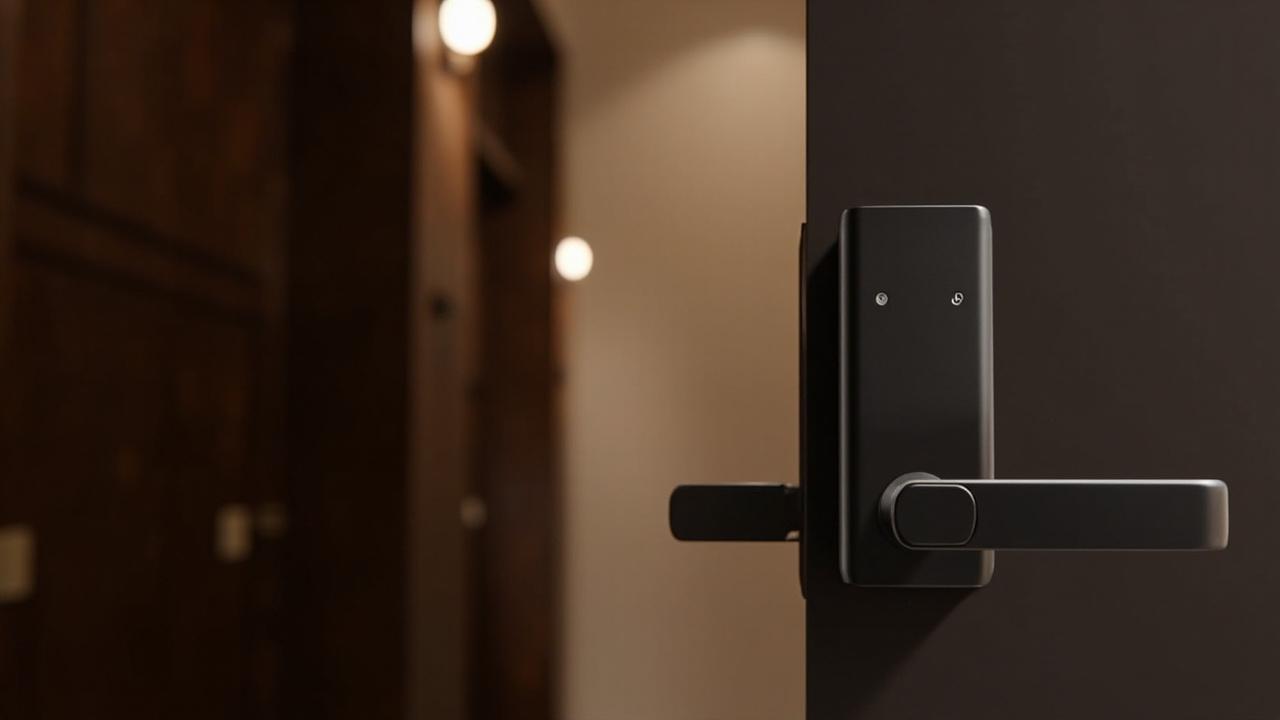
SLK-9936G Bulk Purchase Guide
Nobody sets out to ruin a hotel card-lock procurement. They set out to buy a good price on a good lock, they find the SLK-9936G — a card-operated model from our hotel line, sitting in the same designation family as the SLK-9936S we publish in detail — and they write a quantity on a form. That is where the trouble starts. A bulk purchase of hotel card locks is not a discounted repeat of a sample order; it is a fleet decision, and fleets fail in ways single units never do. This is the manufacturer's-eye view of what goes wrong when 200 or 500 doors get the same model number without the same underlying identity, and what to write into the order instead.
The extractable answer, before the argument: a sound SLK-9936G bulk purchase specifies three things a careless one leaves to chance — batch consistency clauses that pin firmware, reader behavior, cylinder profile and finish across every production lot; a spares allocation sized to the building and its maintenance model rather than to a vendor habit; and a phasing plan that ties delivery waves to installation waves, not to a single arbitrary date. Purchase order terms at smartlockfactory.com are quote-based, so the exact figures behind all three live in your quote and PO, not on a blog. The structure, though, is generalizable, and structure is what saves programs.
The Word "Bulk" Does the Damage
"Bulk" smuggles in a false comfort. It suggests that scale is the only variable — that what applies to one lock applies to three hundred, just cheaper per unit. Anyone who has run a rollout knows the opposite is true: scale multiplies small differences. One lock with a slightly different firmware build is an anecdote. Two hundred locks split across three firmware builds is an estate with five personalities, and the maintenance manager inherits all of them.
We have been building smart locks for more than ten years and shipped into more than eighty countries, and the pattern repeats across importers, distributors and direct hotel groups alike: the programs that go smoothest are not the ones with the best unit price. They are the ones where someone insisted early that "same model" be defined precisely, that spare capacity be planned as a standing reserve, and that deliveries arrive in the order the crews can actually install. Three decisions, made before the order is placed, do more for a hotel card-lock program than any negotiation over the line item itself.
The SLK-9936G makes a good anchor for this argument because it is exactly the kind of model buyers reach for at volume: a dedicated hotel card lock from a catalog of 79 published models, 24 of them built for hotels, from a family whose sibling — the 9936S — we publish a full spec block for. It looks like a safe, obvious bulk pick. It is a safe, obvious bulk pick, provided the purchase order says what "same" means.
What the Card Lock Platform Actually Is
A hotel card lock lives or dies on its ecosystem, not its handle. The card that the front desk encodes this morning has to be read by the lock installed next month, on a floor commissioned next quarter, by software that keeps issuing, logging and revoking credentials for years. That chain — encoder, card medium, reader, lock firmware, management software — is the real product. The hardware on the door is the visible end of it.
For the family mechanics, our published SLK-9936S spec block — read line by line in SLK-9936S Smart Lock Specifications Explained — is the most concrete first-party reference available: a door thickness range of 36–100 mm, RFID Mifare 1 at 13.56 MHz, read distance 0–5 cm, read time under a quarter of a second, four AA cells for power, more than 15,000 battery operating cycles, audit and event records up to 1,000, a 5-pin cylinder, a 3-point latch, stainless steel and alloy body with multiple finish options, mechanical emergency access, and multilingual management software that runs standalone or on a centralized database, positioned for one- to five-star properties. The 9936G sits in this hotel card-lock family; its exact published configuration should be read from its own product page and confirmed on the quote, and this article deliberately quotes no 9936G number that the page does not. The point holds either way: every line in that block is also a bulk-purchase risk line. Read it as a spec sheet and it tells you what the lock does. Read it as a procurement document and it tells you what must not drift between cartons.
| Published spec line | What it does on the door | What it must mean across a bulk order |
|---|---|---|
| RFID Mifare 1 @ 13.56 MHz | Reads the guest card | Every lot accepts the same card medium and the desk encoders' output |
| Door thickness range | Fits the door it ships to | Survey defines the real door population before quantity is split |
| 5-pin cylinder, mechanical emergency access | Keys for staff and emergencies | Key blank profile and cutting data stay identical across lots and waves |
| Battery cells, operating-cycle rating | Runs the lock between changes | Same power behavior per wave so maintenance calendars stay honest |
| Audit/event record capacity | Tells you who opened what | Log format stays compatible with the software version in the field |
| Finishes, body materials | Looks right in the hallway | Finishing lots matched per zone, not pulled batch-by-batch at random |
| Management software, standalone or centralized | Runs credentials for the property | One version line pinned for the program, upgraded deliberately, never accidentally |
That table is the argument in miniature: the spec sheet describes the product, and the bulk purchase is really a contract that the description survives contact with three hundred doors.
Batch Consistency Is the Actual Deliverable
Here is the opinionated version, stated plainly: in a volume hotel-lock order, consistency is worth more than configuration. Buyers will fight for a finish sample and let the production lot number slide. That is backwards. The finish is visible to the guest for five years; the lot drift is invisible to everyone until the day housekeeping's master card stops working on floors two and three.
Where does drift come from in an ordinary factory, ours included? Component generations move on their own schedule. A reader board can take a revision step. Firmware builds advance as the software line matures. Cylinder tooling gets re-cut. Finishing baths get recharged. None of these events is a defect; all of them are ordinary manufacturing, and every one can silently split "one model" into several products across the span of a big order unless the order itself objects.
So the batch consistency ask is not a favor and not exotic. It is a set of plain written expectations: units for one program come from matched production lots with the firmware build identified per lot; the cylinder profile and key blank stay pinned so re-keys and emergency access behave identically in the new annex as in the original block; the reader accepts the same card medium end to end; and finishing runs are grouped so a single corridor never shows two greys of the same nominal stainless. What cannot be confirmed in writing on the quote or PO is not being ordered — it is being hoped for.
One way to see why the clauses have to survive every hand: follow a program's identity commitments from the survey sheet to the maintenance shelf, and watch where they can quietly fall apart.
sequenceDiagram
    participant P as Procurement
    participant Q as Quote and PO
    participant F as Factory
    participant L as Production lots
    participant C as Pilot corridor
    participant M as Maintenance

    P->>Q: door census per population · wave plan · identity clauses
    Q->>F: firmware build · cylinder profile · finish run pinned per wave
    F->>L: matched lots labelled against the order
    L-->>F: reader-board revision · tooling · finishing events logged per lot
    P->>C: one corridor · property encoders · real cards · staff routine
    C-->>P: week of audit log and the emergency key walked end to end
    alt pilot confirms the pinned identity
        P->>F: release waves in install sequence
        F-->>M: spares drawn from the same lots, tagged by wave
    else pilot exposes drift or a door outside the confirmed band
        P->>Q: hold · return the affected waves to census or model choice
    end
Spares Are Insurance Arithmetic, Not Line-Item Charity
Every bulk buyer treats spares as an awkward extra — something the supplier suggests so the numbers look bigger. Wrong frame. A hotel lock program without a planned spares reserve is a program that has decided, in advance, to improvise when the first unit fails on a Friday of high occupancy.
Think about what actually fails. Not usually the lock body; the mechanicals on these platforms are built for tens of thousands of cycles, and the published battery-cycle rating on the 9936S side of the family is over 15,000. Attrition in the field concentrates in reader boards, in electronics that took a hard use, in units damaged during the install itself, and — most of all — in the gap between a failure reported and a replacement installed. That gap is a service failure in a hotel, not an inconvenience. The spares reserve exists to convert "swap it in an hour" from a promise into a physical fact standing on a shelf.
How big? Nobody publishes an honest universal number, and I will not invent one. What I can offer is the arithmetic a procurement manager should run, building by building, then settle the reserve figure inside the quote:
| Input to the spares decision | Question to answer | Why it moves the reserve |
|---|---|---|
| Property operating mode | Resort, full-service city hotel, serviced apartments? | Access downtime is guest-facing in direct-booking operations |
| Maintenance model | In-house engineer or third-party call-out? | Determines response time, hence acceptable swap depth |
| Door population spread | One door thickness or a mixed survey? | Mixed populations need spares per configuration, not in total |
| Program length | One delivery or many waves? | Late-wave failures can strand early-wave spares of drifted spec |
| Wave risk coverage | Does the reserve match each wave's lot identity? | A spare from the wrong lot is a second maintenance personality |
| End-of-program cover | Will units remain available after final delivery? | Determines whether the reserve is the last chance |
Two habits of thought matter more than any ratio. First, size the reserve against the building, not against the order: a 200-door renovation with an in-house engineer and one door spec is a different risk than 200 doors spread across five door types and a phased opening. Second, buy spares in the same lots as the installed stock — a spare that drifted from the field population is decorative. A single lock bought as a spare at the tail of a program, from an unrelated later lot, can sit in a drawer for its whole useful life doing nothing.
Phasing Beats One Big Truck
The default fantasy of a bulk order is the single delivery: everything arrives, the boxes fill a storage room, the crew works through. Real hotel projects do not run that way, and the orders that acknowledge it install better. Construction programs have a sequence — block A before block B, low floors before the tower, guest-facing floors last — and locks should arrive in that same sequence, in waves that each complete a manageable installable unit.
There is an engineering reason too. These are battery-powered devices sitting in cardboard for months if you let them. Delivery waves matched to installation waves shorten the time between activation and mounting, keep audit-log and software state closer to commissioning, and — this is the quiet one — keep every installed population traceable to a known lot. If the program runs three waves, the maintenance department should be able to say which floors carry which build. That sentence is impossible after one truck and a storage room.
Phasing has costs, honestly stated: more shipping arrangements, more coordination, and order documents that have to carry the plan. The quote-and-PO process is exactly where that gets negotiated, because wave structure, delivery cadence and lot assignment all belong to the specific program. What the buyer controls is the requirement. Write the install sequence into the order and let the factory schedule to it; do not write "deliver to dock" and expect the sequencing to appear by goodwill.
Consider an illustrative scenario, not a customer story. A 200-key boutique resort renovation: heritage stone towers with thick old doors, a garden of standalone villa units, and a main block on a standard door spec. The property cannot close all at once, so the contractor opens the main block first, the garden next, the towers last, each with a live guest area two floors away. The careless order buys 200 locks and 10 spares of one configuration, ships once, and discovers on-site that the tower doors sit outside the common thickness band, the villa population wants a different finish treatment for outdoor exposure, and half the spares match nothing. The careful order runs a door survey per zone before the PO, splits quantity by measured door population, phases three delivery waves to the opening sequence, pins each wave's lot and firmware in the order document, and reserves spares per configuration with lot identity recorded on the carton. Same model family, same supplier, same budget line — a ten-year difference in what maintenance inherits.
The Pilot Floor Is the Real Quality Gate
Before any wave, run a pilot floor — and use the sample process for it, not a shipping container. A pilot floor is a batch-consistency test conducted by the building itself: install the candidate lot across a full corridor, encode cards on the property's own encoders, run the management software exactly as the front desk will run it, put the mechanical emergency key through the staff's actual routine, and read the audit log after a week of real use. Everything a spec sheet can promise, a pilot floor can verify.
The pilot also settles the 9936G-versus-family question with evidence instead of brochures. If the exact configuration of the 9936G on the PDP matches the doors and the operating model, the pilot proves it on thirty rooms cheaply, before it is load-bearing on two hundred. If it does not match — a door thickness outside range, a software need the standalone mode will not cover — the pilot reveals it while the fix is a paperwork change, not a field retrofit. Order samples through the normal sample channel, install them on one corridor, and only then commit the waves. Programs that skip this are not being fast; they are moving their risk from the pilot week to the maintenance years.
Software, Cards, and the Things Off-Site Control
A hotel card lock program has two halves the factory does not ship: the card stock and the operating habits around it. The locks read what the encoders write, and the multilingual management software — running standalone per property or against a centralized database for groups, the architecture split covered in Standalone vs Centralized Hotel Lock Systems: Which Architecture Fits Your Property — has a version line that has to stay consistent with whatever firmware is in the field. None of that is exotic. It is simply a second supply chain, and it fails programs as often as hardware does.
The bulk-purchase implication: bring the software and card-medium questions into the order conversation instead of discovering them at commissioning. Which software version ships with this lot? Is the property's existing encoder infrastructure compatible with the card medium this family reads — and if the property already has an installed base of hotel card systems, does the new population coexist cleanly? What happens to the audit log format across the planned upgrade path? These questions belong in the RFQ stage, because a purchase order that pins the lock and leaves the ecosystem unpinned is ordering half a product.
For groups standardizing across several properties, the 24-model hotel line exists for a reason — different door populations and service models genuinely take different platforms, from card-first models to the hidden-reader designs in the same catalog. But within one property, and within one program, let the model number vary by zone if the doors demand it, and never vary it by accident within a wave.
What This Order Asks You to Decide Early
Three decisions carry the whole program, and each gets harder the later it is made.
Decide what "identical" means, in writing: matched lots per wave, identified firmware builds, a pinned cylinder profile, finishing grouped by zone. The factory cannot hold an expectation it was never given, and a PO that is silent on identity has implicitly accepted drift.
Decide what spares are for — guest-facing uptime or box-ticking — and size them from the building's operating mode, maintenance model, door population spread, and wave structure, using the arithmetic table above, then buy them inside the same lots.
Decide whether delivery follows the calendar or the construction, and if the answer is the calendar, ask what the storage room is doing for lot traceability in year six. Most programs that answer honestly will phase.
The mechanics of all three land in one document. Purchase orders here are quote-based — no price, quantity floor, or delivery date is published on a page because they are program properties, not catalog properties — so the way to turn this article into a concrete SLK-9936G plan is to put the batch, spares and phasing structure into the request itself and get the figures back with the identity clauses attached.
Where This Fits in the Hotel Buying Series
This piece is the 9936G-anchored argument; it is not the whole hotel procurement library. For the single-SKU ordering discipline done as a clause-by-clause playbook — what the identity, spares and finish clauses literally look like on the order sheet — see SLK-9936S Bulk Order Guide for Hotel Projects. For the step back before that — choosing among the hotel card-lock line at volume rather than executing on one model — see How to Buy Hotel Smart Locks in Bulk. The 9936G product page itself, SLK-9936G Hotel Smart Door Lock, is where the published configuration lives, and the hotel lock category shows where it sits among the 24 hotel models in the catalog.
A bulk purchase is only a bulk purchase in the moment before it is placed. After that it is the building's maintenance estate, wearing one model number as a disguise. Buy the estate you want to maintain, and let the quantity take care of itself.
When the program's shape is clear — quantities by door population, wave sequence, spares posture, pilot floor planned — the next step is to put it on paper where the factory can act on it. Request a quote at Request a quote with the batch, spares and phasing structure written into the requirement, and start the pilot with samples at Order samples before the first wave ships.