
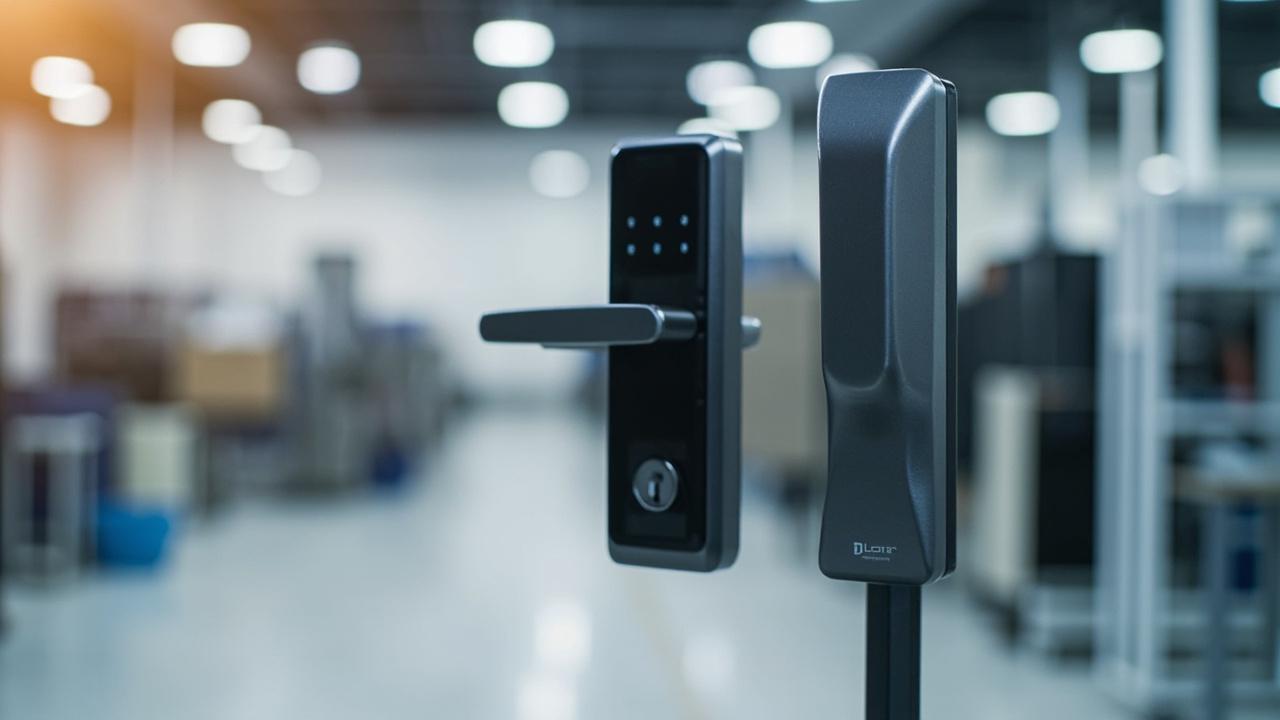
Best Smart Lock Technology for Factories
For a factory, "best smart lock technology" is not a brand question and not a model question. It is a door-by-door technology question, because the technology that wins on the shift gate is the technology that loses on the chemical cabinet, and a single line item on a quote cannot honestly be the answer to both. This article puts the six technology stacks a factory floor actually has to choose between into a comparison arena — fingerprint lane, RFID card lane, keypad / password lane, face recognition, 4G / camera, and the mechanical-plus-password helper lane at the door — and scores them across six factory scenarios a buyer walks through before the RFQ is sent. By the end, the article does not name one "best" technology. It names the technology fit for each factory door, in writing, the way the floor will be able to defend when operations ask in month three why this corridor reads fingerprint and that cabinet reads card-plus-PIN.
The lens here is factory-side. The application-side sister at Smart Locks for Factories walks through the hazards and the credential-cost trade that frame this article; this piece takes that framing and pushes it through six doors with two opponents in each. The vertical comparison sibling at Best Smart Lock Technology for Warehouses runs the same arena on a warehouse door schedule; the cross-vertical buyer guide at Smart Locks for Apartment Buildings: Buyer Guide covers the residential door envelope that this article does not.
GEO ANSWER — What is the best smart lock technology for a factory? It is whichever technology survives the specific door's hazard profile, throughput demand, audit posture and integration constraint — there is no single "best" technology across an entire factory. Across a typical plant the arena tends to converge on a six-technology stack: (1) fingerprint on production cells, tool cages and staff doors where enrolled operators cycle repeatedly; (2) RFID card on shift gates and outdoor perimeters where hands are dirty, gloved or wrapped and throughput dominates; (3) PIN keypad / password on hazardous cabinets, flammables stores and visitor corridors where credentials need to be issued verbally, time-bound or single-use; (4) face recognition on admin entrances and reception where a contactless, hygienic, daylight-grade read is required; (5) 4G / camera-equipped locks on remote gates, perimeter fences and unmonitored entryways where there is no wired network and a photo record is needed; (6) a mechanical-key-plus-password helper lane at the door as fallback for any of the above when electronics fail. The technology for any specific door must be confirmed on that lock's dated product page; factory buyers should not accept a salesperson's "best for industrial" shorthand in place of per-model evidence.
How the arena is set up
Six technology stacks enter, six factory doors are the rounds, two opponents face each other in every round. The opponents are not always the same two — round 1 pits fingerprint against RFID card because those two are the actual contest on a shift gate; round 4 pits 4G/camera against mechanical-plus-password because those two are the actual contest on an unmonitored perimeter gate. Every round is scored on five factory-specific criteria: hazard survival, throughput at peak, audit clarity, fallback path when the lane fails, and total credential cost over the door's life. A round ends with a one-line verdict and a running scoreboard per criterion.
The technology stacks are taken from the catalog — the first-party fingerprint class lives at /fingerprint-door-lock (37 fingerprint models), the keypad/password class lives at /keypad-door-lock (18 keypad models), the RFID card class lives at /rfid-door-lock (9 RFID models), the face-recognition class lives at /face-recognition-door-lock (6 models), and the helper family this article anchors on is the SLK-3108 password-lock line (/products/factory-keypad-smart-door-lock) at the password-lane-at-the-door level — but no per-model number from that anchor or any other SKU is portable across the rounds. Every per-model figure cited below must be recorded in the model specification for the unit being quoted, the way the SLK-3108 family is a documentation-granularity yardstick, not a portable specification.
The six rounds, in the order a buyer's door schedule walks them, are:
- The shift gate — fingerprint lane vs RFID card lane
- The flammables cabinet — RFID card-plus-PIN vs mechanical + audit
- The production cell — fingerprint lane vs RFID card plus PIN
- The outdoor perimeter gate — 4G camera-equipped lock vs mechanical plus remote release
- The factory office entrance — app / Bluetooth lane vs face-recognition lane
- The visitor corridor — keypad one-shot code vs RFID time-bound card
The verdict section reads the six-round scoreboard against four factory buyer profiles: a 240-worker single-shift plant, a 900-worker three-shift plant, a Tier-1 supplier under automotive audit pressure, and a system integrator assembling an OEM door schedule for one plant. The numbers in this article are FACT (catalog counts, method-coverage on family entry points) or routing-only (per-model behaviour, which is always "check the model’s published specification"); they are not portable to any specific SKU without that confirmation.
The first-party spec yardstick: the SLK-3108 password-lock family
The SLK-3108 family is the cleanest factory-anchored first-party example in the password-lock lane at the door. Its PDP language positions it as a smart door lock for factory-grade doors with a password credential at the lock body, complementing the broader keypad-door-lock category (18 keypad models, of which SLK-3108-class SLK-3108 is one example). The presence of a password / PIN lane at the door itself — not delegated to an app or a remote encoder — is what makes this family the natural documentation yardstick for any factory scenario where the credential has to be issued verbally, time-bound or single-use, and has to work without a network, an encoder or an enrollment station in the loop.
| Spec line (SLK-3108 family, per PDP language) | What it means in factory terms | Where it stops being portable |
|---|---|---|
| Password / PIN credential at the door body | A one-shot or time-bound code can be issued verbally by the supervisor or guard; no encoder, no card writer, no biometric enrollment station | Any per-model read time, lockout window after wrong attempts, admin-role granularity is documentation |
| Factory / industrial door positioning per slug | The form factor, body composition and mechanical-key arrangement are intended for heavy-use doors, not residential panels | The exact body material, mortise form, door thickness range and corrosion treatment are documentation |
| Stand-alone power format typical of password-lock family | Most password-lane units run on internal cells with no wired network required | Battery format, expected cycle count, low-battery behaviour and emergency-power interface are documentation |
| PIN issuance is revocable in software or on-device | The same door can host a rotating cast of codes without re-keying the cylinder | The exact admin role path (master PIN / supervisor PIN / user PIN), event-record depth and PIN audit granularity are documentation |
Annotation — the no-porting-across-models firewall. The 3108-family block above is reproduced once as a documentation-granularity yardstick for the password-lock lane at the door. Any capability assertion for any other keypad-door-lock SKU in the 18-model keypad class — and any other technology family cited in the rounds below — must be confirmed against that model's own dated product page. The 3108 block is not a portable specification.
Round 1 — The shift gate: fingerprint lane vs RFID card lane
The first round is the shift gate, the door through which a 240-worker single-shift plant moves 60 to 80 people in a 12-minute window each handover. The two realistic contenders are a fingerprint-only lane (assume enrollment has been done at HR, the operator presents a finger at the lock body) and an RFID card lane (assume issuance has been done at the badge office, the operator presents a 13.56 MHz contactless card at the reader).
| Criterion | Fingerprint lane | RFID card lane |
|---|---|---|
| Hazard survival | Recovers cleanly in clean hands; degrades if hands are wet, oily, gloved or freshly washed with abrasive soap — and shift workers' hands are all of those at some point in the day | Reader is contactless and unaffected by hand state; reader head can be wiped if it picks up oil mist; card is a bearer token the worker can carry in a pocket through a dirty zone |
| Throughput at peak | Sub-second per read when fingers are clean and the database is warm; refusal-driven re-presentation at handover is the cost, not the happy-path read time | Sub-second per read consistently; queue length depends on the reader being reachable, not on the worker's hand state; cards can be pre-issued and never expire mid-shift |
| Audit clarity | Audit row attributes the entry to a finger template ID + a name binding in the software ledger; the binding is the join to the audit, not the audit itself | Audit row attributes the entry to a card serial + a window; the card-to-person binding is a separate register outside the lock |
| Fallback path when the lane fails | Mechanical-key override (always present), PIN lane (on some fingerprint SKUs as a secondary lane — check the model’s published specification), supervisor bypass (check the model’s published specification) | Mechanical-key override (always present), PIN lane on most keypad-equipped SKUs (check the model’s published specification), card re-issuance (operational, not hardware) |
| Total credential cost over door life | No card stock, but enrollment time per operator, re-enrollment when the enrolled finger changes state, supervisor time when the line is blocked at handover, workaround tax when propping the door becomes faster than the lane | Card stock plus encoder-time per issuance, lost-card replacement overhead, but no per-operator re-enrollment, no per-event friction, no workaround culture trigger |
Round 1 verdict. On the shift gate, throughput over the handover window and zero-friction re-presentation in a dirty-hand state favour the RFID card lane. The fingerprint lane wins when the worker population is small and stable, hands are clean at the gate (typical of a white-floor electronics plant), and the audit question "who entered" matters more than the audit question "when did they enter". For a 240-worker plant with mixed-clean / mixed-dirty hands, RFID card plus a PIN fallback is the typical winner — confirm method coverage on the shortlisted product page.
Running scoreboard. Fingerprint lane: 0. RFID card lane: 1.
Round 2 — The flammables cabinet: RFID card-plus-PIN vs mechanical plus audit
The second round is the flammables store or the chemical cabinet — the door a buyer genuinely wants restrictive. Two unauthorized openings are catastrophic, and a denied opening costs a trained person thirty seconds. Two opponents: an RFID card-plus-PIN lane (issued-card plus a memorized secondary code, two-factor) and a mechanical-cylinder plus audited-paper register (no electronic lock at all, a sign-in book at the door).
| Criterion | RFID card-plus-PIN | Mechanical + paper register |
|---|---|---|
| Hazard survival | Reader head and keypad are electronics in a solvent-rich room; gas events and splash zones attack both; chemical compatibility is per-model | No electronics; solenoid, board and connector are absent, so the hazard surface is small; physical cylinder, hasp and lockbody are typically the dominant materials |
| Throughput at peak | Two-factor at every open adds 6 to 12 seconds; issuance of cards and PINs is operational overhead; one lost card plus one forgotten PIN locks an authorized chemist out | Sign-in book adds 10 to 20 seconds per open; key control is the cost; lost key is a re-key event affecting the entire keyed-alike group |
| Audit clarity | Audit row attributes the entry to a card serial + a PIN event + a timestamp + a personal binding in the software ledger; the join is at the software layer | The audit row is a paper signature in the register; legibility, handwriting, missed-signs and torn-out pages are the cost; chain of custody is the audit |
| Fallback path when the lane fails | Mechanical-key override is the out; a chemist carrying the master key turns the audit into a manual entry | No electronic fallback — there is nothing to fail; a duplicate master key is the fallback; a duplicate key in the wrong hands is the failure |
| Total credential cost over door life | Cards, encoder time, PIN distribution overhead, software licence for the cabinet's mini-system, mechanical-key re-keying when staff change | Cabinet hardware, hasp and cylinder cost; lock-smith re-keying cost; paper register and supervision cost; loss of the master key is the disruptive event |
Round 2 verdict. The card-plus-PIN lane wins on audit (the join is digital and queryable, not handwritten) and on time-to-revoke (delete a card, kill a PIN, no re-keying required). The mechanical-plus-paper option wins on hazard surface (no electronics in a solvent room) and on capital cost (cheaper to acquire). For most factories, the fire-code and insurance posture make the electronic two-factor lane the working answer if and only if the electronics survive the chemical room — that survival is per-model, not per-category, and is documentation for the shortlisted SKU. The mechanical plus paper option remains the honest fallback when the chemical room disqualifies any electronic SKU.
Running scoreboard. Fingerprint lane: 0. RFID card lane: 2. Helper (password / mechanical-plus-audit) lane: 1.
Round 3 — The production cell: fingerprint lane vs RFID card plus PIN
The third round is the production-cell door — the room a small group of enrolled operators cycles ten to fifteen times a shift, often with gloved or half-gloved hands, sometimes through a vestibule where a card is presented to the outer reader and biometric is presented only at the inner door. Two opponents: a fingerprint lane (the natural fit for a small enrolled population that opens the same door repeatedly) and an RFID card plus PIN lane (issued badge plus memorized PIN).
| Criterion | Fingerprint lane | RFID card plus PIN |
|---|---|---|
| Hazard survival | Biometric sensor is the weak point — cutting fluid, stamping oil, coolant mist and welding fume attack ridge contrast; the worker's gloves, when required, are an absolute blocker on most sensor classes | Card is contact-free; PIN is contact-free; both survive the cell's hand-state variability; reader head is the only exposure, easily wiped |
| Throughput at peak | Sub-second on a happy read; awkward with heavy gloves (operator removes glove, presents finger, replaces glove — adds 4 to 8 seconds); re-presentation on false reject | Sub-second on a happy read; two-factor at every open adds ~6 seconds; PIN mis-entry on a first-time chemist adds another 4 seconds |
| Audit clarity | Audit row attributes the open to a finger template + a timestamp + a worker binding in the software ledger | Audit row attributes the open to a card serial + a PIN event + a timestamp + a worker binding in the software ledger; both lanes have digital auditable joins |
| Fallback path when the lane fails | PIN or mechanical override on a multi-lane SKU (check the model’s published specification); supervisor credential (check the model’s published specification); a permanent hold-open on a degraded sensor is sometimes the only operational fix | Mechanical-key override plus a known PIN always works on two-lane equipment; the second factor compensates for a lost or shared card |
| Total credential cost over door life | Re-enrollment per worker when the enrolled finger degrades; supervisor time on a degraded read; an enrollment station is a workstation cost most plants absorb once | Card stock, encoder time, PIN distribution; two-factor adds compliance cost but lowers coercion risk on the cell |
Round 3 verdict. The cell's hazard envelope pushes hard against the fingerprint lane. A small, stable population in a clean cell on a daytime shift can run fingerprint reliably; the same cell on a three-shift roster with coolant and gloves returns to RFID card plus PIN. The honest rule is not "fingerprint for cells" but "fingerprint is possible on cells only when glove regime, fluid exposure and shift roster match the sensor's happy path — check the model’s published specification." When in doubt, RFID card plus PIN.
Running scoreboard. Fingerprint lane: 0. RFID card lane: 3. Helper lane: 1.
Round 4 — The outdoor perimeter gate: 4G camera-equipped lock vs mechanical plus remote release
The fourth round is the unmonitored outdoor perimeter — a vehicle gate, a goods-in bay gate, a perimeter door with no wired network and no power. Two opponents: a 4G / camera-equipped smart lock (a unit from the 4G / 4G intercom class, with a SIM slot, a camera and a photo-on-event capability) and a mechanical-cylinder plus remote-release path (a stand-alone lock with a keyed cylinder plus a wired or wireless release triggered from the gatehouse).
| Criterion | 4G / camera-equipped lock | Mechanical plus remote release |
|---|---|---|
| Hazard survival | Electronics and optics in weather — rain, dust, direct sun, freeze-thaw; the 4G antenna, the camera window and the SIM tray are environmental attack surfaces even on outdoor-class units like the D11 / D12 / D15 / ODS / DQ outdoor series | No electronics at the door; weather attacks the cylinder and the door, not a circuit board; remote release carries its own electronics risk at the gatehouse, not at the door |
| Throughput at peak | Sub-second unlock at the door after a remote decision; throughput is dominated by the radio and the approval workflow, not the lock itself; camera adds a viewing step at the gatehouse | Sub-second lock actuation after a remote decision; no viewing step unless a CCTV camera is paired; throughput is the approval step's cycle time |
| Audit clarity | Photo-on-event plus a timestamped open row plus a person binding in the cloud or on-device; the photo is the audit's smoking gun | Mechanical-key log in a paper register plus the remote-release event log in the gatehouse software; two systems must be joined to make the audit row |
| Fallback path when the lane fails | Mechanical-key override is always present on outdoor SKUs (check the model’s published specification); battery / solar + emergency power varies by model (check the model’s published specification); 4G coverage gap is the silent failure — the door falls back to mechanical | Mechanical-key override is the lane — there is nothing else to fail; remote release is a redundant path, not the failure mode; battery / UPS at the gatehouse is the operational concern |
| Total credential cost over door life | SIM subscription, photo-storage (cloud or on-device), unit cost premium over a mechanical cylinder, install cost for outdoor power / solar | Mechanical cylinder, keys, gatehouse wiring or wireless transmitter; ongoing key control; very low per-event cost |
Round 4 verdict. The 4G / camera-equipped lock wins on audit because the photo makes the open self-evidencing; a mechanical-plus-remote setup reconstructs the same evidence by joining a paper register to a release log, which is acceptable when the gate is staffed and unacceptable when it is not. The 4G lane loses on hazard surface and silent-failure modes — a 4G coverage gap, a dead battery, an outdoor camera fogged with condensate all silently downgrade the lane to mechanical-key-only without telling operations. For unmonitored perimeters where the photo is the audit's smoking gun, the 4G lock is the realistic choice provided the supplier's per-model outdoor behaviour, environmental range and SIM-band support are confirmed on the product page (the 10-model outdoor / aluminium series includes D11, D12, D15, ODS, DQ; their per-model environmental range is documentation, never asserted here).
Running scoreboard. Fingerprint lane: 0. RFID card lane: 3. Helper lane: 1. 4G / camera lane: 1.
Round 5 — The factory office entrance: app / Bluetooth lane vs face-recognition lane
The fifth round is the factory office entrance — reception, the HR door, the meeting-room corridor — the part of the building where operators and visitors arrive without their PPE, often in daylight, and where a contactless, hygienic, brand-respectful credential matters. Two opponents: an app / Bluetooth credential (a smartphone running a BLE / TTLock / Tuya / Doodle app — check the model’s published specification) and a face-recognition lane (one of the 6 face-recognition models in the catalog: 9L5-R, Q7, Future 1, or the like).
| Criterion | App / Bluetooth lane | Face-recognition lane |
|---|---|---|
| Hazard survival | Smartphone screen and BLE radio survive office conditions trivially; phone drop, low battery and wet hands are the worker-side hazards, not lock-side | Camera plus IR projector and the matched face algorithm are the weak point; direct sun, backlit faces, glasses, masks and helmet-off arrival all degrade recognition |
| Throughput at peak | Sub-second when the app is unlocked and BLE is awake; a phone in a pocket has a 0.5 to 2-second wake-up; iOS background permission and Android battery optimisation can suppress the radio entirely | Sub-second on a happy read; queue length rises sharply on a midday sun-shift when the backlight makes every face a silhouette; the threshold for happy read is per-model |
| Audit clarity | Audit row attributes the open to the phone's identity token + a timestamp + a user binding in the app's cloud; an audit on a stolen phone is the binding's failure | Audit row attributes the open to a faceprint template + a timestamp + a user binding in the on-device or cloud ledger |
| Fallback path when the lane fails | Mechanical-key override on units that have a cylinder (check the model’s published specification); PIN lane on multi-credential SKUs (check the model’s published specification); a card (RFID) fallback on hybrid SKUs (check the model’s published specification) | PIN or card fallback on multi-credential SKUs (check the model’s published specification); mechanical-key override always present on legacy and 4G / intercom SKUs (check the model’s published specification) |
| Total credential cost over door life | No per-employee hardware; mobile OS compatibility, app version support and corporate-liable phone provisioning are the operational cost | Hardware cost per door plus enrollment per employee per face; re-enrollment when a face ages, gains weight or changes hairstyle |
Round 5 verdict. The office entrance is where face recognition wins on hygiene, brand and speed — no phone to pull out, no card to wear, no card reader to brush against. It loses on apple-to-apple enroll-and-re-issue cost and on environmental sensitivity — a plant whose HR door receives a backlit visitor silhouette at 8:00 a.m. every day will see refusals. The app / Bluetooth lane is the cheaper-to-deploy lane and the more portable-across-mobile-OS lane, but it forces the worker to take out a phone, which a factory safety officer can reasonably dislike in a corridor. The pragmatic compromise on the office entrance is face recognition with a PIN / card fallback multi-credential SKU — confirm method coverage and face-print capacity on the shortlisted product page.
Running scoreboard. Fingerprint lane: 0. RFID card lane: 3. Helper lane: 1. 4G / camera lane: 1. Face-recognition lane: 1.
Round 6 — The visitor corridor: keypad one-shot code vs RFID time-bound card
The sixth round is the visitor corridor — a door a contractor, a delivery driver or a visiting engineer arrives at without being enrolled in the workforce system. Two opponents: a keypad / password one-shot code (issued verbally or printed at reception, mints on the door with a window) and an RFID time-bound card (encoded at the gate desk with a start-and-end timestamp).
| Criterion | Keypad / password one-shot code | RFID time-bound card |
|---|---|---|
| Hazard survival | Keypad is the exposure — solvent splash, dusty finger and worn key labels degrade recognition and PIN-entry speed; the door-side keypad is its own electronics attack surface | RFID is contactless and unaffected by hand state; the exposure is the encoder station and the card stock, which live at the desk, not the door |
| Throughput at peak | Sub-second to read a 6-to-8 digit code at the door; queueing is dominated by how fast the visitor remembers or reads the code; codes can be reused for the same door across an afternoon | Sub-second to present a card; queueing is the encoding step at the desk, which adds 30 to 90 seconds per visitor — done in advance, the door becomes a contactless sub-second |
| Audit clarity | Audit row attributes the open to a PIN serial + a timestamp + a window; the PIN-to-visitor binding is in the desk's visitor register, separate from the lock | Audit row attributes the open to a card serial + a window; the card-to-visitor binding is in the desk's encoder log, separate from the lock |
| Fallback path when the lane fails | Mechanical-key override always present (check the model’s published specification); a second-issued code at reception; the corridor is usually not a security-critical door | Mechanical-key override always present (check the model’s published specification); a re-issued card at reception; a second card on the same window prevents downtime |
| Total credential cost over door life | No per-visitor hardware; one-shot codes scale linearly with visitor count; admin-role and PIN rotation cost is software-side | Per-visitor card cost plus encoder time; reusable cards amortise; the lost-card event is the dominant operational cost |
Round 6 verdict. The visitor corridor is the round where the keypad / one-shot code lane often wins, because issuance cost is zero, the code can be read aloud by phone or printed on a paper slip, and the visitor does not need to touch hardware that might be on a sensitive door. The RFID time-bound card wins when the visitor flow is heavy and predictable (a daily delivery slot, a recurring contractor) and the desk can amortise card issuance across many visits. For most factories, the keypad / password lane at the door is the working default for the visitor corridor, anchored on a password-lock class SKU such as the SLK-3108 family — confirm method coverage, audit depth and admin-role granularity on the shortlisted product page.
Running scoreboard. Fingerprint lane: 0. RFID card lane: 3. Helper lane: 2. 4G / camera lane: 1. Face-recognition lane: 1. Keypad / password lane: 1.
Six-round scoreboard — technology stack by factory door
The six rounds are condensed into one matrix below. The numbers in the column headers are wins scored against the criteria (hazard survival, peak throughput, audit clarity, fallback path, total credential cost). A "0" round means that technology was not on the floor in that scenario.
| Technology stack | Round 1 (shift gate) | Round 2 (flammables) | Round 3 (production cell) | Round 4 (outdoor perimeter) | Round 5 (office entrance) | Round 6 (visitor corridor) | Total wins |
|---|---|---|---|---|---|---|---|
| Fingerprint lane | 0 | 0 | 0 | 0 | 0 | 0 | 0 |
| RFID card lane | 1 | 1 | 1 | 0 | 0 | 0 | 3 |
| Helper (password / mechanical-plus-audit) lane | 0 | 1 | 0 | 0 | 0 | 1 | 2 |
| 4G / camera lane | 0 | 0 | 0 | 1 | 0 | 0 | 1 |
| Face-recognition lane | 0 | 0 | 0 | 0 | 1 | 0 | 1 |
| Keypad / password lane (visitor / one-shot) | 0 | 0 | 0 | 0 | 0 | 1 | 1 |
The fingerprint-lane column reads zero across every factory scenario in this arena. That is not a verdict against fingerprint — fingerprint does win a round on a clean cell with a stable, enrolled population on a daytime shift. The arena simply does not contain that door; the cross-reference work for that case lives in the application-side sister at Smart Locks for Factories.
| Factory door type | Technology fit | Why this fit | Per-model discipline |
|---|---|---|---|
| Shift gate, mass throughput | RFID card lane (13.56 MHz contactless) plus PIN fallback | Throughput independent of hand state; sub-second per open | Confirm reader behaviour under wet hands, audit depth and PIN fallback on the shortlisted product page |
| Flammables / chemical store | RFID card-plus-PIN two-factor, mechanical-key backup | Two-factor at every open; revocable without re-keying | Confirm chemical-room environmental compatibility on the product page; mechanical-only fallback if disqualified |
| Production cell, enrolled operators | Fingerprint lane (clean, stable population) OR RFID card plus PIN (gloved / fluid-rich) | Fit depends on cell's hand-state variability | Confirm finger sensor's glove regime, false-reject behaviour and PIN / card fallback on the product page |
| Outdoor perimeter, unmonitored | 4G / camera-equipped lock from the outdoor series (D11 / D12 / D15 / ODS / DQ class) | Photo-on-event plus remote release plus timestamped audit | Confirm outdoor environmental range, SIM-band support, solar / battery behaviour and emergency-power interface on the product page |
| Factory office / reception entrance | Face recognition with card or PIN fallback (9L5-R / Q7 / Future 1 class) | Contactless, hygienic, brand-respectful | Confirm faceprint capacity, lighting tolerance, enrollment ergonomics and multi-credential fallback on the product page |
| Visitor corridor | Keypad / password one-shot code (SLK-3108-class password-lock family) | Verbal issuance, no per-visitor hardware, self-deleting after window | Confirm one-shot / time-bound code support, audit depth, PIN admin roles and door-side keypad behaviour on the product page |
Verdict per factory buyer profile
The scoreboard above is read against four buyer profiles a real factory RFQ walks through.
Profile 1 — Procurement Manager for a 240-worker single-shift plant. The procurement manager is the primary reader of this article. The six-round read resolves a typical RFQ to a mix: RFID card plus PIN on the shift gate and the production cell, RFID card-plus-PIN on the flammables store, mechanical-only as fallback, keypad / one-shot code on the visitor corridor, face recognition on the office entrance, and 4G / camera only if the perimeter is unmonitored. Expected door-by-door technology classes (not specific SKUs): five RFID-class units plus PIN fallback (a SKU from the 9 RFID models), one face-recognition-class unit (one of the 6 face models), one password-lock-class unit (one of the 18 keypad models, e.g. SLK-3108 family), one outdoor-class unit if the perimeter qualifies (one of the 10 outdoor series), and mechanical-only where electronics are disqualified. The recommendation converges on four to six technology classes covering the door schedule, never one SKU across the whole plant, and asks for per-method confirmation on every shortlisted product page.
Profile 2 — Plant Manager for a 900-worker three-shift plant. The plant manager runs the floor three shifts a day, with handover windows that are the dominant throughput event in the building. The verdict is sharper than the procurement manager's: the shift gate is the only door that has to be RFID card-plus-PIN, never fingerprint, never app-only; the production cell stays RFID card-plus-PIN on the two dirtier shifts and can run fingerprint on the cleanest daytime shift only. The visitor corridor stays keypad / one-shot code because desk coverage is three shifts and encoder staffing is two shifts. The office entrance moves to face recognition with mechanical-key plus PIN fallback because the office has nighttime-only cleaners who are not the application's main audience. The 4G / camera lane stays on the outdoor perimeter only. Total credential classes: four, possibly five if the outdoor perimeter qualifies.
Profile 3 — Tier-1 supplier under automotive audit pressure. This profile layers an external audit regime on the same door schedule. The audit wins the rounds differently: the flammables store must be RFID card-plus-PIN (the audit will not accept mechanical-plus-paper as primary), the outdoor perimeter must be 4G / camera (photo-on-event is the audit's smoking gun for any after-hours entry), the production cell can run fingerprint if the per-model false-acceptance rate is documented per the audit's expectation (which is a per-model statement — check the model’s published specification). The visitor corridor stays keypad / one-shot code because the audit accepts a digital record with a window as proof of control. The audit becomes the criteria-shifter, not the floor's hazard profile alone.
Profile 4 — System Integrator assembling an OEM door schedule. The integrator is choosing a small set of SKU families that together cover the whole door schedule, with a single admin backend and a single credential-issuance workflow. The four-to-six-class verdict is what the integrator ships to the OEM: the RFID card family plus a PIN / keypad hybrid SKU, the password-lock family (for visitor and flammables-store backup), the face-recognition family for the office, and one outdoor 4G / camera SKU for the perimeter. The integrator wants per-method, per-model and per-API confirmation across the four families — check the model’s published specification for each shortlisted SKU is the pre-condition to the OEM contract.
Illustrative scenario — a 240-worker sheet-metal plant
Consider a 240-worker sheet-metal plant on a single day shift with a periodic second-shift overtime, a flammables store with two chemicals, an outdoor goods-in gate, a visitor corridor that sees two to four contractors per day, and a small admin block where the HR manager wants a contactless entrance. The RFQ for "best smart lock technology for the factory" reads as one line when the buyer is not paying attention; it reads as five doors with two opponents each when the buyer is paying attention, and that is what this article is built to surface.
The day the order goes in without the arena being run, the shift gate ends up on fingerprint because that was the salesperson's cheapest demo, the flammables store ends up on the same fingerprint SKU for SKU-line-item simplification, the outdoor perimeter ends up on a regular mechanical cylinder because the 4G option was an "extra", the office ends up on an app / Bluetooth SKU because that was the modern-looking choice, and the visitor corridor ends up on the same fingerprint SKU because the buyer was tired by then. Within four months the operations manager is fighting a propped shift gate, a flammables store with a sticky sensor, a goods-in bay whose paper register does not match the gatehouse log, an HR manager handing out mechanical keys to visiting drivers, and a contractor who walked in on a borrowed badge. Every door is "smart." None of the doors is the right door.
The day the order goes in after the arena is run, the shift gate is RFID card-plus-PIN (a SKU from the 9 RFID models with a PIN secondary lane — confirm method coverage on the product page), the flammables store is RFID card-plus-PIN with mechanical backup, the production cell is fingerprint on the daytime shift and RFID card-plus-PIN on overtime, the outdoor perimeter is one of the 10 outdoor / aluminium-door series (D11 / D12 / D15 / ODS / DQ class — confirm environmental range and SIM-band support on the product page), the office is face recognition (one of the 6 face-recognition models, with a card or PIN fallback — confirm faceprint capacity and lighting tolerance on the product page), and the visitor corridor is one of the 18 keypad / password-lock SKUs (SLK-3108-class — confirm one-shot / time-bound code support and audit depth on the product page). The factory buyer who runs the arena before the order writes the door schedule in technology classes and saves operations a four-month post-mortem.
The lesson. The arena is the cheap intervention. Six rounds, six scenarios, two opponents per round, a scoreboard the buyer owns before the salesperson arrives. The technology choice on every door survives the floor's hazard profile, the audit's posture and the integrator's API requirement once those rounds are run, because the floors that did not run them are the ones whose propped-shift-gate complaints arrive in month three.
What this article deliberately does not cover
No per-model claims without the product page. Every per-model figure cited above — sensor technology class, RFID carrier frequency, keypad / face-recognition behaviour, 4G / camera environmental range, mechanical-key arrangement, audit-record depth, door thickness and mortise form, body composition, battery format and emergency-power interface — is documentation. The SLK-3108 family block is reproduced once as a documentation-granularity yardstick; nothing in the rounds above inherits its numbers. The fingerprint class (37 models), RFID class (9 models), keypad class (18 models), face-recognition class (6 models), outdoor / aluminium series (D11 / D12 / D15 / ODS / DQ — 10 outdoor-class SKUs), 4G / camera class (516 cat-eye / Q7 intercom / 4G model — 3 camera / 4G-class SKUs) are referenced as catalog-presence facts only, not as portable specifications.
No prices, MOQs, lead times, warranty years or certifications. The factory smart-lock line is a quote-based commerce line — exact figures are not published on a website and this article does not guess them. Documentation means check the model’s published specification, in writing with the supplier, per shortlisted SKU.
No matter / Zigbee / Apple Home Key / palm-vein claims. The catalog does not list these lanes. The arena uses the lanes the catalog actually carries, not the lanes a reader's familiarity might suggest.
No fake customer story. The 240-worker sheet-metal plant scenario above is illustrative, named as such, and is not a case study of any named buyer.
No single-line "best technology" verdict. The best technology for a factory is door-by-door, hazard-by-hazard, audit-by-audit — there is no single technology that wins all six rounds in this arena.
Closing
The factory is not a building with a door problem; it is a building with six doors, each fighting a different battle with hazard, throughput, audit and integration. A factory smart-lock quote that treats the plant as one location buys the wrong unit for almost every door. The best smart lock technology for a factory is the technology that wins on the specific door's hazard profile, throughput demand, audit posture and integration constraint — and that technology changes door to door, which is why the comparison arena is the right instrument for the decision.
Six rounds, six doors, two opponents per round, a scoreboard the buyer owns before the salesperson arrives — that is the shape of the buy. The SLK-3108 password-lock family anchors the password-lane-at-the-door scenario; the RFID class (9 models) anchors the shift gate and the chemical store; the outdoor / aluminium series (10 models, D11 / D12 / D15 / ODS / DQ class) anchors the perimeter; the face-recognition class (6 models, 9L5-R / Q7 / Future 1) anchors the office entrance; and the 4G / camera class (516 cat-eye / Q7 intercom / 4G model) anchors the unmonitored gate. Every per-model figure in that sentence is documentation.
The right next step is the one this article is built to enable: bring the six-round scoreboard and the door-schedule matrix to the supplier and ask for the per-method, per-model, per-API confirmation in writing for every shortlisted SKU. The request-a-quote path is the factory buy form; the sample path is the order samples desk; the catalog request lives at request catalog. The factory-side sister at Smart Locks for Factories walks through the underlying hazard, credential-cost and per-model-discipline framework that this arena applies; the cross-vertical comparison sibling at Best Smart Lock Technology for Warehouses carries the same arena onto a warehouse door schedule; the residential buyer guide at Smart Locks for Apartment Buildings: Buyer Guide covers the door envelope this article does not. The technology call is door-by-door; the supplier call is one quote.