
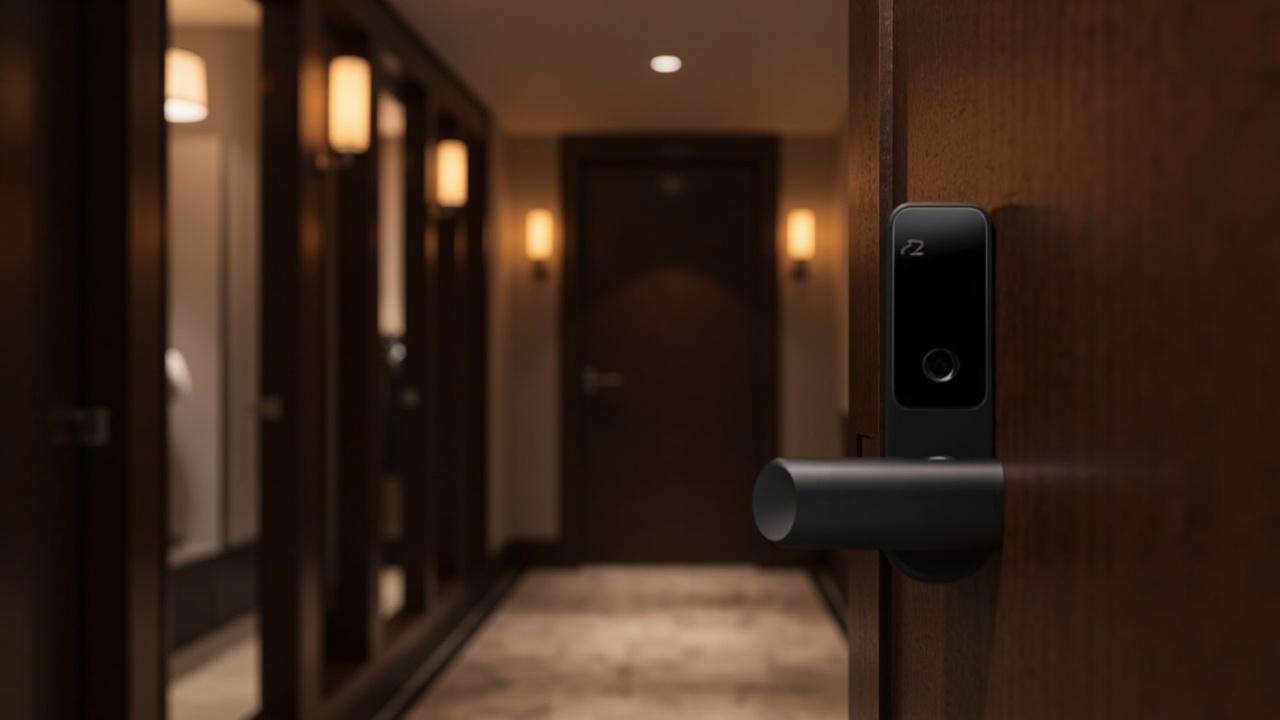
Hotel Smart Lock Central Database
Hotel smart lock central database is the single authoritative store that owns every guest credential, every staff credential, every override record, every card-issuance event, every audit row and every encoder transaction for an entire hotel property or hotel group — running on hotel PC software that sits at the front desk (or in the back office) and pushes authority down to the locks through an encoder workflow rather than programming each lock at the door. In the 79-model catalog carried on smartlockfactory.com, central database is the documented operating mode of the hotel PC-software line only. Standalone locks, residential Bluetooth locks, fingerprint-only locks, keypad locks, most RFID non-hotel locks, outdoor, glass, face, cabinet, video and the rest of the catalog run on a per-lock or per-property model and are not centrally managed in any first-party spec block. The phrase "central database" gets pasted into RFPs as if every connected lock delivered it; the engineering reality is narrower, and the buyer who treats it as a universal feature ends up retrofitting a database later.
This article is an annotated dialogue. Two voices carry it. Mira is an IT architect at a multi-property hotel group. Devansh is the hotel-side technical lead at the supplier, and he is responsible for the hotel PC software, the encoder workflow and the per-model database capability answers. The dialogue is structured in rounds, each closing with an italicized What's really being said / Verify by annotation block that separates the buyer-facing surface from the document-the-supplier-must-produce check. It is deliberately distinct from the cluster pillar at Hotel Smart Lock System Architecture, the central-management five-pillar discipline at Hotel Smart Lock Central Management, and the cluster-wide centralized-management concept at Smart Lock Centralized Management — those three sit above and beside the database question; this one goes inside the database.
Round 1: "What does 'central database' actually mean on a hotel lock system?"
Mira: When I say "central database," I mean one place where every credential that exists anywhere in our estate is recorded, and one place where every lock event eventually lands. Is that what you mean when the SLK-9936S spec block says "standalone or centralized database modes"?
Devansh: It is, but with three boundaries the spec block doesn't print in bold. The first boundary: the database is the property-side hotel PC software, not a cloud vendor's database. It runs on a workstation at the front desk or in the back office. The second boundary: the lock does not query the database at the door. The encoder queries the database at the front desk and writes authority onto a card; the card carries authority to the door. The third boundary: "centralized" here means centralized for the property or property group, not real-time centralized for every door in the world. The locks still hold their own local buffer — the SLK-9936S spec block quotes that buffer at up to 1,000 audit/event records — and the database pulls that buffer back when a handheld reader is brought to the door.
Mira: So if I run the database at one property, I get centralization for that property. If I run one database across three properties, I get centralization across the three.
Devansh: That depends on whether the supplier's hotel PC software supports multi-property in one database instance or only multi-property as multiple instances with replication between them. That is a per-model question — check the model’s published specification.
What's really being said. "Central database" is not the same as "real-time cloud control of every door." It is a property-side store that owns credentials and audit, with an encoder workflow in the middle and a local buffer at every lock. The buyer who skips that distinction ends up buying a database they think is a control plane and finding it is a record-of-truth instead.
Verify by. Ask the supplier, in writing: (1) Does the hotel PC software run on property-side hardware or vendor cloud? (2) Is the database access path at the door through the card, not a live network? (3) What is the local audit buffer envelope per lock — is the 1,000-event figure quoted on the spec block the per-lock envelope on the SKU you are buying, or only on the SLK-9936S class?
Round 2: "Why is central database only on the hotel PC-software line?"
Mira: I have a residential Bluetooth lock on my office door at home, a fingerprint lock on the staff entrance, and a hotel-class RFID lock on every guest room. Why can't the residential and the hotel locks share one database?
Devansh: They can share a database at the PMS level — that is a different layer, where a property management system unifies reservations, billing and access. At the lock database level, the hotel PC software is the only line in the 79-model catalog that ships with a centralized database mode in the first-party spec block. The residential Bluetooth, fingerprint, keypad, outdoor, glass, face, cabinet and video lines are per-lock or per-app — they don't have a first-party documented centralized database mode. So if you try to put them under one lock database, you are doing custom integration the catalog doesn't sanction.
Mira: So the central database is for the locks that are part of the hotel property's access story, not for every lock we own as a group.
Devansh: Correct. And inside the hotel line, the central database is documented for the SLK-9936S-class hardware. The SLK-9936G, SLK-9905A, SLK-9951TH and SLK-9962S each have their own capability profile — check the model’s published specification for each one.
What's really being said. The catalog draws a hard line at the hotel PC-software lane. The buyer who wants "one database across everything" is asking the supplier to build a custom layer on top of per-app locks. That custom layer is exactly what the supplier will not be able to warranty in five years.
Verify by. Ask, in writing, for every non-hotel SKU shortlisted: "Does this model support centralized database mode via hotel PC software, or only per-app / per-lock management?" If the supplier hedges on a non-hotel SKU, the answer for the database question is "no."
Round 3: "What does the database schema actually need to hold?"
Mira: If I'm designing the schema, what fields are mandatory, what fields are nice to have, and what fields am I going to regret not having in year three?
Devansh: The schema will be the supplier's schema — the hotel PC software defines it. What you control is which fields you require the supplier to support before you sign the RFQ. From an architecture point of view the schema has five mandatory tables: the property table (one row per logical property in the database), the lock table (one row per physical lock, with property binding and firmware version), the credential table (one row per active guest or staff card, with issue/expiry timestamps and revocation status), the audit event table (one row per door event imported from the locks' local buffers), and the encoder transaction table (one row per encoder action, capturing who issued or revoked which credential when).
Mira: What about overrides, master cards, emergency accesses?
Devansh: Those belong in the credential table with a role field, or in a separate role-hierarchy table that joins to credential. The SLK-9936S spec block does not enumerate the role hierarchy — that is per-model and check the model’s published specification. The same applies to whether the schema supports custom fields (guest VIP flag, group booking flag, company billing code) — check the model’s published specification.
What's really being said. The supplier owns the schema, but the buyer owns the field-list question. Field-list completeness in year one is the single biggest determinant of whether the database is still usable in year five.
Verify by. Ask the supplier for a schema diagram and field dictionary before signing. If the supplier cannot produce one in writing, the database is not ready for an RFQ.
Round 4: "How does multi-station sync work — what happens when two front desks act on the same property?"
Mira: We have two front desks at our 220-room property. Both can issue cards. Both can revoke. What stops one desk from issuing a card that the other desk just revoked?
Devansh: Three answers, depending on what the supplier's hotel PC software actually does. The first answer: the database is a single instance on a single server, and both desks connect to it over the LAN; in that case, last-write-wins on the credential table, and the issue/revoke latency is the LAN round-trip — typically tens of milliseconds. The second answer: the database is a single instance but the desks are sometimes disconnected (laptop at the pool bar, mobile check-in kiosk on a weak network); in that case, you need conflict resolution on reconnect — typically the most-recent action wins, with both actions logged. The third answer: the database is multi-instance with replication, and the question gets harder — replication lag, split-brain, and merge policy become real operational risks. Which of those three models the supplier supports is a per-model question — check the model’s published specification.
Mira: So I cannot assume that two front desks equals two safe writers.
Devansh: Correct. You have to verify in writing in writing which of the three models the SKU ships with, and then design the operational procedure around that model.
What's really being said. Multi-station sync is a property-side problem on hotel PC software, not a vendor-cloud problem. The buyer who assumes "cloud = solved" is buying a vendor lock-in the catalogue doesn't promise.
Verify by. In writing, ask: "When two front desks write to the same database for the same property, what conflict-resolution behaviour does the hotel PC software guarantee?" If the supplier cannot describe the behaviour in three sentences, the SKU is not ready for a multi-station rollout.
Round 5: "How does audit get from the lock back into the database?"
Mira: The SLK-9936S spec block says up to 1,000 audit/event records held at the lock. How do those events get to the database?
Devansh: Through a handheld reader that a porter or security officer brings to the door. The reader reads the lock's local buffer, the encoder software imports the read into the database, and the events land in the audit table. The cadence is a property decision — some properties read every door daily, some read every door on a security incident, some read only on a guest dispute. The 1,000-record envelope at the lock is the upper bound on how long a door can sit unread before the buffer rolls over; that envelope is per-model and the SLK-9936S spec block is the only documented value in the catalog — check the model’s published specification for every other shortlisted SKU.
Mira: What if a guest dispute happens on day 800 with no read since day 1?
Devansh: You have whatever the lock still holds — the buffer has rolled, but the most recent ~1,000 events are intact. Anything before the rollover is gone from the lock. Anything from the encoder transaction table on the database side (every issue, every revoke, every check-in, every check-out) is still on the database side and is the canonical record for the credential life. The audit table on the database side is the canonical record for the door event life. They are two complementary logs.
What's really being said. The 1,000-record buffer is the lag tolerance between lock event and database import. The database side owns the credential life; the lock side owns the recent event life. The buyer who treats audit as one thing ends up losing either credential history or event history in an incident.
Verify by. In writing, ask: (1) What is the audit buffer envelope on each shortlisted SKU? (2) What is the recommended read cadence for the property's incident profile? (3) Does the encoder software flag read failures (door unreachable, lock battery dead, card mid-write) so the operator knows the import is incomplete?
Round 6: "What does the database need to be backed up, and how often?"
Mira: Database backups. What does the supplier recommend?
Devansh: Three layers. Layer one: the hotel PC software's own export — most hotel PC software exports the database to a portable format on a schedule; ask the supplier what that format is, whether it is documented, and whether a buyer-side script can read it. Layer two: a workstation-side image or VM snapshot of the workstation running the database; this is your fallback if the export is corrupt. Layer three: an off-property copy — to a second site, to a cloud storage bucket, or to a tape that leaves the building. The cadence of all three is a property decision; the supplier can recommend but not mandate.
Mira: What retention?
Devansh: That is also a property decision driven by the local data-retention regulation. The supplier does not impose a retention window; the property does. Confirm with the supplier whether the database export includes the audit table, the credential table, the encoder transaction table, and the role-hierarchy table — all four, not just one or two. If the export is partial, the backup is partial, and the partial backup is not a backup.
What's really being said. The supplier provides the export capability; the buyer owns the cadence, the off-property copy and the retention window. A backup that lives on the same workstation as the database is not a backup, it is a copy.
Verify by. Ask the supplier, in writing: (1) What export formats does the hotel PC software produce? (2) Does the export include all four canonical tables — property, lock, credential, audit, encoder transaction? (3) Is the export documented to the level that a buyer-side DBA can verify a restore without supplier intervention?
Round 7: "What happens during a workstation failure?"
Mira: The front-desk workstation dies at 11 p.m. on a Saturday. What do I do?
Devansh: Three scenarios. Scenario one: the workstation is the database server. If the database is on the workstation, the database is offline until the workstation is restored. The locks still open on the cards already issued — the cards carry authority, the database is not consulted at the door — so the property is not locked out; it is unable to issue new cards until the database is back. Scenario two: the database is on a separate server and the workstation is only a client. The workstation dies, the database lives, and a laptop on the LAN can act as a temporary client until the workstation is replaced. Scenario three: the database is replicated to a hot spare. Either workstation dying has no operational impact. Which of those three scenarios the supplier supports is a per-model question — check the model’s published specification.
Mira: And the locks themselves?
Devansh: The locks keep running. The local buffer keeps recording. Authority on already-issued cards is unaffected. The only thing that stops is the database side of new card issuance and audit import. The property can keep operating the rooms for the duration of the workstation outage; it just can't issue new cards or pull new audit rows.
What's really being said. The workstation is the issuance plane, not the access plane. The buyer who designs a database failover plan that includes "the locks fail too" is over-spending on the wrong failure mode.
Verify by. In writing, ask: (1) Is the database server separate from the workstation, and what is the failover posture? (2) Can a temporary laptop client connect to the database during a workstation outage? (3) What is the documented recovery time objective for the database on the SKU you are buying?
Round 8: "How does multi-property work — one database or many?"
Mira: We have three properties. Do I run one database across all three, or one database per property with replication?
Devansh: That is a per-model question, and you have to verify against the model’s published specification. The architectural options the hotel PC software line typically offers are: (a) one database instance per property, no replication between them — each property is operationally independent; (b) one database instance per property with cross-property replication on a schedule — each property can see the others' credential state for shared-stay guests, but with replication lag; (c) one database instance holding all three properties as logical partitions — single source of truth across the group, but a single point of failure for all three.
Mira: Which is most properties' choice?
Devansh: Most multi-property operators we work with pick option (b) — one database per property with cross-property replication — because it preserves operational independence at the property level while enabling group-wide guest movement. Option (c) looks attractive on paper but creates a single point of failure; a database outage at the group's central site takes all three properties offline simultaneously. Confirm with the supplier which of the three options the SKU ships with, and confirm what the cross-property replication cadence is if option (b) is supported.
What's really being said. Multi-property is a database architecture decision, not a procurement decision. The buyer who lets the supplier default to option (c) gets single-point-of-failure across the whole group.
Verify by. In writing, ask: (1) Does the hotel PC software support multi-property in one instance, separate instances, or both? (2) What is the cross-property replication cadence if supported? (3) Is the central-database SLK-9936S-class capability portable across properties or per-property-bound?
Round 9: "What does the database have to expose to the PMS?"
Mira: The property management system has to know which room is occupied, which guest is in which room, and which cards are active for that guest. How does the PMS get that out of the database?
Devansh: Two paths. Path one: the PMS sends check-in events to the hotel PC software, the hotel PC software issues the credential and writes the encoder transaction, and the room is bound. Path two: the hotel PC software publishes events back to the PMS (card issued, card revoked, audit row imported) so the PMS can reconcile its own state. Path one is mandatory. Path two is optional but strongly recommended — without it, the PMS and the database drift.
Mira: So the database is downstream of the PMS for issuing and upstream of the PMS for reporting?
Devansh: Exactly. The PMS is the system of record for the stay. The hotel lock database is the system of record for the credential. The two are different records that have to be joined at check-in and check-out.
What's really being said. The database is not the PMS and the PMS is not the database. The buyer who treats them as one ends up with no canonical record for either stays or credentials.
Verify by. In writing, ask: (1) What is the documented PMS-to-database integration contract on the SKU you are buying? (2) Does the database publish events back to the PMS, or only consume events from it? (3) What is the documented reconciliation window after a network partition between PMS and database?
Round 10: "How do we migrate from standalone mode to centralized database mode?"
Mira: We opened on standalone mode at our first property — every lock programmed door-by-door with a handheld writer. We want to move to central database mode for the second property. What does the migration look like?
Devansh: Three stages. Stage one: the database is stood up at the front desk of the second property, and the locks at the second property are commissioned in central mode from day one — that is the easy case. Stage two: a property already running standalone is migrated lock-by-lock to central mode; each lock is re-commissioned, the audit buffer is imported, and the encoder workflow is enabled for that lock. The complexity here is that the lock may have credentials issued under standalone rules that the database cannot reproduce — those credentials have to be cancelled and re-issued. Stage three: a property running standalone is migrated lock-by-lock without re-issuing every credential — this requires the supplier to support a hybrid mode where standalone-issued credentials are honoured alongside database-issued credentials for a transition window. Stage three is the rarest and is per-model — check the model’s published specification.
Mira: How long does each stage take?
Devansh: That is property-specific and per-model — confirm with the supplier in writing. The supplier can quote a service-scope range; the property has to size the operational risk.
What's really being said. Migration is a per-model capability, not a generic capability. The buyer who assumes the supplier can migrate a 200-lock standalone property to central mode in a weekend is buying a service engagement the catalogue doesn't sanction.
Verify by. In writing, ask: (1) Does the SKU support a documented migration procedure from standalone to central database mode? (2) What is the credential-reissue requirement — every credential, or only credentials issued during the transition window? (3) What is the documented hybrid-mode duration on the SKU you are buying?
Round 11: "What belongs in the per-model confirmation worksheet before the RFQ?"
Mira: Let's close the dialogue by naming every per-model question the buyer has to put in writing before the RFQ is signed.
Devansh: Yes. Eleven questions, one row per question, one column per shortlisted SKU.
| # | Per-model confirmation question | SLK-9936S (anchor) |
|---|---|---|
| 1 | Does the SKU support centralized database mode via hotel PC software? | Yes (product-page-documented) |
| 2 | What is the local audit buffer envelope at the lock (events)? | Up to 1,000 (product-page-documented) |
| 3 | What is the credential-table field set (guest fields, staff fields, role fields)? | Not enumerated |
| 4 | What is the multi-station conflict-resolution model (LAN / disconnected / replicated)? | Per-model |
| 5 | What is the documented workstation-to-database failover posture? | Per-model |
| 6 | What is the multi-property architecture (one instance / replicated / partitioned)? | Per-model |
| 7 | What is the documented export format and table coverage? | Per-model |
| 8 | Does the SKU publish events back to the PMS or only consume? | Per-model |
| 9 | What is the standalone-to-central migration procedure? | Per-model |
| 10 | What is the multilingual management software language set on the SKU? | Multilingual (product-page-documented) |
| 11 | What is the encoder-software contract (per-encoder licence, per-seat, per-property)? | Per-model |
Mira: And if the supplier answers any of those with "we can customize that"?
Devansh: That answer is a red flag. The supplier is telling you the capability is not in the documented catalogue and would have to be built bespoke. Bespoke is acceptable if you understand the support lifetime you are buying; it is not acceptable if you think you are buying a catalogue SKU.
What's really being said. The eleven-question worksheet is the contract surface between the buyer and the supplier. Every cell outside the SLK-9936S anchor is a "check the model’s published specification" cell — and the supplier's written answer to each cell is what makes the SKU RFQ-ready.
Verify by. Send the worksheet to the supplier and require a written line-by-line answer before the quote is signed. The supplier's answer sheet, attached to the quote, is what you take to the procurement committee.
The five canonical tables Devansh described in Round 3 sit in a simple structure — property at the top, everything else hanging off it:
classDiagram
    class Property {
        +logical_property
    }
    class Lock {
        +property_binding
        +firmware_version
    }
    class Credential {
        +issue_time
        +expiry_time
        +revocation_status
    }
    class AuditEvent {
        +door_event
    }
    class EncoderTransaction {
        +issued_by
        +revoked_by
    }
    Property "1" --> "many" Lock : commissions
    Property "1" --> "many" Credential : holds
    Lock "1" --> "many" AuditEvent : buffers until pulled
    Credential "1" --> "many" EncoderTransaction : tracked by
What the central database commits and what it leaves open
The central database on documented hotel-class hardware (the SLK-9936S-class spec block is the first-party anchor in the catalog) commits to: a property-side database on hotel PC software; credential lifecycle ownership (issue, expire, revoke, reissue); audit table ownership for imported events; encoder transaction ownership; multilingual management software; and a local audit buffer envelope at the lock of up to 1,000 events.
The split between the two sides of that commit is worth stating as a table, because it is the split every round of the dialogue kept returning to:
| Responsibility | Database side · hotel PC software | Lock side · at the door |
|---|---|---|
| Credential lifecycle — issue · expire · revoke · reissue | Owns the canonical record | Receives authority carried by the card |
| Door events | Canonical once the buffer is imported | Held locally — up to 1,000 records on the SLK-9936S anchor; per-model on every other SKU |
| Encoder transactions | Owns every issue and revoke row | Not involved at the door |
| Access decision at presentation | Not consulted live at the door | Lock firmware evaluates the presented credential |
| Backup and retention | Export capability ships with the software | Cadence · off-property copy · retention window are property decisions |
The central database does not commit to: real-time cloud control of every door; multi-property as one logical instance; workstation-to-database hot failover; a specific export format that a buyer-side DBA can restore without supplier intervention; a specific credential-table field set beyond what the hotel PC software documents; a specific migration procedure from standalone to central mode; or any specific PMS integration contract beyond what the integration surface documents. Every one of those is a per-model confirmation, not a catalog-wide promise.
The buyer who treats the first list as the contract and the second list as the RFQ-question set walks into the engagement with the right scope. The buyer who treats the second list as also-promised walks into a custom integration that will be expensive to maintain and impossible to replace.
Illustrative project scenario — a 220-room property standing up its first central database
Consider a 220-room property that opened on standalone mode three years ago. The general manager is replacing the standalone installation with a central database at the front desk. The IT architect's first task is the per-model worksheet from Round 11 — eleven questions, one column per shortlisted SKU, written answers required from the supplier before any quote is signed. The general manager's first task is the property-side operational scope — front-desk workstations, encoder station location, the backup cadence, the off-property copy, the retention window.
The second task is the schema review. The supplier's hotel PC software defines the schema; the buyer reviews it against the eleven questions and decides whether the field set covers group bookings, VIP flags, multi-property guest movement and the role hierarchy the property actually uses. If the schema is missing a field, that becomes a written ask to the supplier before the RFQ is signed.
The third task is the multi-station setup. The property has two front desks and a mobile check-in kiosk. The buyer confirms in writing which of the three multi-station models the SKU ships with, designs the operational procedure around that model, and writes the conflict-resolution rule into the front-desk SOP.
The fourth task is the audit cadence. The buyer picks a daily handheld read for guest-room doors and an event-driven read for staff doors. The buyer writes the cadence into the SOP and confirms the encoder software flags failed reads so the operator knows when the import is incomplete.
The fifth task is the backup and retention. The buyer picks a daily export, a weekly workstation image, and an off-property copy to a second site. The retention window is set to whatever the local data-retention regulation requires — not whatever the supplier defaults to.
The sixth task is the workstation failover plan. The buyer confirms whether the database lives on the workstation or on a separate server. If on a separate server, a laptop is provisioned as a temporary client during a workstation outage. If on the workstation, a hot spare workstation is provisioned.
The seventh task is the migration. The property is already on standalone. The buyer confirms the per-model migration procedure, the credential-reissue requirement, and the hybrid-mode duration. Every name and number in this scenario is fictitious; every decision is illustrative.
Where this dialogue leaves the buyer
The central database on documented hotel-class hardware is the source of truth for the credential life and the audit life across the property or the group. The eleven-round dialogue above names the per-model surface — what the database commits, what it leaves open, and which eleven questions the buyer has to put in writing before the RFQ is signed. The per-model confirmation worksheet is the contract that closes the gap between marketing and engineering on this lane.
For the broader hotel lock architecture pillar, see Hotel Smart Lock System Architecture. For the central-management five-pillar discipline that runs on top of this database, see Hotel Smart Lock Central Management. For the cluster-wide centralized-management concept that sits at the connectivity layer, see Smart Lock Centralized Management. For the hotel PC software feature datasheet and the hotel network management sibling, see Hotel Smart Lock Management Software and Hotel Smart Lock Network Management. For the software buyer's guide and the OEM/ODM scope on which the hotel line sits, see Hotel Smart Lock Software Guide, Smart Lock Manufacturer, OEM/ODM, and for the per-property RFQ, request a quote at Request a quote. Every per-model capability named in the dialogue above (audit buffer envelope, multi-station conflict resolution, multi-property architecture, export format, failover posture, migration procedure) is a documentation cell until the supplier has answered it in writing. That is the database-side discipline, and it is the only one that scales across properties.