
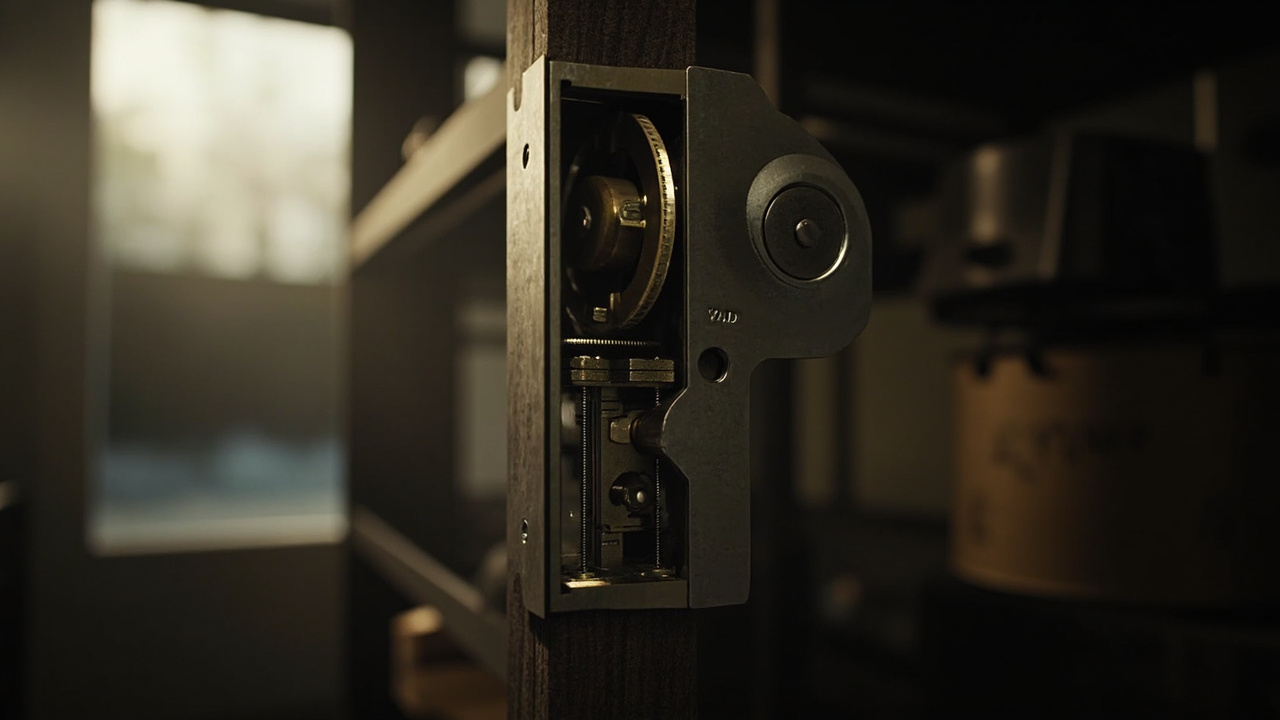
The Secure Element and Key Storage and Door Compatibility: The Fit Envelope
Workbook boundary and completion rule
Use this qualification worksheet to map the secure element and key storage door fit envelope before a system integrator approves a candidate lock. It separates protection evidence, supplier evidence and complete-assembly fit.
Direct answer. Complete one copy per door type and candidate SKU. Do not treat a category page, credential method or successful credential read as proof of physical fit. The 79-model catalogue supplies context, but this excerpt does not expose secure-element implementation or internal credential storage. For the selected SKU, confirm on the dated product page for the specific SKU and request the drawings and evidence below. Before the next supplier meeting
This qualification worksheet records assumptions; it is not a security guarantee. For smart lock door compatibility, every unanswered field remains a hold point.
Fix the product and evidence baseline
| Complete before review | Supplier entry | Reviewer disposition |
|---|---|---|
| Exact product name and SKU | [Enter] | Match every drawing and evidence file to one SKU |
| Revision, date and source owner | [Enter] | Record the dated revision and responsible issuer |
| Door types in scope | [Enter] | Separate factory-new and retrofit conditions where relevant |
| Drawing set and installation guide | [Enter] | Mark dimensioned drawing available or descriptive only |
| Evidence index | [Enter] | Link each claim to a dated page or report |
Use Reading the Secure Element and Key Storage Claims in a Supplier Datasheet to challenge wording and Clause Bank: Specifying the Secure Element and Key Storage: Questions that Get Real Engineering Answers for precise engineering questions. Do not approve from a category page alone.
Name every protected object
The credential storage architecture field must distinguish cryptographic key material from access credentials, audit records and a physical override key. Ask where each object is created, stored, used, rotated, revoked and destroyed. Treat a secure element key storage claim as an architectural statement, not a lifecycle answer.
The same question is worked through in more detail in connected smart locks complete b2b. That is the same question secure element and key storage door fit envelope has to answer here.
| Object or boundary | Fill-in prompt | Minimum acceptable answer |
|---|---|---|
| Cryptographic key material | [Enter] | Identify protected objects, trust boundary and lifecycle evidence |
| Card, passcode or fingerprint records | [Enter] | State processing location, storage location and revocation route |
| Audit and event records | [Enter] | Separate operational logs from identity and update material |
| Mechanical override key | [Enter] | Treat as physical access, not electronic key storage |
| Provisioning and recovery | [Enter] | Name approved tools, custody controls and duplicate handling |
| End-of-life action | [Enter] | Define erasure, return and disposal responsibilities |
Use The Secure Element and Key Storage Trade-Offs: Cost, Durability and Service to compare design choices. Request proof through The Secure Element and Key Storage Test Evidence a Buyer Can Actually Request, then record what the evidence demonstrates.
Establish the physical fit envelope
The fit envelope is the intersection of door leaf, frame, hardware and lock-body constraints. Obtain stated ranges, not a best-case photograph. The lock body mortise dimensions, interface spacing and clearance requirements must cover the worst representative door in that family.
For the measurement side of this, see bluetooth smart locks for commercial applications. That is the same question secure element and key storage door fit envelope has to answer here.
flowchart LR
  A[Record dated SKU evidence] --> B[Map protected objects]
  B --> C[Measure door interfaces]
  C --> D[Compare stated ranges]
  D --> E{Every check passes}
  E -->|Yes| F[Approve qualification]
  E -->|No| G[Hold for resolution]
| Interface to verify | Stated range or dimension | Measured value | Source | Result |
|---|---|---|---|---|
| Applicable door thickness | [Enter] | [Enter] | [Drawing or site] | [Pass or hold] |
| Panel dimensions and operating clearance | [Enter] | [Enter] | [Drawing or site] | [Pass or hold] |
| Lock body or mortise and backset | [Enter] | [Enter] | [Drawing or site] | [Pass or hold] |
| Spindle, handle or lever interface | [Enter] | [Enter] | [Drawing or site] | [Pass or hold] |
| Latch or deadbolt, strike plate and keeper | [Enter] | [Enter] | [Drawing or site] | [Pass or hold] |
| Door frame rebate and cylinder collar | [Enter] | [Enter] | [Drawing or site] | [Pass or hold] |
| Battery compartment and emergency power port | [Enter] | [Enter] | [Drawing or site] | [Pass or hold] |
| Glass patch fitting or adjacent hardware | [Enter if applicable] | [Enter] | [Drawing or site] | [Pass or hold] |
A blank dimension is unverified, not a pass. Record the measurement method, door revision and drawing revision so later changes can be checked against the same evidence.
Compare evidence routes before release
Compare the evidence behind each claim rather than mixing product facts with sales statements.
| Decision | Dated SKU evidence | General statement | Field trial | Acceptance rule |
|---|---|---|---|---|
| Protected-object boundary | Architecture and lifecycle documents | Marketing description | One successful credential use | Accept only traceable SKU evidence |
| Credential revocation | Procedure and audit trail | Feature claim | A single deletion event | Procedure must cover service and end-of-life paths |
| Mechanical fit | Dimensioned drawings and ranges | Compatibility statement | Trial on one door | Range must cover the declared door family |
| Service access | Procedure and parts information | General service promise | One successful service visit | Evidence must identify authorized actions |
| Combined release | Matched storage and fit records | Category-level summary | Demonstration only | Both workstreams must pass for the same SKU |
For failure containment, use The Secure Element and Key Storage Failure Modes Seen on Smart Lock Projects to identify symptoms that should trigger a hold. A field trial can disprove a fit claim, but it cannot replace a declared range or the key-storage lifecycle record.
Convert gaps into explicit holds
| Gap | Classification | Required closure |
|---|---|---|
| Missing lock body dimension | Fit hold | Obtain a dated drawing or select another SKU |
| Undefined key owner or recovery path | Storage hold | Obtain the lifecycle procedure |
| Evidence belongs to another revision | Baseline hold | Re-index evidence to the proposed SKU |
| Site door differs from the reference | Site hold | Re-measure and compare against the envelope |
| Only a credential demonstration exists | Evidence hold | Request traceable technical evidence |
The secure element and key storage door fit envelope is closed only when both evidence sets pass for the same dated SKU and door revision. Log exceptions in Maintenance Implications of the Secure Element and Key Storage Choices before assigning service ownership. Send the completed record and drawings with the request-a-quote enquiry, asking for exact SKU revisions and the evidence needed to close each hold.