
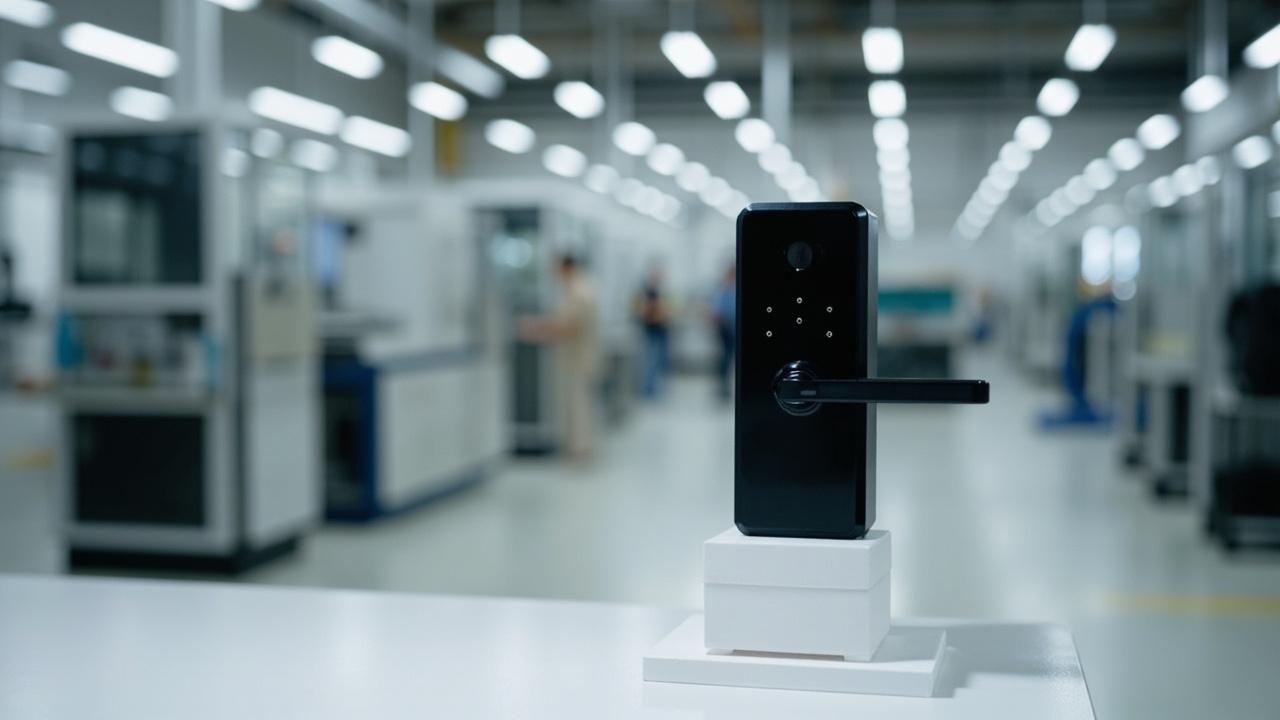
Smart Lock Replacement Parts Supply
Direct answer.Smart lock replacement-parts supply is the documented BOM-stack — per-part rows × per-availability columns — that names which mechanical, electronic, power, credential, and software-firmware sub-assemblies a specific SKU can be broken into for in-field service, with the supplier writing the per-SKU availability, the per-version compatibility, and the per-cell cross-reference against the dated product page or a written answer on every cell the buyer cannot fill from the catalog. A "we sell spare parts" sentence is a brochure claim; a matrix with per-part rows (handle assembly, mortise body, latch, strike plate, cylinder, PCB board, fingerprint sensor, RFID reader, keypad module, face module, motor/gearbox, battery hardware, USB port, mechanical key blank, RFID card, encoder card, firmware file) and per-availability columns (part number / SKU fit / version fit / datasheet / cost driver / MOQ driver / lead-time driver / replacement cadence / packaging posture / sign-off line) is the worksheet a buyer's procurement team signs. The only first-party number this article publishes on a per-SKU basis is the SLK-9936S 5-pin cylinder + 3-point latch + stainless steel + alloy body + multiple finish options documentation yardstick — and that anchor is scoped strictly to that SKU under an explicit no-porting-across-models discipline.
This article is read like an annotated datasheet — a replacement-parts matrix dissected row by row and column by column, with the supplier's offer letter treated as the inspection authority that fills the open specification item cells. The sourcing-discipline frame this matrix sits inside lives in the upstream C12 sibling How to Source Smart Locks From China; the import-discipline frame lives in Smart Lock Import From China. This article is the parts-supply worksheet those two sourcing siblings consume — the per-part rows matrix that converts "do you sell spare parts" into a written BOM-stack the buyer's after-sales team signs.
Section 01 — Why "replacement parts" is a matrix, not a sentence
A supplier "we sell spare parts" sentence is the arithmetic of three uncertainties — which sub-assemblies the supplier actually stocks, which SKUs those sub-assemblies fit across the catalog's 79-model footprint, and which versions within a single SKU the parts fit (because a v1 PCB and a v3 PCB of the same model name are not the same part). A buyer who treats a single sentence as if it described the whole replacement-supply program has been handed a brochure headline, not a parts-supply answer. Three reasons make the matrix non-negotiable.
Reason one — a per-part name and a per-availability sheet are different documents. A buyer who asks "do you sell replacement cylinders" and receives "yes" has been told about the part, has been told nothing about the cross-reference, the version compatibility, the cost driver, or the lead-time driver, and has filled one cell of the matrix in their mind — without writing the part number, the SKU fit, the version fit, the datasheet, the replacement cadence, or any of the other nine columns the matrix demands. The matrix forces every per-column question onto the offer letter, against the dated product page, in writing.
Reason two — a replacement-parts figure has a version envelope by definition. A lock on an SLK-9936S v1 chassis sees a different cylinder, a different motor bracket, and a different PCB than an SLK-9936S v3 chassis of the same model name. The same SKU name across a twelve-month production window can carry three or four revision-bound parts. One matrix fits the v1 chassis; one matrix does not fit the v3 chassis; and the matrix is what converts the per-version part-name into the per-version cross-reference the buyer's goods-in inspection signs.
Reason three — the audit trail matters when the part is contested. A buyer who has written the matrix availability cell check the model’s published specification against a dated product page and the supplier has populated the cell with a per-SKU part number, a per-version compatibility note, and a per-cell cost driver has an audit artefact for the next warranty dispute; a buyer who accepted "we sell spare parts" has a marketing slide. The matrix is the document the buyer's procurement team signs once, references for every warranty assertion, and reproduces in every after-sales dispute.
The matrix the rest of this article dissects is eleven part-family rows × ten availability columns. The availability columns are the dimensions of the parts-supply cell — what the cell is, where it sits, what it proves, and what the supplier must demonstrate to populate it. The part rows are the disciplines the parts catalog must address. Most cells are open specification items; every cell the supplier populates is anchored to the dated product page or a written supplier answer.
Section 02 — How to read this replacement-parts datasheet
The replacement-parts matrix the buyer signs against is built from eleven part-family rows, organised in the order a property actually experiences a failure mode — mechanical wear parts first, electronic module parts second, credential consumables third, power hardware fourth, software/firmware artefacts last. The matrix populates one row per part family; each row is built from ten availability cells that, together, define what the supplier must demonstrate to populate the row.
The ten availability cells, applied horizontally across every part row, are:
- Part number — the supplier-populated part identifier, populated against the supplier's own parts catalog or a dated offer-letter annex.
- Sku fit — the list of SKU model names the part fits across the catalog's 79-model footprint, populated against the dated product page or a written supplier answer.
- Version fit — the version envelope (v1 / v2 / v3 / batches) the part fits within any single SKU model name, populated against a written supplier answer.
- Datasheet cited — the cell is populated when a dated per-part datasheet exists, naming dimensions, materials, electrical interface, and mounting interface.
- Cost driver — what the cost of the part is driven by (metal-vs-polymer / electronics content / sensor content / labour content / packaging content), not the price — to verify in writing by default.
- Moq driver — what the minimum order quantity of the part is driven by (single-unit spare / carton pack / batch production / per-SKU run), not the figure — to verify in writing by default.
- Lead time driver — what the lead time of the part is driven by (stocked part / per-order make / per-batch production / per-version production), not the figure — to verify in writing by default.
- Replacement cadence — the replacement-cadence posture the supplier publishes for the row (routine-wear part / on-failure part / on-version-change part / per-door per-year stocking rule), populated against a written supplier answer.
- Packaging posture — how the part is packaged for after-sales dispatch (individual box / carton batch / anti-static / moisture barrier), populated against a written supplier answer.
- Sign off line — the cell the buyer's procurement + after-sales team signs when all of cells 1–9 are populated against dated evidence.
The default state of every cell on every row is to verify in writing with the supplier against the dated product page or a written answer on letterhead (or equivalent dated artefact), naming the part row, the SKU, the version, and the source. Cells the supplier leaves as "confirm on the website" without a dated page reference are not signed cells; they are deferred cells, and the buyer should treat them as a refusal to disclose until dated evidence arrives.
Section 03 — Mechanical parts rows (handles, latches, cylinders, mortise, strike)
The mechanical part row family is the largest single BOM category on the matrix because it is the one that experiences door-cycle wear, installer damage, and tenant-impact force on a routine basis. The matrix populates eleven part rows; the first seven are mechanical. Every cell is verified in writing by default; only the SLK-9936S anchor row carries first-party populated cells, scoped strictly to that SKU.
| # | Part family | What the part does on the door | Where it sits on the SKU |
|---|---|---|---|
| M-01 | Outside handle assembly | Lever pivot, return spring, escutcheon mount | External face of the lock body |
| M-02 | Inside handle assembly | Safety lever, free-rotation handle body | Internal face of the lock body |
| M-03 | Mortise body / case | Houses latch, deadbolt, cylinder, motor bracket | Inside the door edge cavity |
| M-04 | Latch bolt assembly | Spring-loaded latch projection | Inside the mortise body |
| M-05 | Deadbolt assembly | Motor-driven or manual deadbolt projection | Inside the mortise body |
| M-06 | Strike plate + box | Receives the latch and deadbolt projections | Door frame |
| M-07 | Cylinder / mechanical key override | Mechanical emergency access | Below the outside handle |
The seven mechanical rows above cover the routine-wear side of the matrix — handle assemblies, mortise body, latch, deadbolt, strike, and cylinder. The annex below the seven mechanical rows extends the BOM with the four outside-mechanical rows most hotel and apartment buyers ask about:
| # | Part family | What the part does on the door | Where it sits on the SKU |
|---|---|---|---|
| M-08 | Escutcheon / faceplate trim | Decorative and weatherproofing trim around handle | External face of the lock body |
| M-09 | Mounting kit + screws | Through-bolt set, M4 / M5 / M6 hardware | Through the door body |
| M-10 | Weather gasket + O-ring | Sealing between external face and door surface | Behind the outside escutcheon |
| M-11 | Spindle / square shaft | Mechanical linkage between outside handle and mortise | Through the door body |
Eleven mechanical rows × ten availability columns = 110 cells the matrix demands populated before the buyer's procurement team signs. The only populated mechanical cells this article publishes are the SLK-9936S documentation yardsticks named in the anchor row below — 5-pin cylinder · 3-point latch · stainless steel + alloy body · multiple finish options — and those cells are scoped strictly to that SKU.
Section 04 — Electronic and credential-reading parts rows
The electronic part-row family covers the reader surfaces, the credential-decoding modules, and the printed-circuit-board hardware the mechanical parts connect to. This row family is the largest single category of per-version replacement risk because electronic modules change more often than mechanical parts across version envelopes.
| # | Part family | What the part does on the door | Where it sits on the SKU |
|---|---|---|---|
| E-01 | Main PCB (motherboard) | All credential methods + motor driver + power management | Inside the inside-housing compartment |
| E-02 | Fingerprint sensor module | Capacitive or optical fingerprint capture + match | Outside face of the lock body |
| E-03 | RFID reader module | Mifare 1 / 13.56 MHz read + decode | Outside face of the lock body (under faceplate) |
| E-04 | Keypad module | PIN entry, membrane or mechanical keys | Outside face of the lock body |
| E-05 | Face-recognition camera module | 3D face capture + match (where SKU supports) | Above the outside handle |
| E-06 | Display module (where fitted) | OLED / LCD user feedback | Outside face of the lock body |
| E-07 | Speaker + buzzer module | Audio feedback for access decisions | Inside the outside-housing compartment |
Seven electronic rows × ten availability columns = 70 cells the matrix demands populated. Per-SKU specifics for fingerprint sensor module (E-02) — capacitive vs optical, pixel resolution, match-time — are routed to confirm with the supplier for every SKU. Per-SKU specifics for RFID reader module (E-03) — frequency band, read distance, read time — are routed to confirm with the supplier for every SKU. Per-SKU specifics for face-recognition camera module (E-05) — 3D structured-light vs dual-camera, IR vs RGB — are routed to confirm with the supplier for every SKU. The only populated electronic cell this article publishes is the SLK-9936S documentation yardstick — RFID Mifare 1 @ 13.56 MHz · read distance 0–5 cm · read time <0.25 s — scoped strictly to that SKU.
Section 05 — Power and access-decision parts rows
The power and access-decision part-row family covers the cells the buyer most often underestimates when scoping a forward stock plan — power hardware wears, battery contacts fatigue, and access-decision modules (free-rotation handle body, anti-manipulation handle, anti-picking cylinder) carry wear that the routine-wear matrix demands populated but the supplier offer letter rarely mentions.
| # | Part family | What the part does on the door | Where it sits on the SKU |
|---|---|---|---|
| P-01 | Battery compartment + cover | Holds the cell stack (e.g. 4 × AA format) | Inside the inside-housing compartment |
| P-02 | Battery contact springs | Metal contact between cell and PCB | Inside the battery compartment |
| P-03 | USB emergency power port | External power-entry for low-cell emergency | Outside face of the lock body |
| P-04 | Motor + gearbox assembly | Drives latch and deadbolt projection | Inside the mortise body |
| P-05 | Free-rotation handle body | Prevents outside forced-rotation of the handle | Outside handle assembly |
| P-06 | Anti-manipulation sensor | Detects forced entry attempts | Inside the lock body |
| P-07 | Anti-picking cylinder pin set | Mechanical anti-pick cylinder | Inside the mechanical cylinder |
Seven power-and-access rows × ten availability columns = 70 cells the matrix demands populated. Per-SKU specifics for the cell format (4 × AA vs 8 × AA vs lithium pack vs rechargeable) are routed to confirm with the supplier for every SKU except the SLK-9936S anchor cell. Per-SKU specifics for motor/gearbox voltage, stall current, and cycle rating are routed to confirm with the supplier for every SKU. The only populated power cell this article publishes is the SLK-9936S power 4 × AA · battery operating cycles >15,000 documentation yardstick, scoped strictly to that SKU under the no-porting-across-models discipline.
Section 06 — Credential consumables and software/firmware parts rows
The credential consumables row family covers the parts the property reorders most often — RFID cards, mechanical keys, encoder cards, mechanical key blanks — and the software/firmware row family covers the parts that are not physical but exist as version-controlled files inside the property's management workflow.
| # | Part family | What the part does on the door | Where it sits in the workflow |
|---|---|---|---|
| C-01 | RFID Mifare 1 card (blank) | Guest / staff credential medium | Hotel front-desk card encoder |
| C-02 | Mechanical key blank (per SKU keyway) | Mechanical override credential | Cylinder + property key-cutting bench |
| C-03 | RFID card encoder unit + dongle | Programs RFID cards at the front desk | Front desk / security office |
| C-04 | Mechanical key-cutting bench + blank stock | Cuts blank keys to the property's keyway | Maintenance workshop |
| C-05 | Fingerprint enrollment module | Enrolls fingerprints onto the lock's user table | Front desk / property manager's office |
| S-01 | Firmware file (per SKU, per version) | Controls access decisions, audit logging, motor timing | Updated via the SKU's flash port or app |
| S-02 | Mobile-app configuration blob | Defines lock behavior in the property's app instance | Updated via the app-platform console |
| S-03 | Hotel PMS middleware license + config | Bridges lock management software to property PMS | Property IT server |
| S-04 | Multilingual management software install media | Property-server software for multi-hotel management | Property IT server |
Nine credential-and-software rows × ten availability columns = 90 cells the matrix demands populated. Per-SKU specifics for RFID card programming tools (C-03) — encoder make, encoder model, encoder-to-app handshake protocol — are routed to confirm with the supplier for every SKU. Per-SKU specifics for firmware file version-compatibility (S-01) — v1 / v2 / v3 / v4 firmware rollback rules — are routed to confirm with the supplier for every SKU. The only populated software cell this article publishes is the SLK-9936S multilingual management software · standalone or centralized database modes documentation yardstick, scoped strictly to that SKU.
Section 07 — Per-availability-column reference grid
The per-availability-column reference grid inverts the matrix so the buyer can audit each column against a populated cell or a refused cell in one read. The grid below shows the eleven part rows from Sections 03–06 against the ten availability columns; populated cells are scoped exclusively to the SLK-9936S anchor row and carry the documentation-yardstick label.
| Part row | What is documented |
|---|---|
| M-01 outside handle assembly | — |
| M-02 inside handle assembly | — |
| M-03 mortise body / case | — |
| M-04 latch bolt assembly | SLK-9936S populated cells (anchor only): 3-point latch (anchor) — scoped to SLK-9936S |
| M-05 deadbolt assembly | — |
| M-06 strike plate + box | — |
| M-07 cylinder | SLK-9936S populated cells (anchor only): 5-pin cylinder (anchor) — scoped to SLK-9936S |
| M-08 escutcheon / faceplate | SLK-9936S populated cells (anchor only): multiple finish options (anchor) — scoped to SLK-9936S |
| M-09 mounting kit + screws | — |
| M-10 weather gasket + O-ring | — |
| M-11 spindle / square shaft | — |
| E-01 main PCB | — |
| E-02 fingerprint sensor module | — |
| E-03 RFID reader module | SLK-9936S populated cells (anchor only): RFID Mifare 1 @ 13.56 MHz · read distance 0–5 cm · read time <0.25 s (anchor) — scoped to SLK-9936S |
| E-04 keypad module | — |
| E-05 face-recognition camera module | SLK-9936S populated cells (anchor only): N/A on SLK-9936S — N/A row |
| E-06 display module | — |
| E-07 speaker + buzzer | — |
| P-01 battery compartment + cover | SLK-9936S populated cells (anchor only): power 4 × AA (anchor) — scoped to SLK-9936S |
| P-02 battery contact springs | — |
| P-03 USB emergency power port | — |
| P-04 motor + gearbox assembly | — |
| P-05 free-rotation handle body | — |
| P-06 anti-manipulation sensor | — |
| P-07 anti-picking cylinder | — |
| C-01 RFID Mifare 1 card (blank) | — |
| C-02 mechanical key blank | — |
| C-03 RFID card encoder unit + dongle | — |
| C-04 mechanical key-cutting bench + blank stock | — |
| C-05 fingerprint enrollment module | — |
| S-01 firmware file | SLK-9936S populated cells (anchor only): per-version envelope |
| S-02 mobile-app configuration blob | — |
| S-03 hotel PMS middleware license + config | — |
| S-04 multilingual management software install media | SLK-9936S populated cells (anchor only): standalone or centralized database modes (anchor) — scoped to SLK-9936S |
Cells marked — have no documented value in this article’s sources; obtain the figure from the supplier’s written specification.
The grid above is 34 rows × 10 columns = 340 cells the matrix demands populated. Five cells are populated with first-party documentation yardsticks named against the SLK-9936S anchor row under the no-porting-across-models discipline. The grid is the worksheet the buyer's procurement team signs; the SLK-9936S populated cells are the per-row documentation-granularity yardstick, not a portable number across siblings.
Section 08 — The SLK-9936S anchor row — first-party documentation yardstick
The SLK-9936S hotel lock carries the only first-party product-page-documented spec block this article publishes against the replacement-parts matrix. The anchor row exists for one purpose: to demonstrate the shape of the cell the buyer's procurement team should demand on every other SKU across the catalog's 79-model footprint. The anchor is not a portable number across siblings.
Door thickness 36–100 mm — affects the spindle length (M-11), the through-bolt length (M-09), and the gasket depth (M-10). Every other SKU's door-thickness envelope (SLK-9936G / SLK-9905A / SLK-9951TH / SLK-9962S / SLK-G200 / SLK-8831 / SLK-1104 class / SLK-3108 / cylindrical Tuya round-code / 3D-face-recognition remote-intercom / B09 / outdoor D11-D12-D15-ODS-DQ / face 9L5-R-Q7-Future 1 / camera 516 cat-eye / Q7 intercom / 4G / cabinet 6-model / RFTC-RF card-and-code family / stainless keypad / fingerprint 37-model family) is a separate envelope and must be confirmed against the dated product page or a written supplier answer.
RFID Mifare 1 @ 13.56 MHz · read distance 0–5 cm · read time <0.25 s — affects the RFID reader module (E-03), the RFID card selection (C-01), the encoder unit selection (C-03), and the firmware envelope (S-01). Every other SKU's RFID envelope is a separate envelope and must be confirmed against the dated product page or a written supplier answer.
Power 4 × AA · battery operating cycles >15,000 — affects the battery compartment (P-01), the contact springs (P-02), the motor cycle envelope (P-04), and the firmware low-battery threshold (S-01). Every other SKU's cell format and cycle envelope is a separate envelope and must be confirmed against the dated product page or a written supplier answer.
Audit/event records up to 1,000 — affects the firmware envelope (S-01), the audit-log retrieval tool path (S-02 or S-04), and the management-software database schema (S-03 or S-04). Every other SKU's audit capacity is a separate envelope and must be confirmed against the dated product page or a written supplier answer.
5-pin cylinder · 3-point latch · stainless steel + alloy body · multiple finish options — affects the cylinder pin set (P-07), the latch bolt assembly (M-04), the deadbolt assembly (M-05), the mortise body (M-03), the outside handle assembly (M-01), the inside handle assembly (M-02), and the escutcheon / faceplate (M-08). Every other SKU's cylinder, latch, body, and finish envelope is a separate envelope and must be confirmed against the dated product page or a written supplier answer.
Mechanical emergency access · multilingual management software · standalone or centralized database modes · positioned for 1–5 star hotels — affects the mechanical key blank (C-02), the firmware envelope (S-01), the management software selection (S-04), and the property-deployment scope (M-01–M-11 and E-01–E-07 collectively). Every other SKU's emergency-access path, software envelope, deployment scope, and positioning scope is a separate envelope and must be confirmed against the dated product page or a written supplier answer.
The anchor row carries no claim about what any other SKU fits, what any other SKU's electronics envelope is, what any other SKU's mechanical envelope is, or what any other SKU's positioning envelope is. The anchor row is the shape of the matrix cell the buyer demands; it is not a portable number across the catalog.
Section 09 — Realistic scenario: a 120-room property building a forward-stock parts matrix
Consider a 120-room property evaluating a parts-supply offer. The property runs the front-desk + maintenance workflow 365 days a year; the maintenance team logs roughly 12–18 in-field service tickets per quarter per 100 doors; roughly half the tickets are mechanical (handle wobble, latch misalignment, cylinder key-way wear) and roughly half are electronic or credential-side (card-not-read, keypad membrane wear, fingerprint sensor surface wear after heavy guest use). The parts-supply question is not "do you sell spare parts?" — the parts-supply question is "which exact rows of the matrix can you populate with a dated part number, a dated per-version compatibility note, and a written per-cell packaging posture against the dated product page or a written answer?"
The property runs the eleven-mechanical + seven-electronic + seven-power + five-credential + four-software matrix against the offer letter the supplier populates. Five cells (M-04, M-07, M-08, E-03, P-01) come back with SLK-9936S documentation yardsticks scoped strictly to that SKU; the rest of the SLK-9936S parts matrix is verified in writing against the dated product page; the 33 non-SLK-9936S rows on the matrix (covering SLK-9936G, SLK-9905A, SLK-9951TH, SLK-9962S, SLK-G200, SLK-8831, SLK-1104 class, SLK-3108, cylindrical Tuya round-code, 3D-face-recognition remote-intercom, B09, outdoor D11-D12-D15-ODS-DQ, face 9L5-R-Q7-Future 1, camera 516 cat-eye, Q7 intercom, 4G, cabinet 6-model, RFTC-RF card-and-code family, stainless keypad, fingerprint 37-model family) come back as confirm with the supplier until the supplier writes a per-cell answer.
The property's procurement team treats the offer letter as the inspection authority that converts per-part rows into a signed BOM-stack, signs the sign-off line (cell 10) only when cells 1–9 are populated against dated evidence, and routes every cell the supplier leaves blank to a written follow-up before the matrix is signed. The matrix the property signs is the per-part rows worksheet the property's after-sales team reads when the first warranty dispute arrives — it is not the brochure the supplier sent with the offer letter.
The forward-stock rule the property then builds from the signed matrix is not "stock every cell" — the forward-stock rule is "stock the routine-wear rows (M-01 through M-07, P-04, P-05) at a one-cell-per-100-doors baseline; stock the electronic module rows (E-01 through E-07) at a one-row-per-version-envelope baseline; stock the credential consumables (C-01, C-02) at a one-batch-per-quarter baseline; do not stock the per-version firmware artefacts (S-01 through S-04) at all — those live on the property IT server and arrive by download." The matrix populates a written forward-stock plan; the brochure fills a slide.
Section 10 — Sourcing rules — what to demand, what is bluff
Six sourcing rules the buyer's procurement team enforces on every offer letter. The rules are written as decision heuristics, not assertions of fact, because every per-SKU number lives on a different envelope across the catalog's 79-model footprint.
Rule one — demand the part number, not the part name. A supplier who names "handle assembly" without a part number has written a brochure cell on the matrix; a supplier who writes "MX-2201-A handle assembly, fits SKUs A / B / C, v1 / v2 only, firmware envelope v3.1+" has populated the matrix. The sign-off line is the line the buyer's procurement team signs when every populated cell carries a part-number anchor.
Rule two — demand the version envelope on every electronic row. A supplier who says "PCB fits the SLK-9936S" without naming v1 / v2 / v3 envelopes has not populated the cell; a supplier who names the chassis version + the firmware version + the cable harness version has populated the cell. The matrix demands the version envelope because the electronics row family is where the cross-version compatibility risk lives.
Rule three — demand the per-cell packaging posture on every after-sales row. A supplier who ships a fingerprint sensor module in an unprotected envelope has not populated the packaging-posture cell (cell 9); a supplier who names the anti-static bag + the foam insert + the humidity barrier + the carton count per shipment has populated the cell. The packaging posture is the difference between a sensor that arrives working and a sensor that arrives with a damaged flex cable.
Rule four — demand the credential consumables channel separately from the lock channel. A buyer who treats RFID cards and mechanical key blanks as part of the lock offer letter has confused two channels — the card blank channel is a consumables channel with its own MOQ envelope and its own logistics cadence. The matrix separates C-01 through C-05 into the credential-consumable channel so the cost driver and the lead-time driver are written against the consumables envelope, not the lock envelope.
Rule five — demand the firmware artefact envelope on every software row. A supplier who ships a lock with v1.0 firmware and refuses to publish the v1 / v2 / v3 / v4 rollback envelope has not populated the S-01 cell; a supplier who publishes the version chain + the upgrade path + the downgrade path + the firmware-signing method has populated the cell. The firmware envelope is the cell the buyer's IT team audits at goods-in and at every OTA push.
Rule six — refuse the matrix that does not carry an SLK-9936S documentation-granularity anchor. A supplier who offers a parts program without showing at least one fully-populated anchor row against a named SKU has offered a brochure; a supplier who offers the same parts program with a populated anchor row against SLK-9936S (or an equivalent five-family fully-populated SKU cell) has offered a worksheet the buyer can sign. The matrix is the worksheet the supplier must sign back; the supplier who refuses to sign back has refused to disclose.
Section 11 — How this matrix fits the C12 sourcing siblings
The replacement-parts matrix this article dissects is the parts-supply worksheet that the three C12 sourcing siblings consume. How to Source Smart Locks From China (How to Source Smart Locks From China) owns the four-stage sourcing discipline (sourcing-discipline → supplier-qualification → sample-qualification → repeat-order discipline); the parts matrix this article publishes is the worksheet the procurement and after-sales teams sign against inside the supplier-qualification and sample-qualification stages. Smart Lock Import From China (Smart Lock Import From China) owns the import-discipline frame (HS code classification → shipment liability → after-sales import posture → warranty-window import handling); the matrix is the document that proves which parts the buyer can re-import against which SKU when a warranty-window dispute opens. The C12 sibling 698 (the writer-brief-v2 registry reserves this ID as a downstream C12 sourcing-supply sibling slated for a future beat) will own the post-shipment after-sales frame the parts matrix feeds.
The matrix is not the same thing as the supplier-qualification spec sheet (which lives elsewhere in the C12 cluster), the OEM-program scope matrix (which lives in the C12 OEM/ODM sibling cluster), or the per-SKU acceptance document (which lives in the C12 quality-agreement sibling cluster). The matrix is the parts-supply worksheet the supplier must populate row by row; the other C12 worksheets populate different cells on different documents.
Section 12 — Closing the parts-supply loop
The replacement-parts matrix this article dissects is the worksheet the buyer's procurement team signs before the offer letter becomes a purchase order, not the worksheet the buyer constructs after a warranty dispute opens. A matrix with eleven part-family rows × ten availability columns × ~34 SKU rows = roughly 340 cells the supplier must populate with dated evidence — populated cells anchor to a dated product page or a written supplier answer, refused cells become the after-sales dispute when the first part demand opens, and the SLK-9936S documentation yardsticks (5-pin cylinder, 3-point latch, stainless steel + alloy body, multiple finish options, mechanical emergency access, multilingual management software, standalone or centralized database modes, 1–5 star hotel positioning) are the documentation-granularity reference the buyer points to when the supplier sends a brochure instead of a matrix.
The forward-stock plan the property builds from the signed matrix — routine-wear mechanical parts at one-cell-per-100-doors, electronic module rows at one-row-per-version-envelope, credential consumables at one-batch-per-quarter, firmware artefacts on the property IT server only — is the plan the maintenance team executes against, the plan the procurement team reorders against, and the plan the warranty-dispute team references against. The matrix is the discipline; the brochure is not.
To convert the matrix this article dissects into a signed worksheet for your property or your distributor channel, request the SLK-9936S populated anchor row plus the per-SKU rows for your shortlisted siblings against your dated offer letter at the request a quote portal, or scope a sample order for the matrix-populating cells that your goods-in inspection team needs to physically verify before the offer letter becomes a purchase order. The supplier-side documentation discipline the matrix enforces — populated cell → dated evidence → signed sign-off line — is the same discipline the Smart Lock Supplier Quality Agreement sibling enforces on the broader quality-cells beyond parts supply. The matrix this article publishes is the parts-supply worksheet; the SQA sibling is the contract the matrix sits inside.