
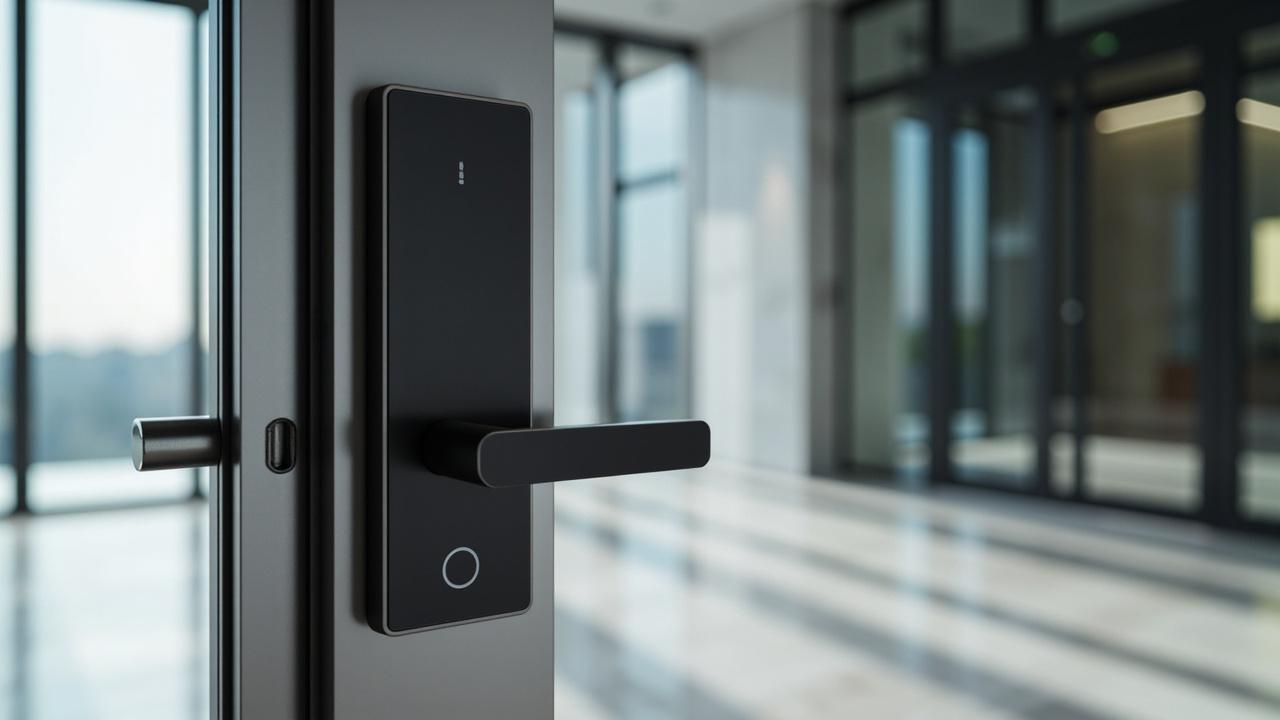
Smart Locks for Server Rooms
A server-room door is the smallest door with the longest paper trail in the building. It gets a handful of entries a week from a handful of named people, plus an unpredictable stream of escorted contractors, plus the occasional incident the compliance team will reconstruct three weeks later. That profile — small population, paper-trail-heavy, vendor-heavy, low-traffic, high-stakes — is what makes the lock decision interesting and what makes it different from a fingerprint-specific build, a factory-floor build, or a data-center datasheet build. This article treats the general server-room door as its own problem.
The extractable answer, up front: a smart lock is the right instrument for a server room when (1) its audit-log story survives being asked as per-model questions on the product page, (2) the contractor lane can be run as a real escort policy the lock can support, (3) the lock produces evidence a manager can replay after an incident, (4) the after-hours discipline is enforceable on the door not on a sign, and (5) the population is small and named enough that the credential hierarchy stays a one-page diagram. A standalone battery-powered lock is the right form factor when no reliable network drop is worth provisioning; the model must be picked from product pages, not from a sales conversation.
Five pillars carry the rest of the piece. Each pillar is the buyer decision, framed so that a spec sheet, a quote sheet, or a product page can be tested against it. Where the article cites a number, the number belongs to a single named model — the hotel lock SLK-9936S — and the rule is stated in plain text: that figure does not transfer to any other model. The exercise is to take the same shape of question to the models actually on the shortlist and see which cells come back filled.
This piece is deliberately distinct from three siblings: Smart Locks for Data Centers treats server halls and suites as a datasheet anchor (per-line spec dissection, rack-density scale, hot-aisle decision); Fingerprint Smart Locks for Server Rooms treats biometric credential selection as the dominant decision in office-grade conditions; Smart Locks for Factory Server Rooms treats the door next to live machinery with contractor-escort policy as a primary pillar under ambient-condition stress. The general server-room lens here is wider than a fingerprint build, narrower than a datasheet, and ambient-condition-agnostic compared to the factory build — which is precisely why five pillars, not one, are needed.
Ground rule for the rest of this article. Where a number, a figure, a credential capacity, a battery cycle, or a "supports audit logs" sentence appears, it is either (a) attributed to a single named model page, or (b) flagged as a per-model question to verify in writing on the page you are actually quoting. No figure is transferred across models. No certification, price, MOQ, lead time, or held warranty is asserted anywhere.
Pillar 1 — Audit-log expectation, framed as per-model questions
The single most expensive mistake on a server-room lock is treating the phrase "supports audit logs" as a feature. It is a capability shape, not a feature. The shape has six fields, and whether a candidate model fills each field is a per-model question on its product page.
The six questions, stated as the buyer has to ask them:
- Does the lock record events at all — grants, denials, low battery, initialization, mechanical-key overrides, admin changes?
- How many events are retained before the oldest is overwritten — stated as a record count, not as a vague "history."
- What is the read-out path — local app, PC management software, offline export file, cable, SD card?
- What format is the export — and can a third party parse it without the management software?
- What is the overwrite behavior — first-in-first-out, lock-at-full, or write-protected above a threshold?
- Can the export be tied to a named identity in the same row as the timestamp?
The hotel lock SLK-9936S is documented on its product page with one of those answers — audit/event records up to 1,000 — and that figure belongs to that page. It is reproduced here as the shape of a complete answer, not as a transferable spec:
| Documented line, SLK-9936S (hotel model page) | What the page states | Does this transfer to a server-closet model? |
|---|---|---|
| Audit / event record | up to 1,000 records | No. Belongs only to this model's page. |
| Credential reader | RFID Mifare 1 @ 13.56 MHz, 0–5 cm read, <0.25 s | Only as an example of a numbered spec line. |
| Management mode | standalone or centralized database mode | Do not assume either mode on any other model. |
| Power | 4 × AA, >15,000 battery operating cycles | Cycle figures are model-specific; treat blank cells as unknown. |
The exercise is to take that table's shape to every shortlist model and fill each row from the actual page. Where the row comes back blank, the answer is "the supplier has not committed," not "probably yes."
The retention-versus-traffic point nobody does. A capacity number without a traffic assumption is decoration. If a documented buffer holds 1,000 events and the door sees 40 events a day, that is 25 days of history. The same 1,000-event buffer on a closet used twice a month is years of history — and that is precisely where modest standalone locks look best on paper. Do the division before you buy. The arithmetic is yours; the buffer figure is the supplier's, and the supplier's figure only counts when the page actually states it.
Check the model’s published specification for the model actually being quoted. The catalog hosts models whose product pages either state these six lines or do not. Where the page is silent, the supplier's sales answer is not the page; ask again in writing, on the RFQ, on the page, or on the order confirmation.
Pillar 2 — Contractor escort policy
The server-room door has two populations: the people whose names sit on the door's allowed list for the next year, and the people who appear on a Tuesday afternoon with a service ticket and a laminated badge. The first population has a credential. The second population has a policy. Smart locks do not remove the policy — they make it auditable.
Three discipline rules belong in writing before any model is shortlisted:
- Vendor time-box. Every contractor entry has a start window and an end window. Standing contractors (a managed-service network engineer who comes monthly) get a recurring window tied to the visit, not to the year. Ad-hoc contractors (an instrument tech on a single break-fix) get a single bounded window. A window that does not end is not a window; it is an unenrolled stranger with a code.
- Escort, not credential. The vendor does not enroll. The escort enrolls. The vendor's name is in the escort's diary, not in the lock's user table. The lock records the escort, the time window, and the visit ID; the lock does not record the vendor as a named credential unless the policy has explicitly approved it.
- Mechanical fallback is logged. When the credential fails (reader error, dead battery, vendor badge in the wrong pocket) the mechanical-key route is taken, but the key event is recorded: who fetched the key, why, and what clock time. A key that "just opens the door" with no log line is the same audit hole as a code on a post-it note.
The lock's job in this pillar is narrower than the marketing material suggests. The lock does not enforce the policy — the operations team does. The lock records the policy's execution in a way the operations team can replay. That is the testable question for pillar 2:
| Contractor-escort capability the lock must support | Per-model question for the product page | Why it matters at the audit |
|---|---|---|
| Time-boxed credential, hour-bounded | Does the model allow per-credential start/end times? | Standing access is the audit hole. |
| Master / sub-card hierarchy (escort enrolls vendor) | Does the model support hierarchical credentials? | Vendor-as-named-user defeats the lane. |
| Event log includes credential ID, time, and result | Are credential ID and result both in the log row? | "Someone opened the door" is not evidence. |
| Mechanical-key event is recorded (or distinguishable in log) | Does the model treat mechanical-key use as a logged event? | Mechanical fallback with no log = no audit trail. |
Each row of that table is answered on a product page, not in a brochure. A model whose page states all four is doing the procedural work the lock can be asked to do; a model whose page states two of four leaves the buyer holding the policy in a folder and the lock unable to back it.
Pillar 3 — Incident-replay evidence
The compliance person will, one day, ask who was in the room on a date and a time. The lock has to make that answer possible. The discipline of pillar 3 is the difference between a lock that produced a usable record and a lock that produced data the manager could not reconstruct from.
Three things make an incident replay possible:
- Identity in the row. Every log row carries a named identity, not just "user 7." The named identity has to be exportable to a CSV the compliance officer can read in a meeting.
- Time discipline. The lock's clock is set, kept, and documented. A log row whose timestamp is two hours off the wall clock is a log row the auditor cannot trust. Battery-backed RTCs are normal; clocks that drift visibly across a quarter are not.
- Export completeness. When the manager pulls a quarter's history, the pull includes every event the lock recorded during that quarter. If the pull returns a sample or a paginated window, the export is incomplete; the manager has to know that and the supplier has to say so.
The exercise for pillar 3 is a one-page replay worksheet that the manager fills from the lock's export. The form is short, the supplier's product page either makes it fillable in five minutes or it does not.
| Replay field the manager needs at the desk | Source | Per-model page must state |
|---|---|---|
| Lock identifier (serial, firmware) | Header row of export | Yes — and stable across firmware updates |
| Time window covered | Export parameters | Yes — inclusive bounds, not "approximately" |
| Named identities, one per row | User table | Yes — exported with display names |
| Granted / denied / mechanical-key tags | Event record | Yes — distinguishable in the export |
| Source credential type per row | Event record | Confirm — many locks log only result, not credential class |
| Overwrite boundary (did the oldest events roll out?) | Supplier statement | Confirm — necessary to prove completeness |
The single trap is the supplier who answers "yes, it logs" and then describes the export as "you can review events in the app." That answer does not produce a CSV a third party can audit. The product page either shows an export format the buyer can hold or it does not; where the page is silent, the supplier is selling a feature that has not been demonstrated.
The honest unit of comparison is the model page, not the supplier's memory. A supplier who can fill all six rows for the model the buyer is actually quoting has nothing to hide; a supplier who answers "yes it logs" and stops there is selling a feature they have not verified.
Pillar 4 — After-hours discipline
After-hours is when the server-room lock earns its keep. During business hours the door is watched; after hours it is not. Three disciplines bind the lock to the door at 23:40 on a Tuesday:
- No silent bypass. A lock that opens via a master code with no log line, or a lock that opens via a mechanical key with no key-custody record, is not after-hours disciplined. The lock's behavior after hours has to be auditable from the same export the manager uses during business hours.
- Time-windowed credentials, not after-hours codes. Vendors and standing staff get hour-bounded credentials, not "after hours, use this." A standing after-hours code is an audit hole a year from now; a time-windowed credential is an audit row.
- Mechanical-key custody is a separate discipline. Mechanical keys are a fallback. They live in a sealed cabinet, they are signed out, they are signed back in. The lock either logs the mechanical-key event or it does not; the policy around the key is the team's, not the lock's, but the lock's log has to make the policy testable.
The lock's role in pillar 4 is to refuse a hidden state. The discipline is procedural; the lock's value is that it does not silently permit a behavior the policy forbids.
| After-hours discipline | Where the policy lives | Where the lock either supports it or fails it |
|---|---|---|
| Time-windowed staff credential | Operations policy | Lock supports per-credential time windows (confirm on page) |
| Vendor time-window + escort | Vendor management policy | Lock logs escort and time window (confirm on page) |
| Mechanical-key custody | Key-cabinet policy | Lock logs mechanical-key event or lock does not (confirm on page) |
| Audit export at next business open | Compliance policy | Lock supports offline export without internet (confirm on page) |
| Battery visibility | Maintenance policy | Lock signals low battery before failure (confirm on page) |
Five rows, five per-model confirmations. None of them are answered by the phrase "it works after hours." All five are answered on the product page the buyer actually holds, or they are not answered at all.
Pillar 5 — Named population fit and credential hierarchy
The server-room door is not a staff door. It is a small door with a small named population, and the moment that population stops being nameable, the lock stops being a server-room lock and starts being a staff door with a different problem. Pillar 5 is the test of whether the buyer is still buying a server-room instrument.
A small named population fits the door when:
- The total named identity count on the door is under twenty.
- The named identities are stable across a year — the same five to fifteen people, with additions and removals driven by HR, not by shift swap.
- The credential hierarchy can be drawn on one page: a small number of admin seats, a small number of user seats, a defined vendor lane, and a mechanical-key lane.
A standing population above twenty — or a rotating staff population that changes by quarter — is no longer a server-room problem; it is a staff entrance problem, and a server-room lock will be misapplied to it.
The credential hierarchy test:
| Population profile | Fits the server-room lock? | What changes if misapplied |
|---|---|---|
| 5 named employees, 1 vendor, weekly entries | Yes | — |
| 5 named employees + 20 contractors over a quarter | Boundary — vendor lane must be time-boxed; see pillar 2 | Vendors become unenrolled strangers with codes |
| 20 named employees + rotating staff | No — staff-door problem | Audit fails; population exceeds admin-lane capacity |
| Tenant mix with multiple access lists | No — access-control problem | Requires controller; standalone lock cannot arbitrate |
| Standing after-hours access for >10 users | No — credential hygiene fails | Codes shared; log becomes "someone" rather than "named" |
Cells marked — have no documented value in this article’s sources; obtain the figure from the supplier’s written specification.
The hierarchy has a second job: it defines who administers the lock. A lock whose admin lane cannot be tied to a single accountable person is a lock the audit cannot locate in the org chart. Check the model’s published specification whether the model supports named admin credentials and whether admin actions are logged as a distinct event class.
A standalone battery-powered lock is the right form factor when no reliable network drop is worth provisioning. That is the default for closets that were not designed for a security build — the IDF on the second floor, the riser cupboard, the small comms room. A network drop is not free, and the lock's value on these doors is rarely the network; it is the per-person log row the manager can read on a Monday. Where a wired controller is justified — and the buyer has the budget and the conduit — that is a different conversation and lives outside the server-room standalone lock's brief.
Five-pillar decision matrix
Pillars 1–5 reduce to a single decision matrix the buyer can run against any shortlisted model. Each row is a per-model question; each cell is filled from the product page.
| Pillar | Test the buyer asks the product page | Pass condition |
|---|---|---|
| 1. Audit-log expectation | Does the page state record type, capacity, read-out path, format, overwrite behavior, identity-in-row? | All six fields answered on the page |
| 2. Contractor escort | Per-credential time windows, hierarchical credentials, mechanical-key event logging? | All three fields answered on the page |
| 3. Incident-replay evidence | Stable lock identifier, named identities in export, granted/denied/mechanical tags, completeness disclosure? | All four fields answered on the page |
| 4. After-hours discipline | Time-windowed credentials, mechanical-key event log, offline export, low-battery signal? | All four fields answered on the page |
| 5. Population fit | Admin-lane naming, admin-event log class, single accountable admin supported? | All three fields answered on the page |
A model that scores 20/20 on this matrix has a complete answer on the product page. A model that scores under 12/20 has a sales conversation masquerading as a spec. Most shortlists land between; the buyer who runs this matrix before writing a quote sheet is not the buyer who later needs to redo a procurement.
Server-room smart-lock selection scorecard
A second view of the same decision, weighted by pillar. Weights are buyer judgment; the supplier does not set them.
| Pillar | Weight | How to score 0–2 |
|---|---|---|
| Audit-log six questions answered on page | 30% | 0 = silent; 1 = partial; 2 = all six |
| Contractor escort three questions answered | 25% | 0 = silent; 1 = partial; 2 = all three |
| Incident-replay four fields present in export | 20% | 0 = app-only; 1 = file export but identity absent; 2 = identity + tags + completeness |
| After-hours four disciplines supported | 15% | 0 = silent; 1 = partial; 2 = all four |
| Population-fit three admin fields | 10% | 0 = silent; 1 = partial; 2 = all three |
Interpretation:
- Score ≥ 85% with all rows confirmed on the product page — proceed to RFQ.
- Score 60–84% with one or more partial answers — ask the supplier to put the missing cells in writing before the quote is signed.
- Score < 60% or any row returning silence — model is a sales conversation, not a server-room lock; remove from shortlist until the page fills the cell.
The score is only as honest as the page the buyer reads. A brochure sentence is not a page; a spec line is.
Illustrative scenario — the 38-person operations company, one shared closet
Consider a 38-person operations company — accounting, sales, ops — sharing a single server closet on the second floor, no dedicated network drop, a part-time IT consultant on Tuesdays, and a once-a-quarter auditor whose firm will, one day, ask who was in the closet on the 14th. The named population is six people: two IT leads, a controller, an ops manager, an external IT consultant, and a co-founder with root access. Vendor traffic is the consultant weekly and a cabling contractor twice a year.
The buyer runs the five-pillar matrix against two models on the shortlist:
| Pillar | Model A — page states | Model B — page states |
|---|---|---|
| Audit-log | "Records access events" (one sentence) | Record type listed, capacity stated, read-out path named, format named, overwrite behavior named, identity-in-row named |
| Contractor escort | Master card + user card (no time windows) | Per-credential time windows, master/sub hierarchy, mechanical-key event logging |
| Incident replay | App-only review | CSV export with identity + tags + completeness disclosure |
| After-hours | Time-windowed credentials (one line) | Time windows, mechanical-key log, offline export, low-battery signal |
| Population fit | "Multiple admin supported" | Named admin, admin-event log class, single accountable admin |
The matrix is decisive. Model B is the shortlist. Model A is not disqualified by capability but by silence; the buyer cannot answer an audit from a brochure. The five-pillar exercise produces a quote sheet, not a brochure conversation.
The lock is then installed, the consultant gets a Tuesday time window, the co-founder's credential carries a named identity and an admin flag, the mechanical key lives in a sealed cabinet and is signed out, the first audit export covers a quarter, and the auditor's question on the 14th is answered from a CSV the IT lead printed at 9:00 that morning. None of that is the lock's feature; it is the lock's answer to five pillars a sales conversation would not have surfaced.
Frequently confused questions, answered in line
(This section is not a FAQ. The five pillars already answer the recurring buyer questions; the questions below are the ones that routinely misroute the procurement, and the answers belong inside the relevant pillar rather than under a dedicated heading.)
"Is a server-room lock the same as a data-center lock?" No. A data-center build treats suites, hot-aisle decisions and rack-density scale as the dominant factors and is dissected as a datasheet (Smart Locks for Data Centers). A server-room build is a small named-population standalone decision. The lock may be similar, but the procurement discipline is not.
"Is this the same as a fingerprint server-room lock?" No. The fingerprint-specific build (Fingerprint Smart Locks for Server Rooms) treats biometric credential selection as the dominant decision and ambient conditions as office-grade. The general server-room build accepts fingerprint, keypad, RFID or hybrid as legitimate credential lanes and tests each against the same five pillars.
"Is the factory server-room lock the same product?" No. The factory-floor build (Smart Locks for Factory Server Rooms) lives next to live machinery, has a recurring PLC programmer in a coolant puddle, and treats ambient-condition envelope as a primary pillar. The general server-room build is ambient-condition-agnostic and treats contractor escort as one of five pillars, not the dominant one.
"Can a server-room lock integrate with the corporate access-control system?" That is a different procurement. A standalone battery-powered lock, by definition, makes its own decisions on-device. Integration with a wired controller, a PACS, or a building management system is a separate scope. The buyer who wants integration should be reading the access-control category and not treating a server-room lock as the path to it.
"How long does the battery last?" That is a per-model figure stated on the product page. The hotel lock SLK-9936S page states >15,000 battery operating cycles; that figure is reproduced here only as the shape of a complete answer. It does not transfer to other models. Confirm on the page.
What to take to the quote sheet
The five pillars produce a quote sheet, not a brochure. The buyer takes the matrix, the scorecard, and the per-model confirmations into the RFQ; the supplier answers in writing; the lock is shortlisted on the answer, not on the marketing.
Three line items the RFQ should carry as standard:
- A row titled "audit-log six questions" with the supplier's written answer per model.
- A row titled "contractor escort three questions" with the supplier's written answer per model.
- A row titled "incident-replay four fields" with a one-page sample export from the supplier's own demo unit.
A supplier who fills all three rows in writing, per model, on the product page or the order confirmation, has answered the procurement. A supplier who fills none has not. The lock is then the lock — the rest is operations.
The general server-room door is small. The procurement discipline behind it is not.
Primary resource on this site for this topic: the five-pillar matrix and selection scorecard above function as the working tool. Sibling pages route to the fingerprint-specific build (Fingerprint Smart Locks for Server Rooms), the factory-floor build (Smart Locks for Factory Server Rooms), and the data-center datasheet (Smart Locks for Data Centers). For model-by-model capability and audit-log evidence, request the catalog or order a sample; for quotation routing, the recommended CTA is Request a quote with the secondary route being Keypad Hotel Smart Door Lock as the worked-example product page referenced through the pillars.