
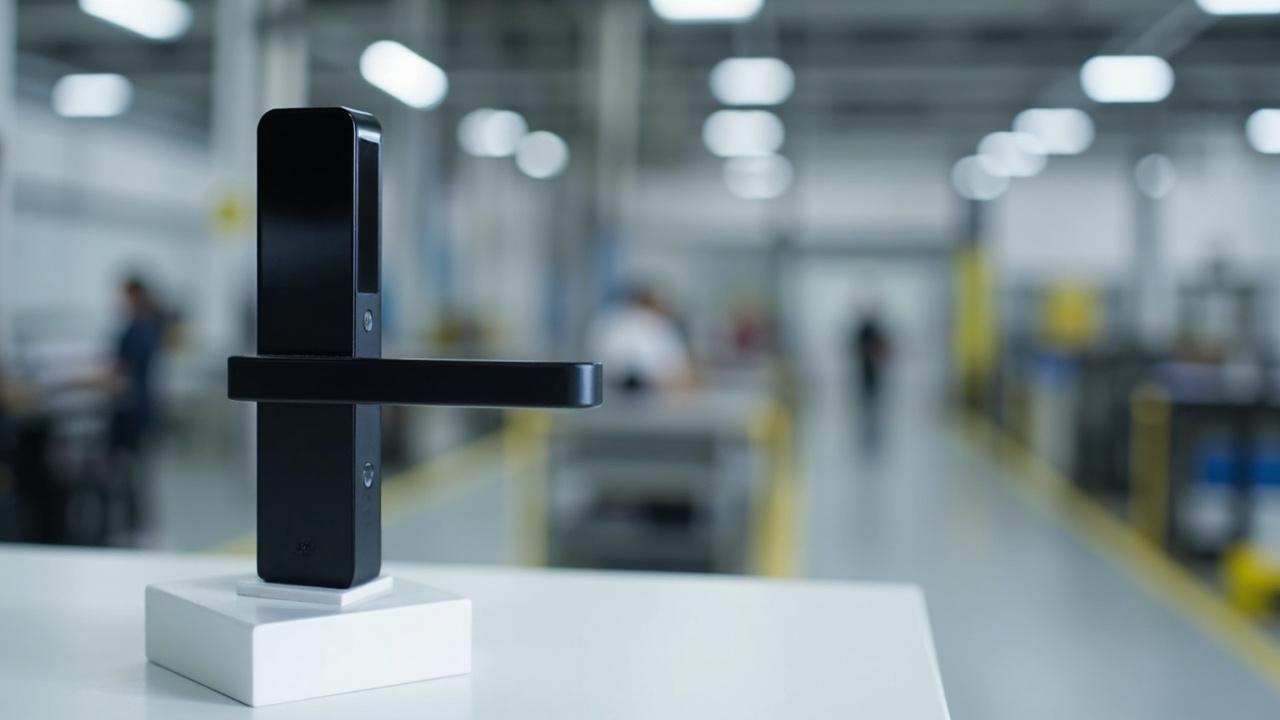
Smart Lock Sample Order Process
A smart lock sample order is the single most consequential procurement event a B2B importer runs before committing to a bulk order: it is where the catalog brochure turns into a unit the buyer can hold, where the sample-order lifecycle — request → quote → production → shipment → arrival inspection → acceptance — runs in compressed form, and where every per-model figure the buyer needs for a 200-room hotel or a 1,000-unit apartment rollout gets tested against a real bench, a real door, and a real electronic handshake. A sample order is not a marketing handout. It is a six-stage process/timeline with entry criteria, exit criteria, named deliverables, and a written accept-or-rework gate at the end. Treat it as one and the bulk-order transition runs cleanly; treat it as a courtesy parcel and the same defects show up on a container dock three months later.
This article reframes the smart lock sample order process as a six-stage process/timeline document — Stage Gate 1 sample request and qualification brief → Stage Gate 2 quotation and sample plan confirmation → Stage Gate 3 sample production at the factory → Stage Gate 4 pre-shipment sample verification → Stage Gate 5 sample shipment and customs documentation → Stage Gate 6 arrival inspection and acceptance — with arrows and sequence language carrying the layout, per-gate entry/exit criteria, per-gate deliverable, and a per-SKU firewall that routes every spec figure (door thickness envelope, credential family, read distance/time, battery count, cycle count, audit buffer, cylinder pin count, latch type, body material, finish options, mechanical override, software mode, app platform, multilingual posture, accessory set, packaging spec, labeling) to the dated product page for the SKU in scope. A sample order process is the buyer's first acceptance test. The cost of running it loosely is not the sample fee — it is the bulk-order mistake a clean sample process would have caught.
Within the first 100 words: a smart lock sample order is a six-stage process/timeline (request → quote → production → shipment → arrival → acceptance), each stage has an entry criterion, an activity set, an exit criterion, and a named deliverable, and every per-SKU figure — door thickness envelope, credential family, battery count, cycle count, mechanical override, software mode, app platform, packaging spec — is confirmed on the product page for the SKU in scope, with SLK-9936S as the documentation-granularity yardstick scoped strictly to that SKU. Sample order specifics (sample fee, sample deposit, sample refund path, sample-unit count, sample lead time, sample shipping incoterm, sample customisation scope) belong in the quote and are confirmed with the supplier per deal — confirm with the supplier for the SKU, the quantity, the destination, and the timeline in scope.
Stage Gate Overview — The Sample-Order Lifecycle at a Glance
The sample-order lifecycle is six gates in sequence. Each gate has an entry criterion (what must already be true before the gate starts), an activity set (what happens during the gate), an exit criterion (what must be true before the gate closes), and a deliverable (the named document the gate produces). A gate cannot be skipped without breaking the next gate's inputs. A gate whose exit criterion is not signed off does not produce a deliverable, and the lifecycle pauses at that gate until the sign-off is in writing.
| Gate | Entry criterion | Activity set | Exit criterion | Deliverable |
|---|---|---|---|---|
| Gate 1 — Request | Buyer has shortlist of 1–3 SKUs from the catalog | Buyer submits qualification brief; supplier reviews fit | Brief acknowledged in writing; sample scope agreed | Sample Request Brief (signed by both sides) |
| Gate 2 — Quote | Sample Request Brief signed | Supplier prepares sample quotation; buyer reviews | Quote accepted in writing with scope of work | Sample Quotation (supplier-stamped, buyer-initialed) |
| Gate 3 — Production | Quote accepted; deposit settled | Factory builds samples per the sample plan; buyer may attend or appoint a witness | Samples built, lot ID assigned, status report issued | Sample Production Status Report + serial-numbered sample list |
| Gate 4 — Pre-shipment verification | Samples built; lot complete | Per-unit inspection at the factory; per-SKU bench check; sample photo pack | Inspection signed off; samples packed for export | Sample Inspection Report + sample photo pack |
| Gate 5 — Shipment | Samples packed; export documents drafted | Customs declaration, courier or air freight booking, parcel tracking | Parcel dispatched; tracking number issued; documents emailed | Sample Shipment Advice + customs documents + tracking number |
| Gate 6 — Arrival + Acceptance | Parcel in transit | Receipt inspection, bench test, integration test, written accept/rework decision | Sample Acceptance Form signed by both sides | Sample Acceptance Form + bench-test record + integration-test record |
Read this table as the spine of the article. Every section below sits inside one of these six gates, with the per-gate subsections adding the depth the table can only sketch.
The gate sequence below traces the same path a signed sample cycle runs — from the first qualification brief to the bulk-order PO the acceptance form unlocks — and shows where a rework loops the lot back to production while a reject halts it at the gate.
flowchart TD
    G1["Gate 1 · Sample Request Brief"] --> G2["Gate 2 · Sample Quotation and Plan"]
    G2 --> G3["Gate 3 · Sample Production · serial-number range"]
    G3 --> G4["Gate 4 · Sample Inspection Report · photo pack"]
    G4 --> G5["Gate 5 · Shipment Advice · customs documents"]
    G5 --> G6["Gate 6 · Arrival bench · install test"]
    G6 --> DEC{"Sample Acceptance Disposition"}
    DEC -->|"accept"| PO["Bulk-order PO authorisation"]
    DEC -->|"rework-and-resubmit"| G3
    DEC -->|"reject"| HALT["Lifecycle pauses at the gate"]
Gate 1 — Sample Request and Qualification Brief
The sample order starts with a written brief, not a verbal "send me one of each". A verbal request leaves the scope of work open, and an open scope becomes the first disagreement the moment the sample lands. The Sample Request Brief is the document that closes the scope before any unit is built.
The brief carries five blocks: (i) the SKU shortlist — 1–3 SKUs from the catalog with the verified product-page URL for each SKU; (ii) the per-SKU confirmation set — door-thickness envelope, credential family, battery count, mechanical-override path, software mode, app platform, finish colour, accessory set, packaging spec, labelling — every cell a per-SKU documentation blank by default; (iii) the sample-unit count and per-unit serial-number request — the buyer states the units needed and the supplier assigns the serial-number range that travels with the lot; (iv) the sample-shipping destination — country, city, postal code, courier account (if any), and the incoterm the buyer wants to discuss (the actual incoterm is confirmed in the quote, not assumed here); (v) the use-case envelope — the project the samples feed into (e.g. 120-room hotel refurbishment, 600-unit apartment rollout, 80-room boutique conversion), so the factory understands the downstream bulk order without seeing the bulk-order PO yet.
| Brief block | What the buyer fills | What the supplier confirms | Source for the value |
|---|---|---|---|
| SKU shortlist | 1–3 SKU names + product-page URL | SKU exists in catalog and is in current production | Catalog + product page |
| Per-SKU confirmation set | Door thickness / credential family / battery count / mechanical override / software mode / app platform / finish / accessories / packaging / labelling | Per-SKU figure as published on the product page | Product page (dated) |
| Sample-unit count | Units per SKU (typical 1–3 per SKU for buyer-bench test, 5–10 if a third-party lab will bench-test) | Supplier can produce the requested count in the requested configuration | Quote (Gate 2) |
| Shipping destination | Country, city, postal code, courier account | Shipping route viable; no export-restricted component | Quote (Gate 2) |
| Use-case envelope | Project description (rooms, units, property type) | Supplier notes the downstream shape | Internal reference |
The Sample Request Brief is the document the supplier signs first. If the supplier pushes back on any block — "we don't sell the 36–100 mm envelope to that market" or "the TTLock build is firmware-version dependent" — that pushback belongs in Gate 1, not in Gate 3 when the sample is on the bench. Pushback handled in Gate 1 is a brief revision; pushback handled in Gate 3 is a rework.
A buyer-side discipline that pays off: file the brief with the project code as the document name (e.g. PROJ-2026-Q4-Hotel-Refurb-Sample-Brief-v01.docx) and ask the supplier to reference the project code in every subsequent email. The project code is the join key that ties the sample to the bulk-order PO six months later.
Gate 2 — Quotation and the Sample Plan Confirmation
The sample quotation is where the sample-order economics are written down. Smart lock sample orders run on quote-based commerce — there is no published sample fee, no published MOQ for samples, no published sample lead time. The numbers are confirmed with the supplier per deal. The buyer's job in Gate 2 is not to negotiate the smallest possible sample fee; the buyer's job is to make sure the quotation scope matches the brief and that the sample plan is unambiguous.
The sample quotation carries four blocks: (i) per-SKU sample fee, with the configuration specified line by line (e.g. "SLK-9936S, RFID Mifare 1 @ 13.56 MHz, stainless steel body, satin finish, TTLock app platform, multilingual management software, standalone mode") — check the model’s published specification; (ii) sample deposit terms — whether a deposit is required, the deposit percentage, the refund path if the sample is rejected and the bulk order proceeds with a different supplier, and the credit path if the sample is accepted and the bulk order proceeds with the same supplier; (iii) sample lead time — the calendar window from deposit cleared to sample ready for pre-shipment verification, with the assumption stated (sample production slotted into the next available production window, not a dedicated line); (iv) shipping cost and incoterm — sample courier cost, sample air-freight cost, the incoterm the supplier quotes (EXW / FOB / CIF / DAP are all plausible depending on the buyer-supplier agreement), and the documents that travel with the parcel (commercial invoice, packing list, certificate of origin if requested, proforma if requested).
A Sample Plan Confirmation is the second document signed in Gate 2. It captures: the sample-unit serial-number range the supplier will assign; the per-unit configuration matrix (which unit gets which finish, which firmware build, which app platform); the bench-test sample protocol the buyer wants run at the factory before the parcel ships; and the photo-pack specification (front / back / side / packaging / labelling / carton marks / per-unit serial-number close-up).
| Sample Plan block | What the supplier confirms | What the buyer keeps | Source for the value |
|---|---|---|---|
| Per-SKU configuration matrix | Each unit's finish / firmware / app / language | A copy countersigned at Gate 4 | Product page + per-unit spec |
| Sample-unit serial-number range | e.g. SLK-9936S SN 0001–0003, SLK-8831 SN 0001–0002 | A copy in the bulk-order file | Internal lot register |
| Bench-test protocol | Supplier runs the buyer's protocol OR buyer attends OR third-party inspector attends | Bench-test record signed at Gate 4 | Per-SKU bench-test worksheet |
| Photo-pack specification | Front / back / side / packaging / labelling / carton marks / per-unit close-up | A copy in the bulk-order file | Photo-pack standard |
The Sample Quotation and the Sample Plan Confirmation together form the Gate 2 exit criterion. Both are signed before Gate 3 starts. A quotation without a Sample Plan is not an exit; it is a price. A Sample Plan without a quotation is not an exit; it is a wish list. Both are required.
A discipline that protects the buyer: any per-SKU figure the supplier adds to the quotation that is not on the dated product page is a supplier-side claim, not a catalog fact. The discipline is to refuse the quotation line until the figure is either confirmed on the product page or routed to a "confirm with the supplier for this deal" footnote. This is the only path that keeps the bulk-order PO consistent with the sample the buyer just signed off on.
Gate 3 — Sample Production at the Factory
Sample production is a miniature version of the bulk-order production run: the same SMT lines, the same lock-body machining cells, the same assembly benches, the same firmware flashing stations, the same finished-goods inspection — the only difference is the lot size. The sample-order process must therefore use the same production discipline the bulk order will use, or the sample tells the buyer nothing about the bulk order.
Sample production runs against four checkpoints. Checkpoint A — material incoming: the supplier confirms the lot codes of the credential reader module, the motor, the PCB, the lock body, the cylinder, and the batteries against the BOM for the SKU. Per-SKU material confirmation is per the dated product page; the sample BOM and the bulk-order BOM must match exactly, or the sample is not a valid proxy for the bulk order. Checkpoint B — sub-assembly: the supplier confirms the firmware version flashed onto each sample, the app platform bound to each sample (TTLock / Tuya / Doodle / hotel PC software are all documented app/platform lanes — check the model’s published specification for the SKU), and the language stack loaded onto each sample's management software.
Checkpoint C — final assembly and bench test: each sample is unlocked 50–100 times across the documented credential methods (fingerprint / passcode / RFID-IC / mechanical key / app-Bluetooth / remote control / 3D face on the few models that have it / hotel PC software / camera-cat-eye / 4G on the models that have it — check the model’s published specification for the SKU), the battery compartment is verified, the audit-event buffer is verified, and the mechanical override is verified. Checkpoint D — finished-goods inspection: cosmetic per the published finish options, packaging per the published packaging spec, labelling per the buyer's labelling requirement (brand-owner use-case), and the per-unit serial-number label.
| Checkpoint | What the supplier confirms | What the buyer tracks | Source for the value |
|---|---|---|---|
| A — Material incoming | Credential module / motor / PCB / body / cylinder / battery lot codes | Lot-code register | Per-SKU BOM on product page |
| B — Sub-assembly | Firmware version / app platform / language stack / mechanical-override path | Firmware-version register | Per-SKU product page |
| C — Final assembly + bench | 50–100 cycle test per credential method; battery; audit buffer; mechanical override | Bench-test record (sample-acceptance form) | Per-SKU bench-test worksheet |
| D — Finished-goods | Cosmetic / packaging / labelling / serial-number label | Photo pack | Per-SKU packaging spec on product page |
A buyer-side discipline that catches the bulk-order mistake early: at Checkpoint C, ask the supplier to record one full bench-test cycle for each sample as a short video clip, the bench-test cycle including one fingerprint enrolment + one fingerprint unlock + one RFID-card unlock + one passcode unlock + one mechanical-key override + one app-Bluetooth unlock. The video clip is the evidence base if the bulk-order arrival inspection later finds a per-credential-method defect — the buyer can compare bulk-order behaviour to sample behaviour without travelling back to the factory. This is not a substitute for the bulk-order pre-shipment inspection; it is a baseline the buyer can hold the bulk-order inspection against.
A second discipline: the sample serial-number range assigned at Gate 2 must travel through every checkpoint in Gate 3. If a sample unit is reworked (e.g. firmware re-flash after a Checkpoint C bench-test failure), the rework is logged against the serial number, not against the SKU. Bulk-order rework tracking follows the same discipline — the sample sets the rule.
A note on the SLK-9936S documentation-granularity yardstick. The SLK-9936S hotel smart door lock is documented on its product page with a specific spec envelope — door thickness 36–100 mm, RFID Mifare 1 @ 13.56 MHz, read distance 0–5 cm, read time <0.25 s, 4 × AA battery power, battery operating cycles >15,000, audit/event records up to 1,000, 5-pin cylinder, 3-point latch, stainless steel + alloy body, multiple finish options, mechanical emergency access, multilingual management software, standalone or centralized database modes, positioned for 1–5 star hotels. This spec envelope is the yardstick the buyer uses to evaluate whether the sample behaviour the supplier is reporting matches a documented cell.
The yardstick is scoped strictly to the SLK-9936S sample; the per-SKU bench-test record for any other SKU in the shortlist (SLK-9936G / SLK-9905A / SLK-9951TH / SLK-9962S / SLK-G200 / SLK-8831 / SLK-1104 class / SLK-3108 / cylindrical Tuya round-code / 3D face intercom / outdoor D11-D12-D15-ODS-DQ / glass B09 / face 9L5-R-Q7-Future 1 / 516 cat-eye / Q7 intercom / 4G model / cabinet 6-model family / RFTC-RF card-and-code 118-118E-228-230-232-238-239-253-305-306-308-309-502-620-621-911-002-019-022-2020-760 with stainless options for 019/022/309 / fingerprint 37-model family / keypad 18-model family / RFID 9-model family / face-recognition 6-model family / cabinet 6-model family / video-camera 3-model family / glass 3-model family / outdoor 10-model family) is built against the dated product page for that SKU, not against the SLK-9936S envelope.
Gate 4 — Pre-Shipment Sample Verification
Pre-shipment sample verification is the gate the buyer often skips, on the assumption that the factory's own finished-goods inspection is sufficient. It is not. The pre-shipment gate is the buyer's last chance to bench-test the sample against the per-SKU spec block before the parcel ships and the courier window starts. The cost of finding a defect at Gate 6 is not the courier cost — it is the calendar cost of re-running the sample cycle while the bulk-order production slot drifts.
The pre-shipment verification runs in three steps. Step 1 — per-unit cosmetic and packaging inspection: each sample is photographed (front, back, side, packaging, labelling, serial-number close-up, carton marks) and the photos are filed against the serial-number range. Step 2 — per-unit bench-test: each sample is bench-tested against the per-SKU spec block the buyer carried into Gate 1, with the bench-test result recorded as pass / borderline / fail per credential method, per mechanical function, per electronic function. Step 3 — sample acceptance criteria sign-off: the buyer (or the buyer's appointed witness inspector) signs the Sample Inspection Report before the parcel is sealed for export.
| Step | Activity | Tool / method | Pass criterion | Source for the value |
|---|---|---|---|---|
| 1 — Cosmetic + packaging | Per-unit photo pack against the published finish and packaging spec | Camera; per-SKU packaging spec | Cosmetic per published spec; packaging intact; serial-number label legible | Per-SKU product page |
| 2 — Per-unit bench test | 50–100 cycle test per credential method; battery; audit buffer; mechanical override | Bench-test worksheet; serial-number register | All credential methods pass; battery compartment clean; audit buffer records events; mechanical override releases | Per-SKU product page |
| 3 — Sign-off | Sample Inspection Report signed by buyer-side witness OR third-party inspector OR buyer-appointed representative | Sample Inspection Report template | All pass OR explicitly signed borderline-acceptable items | Sample Inspection Report |
A buyer-side discipline that holds across gates: the Sample Inspection Report is a single document with a single sign-off, not three separate sign-offs on three separate pieces of paper. The sample acceptance criteria the buyer agreed to in Gate 2 (the per-SKU spec block, the bench-test protocol, the photo-pack specification) are the criteria the inspection runs against. If the criteria were not specific enough in Gate 2, the Gate 4 inspection cannot be more specific than the criteria allow.
A second discipline: the Sample Inspection Report carries the serial-number range, the per-unit bench-test result, the per-unit photo-pack reference, and the buyer-side witness's signature with date. The report is filed in the bulk-order PO file at Gate 6 — it is the document the buyer cites if the bulk-order arrival inspection finds a sample-vs-bulk deviation.
A third discipline: the pre-shipment gate is the right place to make the go/no-go call on the bulk-order supplier, not Gate 6. If the sample fails Gate 4, the bulk-order decision is already made — the buyer should not run Gate 5 (shipment) and Gate 6 (arrival) on a sample that already failed Gate 4. Re-running Gate 5 and Gate 6 on a failed Gate 4 sample is calendar burn, not procurement discipline.
Gate 5 — Sample Shipment and Customs Documentation
Sample shipment is a small-parcel customs event, not a container-load customs event, but the documentation discipline is identical: every document that travels with the parcel must be present before the parcel is handed to the courier, and every document must be filed in the bulk-order PO file. The bulk-order container will reuse the same document set at much larger volume; the sample parcel is the rehearsal.
The customs document set carries six items: (i) commercial invoice — supplier-stamped, with per-sample line item, total value, currency, incoterm, and buyer-side ship-to address; (ii) packing list — per-sample serial number, per-sample configuration, per-sample carton, total carton count, total gross weight, total net weight; (iii) certificate of origin — if requested by the buyer's customs regime (some markets require COO for smart locks even on sample parcels); (iv) proforma invoice — if the buyer's accounting requires a proforma before the deposit clears; (v) air waybill or courier tracking number — the courier's reference, the buyer's reference (the project code from Gate 1), and the estimated delivery date; (vi) sample-parcel photo pack — the same photo pack from Gate 4, attached to the shipment-advice email so the buyer has the photo evidence in the email thread, not in a separate file share.
| Document | Issued by | Travels with parcel | Filed in bulk-order PO file | Source for the value |
|---|---|---|---|---|
| Commercial invoice | Supplier | Yes | Yes | Per-sample quote |
| Packing list | Supplier | Yes | Yes | Per-SKU spec + serial-number register |
| Certificate of origin | Supplier (if requested) | Yes | Yes | Per-market requirement |
| Proforma invoice | Supplier (if requested) | Sometimes | Yes | Per-buyer-accounting requirement |
| Air waybill / courier tracking | Courier / freight forwarder | Yes (parcel label) | Yes | Tracking number |
| Sample-parcel photo pack | Buyer-side witness (from Gate 4) | No (in email + file share) | Yes | Gate 4 photo pack |
A buyer-side discipline that prevents the most common sample-shipment mistake: the courier account the buyer wants to use is named in Gate 1 and confirmed in Gate 2. If the buyer changes courier account after Gate 4, the supplier's shipping department has to re-cut the air waybill, and the parcel slips by 24–72 hours. The cleanest path is to lock the courier account in Gate 2 and not touch it again.
A second discipline: the sample parcel does not travel with marketing collateral, branded boxes, or sample-only inserts unless the buyer has explicitly asked for them. The sample parcel is a procurement artefact, not a sales kit; the only thing the buyer needs to unpack is the sample unit, the serial-number label, the configuration match to the brief, and the bench-test baseline.
A third discipline on shipping cost: sample shipping cost is real, and it is not refundable. The buyer should expect the shipping line on the invoice to be a non-trivial percentage of the sample fee. The shipping cost is confirmed with the supplier per deal — confirm with the supplier for the SKU, the destination, the courier account, and the incoterm in scope.
Gate 6 — Arrival Inspection and Sample Acceptance
Gate 6 is the gate the buyer controls end-to-end: the parcel is on the buyer's dock, the bench is in the buyer's lab (or the buyer's office, or the buyer's hotel back-of-house), and the per-SKU spec block the buyer carried into Gate 1 is the only document the acceptance decision reads against. Gate 6 produces the Sample Acceptance Form — the document that converts the sample cycle into a bulk-order go/no-go decision.
The arrival inspection runs in five steps. Step 1 — parcel and packing inspection: carton count, gross weight vs the packing list, serial-number labels per the packing list, cosmetic condition of the carton. Step 2 — per-unit unpacking and configuration match: each sample is unpacked, the serial-number label is verified, the configuration (finish, firmware build, app platform, language stack) is checked against the Sample Plan Confirmation from Gate 2. Step 3 — per-unit bench test on the buyer's bench: each sample is bench-tested against the per-SKU spec block, with the bench-test result recorded as pass / borderline / fail per credential method, per mechanical function, per electronic function. Step 4 — installation test on a real door (if available): each sample is installed on a real door (a hotel back-of-house door, an apartment unit door, an office corridor door) and run through the full daily-use cycle for 24–72 hours, with a per-use-cycle log filed. Step 5 — acceptance decision and Sample Acceptance Form: the buyer signs the Sample Acceptance Form with one of four dispositions — accept, accept-with-remarks, rework-and-resubmit, reject.
| Step | Activity | Tool / method | Pass criterion | Source for the value |
|---|---|---|---|---|
| 1 — Parcel + packing | Carton count / weight / labels / cosmetic | Scale; serial-number register; photo | Matches packing list | Packing list (Gate 5) |
| 2 — Unpacking + configuration match | Per-unit serial number + finish + firmware + app + language | Bench; product page | Matches Sample Plan Confirmation | Gate 2 Sample Plan + product page |
| 3 — Per-unit bench test | Per credential method / mechanical / electronic | Bench-test worksheet | All credential methods pass; battery clean; audit buffer records events | Per-SKU product page |
| 4 — Installation test (if available) | 24–72 hour daily-use cycle on a real door | Use-cycle log | Daily-use cycle completes without failure | Per-SKU product page |
| 5 — Acceptance decision | Sample Acceptance Form signed | Sample Acceptance Form template | Disposition: accept / accept-with-remarks / rework-and-resubmit / reject | Sample Acceptance Form |
The Sample Acceptance Form carries the serial-number range, the per-unit disposition, the bench-test result, the installation-test result (if Step 4 ran), the photo-pack reference, and the buyer's signature with date. The form is filed in the bulk-order PO file. The form is the document the buyer cites at the bulk-order pre-shipment inspection to verify in writing that the bulk-order units behave the same way as the accepted sample.
A buyer-side discipline that pays off across the lifecycle: the Sample Acceptance Form names the per-credential-method pass result for each sample unit, not just an overall pass / fail. A bulk-order defect that shows up only on the fingerprint reader is much easier to argue from a Sample Acceptance Form that explicitly records the fingerprint-reader result than from a form that records only an overall pass.
A second discipline: if any sample lands in the rework-and-resubmit disposition, the rework is logged against the serial number, the rework cycle is re-run through Gates 3–6, and the second-cycle Sample Acceptance Form is filed alongside the first-cycle form. A rework that is not logged against the serial number is not a rework — it is a verbal promise, and verbal promises do not survive the bulk-order pre-shipment inspection.
A third discipline on installation test: the 24–72 hour installation test is the gate that catches the per-model defect that no bench test catches — the door-preparation tolerance, the strike-plate alignment, the latch engagement under door-sag, the mechanical-key override under field conditions, the battery low-voltage behaviour under field conditions. The installation test is optional in the strict sense (the buyer can accept a sample on the bench alone), but the optionality has a cost: any field-condition defect that shows up in the bulk-order installation is on the buyer's bench-test protocol, not on the supplier's production discipline.
Exit Criteria — What "Sample Acceptance" Means in Writing
The sample-order lifecycle closes when the Sample Acceptance Form is signed. The form is the exit criterion for the entire sample cycle. A buyer who accepts the sample verbally has not closed the lifecycle — the bulk-order PO cannot cite a verbal acceptance. The bulk-order PO cites the Sample Acceptance Form by document name, document date, and serial-number range.
A clean exit produces five documents in the buyer's bulk-order PO file: (i) the Sample Request Brief from Gate 1, with the supplier's acknowledgement; (ii) the Sample Quotation and Sample Plan Confirmation from Gate 2, both signed; (iii) the Sample Production Status Report from Gate 3, with the serial-number register; (iv) the Sample Inspection Report from Gate 4, with the photo pack and the buyer-side witness signature; (v) the Sample Shipment Advice from Gate 5, with the customs documents and the courier tracking number; (vi) the Sample Acceptance Form from Gate 6, with the per-unit disposition and the buyer's signature. Six documents. One sample cycle. Every document is the input to the next bulk-order gate.
| Document | Gate | What it does | Bulk-order gate it feeds |
|---|---|---|---|
| Sample Request Brief | 1 | Defines sample scope | Feeds the bulk-order SKU shortlist |
| Sample Quotation + Sample Plan Confirmation | 2 | Locks sample economics and configuration | Feeds the bulk-order PO's per-SKU line items |
| Sample Production Status Report + serial-number register | 3 | Records how the sample was built | Feeds the bulk-order pre-production inspection (DUPRO) baseline |
| Sample Inspection Report + photo pack | 4 | Records the per-unit pre-shipment condition | Feeds the bulk-order pre-shipment inspection (PSI) baseline |
| Sample Shipment Advice + customs documents | 5 | Records the parcel dispatch and documents | Feeds the bulk-order shipment document set |
| Sample Acceptance Form | 6 | Records the buyer's accept-or-rework decision | Feeds the bulk-order PO authorisation signature |
A buyer-side discipline that protects the bulk-order PO: the six documents are filed under a single project-code folder (the same project code from Gate 1), not in six separate email threads or six separate file shares. The folder is the join key that ties the sample cycle to the bulk-order cycle. A bulk-order PO that cannot cite the project-code folder has a documentation gap, not a procurement process.
The Per-SKU Firewall — Why Every Sample Decision Is Confirmed on the Product Page
The sample-order process is built on a single discipline: every per-SKU figure the buyer uses to evaluate the sample is recorded in the model specification for the SKU in scope. The discipline is the firewall that protects the bulk-order PO from supplier-side claims, brochure figures, and verbal promises.
The firewall has four rules. Rule 1 — the product page is the source of truth. The supplier's verbal statement, the supplier's marketing collateral, the supplier's catalogue PDF, and the supplier's quotation line are not sources of truth. The product page is.
Rule 2 — the per-SKU figure is dated. The buyer notes the date the product page was read, and the figure is locked to that date. A product page that has been updated since the sample was built is a new source of truth, and the sample must be re-evaluated against the new figure.
Rule 3 — the firewall is scoped per SKU. The SLK-9936S spec envelope (door thickness 36–100 mm, RFID Mifare 1 @ 13.56 MHz, read distance 0–5 cm, read time <0.25 s, 4 × AA battery, battery operating cycles >15,000, audit/event records up to 1,000, 5-pin cylinder, 3-point latch, stainless steel + alloy body, multiple finish options, mechanical emergency access, multilingual management software, standalone or centralized database modes, 1–5 star hotel positioning) is the documentation-granularity yardstick for the SLK-9936S sample. The same envelope is not the yardstick for the SLK-8831, the SLK-G200, the SLK-9905A, the SLK-9951TH, the SLK-9962S, the SLK-1104 class, the SLK-3108, the cylindrical Tuya round-code, the 3D-face intercom, the outdoor D11-D12-D15-ODS-DQ, the glass B09, the face 9L5-R-Q7-Future 1, the 516 cat-eye, the Q7 intercom, the 4G model, the cabinet 6-model family, the RFTC-RF card-and-code 118-118E-228-230-232-238-239-253-305-306-308-309-502-620-621-911-002-019-022-2020-760 with stainless options for 019/022/309, the fingerprint 37-model family, the keypad 18-model family, the RFID 9-model family, the face-recognition 6-model family, the cabinet 6-model family, the video-camera 3-model family, the glass 3-model family, or the outdoor 10-model family. Each SKU has its own product page; each product page is the source of truth for that SKU's sample.
Rule 4 — the firewall extends to the bulk-order PO. The bulk-order PO cites the per-SKU figure from the product page the sample was evaluated against, not from a separate bulk-order figure. The sample and the bulk order must agree on the same figure, or the sample did not evaluate the bulk order the buyer is about to commit to.
| Firewall rule | What it prevents | What it requires |
|---|---|---|
| 1 — Product page as source of truth | Brochure-figure acceptance; verbal-promise acceptance | Per-SKU figure cited from the dated product page |
| 2 — Dated product-page reading | Stale-figure acceptance; product-page-update drift | Date of product-page read noted in the Sample Acceptance Form |
| 3 — Per-SKU firewall (no port-across) | SLK-9936S envelope assumed for SLK-8831 etc. | Each SKU evaluated against its own product page |
| 4 — Sample-to-bulk-order consistency | Sample evaluated one figure, bulk order PO cites another | Bulk-order PO cites the same per-SKU figure as the Sample Acceptance Form |
The firewall is not a refusal of supplier input. The firewall is a refusal of supplier input that is not anchored to a dated source. Supplier input anchored to a dated product page is welcome; supplier input that is not anchored is a supplier-side claim and is routed to a "confirm with the supplier for this deal" footnote.
Common Sample-Order Failure Modes and the Gate That Catches Them
The sample-order process fails in predictable places, and each failure mode has a gate that catches it before it reaches the bulk-order PO. The table below maps the eight most common failure modes to the gate that catches them and to the per-gate discipline that closes them.
| Failure mode | Gate that catches it | Discipline that closes it |
|---|---|---|
| Buyer submits a verbal sample request; supplier builds the wrong unit | Gate 1 | Sample Request Brief signed before production |
| Supplier quotes a configuration the SKU does not support | Gate 2 | Per-SKU spec block confirmed on the product page before quotation accepted |
| Sample built with a different firmware version than the bulk order will use | Gate 3 | Firmware-version register locked at Gate 3 Checkpoint B |
| Sample passes cosmetic but fails mechanical override | Gate 4 | Per-unit bench test at Gate 4 covers mechanical override as a named station |
| Sample parcel ships with wrong serial-number labels | Gate 5 | Serial-number register travels from Gate 2 → Gate 5; packing list cross-checked |
| Sample arrives with cosmetic damage from shipping | Gate 6 | Step 1 parcel and packing inspection; photo pack from Gate 4 is the baseline |
| Sample passes bench but fails real-door installation | Gate 6 | Step 4 installation test on a real door for 24–72 hours |
| Sample accepted verbally; bulk-order PO cannot cite acceptance | Gate 6 | Sample Acceptance Form signed with date and per-unit disposition |
The eight failure modes are the most common, not the only ones. A buyer who runs the six-gate process strictly will catch most of them; a buyer who treats the sample as a courtesy parcel will catch none of them and will discover the failure modes at the bulk-order container dock.
Cross-Link Map — How the Sample Order Process Sits Inside the Cluster
The sample-order process is one process in a five-process sourcing cluster. The cluster carries the buyer from the first search-engine question to the bulk-order PO authorisation; the sample-order process sits in the middle, downstream of the sourcing flow and the lead-time negotiation, and upstream of the bulk-order process.
The sample-order process feeds into and is fed by four sibling articles in the sourcing cluster. How to Source Smart Locks From China sits upstream and owns the four-stage sourcing flow (factory shortlisting, model shortlisting, sample request, bulk order); the sample-order process is that flow's third stage in expanded form — the sourcing article names the stage, this article runs it as a six-gate process. Smart Lock Lead Time Negotiation sits adjacent and owns the lead-time negotiation discipline; the sample-order lead time is the first lead-time negotiation the buyer runs with the supplier, and that discipline applies to the sample as much as to the bulk order. Smart Lock Bulk Order Process sits downstream and owns the bulk-order lifecycle (PO drafting, deposit, production, pre-shipment inspection, shipment, arrival, acceptance); the Sample Acceptance Form from Gate 6 is the document the bulk-order PO cites at authorisation. Smart Lock Product Sample Inspection sits adjacent and owns the per-SKU sample-test deep dive; the Gate 4 pre-shipment verification and the Gate 6 arrival bench test are the buyer-side executions of the protocol that article names.
| Related article | Position in cluster | What this article feeds it / takes from it |
|---|---|---|
| How to Source Smart Locks From China | Upstream | Takes the four-stage sourcing flow; runs Stage 3 (sample request) as a six-gate process |
| Smart Lock Lead Time Negotiation | Adjacent | Takes the lead-time negotiation discipline; applies it to the sample lead time at Gate 2 and Gate 3 |
| Smart Lock Bulk Order Process | Downstream | Feeds the Sample Acceptance Form to the bulk-order PO authorisation gate |
| Smart Lock Product Sample Inspection | Adjacent | Takes the per-SKU sample-test protocol; runs it at Gate 4 (pre-shipment) and Gate 6 (arrival bench) |
Adjacent cluster cross-links the sample-order process also reads against include the Smart Lock Purchase Order Checklist (the bulk-order PO block that cites the Sample Acceptance Form), the Smart Lock Pre-Shipment Inspection China (the bulk-order pre-shipment inspection that uses the sample bench-test record as the baseline), the Smart Lock Quality Inspection China framework (the umbrella the per-SKU sample-test protocol sits inside), and the Smart Lock Factory Audit Checklist (the upstream supplier-side qualification gate that runs before the sample is requested). Each of these is referenced by the bulk-order PO documentation set.
The commercial-program routes the sample-order process also reads against include: the OEM/ODM program route at /oem-odm (when the sample is a custom firmware or custom housing build, not a catalog SKU), the private-label program route at /private-label (when the sample carries the buyer's brand label, not the supplier's), the distributor program route at /become-a-distributor (when the sample is a distributor onboarding SKU), and the catalog request route at /request-catalog (when the buyer wants the full SKU catalog before shortlisting the sample).
Illustrative Scenario — A 120-Room Hotel Refurbishment Sample Cycle
Consider a 120-room independent boutique hotel in a coastal secondary city, owned by a regional hospitality group, refurbishing from legacy mechanical key locks to RFID hotel-class smart locks on 45 mm solid-core timber guestroom doors. The buyer's profile: first-time importer, no in-country hotel-lock distributor, sourcing directly from the factory, project code PROJ-2026-Q1-Boutique-Hotel.
The sample cycle runs as follows. Gate 1 — the buyer submits a Sample Request Brief naming one SKU (SLK-9936S hotel smart door lock) with the product-page URL, the per-SKU confirmation set (door thickness 36–100 mm envelope, RFID Mifare 1 @ 13.56 MHz credential family, 4 × AA battery power, mechanical emergency access, multilingual management software, standalone mode for a single-property deployment, satin stainless finish), the sample-unit count (3 units for buyer-bench + installation test, 1 unit reserved for the buyer's PMS integration partner), the shipping destination (the buyer's hotel back-of-house in the destination country), and the use-case envelope (120-room refurbishment, RFID hotel-class, single-property). The supplier acknowledges the brief in writing.
Gate 2 — the supplier prepares the sample quotation (3 SLK-9936S units at the per-unit sample fee, 1 unit for the PMS integration partner, courier cost to the destination, EXW incoterm on the supplier side, deposit terms, sample lead time estimate). The buyer accepts the quotation and signs the Sample Plan Confirmation (serial-number range SLK-9936S SN 0001–0004, per-unit configuration matrix, bench-test protocol, photo-pack spec).
Gate 3 — the supplier runs the four checkpoints: material incoming (lot codes for the Mifare reader, the motor, the PCB, the stainless body, the cylinder, the AA batteries recorded against the SLK-9936S BOM), sub-assembly (firmware version locked, TTLock app platform bound, English management software loaded, mechanical-override path verified), final assembly and bench test (each unit run through 100 unlock cycles across RFID card + mechanical key, battery compartment verified, audit-event buffer verified), finished-goods inspection (satin stainless finish per spec, packaging per spec, serial-number labels legible). The Sample Production Status Report is filed with the serial-number register.
Gate 4 — the buyer-side witness inspector (or the buyer's appointed third-party inspector) attends the pre-shipment verification. The four samples are photographed against the satin-stainless spec, bench-tested against the per-SKU spec block, and the Sample Inspection Report is signed. Gate 5 — the four samples are packed in a single carton, the commercial invoice and packing list are supplier-stamped, the air waybill is issued, the courier tracking number is emailed to the buyer, and the parcel is dispatched.
Gate 6 — the parcel arrives at the hotel back-of-house, the buyer unpacks the four units, runs the per-unit bench test against the SLK-9936S spec block (3 units all pass RFID + mechanical override + battery + audit buffer; 1 unit for the PMS integration partner passes the bench test and is handed to the partner), installs one unit on a real guestroom door for a 72-hour installation test (pass), and signs the Sample Acceptance Form with disposition "accept" for all four units. The Sample Acceptance Form is filed in the project-code folder. The bulk-order PO is then drafted against the SLK-9936S spec envelope as locked at Gate 6, with the bulk-order PO authorisation signature citing the Sample Acceptance Form by document name, document date, and serial-number range. The bulk-order PO proceeds to the first gate of the bulk-order lifecycle, Smart Lock Bulk Order Process.
This scenario is illustrative — not a customer story, not a verified project, not a quoted outcome. The 120-room scope, the SLK-9936S SKU, the four-unit sample count, the seven-day Gate 3 production, the four-day Gate 5 transit, the three-day Gate 6 installation test are scenario placeholders. The reader's own deal may have a different room count, a different SKU mix, a different sample-unit count, a different lead time, and a different incoterm. The discipline — six gates, per-gate entry/exit criteria, per-gate deliverable, per-SKU firewall, signed Sample Acceptance Form — is what travels across deals; the scenario numbers do not.
Closing — From the Sample Acceptance Form to the Bulk-Order PO
The smart lock sample order process is the buyer's first acceptance test, and the Sample Acceptance Form is the document that converts the sample cycle into a bulk-order go/no-go decision. A sample cycle run as a six-gate process produces six named documents in the buyer's bulk-order PO file, each of which is the input to a bulk-order gate. A sample cycle run as a courtesy parcel produces a verbal acceptance and a documentation gap the bulk-order PO cannot cite.
The next step for a buyer who has just signed the Sample Acceptance Form is to draft the bulk-order PO against the per-SKU spec envelope locked at Gate 6 — door thickness envelope, credential family, read distance/time, battery count, cycle count, audit buffer, cylinder pin count, latch type, body material, finish options, mechanical override, software mode, app platform, multilingual posture, accessory set, packaging spec, labelling — every cell cited from the dated product page the sample was evaluated against. The bulk-order PO authorisation signature then cites the Sample Acceptance Form by document name, document date, and serial-number range, and the bulk-order lifecycle begins.
For sample specifics — sample fee, sample deposit, sample-unit count, sample lead time, sample shipping incoterm, sample customisation scope — confirm with the supplier for the SKU, the quantity, the destination, and the timeline in scope. Smart lock sample orders run on quote-based commerce, and the per-deal specifics are confirmed per deal.
For the broader sourcing flow the sample-order process sits inside, see How to Source Smart Locks From China, the four-stage sourcing flow the sample cycle is the third stage of. For the lead-time negotiation discipline the sample lead time is the first instance of, see Smart Lock Lead Time Negotiation. For the bulk-order lifecycle the Sample Acceptance Form feeds into, see Smart Lock Bulk Order Process. For the per-SKU sample-test protocol the Gate 4 pre-shipment verification and the Gate 6 arrival bench test run against, see Smart Lock Product Sample Inspection. For the bulk-order PO that cites the Sample Acceptance Form, see Smart Lock Purchase Order Checklist. To start a sample cycle on a specific SKU, request a quote at /request-a-quote with the project code, the SKU shortlist, the per-SKU confirmation set, the sample-unit count, and the shipping destination named in this article's Gate 1; to order a sample kit, see /order-samples; to request the full SKU catalog, see /request-catalog.