
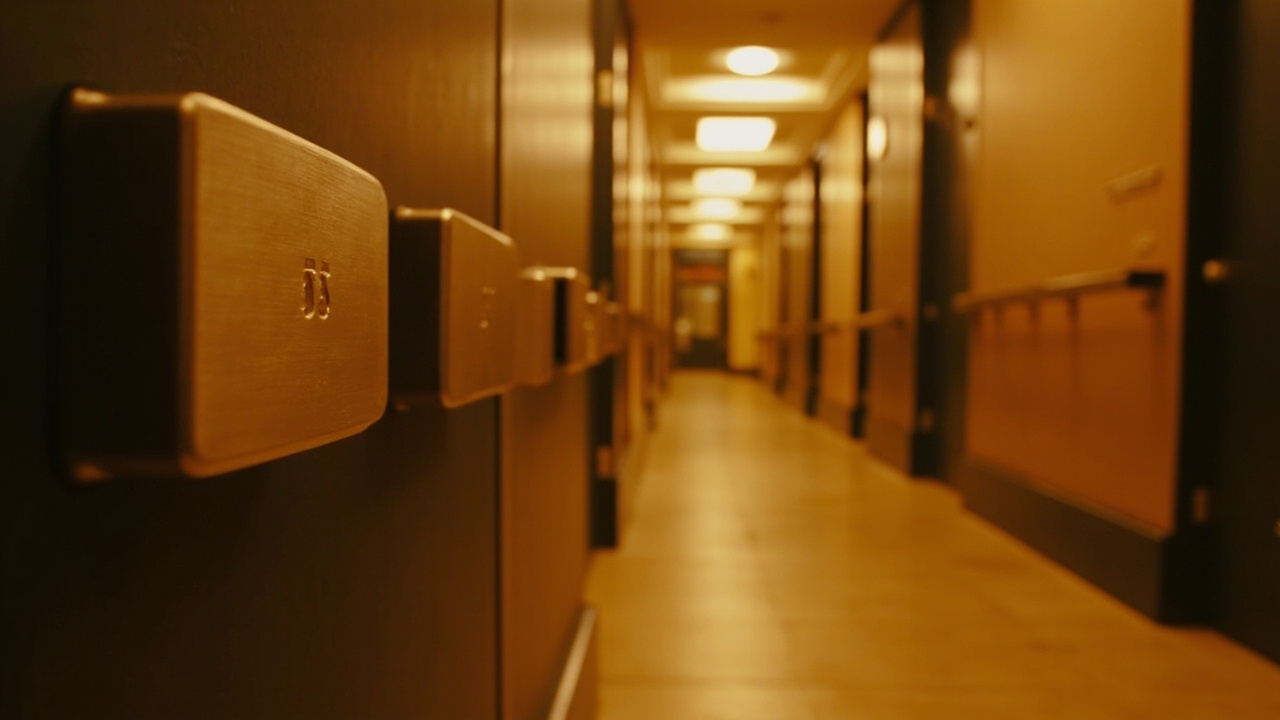
Phased Retrofit: Smart Locks Across a Parking, Lockers and Shared Assets Portfolio
Every building type resolves into door classes, and parking lockers phased retrofit is organised around them. Parking and locker portfolios often look homogeneous from the asset register, but they operate very differently. A pay-and-display locker turns over with every reservation, a staff locker changes hands with the roster, a bicycle room handles repeated shared access, and a parcel locker follows a high-throughput collection schedule. Some doors sit outdoors or in semi-outdoor enclosures where weather exposure matters.
Direct answer. In brief, this article covers parking lockers phased retrofit from parking lockers phased retrofit to parking-lockers. It states what to confirm about parking lockers phased retrofit on the dated product page where a figure is involved. A parking lockers phased retrofit works through one building type door class by door class. parking lockers phased retrofit is the first class to close. parking lockers phased retrofit cannot be quoted until it is.
Read parking lockers phased retrofit as parking lockers phased retrofit. It is a working definition of parking lockers phased retrofit. Not a statutory or certified one. It applies to the market and product in question rather than as a general claim.
- Sort the openings — sort the door population into classes that behave alike, starting from parking lockers phased retrofit
- Classify each door — state what parking-lockers needs before anything is quoted
- Show the fit — record the measurement that closes parking lockers phased retrofit
- In parking lockers phased retrofit, this sequence is what parking lockers is checked against.
This runbook treats a parking lockers phased retrofit as a controlled sequence of decisions rather than a single installation project. Each wave must establish the door, credential, power, recovery route and operating owner before the next group of assets is released. The aim is to prevent a smart lock decision from becoming an unattended battery or access failure.
Set the retrofit unit before defining a wave
The unit of work is not the lock alone. It is the combination of a physical door, its proposed credential, its power source, the people who operate it and the route used when normal access fails. This matters because a pay-and-display locker may use a short-lived code, a locker bank may be controlled through an app, and staff lockers may use a card. A bicycle room’s shared-access route must be confirmed rather than assumed. The catalogue entry point for this is the cabinet locks.
Use parking-lockers as the internal programme identifier in the asset register. Give every door a traceable entry and group assets by operating duty rather than simply by building or proximity.
| Decision | Standard retrofit route | Exception route | Required evidence |
|---|---|---|---|
| Door fit | Use the accepted door and frame configuration | Remediate or defer the individual door | Door fit verification |
| Credential | Match the established short-lived, app-based or staff route | Assign a controlled temporary route | Issue, expiry and recovery method |
| Power | Use the approved locker bank battery management routine | Repair the power provision first | Named recharge owner and escalation route |
| Recovery | Retain the accepted fallback until handover | Do not release the asset to production | Trigger, responsible person and restoration method |
A standard route does not remove site-specific work. It means a deviation is visible and owned rather than hidden inside a bulk installation order.
Build the phase-zero asset register
Before selecting hardware or asking suppliers to quote, complete a smart lock retrofit site survey for every candidate asset. Record the physical door condition, weather exposure, opening cycle, existing access method, expected user group and any door furniture that may affect the proposed arrangement. Capture the normal opening schedule as well as the periods when staff or contractors need entry.
The vertical-specific Smart Locks for Parking, Lockers and Shared Assets: Door Survey and Fit Reality can be used to structure that evidence. The broader Smart Lock Retrofit Site Survey offers another field-check format, but neither replaces a site visit or supplies product-specific facts.
Each register entry should identify:
- the asset class and operating owner;
- the credential route and intended lifetime;
- the power source and recharge responsibility;
- the current fallback and its approval status;
- any survey exception that could delay installation.
A blank field is a gate item, not an administrative detail. If the credential owner cannot say when a short-lived code expires, or the service team cannot say who recharges a locker bank, the asset is not ready for the pilot.
Gate A: authorise fit and operating design
Gate A confirms that the retrofit can be installed and operated as intended. It is not permission to begin a purchase order. Approve it only when the asset register identifies a physical solution, an access route, a power routine and a recovery method.
Use the RFQ Template for Smart Locks for Parking, Lockers and Shared Assets to turn the approved assumptions into comparable supplier questions. Request evidence against the actual door and operating context, not against an idealised locker or a generic smart lock. Any dimension, power characteristic or operating feature that will guide the decision must be confirmed on the dated product page for the specific SKU.
Gate A produces a short decision record for each asset. It states whether the door is released for pilot, released with a named exception, or held. An unresolved door fit issue, an undefined credential expiry or an absent recovery route keeps that asset out of the production wave.
Gate B: prove the complete operating loop
The pilot must exercise the complete reservation or occupancy cycle. Opening the door once proves very little. Test credential issue, first use, expiry, renewal, reassignment, recharge, exception reporting and recovery. Use representative assets from the classes scheduled for early deployment rather than selecting only the easiest door.
flowchart TD
  A[Define asset classes] --> B[Complete phase zero register]
  B --> C[Gate A survey and fit]
  C --> D[Gate B live pilot]
  D --> E[Approve first wave]
  E --> F[Accept or remediate]
  F --> G[Approve next wave]
  F --> H[Hold remaining assets]
A pay-and-display locker pilot should cover rapid user turnover. A staff locker pilot should cover reassignment when personnel change. A bicycle room should be observed under shared traffic and the relevant weather exposure. A parcel locker should be checked against the collection schedule and the need to retrieve or reactivate access after a reservation ends.
Gate B passes only when the operator can state what happens at each transition. Record the observed result, the corrective action and the person who accepted it. If the pilot exposes an unworkable credential handoff or an impractical recharge routine, revise the operating design before replicating it.
Sequence waves around operating dependencies
Build each wave around a shared operating condition rather than an arbitrary list of addresses. A useful first wave contains assets whose procedures are already defined and whose disruption can be observed closely. Later waves can carry higher-throughput doors or more varied asset classes after the first wave has produced stable evidence.
Each wave release should state its included doors, credential method, power route, fallback, responsible operator, acceptance evidence and unresolved exceptions. Do not increase the number of live assets until the previous wave has been accepted. A physical installation without an accepted operating loop merely increases the number of doors that can fail at once.
Keep the old access arrangement available until the replacement route is accepted and the operating records are updated. Its removal is a separate handover decision, not an automatic consequence of fitting the smart lock.
CONFIRM-WITH-LOCAL-FIRE-AND-BUILDING-AUTHORITY: Confirm the approved locking arrangement, emergency release and free-egress route for every affected door before removing existing hardware.
Control credentials through every transition
Treat credential lifecycle management as part of the wave record, not as a back-office task after installation. A short-lived code should be tied to the reservation or access period for which it was issued. The locker bank app route needs a documented user and administrator route. A staff card needs a named owner and a reassignment step when employment or responsibilities change.
For each asset class, define what happens when:
- a user abandons a reservation;
- a credential is issued but never collected;
- a staff member leaves before reassignment;
- a shared user needs a temporary extension;
- the normal credential service is unavailable;
- a lock must be reset after an intervention.
The record should show who issued the credential, what event ended its authorised use and which route removes or replaces it. Keep the operational record proportionate to the asset’s access pattern. A parcel locker does not automatically need the same administrative treatment as a staff door, but every operational decision still needs an owner.
Put power ownership at the wave entrance
Locker bank battery management is a release condition. The vertical failure pattern is clear: a lock that consumes a battery per reservation turns the power routine into a hidden operating cost. The pilot should reveal who notices depletion, who performs the recharge, where any required stock is held and what happens when a lock is unavailable because its power state has not been managed.
Do not approve a wave merely because the lock is installed. Approve it when the recharge route is assigned, the trigger for routine attention is defined and the operator can explain how a depleted or unavailable asset is reported. If a battery-related task would require an unplanned visit for every reservation, redesign the process before expansion.
The Battery and Power Programme for Smart Locks in Parking, Lockers and Shared Assets provides a working structure for documenting that programme. Use the observations from the pilot to populate the actual trigger, owner, route and evidence rather than inserting generic service assumptions.
Protect recovery and contain exceptions
Every wave needs a recovery rule that can be used when a door does not open as intended. The rule should identify the failure signal, who responds, which approved fallback is used, how users are communicated and when the asset returns to service. It must also state what evidence is needed before the next wave is released.
Typical triggers include a door that does not match the survey, a lock that remains unavailable after the approved power check, a credential that expires before its authorised use ends or a shared door whose traffic exposes an operational bottleneck. The response sequence is consistent: contain the affected access point, activate the approved recovery route, communicate the restriction, record the cause and decide whether to remediate, defer or remove the asset from the wave.
An exception is not permission to leave the asset undocumented. Keep it visible in the programme register until the responsible owner accepts either its correction or its permanent exclusion.
Accept each wave and transfer the records
Wave acceptance is a documented operating decision. Inspect the completed work against the survey record, verify that the credential route works through its full cycle, confirm the recharge procedure with the operator and observe the recovery route under a controlled test. Keep defects against the individual asset rather than hiding them inside a portfolio-level completion statement.
It is worth pairing this with the smart lock handover checklist. That is the same question parking lockers phased retrofit has to answer here.Use the Installer Handover and Commissioning for Parking, Lockers and Shared Assets as the handover reference, then assemble the site-specific property handover pack.
| Acceptance item | Required evidence | Accountable role |
|---|---|---|
| Physical installation | Survey matched to the installed configuration | Site and installation lead |
| Access operation | Issue, use, expiry and reset tested | Operations lead |
| Power routine | Recharge trigger, route and escalation accepted | Facilities lead |
| Recovery route | Fallback tested and recorded | Property manager |
| Outstanding exceptions | Asset list with decisions and deadlines | Programme owner |
| Operating transfer | Records, contacts and asset register handed over | Property manager |
A wave may be accepted with clearly bounded exceptions, but only where those exceptions do not remove a required operating control. The property manager must know which doors are live, which are restricted and which have not been released.
Authorise the next wave without losing control
Use this parking lockers phased retrofit checklist before every wave release:
- the previous wave has an accepted status;
- every included door has current survey evidence;
- credential issuance and expiry are owned;
- the power and recharge route is tested;
- the recovery method remains available;
- the operator has accepted the handover records;
- unresolved exceptions have an explicit decision.
The property manager should authorise progression after these items are evidenced. Equipment, installation or operations leads may recommend release, but one accountable owner must make the decision. If any required control is absent, hold the remaining assets rather than hiding uncertainty inside a larger installation programme.
The same question is worked through in more detail in the smart lock installer training. That is the same question parking lockers phased retrofit has to answer here.
Keep the programme open after handover
A phased retrofit does not end when the final lock is fitted. Update the asset register when a credential route changes, a door is repaired, a battery routine changes or an exception is accepted. Retain the decision record, recovery route and named operating owner so the next property team can continue the same controls.
When the asset classes, survey assumptions and operating routines are stable, route the confirmed schedule through request a quote for evaluation against the specified SKUs. The request should carry the evidence gathered during the pilot, not just a door count.