
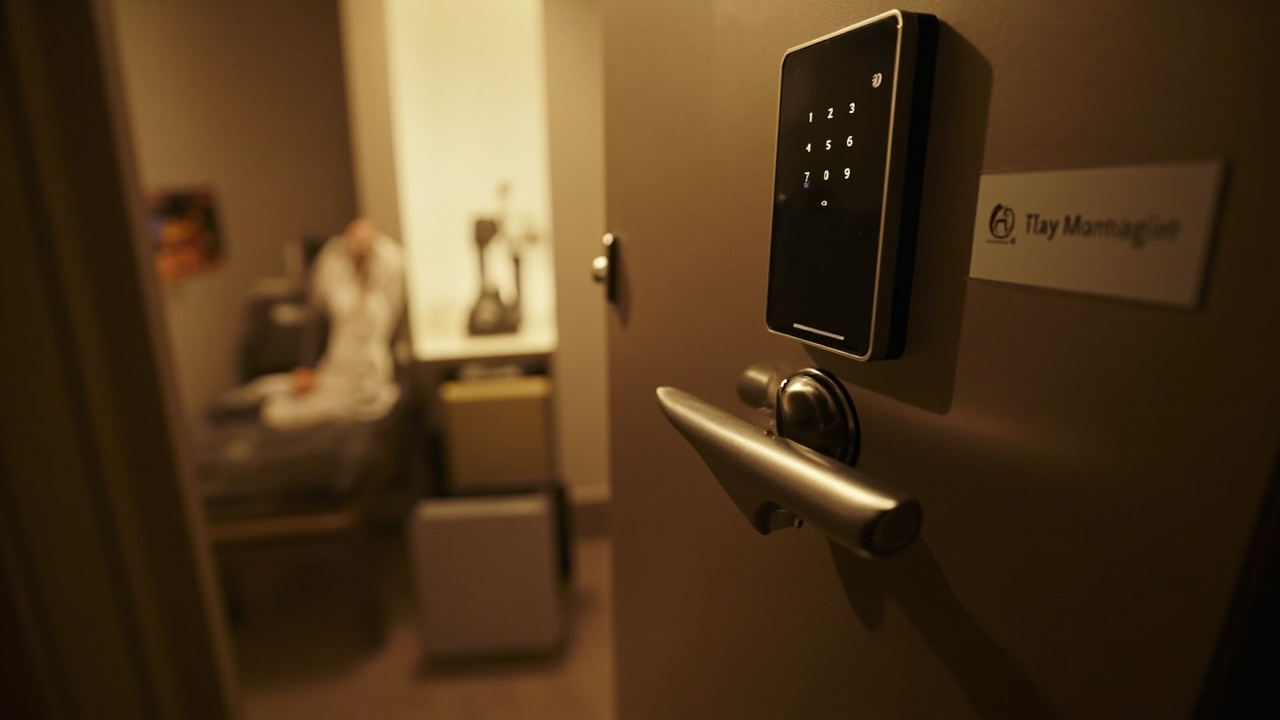
Vandalism, Misuse and Environmental Load on Locks in Hotel Chains
The hotel chains misuse load is not one failure mode. It is the combined pressure created by room turnover, housekeeping, luggage traffic, public-door use, forced-entry attempts, weather, cleaning and the service response to every event. A hotel group can therefore approve a lock that performs well in isolation yet creates recurring failures when rolled across a chain.
Direct answer. The one-line answer — hotel chains misuse load is the working record for hotel chains misuse load. hotel chains misuse load is worthless until hotel-chains is attached to it as evidence. A hotel chains misuse load ties every door class to a requirement. hotel chains misuse load decides which class ends up in the hotel chains misuse load specification.
hotel chains misuse load means here what hotel chains misuse load sets out. It is a working definition of hotel chains misuse load for this market and product. It is drawn from the evidence below, and it is not a general marketing phrase.
- Sort the openings — sort the door population into classes that behave alike, starting from hotel chains misuse load
- Classify each door — state what hotel-chains needs before anything is quoted
- Show the fit — record the measurement that closes hotel chains misuse load
- For hotel chains misuse load, hotel chains is what each step has to answer to.
The evaluation should separate three questions: how the lock is physically abused, how people and workflows misuse the access system, and what environmental and service burden the installation creates. Each requires different evidence. A successful card read proves very little about door alignment, forced-entry resistance, cleaning exposure, network loss or recoverability after the lock case has been damaged.
Door fit must be controlled before any abuse or misuse test. The structured approach in Smart Lock Retrofit Site Survey and Office Smart Lock Site Survey can be adapted for hotel doors, while the chain-specific observations in Smart Locks for Hotel Chains: Door Survey and Fit Reality provide a better starting point. For this evaluation, the hotel-chains programme label should map to one controlled standard, a property exception register and a common pilot protocol.
Separate abuse, misuse and exposure before choosing a lock
Three pressures are often grouped together because they appear at the same door. They should remain separate in the evaluation record. Physical abuse concerns impacts, torque, prying, wedging and repeated operation. Workflow misuse concerns held doors, shared credentials, repeated card presentations, staff overrides and unclear recovery procedures. Environmental exposure concerns cleaning, moisture, temperature, dust, weather and power conditions.
Environmental load also includes the burden created after installation: battery replacement, discarded components, packaging, service travel and repeated visits for faults that could have been diagnosed differently. A candidate may survive the first group but create unnecessary work in the other two.
| Load path | What the chain may encounter | Evidence required |
|---|---|---|
| Physical abuse | Luggage impacts, handle torque, slamming, prying or forced opening | Controlled door-level test and post-test inspection |
| Workflow misuse | Propped doors, shared room credentials, repeated attempts or unmanaged overrides | Observed task and recovery record |
| Site exposure | Cleaning agents, moisture, condensation, dust, heat or weather | Location map and supplier evidence |
| Lifecycle burden | Consumables, replacement parts, waste handling and service visits | Maintenance plan and product documentation |
Each path should produce a different failure classification. A warped strike caused by repeated slamming is not equivalent to a failed credential record or a battery depleted by an unsuitable power arrangement. Keeping the causes separate allows one chain standard to address common requirements while preserving evidence for legitimate property exceptions. Reference the catalogue record: the SLK-002 Keypad RFID Lock for Guesthouses, SKU confirmed on its dated product page. If the answer has to survive a supplier meeting, Guest, Resident and Staff Experience of Smart Locks in Hotel Chains is the next one to read.
flowchart TD
    A[Observe normal and abnormal door use] --> B[Separate abuse misuse and exposure]
    B --> C[Control the object schedule]
    C --> D[Run representative pilot]
    D --> E[Record recovery and residual load]
    E --> F[Apply chain decision gates]
    F --> G[Approve standard and exceptions]
    F --> H[Revise hardware workflow or scope]
Make the chain standard a controlled maintenance object schedule
The first operational question for a hotel chain is: “What is the object schedule we will maintain across every property?” The answer should be a lock maintenance object schedule that identifies every physical item a technician may inspect, replace, adjust or leave in service. It is not enough to standardise a lock model when the door leaf, strike, handle or fixing arrangement differs underneath it.
The schedule should separate chain-owned requirements from property-specific evidence. Chain-owned fields define the required function, test method and record format. Property fields capture the actual construction, exposure and service condition. This prevents one successful installation from becoming an unsupported assumption for every later site.
| Object | Chain-wide definition | Property record |
|---|---|---|
| Door leaf | Required strength, swing, thickness and closing arrangement | Material, condition, dimensions and marks |
| Lock case or mortise | Required operating and service arrangement | Existing cutout, access and damage history |
| Latch or bolt | Required engagement and movement | Alignment, clearance and strike condition |
| Strike and keep | Required fixing and geometry | Fixing points, frame material and distortion |
| Handle and rosette | Required movement and operating force | Lever arrangement, finish and mounting condition |
| Spindle and fixings | Required compatibility and service method | Wear, projection and replacement availability |
| Reader and encoder interface | Required credential workflow | Property-level issuance and support arrangement |
| Power source | Required operating state | Supply arrangement, interruptions and access |
| Manual override | Required controlled recovery method | Holder, procedure and equipment location |
Door hardware compatibility is an explicit gate, not an inference from the lock’s shape. If a field is unavailable for a candidate, record the gap rather than allowing the schedule to treat it as compliant.
Select a multi-property pilot that exposes the real load
A multi-property lock pilot should be assembled from the object schedule and operating conditions, not from the easiest rooms available on the day. Include representative guest-room doors, the public-area perimeter, staff or service doors and any property with a different door construction. Where present, include doors exposed to luggage traffic, trolleys, frequent closing forces, cleaning or weather.
The Smart Locks for Hotel Chains: Door Survey and Fit Reality guidance should be used to establish which doors genuinely represent the standard and which are exceptions. The pilot then tests whether the proposed solution works on that population. A display model in a controlled room cannot expose strike distortion, uneven closing, crowded handles or the workload created by repeated room turnover.
| Pilot stratum | Evidence to capture | Why it belongs in the trial |
|---|---|---|
| Representative guest room | Normal entry, housekeeping, turnover and service interaction | Establishes the repeated baseline |
| Public perimeter | Arrival, luggage, high traffic and attempted access | Exposes abuse and access-control pressure |
| Staff or service door | Master use, override and recovery | Tests shared-workflow risks |
| Different door construction | Fit, alignment and fixing differences | Reveals hidden object-schedule gaps |
| Higher-exposure position | Cleaning, moisture, dust, heat or weather | Tests environmental stress |
Property-level lock failure testing should record the door, hardware, task, observed symptom and recovery action. A failure without that context cannot be used to improve the chain standard. Conversely, recording every irregular guest movement as a product defect would hide the operating causes that the property team also needs to correct.
Turn observed door tasks into abuse and misuse tests
The hotel chains misuse load tests should separate deliberate abuse from accidental misuse and from normal high-volume use. Guest room door abuse may be a force event rather than a lock failure, while misuse may begin with a process that allows a door to remain open or a credential to be passed between people. Each case needs its own expected result.
The following scenarios are illustrative and should be adapted to the property’s operating pattern. The tester should state the action, starting condition and observation method before applying force or changing the workflow. The acceptance rule must cover the complete door assembly, because a lock can remain readable while the leaf, latch, handle or strike no longer performs as intended.
| Scenario | Load or misuse being examined | Evidence to retain |
|---|---|---|
| Luggage or trolley contact | Repeated impact at a predictable height | Leaf, lock case, latch, strike and fixing condition |
| Handle or lever torque | Excessive operating force and handle abuse | Handle, spindle, rose and internal movement |
| Aggressive closing | Slamming, rebound or inconsistent latch engagement | Door closer, latch, bolt and alignment observations |
| Door held or wedged | Operating process that defeats intended latching | Observation, closure response and staff response |
| Shared credential or repeated presentation | Workflow misuse and access-control ambiguity | Issuance record, event record and recovery action |
| Staff override | Legitimate emergency or service use under pressure | Holder, procedure, equipment condition and audit record |
Run a documented baseline before the abuse or misuse scenario, then repeat the normal operation afterwards. This reveals whether a successful opening conceals alignment damage or a weakened assembly. Do not approve a candidate because it eventually opens; record whether the door closes, latches, remains operable and can be serviced without additional damage.
Match environmental stress to the door's actual position
Smart lock environmental stress is rarely uniform across a property. A guest-room corridor, housekeeping area, public entrance, service entrance and semi-outdoor perimeter can expose the same lock family to different combinations of moisture, cleaning, dust, temperature, impact and power conditions. The evaluation should therefore map exposure to the door rather than assign one environmental description to the whole estate.
Ask the supplier what evidence supports the proposed use. A general description such as “commercial” is not a substitute for a door-specific suitability statement, and an unsupported suitability statement should remain an open issue in the evaluation record.
| Door position | Conditions to investigate | Evidence to request |
|---|---|---|
| Guest-room corridor | Repeated use, luggage, cleaning and indoor temperature variation | Duty-cycle, cleaning and environmental limits |
| Housekeeping or service area | More frequent handling and concentrated equipment use | Impact, maintenance and replacement evidence |
| Public entrance | Traffic, weather exposure, grit and occasional forced access | Perimeter and environmental evidence |
| Semi-outdoor entrance | Rain, wind, sunlight and temperature variation | Enclosure, seal and operating-range evidence |
| Plant or utility position | Service access, vibration, dust and unusual operating conditions | Suitability and service documentation |
| Coastal property | Salt and weathering where present | Material, finish and environmental evidence |
Cleaning compatibility deserves a separate test record. Ask what cleaning agents may contact the lock surfaces, reader and seals, then confirm the supplier’s documented guidance for those agents. This is not a claim that one finish is universally superior. It is a request for evidence that the selected assembly can tolerate the property’s actual cleaning routine without creating premature service demand.
Test central access loss as an operating state
Central card issuance, a property-level card encoder and operation when the network is unavailable form the access pattern for a hotel chain. Evaluation must treat network loss and local-system failure as normal operating states, not exceptional demonstrations performed only after installation.
The property team should rehearse the tasks that continue when central services are unavailable. The candidate’s offline behavior must be observed rather than inferred from a general feature description.
| Operating state | Task to rehearse | Evidence required |
|---|---|---|
| Central network unavailable | Issue and use an already valid room credential | Successful authorized use and clear failure reporting |
| Property encoder unavailable | Handle an arriving guest or room move using the approved local route | Procedure followed and exceptions recorded |
| Card presented at the wrong door | Test an invalid or mismatched credential | Denial, event record and staff explanation |
| Local service restored | Reconcile credentials and pending room changes | Correct end state without unexplained exceptions |
| Door lock fails during the outage | Recover access using the approved method | Equipment available and procedure followed by staff |
Offline capability is therefore not a yes-or-no product label. It is the combined result of the lock, encoder, credential state, local procedure, staff competence and recovery equipment. A chain must not approve an offline workflow that exists in a supplier document but cannot be completed by the people responsible at the property.
Combine service recovery with battery and waste planning
Opening tests alone conceal the recurring cost of failures. The service plan should connect each event type to a diagnosis, likely owner, replacement route and evidence that the underlying cause was removed. The operational sequence in Smart Lock Failure Triage for Hotel Chains can be adapted into the pilot’s work-order record.
Battery planning belongs in the same review because batteries, components and replacement routines affect both service demand and environmental load. The control framework in Battery and Power Programme for Smart Locks in Hotel Chains should be used to define chain responsibilities. Any battery chemistry, life, replaceability or supply statement must be confirmed on the dated product page for the specific SKU.
| Service event | Evidence to capture | Chain control |
|---|---|---|
| Low-power indication | Source of warning, user response and recovery | Clear resident and staff instructions |
| Door will not latch | Door condition, latch movement and alignment | Defined inspection and repair route |
| Credential rejected | Issued state, reader event and local procedure | Issuer, encoder and property ownership map |
| Lock or reader damaged | Impact location and assembly condition | Spares, damage assessment and replacement route |
| Network or encoder interruption | Availability state and local workaround | Recovery test and property exception record |
| Unclassified failure | All available observations without premature replacement | Root-cause review before parts are consumed |
Battery waste reduction should begin with accurate demand and recovery data. Prevent avoidable replacements, standardise compatible service items where the selected products allow it, and record what is removed from properties. Do not claim an environmental benefit without evidence covering the actual replacement route. Packaging and end-of-life handling also belong in the tender evidence rather than being treated as procurement afterthoughts.
CONFIRM-WITH-LOCAL-WASTE-AUTHORITY: Confirm the battery, packaging and electronic-waste route for each operating jurisdiction.
Decide what the chain standardises and what stays local
The same door specification repeated across properties magnifies both good decisions and errors. The chain should standardise the functional requirement, evidence method, object schedule and service record. It should not pretend that every property has identical exposure, door geometry or maintenance capacity.
A property exception must state what differs, why the chain baseline cannot be used, who owns the local decision and what evidence supports it. Exceptions should remain visible in the central record. Otherwise, a converted property quietly becomes a second standard that technicians and suppliers were never told to support.
| Decision area | Chain baseline | Permitted property exception | Evidence required |
|---|---|---|---|
| Door geometry | Required fit and operating method | A different leaf, frame or strike arrangement | Door survey and recorded fit decision |
| Abuse exposure | Required resistance and post-test inspection | Different impact or access pressure | Site observation and controlled test |
| Environmental exposure | Required evidence and service conditions | Cleaning, weather or temperature difference | Location map and supplier evidence |
| Power arrangement | Required operating and recovery state | Property-specific supply or interruption pattern | Electrical and operating record |
| Service route | Required diagnosis and escalation | Different local skills or spare arrangement | Named owner and tested recovery route |
This decision-comparison structure prevents a universal specification from being weakened by vague wording. It also prevents local teams from making undocumented substitutions. Each exception should have a defined review status within the property’s maintenance system, and the chain should know which objects remain comparable even when the hardware or operating conditions are not.
Score the pilot against pre-agreed evidence gates
A hotel chain lock evaluation should conclude with evidence, not a feature tally. The buyer team, property teams, security, housekeeping, engineering and suppliers should agree the pass condition before the pilot begins. Where a numerical threshold is needed, it must be the buyer’s own planning assumption for the selected door and task, not a generic claim carried over from another project.
Property-level lock failure testing should preserve the connection between the test and the object schedule. A single damaged strike should not disappear into an aggregate pass rate, while a recovered minor symptom should not conceal a repeated door-design problem.
| Evaluation gate | Evidence | Pass condition |
|---|---|---|
| Door fit | Survey, installation record and normal operation | Assembly operates without unrecorded modification |
| Abuse resistance | Controlled action and post-test inspection | Defined damage and operation limits are met |
| Misuse handling | Credential and workflow scenarios | Denial, recovery and staff response follow policy |
| Environmental suitability | Exposure map and dated product evidence | Known conditions are covered or placed under exception |
| Offline operation | Property-level failure rehearsal | Approved local task can be completed and audited |
| Service recovery | Failure, diagnosis and restoration record | Named route restores operation with the required evidence |
| Lifecycle burden | Battery, replacement, waste and packaging records | No unowned recurring burden remains |
The decision should be one of four outcomes: approve the chain standard, approve with recorded exceptions, require redesign or a revised pilot, or reject the candidate for the stated reason. Conditional approval is useful only when the exception has an owner, a boundary and the necessary local evidence. It should not conceal an unresolved door or service risk.
Keep misuse controls alive after the pilot ends
A pilot can demonstrate a workflow under controlled conditions, but the operating environment will change. After approval, the chain needs a short set of controls that prevent property habits, staff turnover and local modifications from erasing the tested conditions. The Smart Lock Failure Triage for Hotel Chains record can become the basis for recurring review, while the chain retains the original pilot evidence as the approved baseline.
The controls should cover the actions that commonly change door behaviour. Each item needs an operational owner and a record showing that the control is still working.
- Keep card issuance, room moves and property-level encoder procedures under a named chain owner.
- Give housekeeping and front-office teams clear instructions for normal use, suspected damage and failed credentials.
- Record propped doors, repeated forcing and damaged closers as building issues that require repair.
- Maintain the property exception register when a door, finish or local procedure departs from the standard.
- Classify work orders by cause rather than replacing parts without diagnosis.
- Review operational reports for recurring damage, override use and unresolved exceptions.
- Recheck the
hotel-chainsobject schedule whenever a door or maintenance object is changed.
The purpose of this review is not to attribute every misuse event to staff or guests. It is to identify where the lock, hardware, building, credential process or operating instruction created the condition. Use only the access and audit information the property is permitted to retain.
CONFIRM-WITH-LOCAL-DATA-PROTECTION-REVIEWER: Confirm which access and audit records each property may retain, who may review them and how the review process is controlled.
Close local safety and approval questions before approval
Approval of an electronic lock cannot substitute for the property’s safety, building and operating decisions. A chain pilot may show that a door can be fitted and operated, but it cannot establish that the same arrangement is accepted for every property. Questions must be routed to the authority or adviser responsible for the relevant condition.
The review should address the doors and situations identified by the local property team, including any door associated with an egress route, fire control, accessibility provision, cleaning process or manual release. The lock supplier can provide product documentation; it cannot provide the local authority’s acceptance.
- Identify doors that require fire or egress review and the required locking arrangement.
- Confirm the accepted door, handle, strike, fixing and accessibility arrangement.
- Confirm how cleaning staff, front-office staff and engineering teams use manual releases and overrides.
- Record which decisions belong to a corporate standard and which require local confirmation.
CONFIRM-WITH-LOCAL-FIRE-AUTHORITY: Confirm which doors and lock configurations require fire-authority review at each property.
CONFIRM-WITH-LOCAL-BUILDING-AUTHORITY: Confirm the accepted door, handle, strike and hardware arrangement for each property.
CONFIRM-WITH-LOCAL-HEALTH-AND-SAFETY-ADVISER: Confirm the cleaning, manual-release and staff-override procedure for each site.
A property’s confirmation should be attached to the exception or approval record. One site’s sign-off must not become evidence that the same configuration is accepted across the chain. Where confirmation is unresolved, the affected door should remain outside the blanket approval until the responsible party closes the question.
Package the evidence for the chain decision and RFQ
The final deliverable is an evidence pack, not a product shortlist. It should allow another property team to understand what was tested, reproduce the acceptance method and identify every unresolved condition without contacting the original pilot team. The RFQ Template for Smart Locks for Hotel Chains can then be populated with the controlled requirements rather than generic requests for an electronic lock.
The pack should contain the object schedule, site surveys, pilot protocol, test logs, environmental map, offline exercise, service and battery plans, property exceptions, local confirmations and the signed decision record. It should also identify the products and SKUs actually evaluated.
Before the RFQ is issued, check that each respondent must answer the same questions about fit, abuse, misuse, exposure, offline operation, recovery, energy, maintenance and end-of-life handling. Ask for evidence against the stated property conditions, not a general description of a lock family. Require any deviation to appear in the response rather than being discovered during installation.
Readers comparing approaches usually start with slk 9936s vs rfid hotel lock alternatives. That is the same question hotel chains misuse load has to answer here.The chain decision should then record what is approved, what evidence supports it and which exceptions remain. Send suppliers the completed object schedule, pilot findings and exception boundaries so that quotations and technical responses describe the same operational problem. That is how a one-property learning becomes a repeatable hotel-chains standard without repeating the same error at every site.
The quote request is where the decision turns into a number: request a quote.